The summer after I graduated high school, I took a trip to Italy.
I absolutely loved it. There’s nothing more wonderful than being 18 and irresponsible in one of the most beautiful and romantic countries in Europe. I also loved it because everywhere I looked in Italy, I saw the remains of history. When I was in Rome, I visited the Colosseum. When I was in Southern Italy, I visited Comune di Melissa, the village where some of my ancestors once lived. When I visited Florence, I became so overwhelmed by the beauty of it all that I nearly fainted.
And then there was Pompeii. I spent a day visiting the ruins of Pompeii and it was an amazing experience. The eruption of Mt. Vesuvius in 79 AD may have been horrific for the Romans but it’s also gave history nerds like me a chance to step right into the past. Beyond just the thrill of seeing how the world once was, I have two main memories of Pompeii:
First, there was the visit to Pompeii’s brothel. An Australian tourist lay down on one of the stone slabs so that his family could take pictures of him.
Secondly, there was the fact that I wore a really pretty red dress for my visit but I failed to take into account that 1) the area around Pompeii is very hilly and 2) it was a very windy day. So, I can say that I’ve not only visited but I’ve flashed Pompeii as well.
The destruction of Pompeii has inspired several books and more than a few films, as well. One of the earliest was the 1935 film, The Last Days of Pompeii.
The Last Days of Pompeii opens with Marcus (Preston Foster), an extremely bitter blacksmith who lives in the bustling city of Pompeii. Marcus is bitter because he’s not rich and his family has been just been run down by some jackass in a chariot. Marcus does find brief fame as a gladiator but he’s stricken with guilt after he kills a man and then discovers that he’s made an orphan out of the man’s son. Marcus adopts young Flavius, just to then discover that the boy is seriously ill. A fortune teller informs Marcus that Flavius will be healed by “the greatest man in Judea.” Marcus naturally assumes that this is a reference to the Roman governor, Pontius Pilate (Basil Rathbone). However, upon traveling to Judea, Marcus meets a different great man and then watches as his adopted son is healed.
Jump forward about two decades. Marcus is now a rich man and is in charge of Pompeii’s gladiatorial games. Flavius (now played by John Wood) has grown up to be an idealistic young man who barely remembers the day that he was healed. What Marcus doesn’t know is that Flavius has been helping slaves escape from Pompeii. When Flavius is arrested, it appears that Marcus is doomed to watch his own son be killed in the arena.
But wait a minute — what’s that coming down the mountain? It’s kinda smoky and red and it looks like it might be really hot and …. oh damn.
Now, there’s two problems here. First off, from a historical point of view, the film’s timeline doesn’t work out. Jesus was crucified in 33 AD. Pompeii was destroyed 46 yeas later, in 79 AD. Therefore, there’s no way that Flavius should only be in his early 20s. Secondly, just the fact that the film takes place in Pompeii pretty much gives away the ending before the story even begins. Since you know that the volcano is eventually going to kill everyone, it’s hard to get too caught up in any of the drama. You just find yourself sitting there and going, “When isssssssssss the volcano going to eeeeeeeeeeeeerupt!?”
On the plus side, Preston Foster is one of the more underrated of the Golden Age stars and he does a pretty good job here. Plus, you have to love any film that features Basil Rathbone as a semi-decadent Roman. Rathbone plays Pilate as both a bored libertine and a guilt-stricken convert and, both times, he’s impressive.
Despite being directed by the team behind the original King Kong, The Last Days of Pompeii is a bit slow but, if you’re specifically a fan of old sword-and-sandal epics, it’s entertaining enough. See it for Foster, Rathbone, and the ghosts of old Pompeii.
Louise Beavers and Fredi Washington in Imitation Of Life
The 1934 film Imitation of Life opens with Delilah Johnson (Louise Beavers) standing on the back porch of a house owned by widowed mother Bea Pullman (Claudette Colbert). Delilah says that she’s come for the housekeeping position. Bea tells her that there is no housekeeping position and quickly figures out that Delilah has the wrong address. As Delilah wonders how she’s going to get to the other side of town in time to interview for the job, Bea hears her toddler daughter falling into the bathtub upstairs. After Bea rescues her daughter, she agrees to hire Delilah as a housekeeper.
The rest of the film tells the story of their friendship. It turns out that, because she knows an old family recipe, Delilah can make the world’s greatest pancakes. Bea decides to go into business, selling Delilah’s pancakes and using Delilah as the product’s mascot. Soon Delilah’s smiling face is on billboards and she’s known as Aunt Delilah. When it comes time to incorporate the business, Bea and her partner, Elmer (Ned Sparks), offer Delilah 20% of the profits. They tell Delilah that they’re all going to be rich but Delilah protests that she doesn’t want to be rich. She just wants to take care of Bea and help to raise Bea’s daughter.
Delilah, incidentally, is African-American while Bea is white.
Despite the fact that Imitation of Life is considered to be an important landmark as far as Hollywood’s depiction of race is concerned, I have to admit that I was really uncomfortable with that scene. First off, considering that Delilah was the one who came up with recipe and her face was being used to sell it, it was hard not to feel that she deserved a lot more than just 20%. Beyond that, her refusal felt like it was largely included to let white audiences off the hook. “Yes,” the film says at this point, “Delilah may be a servant but that’s the way she wants it!”
It was a definite false note in a film that, up to that point and particularly when compared to other movies released in the 30s, felt almost progressive in its depiction of American race relations. Up until that scene, Bea and Delilah had been portrayed as friends and equals but, when Delilah refused that money, it felt like the film had lost the courage of its convictions.
However, there’s a shot that occurs just a few scenes afterwards. Several years have passed. Bea is rich. Delilah is still her housekeeper but now the house has gotten much larger. After having a conversation about Delilah’s daughter, Bea and Delilah walk over to a staircase and say goodnight. Bea walks upstairs to her luxurious bedroom while, at the same time, Delilah walks downstairs to her much smaller apartment. It’s a striking image of these two women heading different directions on the same staircase. But it also visualizes what we all know. For all of Delilah’s hard work, Bea is the one who is sleeping on the top floor. It’s a scene that says that, even if it couldn’t openly acknowledge it, the film understands that Delilah deserves more than she’s been given. It’s also a scene that reminds us that even someone as well-intentioned and kind-hearted as Bea cannot really hope understand what life is truly like for Delilah.
The film itself tells two stories, one of which we care about and one of which we don’t. The story we don’t care about deals with Bea and her spoiled child, Jessie (Rochelle Hudson). Jessie develops a crush on her mom’s boyfriend, Steve (Warren William). It’s really not that interesting.
The other story is the reason why Imitation of Life is a historically important film. Delilah’s daughter, Peola (Fredi Washington), is of mixed-race ancestry and is so light-skinned that she can pass for white. Throughout the film, Peola desperately denies being black and, at one point, stares at herself in a mirror and demands to know why she can’t be white. When Peola goes to school, she tells her classmates she is white and is mortified when Delilah shows up at her classroom. When Peola gets older, she attends an all-black college in the South but, eventually, she runs away.
When Delilah tracks her daughter down, Peola is working as a cashier in a restaurant. When Delilah confronts her, she is almost immediately confronted by the restaurant’s owner, who angrily tells her that the restaurant is a “whites only” establishment. Peola pretends not to know her mother.
Beyond the confrontation between Peola and Delilah, that scene in the restaurant is important for another reason. It’s the only time that the film provides any direct evidence as to why Peola wants to pass for white. Oh, don’t get me wrong. We all know why Peola thinks that society will treat her differently if it believes that she’s white. (And we also know that she’s right.) But this scene is the first time that the film itself acknowledges the fact that, in America, a white girl is going to have more opportunities than a black girl. Up until that point, white audiences in 1934 would have been able to dismiss Peola as just being selfish or unappreciative but, with this scene, the film reminds viewers that Peola has every reason to believe that life would be easier for her as a white girl than as an African-American. It’s a scene that would hopefully make audiences consider that maybe they should be angrier with a society that allows a restaurant to serve only whites than they are with Peola. It’s a scene that says to the audience, “Who are you to sit there and judge Peola when you probably wouldn’t even allow Delilah to enter the theater and watch the movie with you?”
Imitation of Life was nominated for best picture of the year and, though it lost to It Happened One Night, Imitation of Life is still historically important as the first best picture nominee to attempt to deal with racism in America. (Despite a strong pre-nomination campaign, Louise Beavers failed to receive a nomination. It would be another 5 years before Hattie McDaniel would be the first African-American nominee and winner for her role as Mammy in Gone With The Wind. Interestingly enough, McDaniel got the role after Beavers turned it down.)
Following the box office success of Imitation of Life, there were several films made about “passing.” The majority of them starred white actresses as light-skinned African-American characters. Imitation of Life was unique in that Fredi Washington, who played Peola, actually was African-American. As will be obvious to anyone who watches Imitation of Life, Fredi Washington had both the talent and the beauty to be a major star. However, she was considered to be too sophisticated to play a maid or to take on any of the comedy relief roles that were usually given to African-American performers. (And, as an African-American, no major studio would cast her in a lead or romantic role.) As such, her film career ended just three years after Imitation of Life and she spent the next 50 years as a stage performer and a civil rights activist. (For an interesting look at the history of African-Americans in the film industry, I would suggest checking out Donald Bogle’s Bright Boulevards, Bold Dreams: The Story of Black Hollywood.)
Like Peola, Washington herself could have passed for white. She was often asked if she was ever tempted to do so. I’m going to end this review with the answer that she gave to a reporter from The Chicago Defender:
“I have never tried to pass for white and never had any desire, I am proud of my race. In ‘Imitation of Life’, I was showing how a girl might feel under the circumstances but I am not showing how I felt. I am an American citizen and by God, we all have inalienable rights and wherever those rights are tampered with, there is nothing left to do but fight…and I fight. How many people do you think there are in this country who do not have mixed blood, there’s very few if any, what makes us who we are, are our culture and experience. No matter how white I look, on the inside I feel black. There are many whites who are mixed blood, but still go by white, why such a big deal if I go as Negro, because people can’t believe that I am proud to be a Negro and not white. To prove I don’t buy white superiority I chose to be a Negro.”
— Mildred Rogers (Bette Davis) in Of Human Bondage (1934)
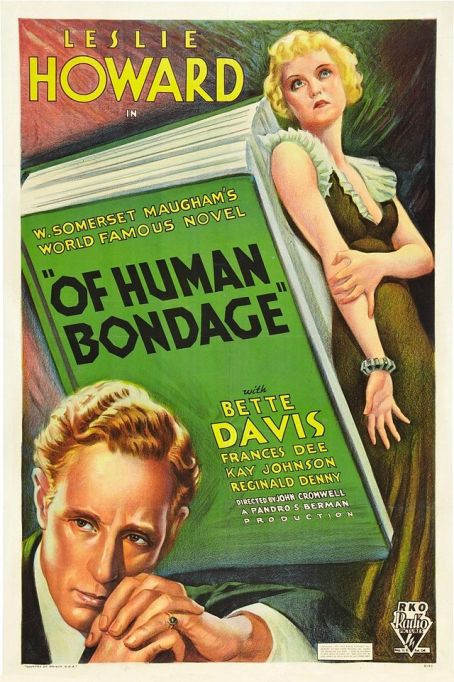
For the next three weeks, I will reviewing, in chronological order, 126 cinematic melodramas. It’s a little something that I like to call Embracing the Melodrama Part II. We started things off yesterday by taking a look at the silent classic Sunrise. Today, we continue with a quick look at the 1934 literary adaptation, Of Human Bondage.
Of Human Bondage opens with Philip Carey (Leslie Howard) living in Paris and struggling to make a living as a painter. The son of a prominent doctor, Philip is self-conscious about both his club foot and his abilities as an artist. When he invited an older artist to take a look at his work, Philip is informed, “There is no talent here. You will be nothing but mediocre.” Philip gives up his artistic ambitions and instead enters medical school.
Philip turns out to be just as miserable and moody as a medical student as he was when he was a painter. (Indeed, Philip may be one of the most miserable characters in cinematic history.) However, he does meet and becomes rather obsessed with a waitress named Mildred (Bette Davis). For her part, Mildred has little use for Philip or any of the other men who are constantly hitting on her. Whenever Philip asks her out, Mildred replies, “I don’t mind.” When Philip asks if he might kiss her goodnight, Mildred coolly replies, “No.”
Philip remains obsessed with Mildred, to the extent that he nearly flunks out of medical school because he can’t stop thinking about her. Mildred, however, eventually leaves Philip for the far more wealthy Emil Miller (Alan Hale). Eventually, Philip meets Norah (Kay Johnson), a romance novelist who falls as deeply in love with Philip as he did with Mildred. However, when the now pregnant Mildred reenters his life, Philip abandons Norah and goes back to her.
And so it goes for the next few years. Philip obsesses over Mildred. Mildred abandons Philip. Philip moves on. Mildred reenters Philip’s life. With each reappearance, Mildred appears to be growing weaker and sicker but she’s never so weak that she can’t yell at Philip and ridicule him for having a club foot…
It’s a little bit strange to admit to enjoying a film like Of Human Bondage because, when you get right down to it, it’s an unpleasant story about an unlikable man being manipulated by a heartless woman. But, interestingly enough, it’s Mildred’s unapologetic anger that make her such a compelling character. If Philip was in any way a sympathetic character, the film would be almost unbearably grim. But since Philip is such a weak-willed character and is so full of self-pity, you can’t help but be happy that Mildred is around to call him out on his bullshit. Everyone else in the film is so awful and boring, that you can’t help but appreciate the fact that Mildred never holds back.
Have you ever wondered why, every Oscar telecast, the Academy makes a point of letting us know that an independent accounting firm counted all of the ballots? Well, it’s because of this film. Or, more specifically, it’s because of Bette Davis’s ferocious performance. In 1935, when Davis somehow failed to be nominated for best actress, there was such outrage and so many people assumed that the nomination process had been rigged that the Academy actually allowed people to write in her name on their ballots. (Davis still lost to Claudette Colbert.) In order to avoid any future controversy, the Academy hired a private accounting firm to count and hold onto the ballots. (And if you’re curious about how that desire to avoid controversy is working out for the Academy, I was one words for you: Selma.) When, the next year, Bette Davis won the Oscar for best actress, it was widely assumed that it was largely to make up for being snubbed for Of Human Bondage.
If you want to see a good Leslie Howard film, go with Berkeley Square. But if you want to see a great Bette Davis film, watch Of Human Bondage.


 Through the Shattered Lens