Lisa Reviews An Oscar Nominee: Zorba The Greek (dir by Michael Cacoyannis)


The 1964 film, Zorba the Greek, tells the story of two very different friends.

Basil (Alan Bates) is a writer.  (“Poetry, essays,” he diffidently says when asked what he writes.)  Basil is British-Greek but, having been raised in the UK, he allows his British side to dominate.  In this film, that means that Basil is very polite and very reserved.  He’s not the type to attempt to flirt with someone who he doesn’t know.  He has never spontaneously broken into dance.  When he is offered a drink, he asks for tea and is shocked to receive rum instead.  If the film was taking place a few decades later, one gets the feeling that Basil would describe Love, Actually as being an okay movie “for people who like that sort of thing.”

And then there’s Zorba (Anthony Quinn).  Unlike the wealthy and well-educated Basil, Zorba is a peasant and he’s proud of it.  He works hard but he plays hard too and there’s nothing that Zorba loves more than the sound of good music.  Zorba not only drinks rum but makes sure that everyone else gets their fill as well.  Zorba dances whenever he feels like it.  Zorba is larger than life, an unfailingly enthusiastic man who is determined to enjoy whatever time he has left in his life.

When Zorba and Basil first meet, Basil is heading to Crete where he’ll be trying to reopoen a mine that was left to him by his father.  As for Zorba, he’s looking for work and, as he explains it, he has tons of experience working as a miner.  Though Basil is, at first, reluctant to hire someone who he’s just met, Zorba talks him into it.  As quickly becomes apparent, the exuberant Zorba can talk people into almost anything.

You can probably guess where all of this is going.  Zorba teaches Basil how to embrace life, which in this film means embracing the Greek side of his heritage.  It takes a while, of course.  Basil is an extremely reluctant protegé and a good deal of the film’s humor comes from just how uncomfortable Basil occasionally gets with his newfound friend.  That said, you don’t have to be a psychic to guess that eventually, the two of them will share a dance on the beach.  It may be predictable but that’s not to say that Zorba the Greek isn’t a good film.  It’s a very good and entertaining movie, featuring a justifiably famous soundtrack and also one of Anthony Quinn’s best and most exuberant performances.

In fact, Quinn is so perfectly cast as Zorba that he occasionally tends to overshadow Alan Bates, who is equally good but in a different way.  In fact, I would say that Bates probably had the more difficult role.  Whereas Zorba (and Quinn) spends the entire movie instigating, Basil (and Bates) spends the entire movie reacting.  It’s difficult to make passivity watchable but Bates manages to do it.

Of course, Zorba isn’t just a comedy about an unlikely friendship.  About halfway through the film, there’s a moment of shocking brutality involving a young widow played by Irene Pappas.  It took me totally by surprise and it left me a bit shaken.  (It also reminded me a bit of another European film featuring Irene Pappas, Lucio Fulci’s Don’t Torture A Duckling.)  It’s a scene that serves as a reminder that 1) not every peasant is Zorba the Greek and 2) friendship and love cannot end darkness but it can make it all a little more bearable.

Zorba the Greek was nominated for Best Picture but it lost to My Fair Lady.
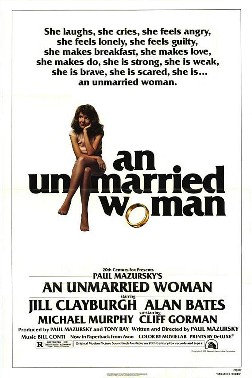
Embracing the Melodrama Part II #58: An Unmarried Woman (dir by Paul Mazursky)


Unmarried_womanI have mixed feelings about the 1978 best picture nominee An Unmarried Woman and I really wish I didn’t because this is one of those films that I really want to love.

Erica (Jill Clayburgh, who did not win the Oscar that she deserved for this film) appears to have the perfect life.  She works at an art gallery in New York.  She has smart, sophisticated friends.  She has an accomplished teenager daughter (Lisa Lucas).  She has a beautiful apartment.  Early on in the film, she wakes up and literally dances from her bedroom to the living room and back again.

And, of course, she has a husband.  His name is Martin and he’s a successful stock broker.  Of course, there are hints that everything might not be perfect.  She and Martin are a cute couple but they’re not exactly passionate.  One need only watch Erica carefully wash dogshit off of Martin’s expensive running shoes to tell who is getting the most out of the marriage.  Add to that, Martin is played by Michael Murphy and, as anyone familiar with 70s cinema knows, Murphy specialized in playing well-dressed, outwardly friendly heels.  And, of course, the film is called An Unmarried Woman and the title can’t be true as long as Erica’s married.

So, you’re not exactly surprised when Martin suddenly breaks down in tears and tells Erica that he’s fallen in love with a younger woman and that he’s leaving her.

The rest of the film deals with Erica’s attempts to adjust to suddenly being an unmarried woman and a single mom.  We follow as she struggles to get back her confidence.  The scenes of Erica dealing with her suddenly rebellious daughter really struck home to me, largely because I’m a rebellious daughter of divorce myself.  There’s a few great scenes of Erica turning to her girlfriends for support.  (Importantly, one of Erica’s friends is happily married, as if the film wants to make sure that we understand that not all marriages are as bad as Erica and Martin’s.)  We watch as Erica starts dating again, having a memorable one-night stand with the obnoxious but oddly likable Charlie (Cliff Gorman).  Finally, she ends up dating a rugged, bearded artist (Alan Bates) and she has to decide whether she wants to remain independent or not.

And it’s all amazingly well-acted and fun to watch but I have to admit that I was a little bit disappointed the first time that I saw An Unmarried Woman.  For some reason, I couldn’t bring myself to like it as much as I wanted.  The more I thought about it, the more clear my issue with it became.

As a character, Eric was simply too wealthy.

As I watched Erica struggle with being an unmarried woman, it was hard for me not to compare her struggles with the struggles that my own mom had to deal with after her divorce.  The film, and specifically Clayburgh’s lead performance, got so much right.  But there’s a difference — a huge difference — between an unmarried woman who has an apartment in Manhattan and a dream job at an art gallery and a woman like my mom who worked multiple jobs, spent hours worrying about how to pay the bills, and who had to do all of this while dealing with four stubborn daughters.  And so, whenever I saw Erica talking to her therapist about how upset she was over suddenly being single, there was a part of me that wanted to say, “Try doing it while living in South Dallas and having to deal with a brat like me.”

The second time that I watched An Unmarried Woman, I was able to better appreciate the film.  Now that I knew that Erica’s experiences were not going to be universal, I could focus on Jill Clayburgh’s great performance in the lead role.  I could marvel at how marvelously wimpy Michael Murphy was in the role of Martin.  I could laugh at Cliff Gorman’s comedic performance.  As for Alan Bates as that bearded artist — well, sorry, that still didn’t work for me.  Eventually, I could accept Erica’s perfect apartment and her perfect job but suddenly introducing a perfect boyfriend who also happened to be a passionate and financially successful painter; it all felt like a bit too much.

But, in the end, An Unmarried Woman is a good film and a valuable historical document of its time.  If for no other reason, see it for Jill Clayburgh’s lead performance.