Though the Academy of Motion Picture Arts and Sciences claim that the Oscars honor the best of the year, we all know that there are always worthy films and performances that end up getting overlooked. Sometimes, it’s because the competition too fierce. Sometimes, it’s because the film itself was too controversial. Often, it’s just a case of a film’s quality not being fully recognized until years after its initial released. This series of reviews takes a look at the films and performances that should have been nominated but were, for whatever reason, overlooked. These are the Unnominated.
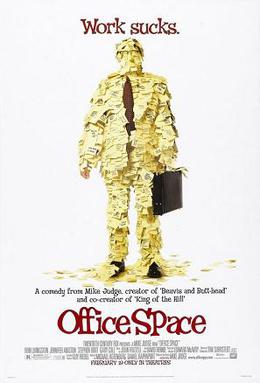
The other night, Erin and I started a new Labor Day weekend tradition of watching the 1999 comedy, Office Space.
As we watched Mike Judge’s first live-action film, it occurred to me that Office Space is a film that unites all of my friends. It doesn’t matter whether they work in an office like Peter (Ron Livingston), Samir (Ajay Naidu), or Michael Bolton (David Herman) or if they work in a restaurant like Joanna (Jennifer Aniston) or even if they’re an independent contractor like Peter’s loud neighbor, Lawrence (Diedrich Bader). It doesn’t matter if they would rather be fishing like Peter or watching reruns of Kung Fu like Joanna. Everyone that I know has said that they can relate to Office Space. Everyone has had to deal with a passive-aggressive jerk of a boss like Bill Lumbergh (Gary Cole). Everyone has known a crazy co-worker like the red stapler-obsessed Milton (Stephen Root). Everyone dreads the arrival of consultants like the Bobs (John C. McGinely and Paul Willson). Everyone resents being told that doing the bare minimum is not enough, whether it’s just sitting in your cubicle or wearing 15 pieces of flair. Everyone dreams of sleeping late and not stressing about TPS reports. Everyone dreams of screwing over their company in a way that’s so clever that they’ll never be caught. (And I think everyone secretly knows that they would screw it up by putting a decimal point in the wrong place.) Everyone wants to destroy the oldest and least reliable piece of equipment at work. Everyone wants to feel like they can just announce that they’re going to quit and spend the rest of their life doing what they would do if they had a million dollars.
Considering the fact that the film has now become universally beloved, it’s interesting that Office Space opened to mixed reviews and middling box office. The studio wasn’t sure how to sell a live action film from the director of Beavis and Butt-Head and King of the Hill and many critics focused on the film’s rather loosely-constructed, episodic narrative and overlooked the fact that the film captured all of the small details that drive people crazy about their work. Audiences, though, discovered the film on video and undoubtedly enjoyed watching it after a long day of dealing with their own annoying boss. The film’s star, Ron Livingston, has said that many people have approached him and told him that he inspired them quit their jobs. “That’s kind of a heavy-load to carry.”
For a film that centers around office workers updating data so that computer systems don’t cash in 2000, Office Space has aged remarkably well. Ron Livingston, David Herman, and Ajay Naidu are an instantly sympathetic and likable trio of nerdy heroes. Stephen Root’s panic as he realizes that he will be the only employee not to get a piece of cake remains both poignant and funny. Gary Cole is still the boss from Hell. I still laugh at John C. McGinley’s rage when his praise of Peter as a “straight-shooter with upper management potential” is dismissed by Peter’s boss. We can all relate to Jennifer Aniston’s dislike of flair and her hatred for Brian (Todd Duffey). The jump to conclusion mat would probably be even more popular today than back in 1999.
Of course, Office Space was not nominated for any Oscars. That’s not really a shock. It’s an episodic comedy that was directed by a Texas filmmaker who was, at the time, best-known for a cartoon about two brain-dead teenagers. Obviously, it wasn’t going to be nominated for anything, even though I think more people have probably watched Office Space over the past few days than have watched American Beauty. Oscars aren’t everything, though. Office Space remains both a great work film and a great Texas film.
Previous entries in The Unnominated:
 Through the Shattered Lens