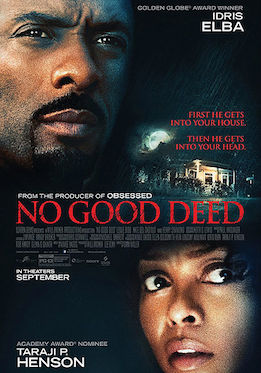
Embracing The Melodrama Part II #121: No Good Deed (dir by Sam Miller)


No_Good_Deed_2014_movie_posterSo, this weekend, my BFF Evelyn and I were watching the critically reviled 2014 film No Good Deed.  As we watched Idris Elba (playing the role of Colin) viciously and violently choke to death a character played by Kate del Castillo, Evelyn said, “He can strangle me any time that he wants.”  My first instinct was to reprimand my friend and remind her that it’s not empowering to allow a man to murder you, regardless of how unbelievably sexy that man may be.  But then, by the time that Idris was murdering Leslie Bibb, I found myself agreeing.  Seriously, Idris Elba can do anything he wants to me….

Idris is pretty much the only reason to see No Good Deed.  No Good Deed is one of those crappy suspense films where every plot point hinges on someone acting like a total idiot.  Colin escapes from prison.  Colin murders his ex-fiancee after he discovers that she’s been cheating on him.  Later, Colin crashes his truck outside of the house of Terri Granger (Taraji P. Henson).  Terri’s husband is out-of-town and when Colin shows up at her doorstop and asks to use the phone to call for a tow truck, Terri invites him inside.  Terri’s friend Meg (Leslie Bibb) shows up.  Mayhem follows.  Of course, there’s a big twist at the end.

This is where I’d usually say something like, “DON’T REVEAL THE SURPRISE ENDING OF NO GOOD DEED!” but, honestly, you’ll figure it out within the first few minutes of the film.  It’s pretty obvious and it’s pretty stupid.  I won’t reveal it but if you see the film, feel free to tell all your friends about the big twist.  Some films were meant to be spoiled.

As I watched No Good Deed and found myself hissing at the terrible dialogue and the total stupidity of all of the characters and wondering if any of the filmmakers had ever actually met any real human beings, I found myself wondering how this film could be so incredibly bad.  I hopped onto the imdb and discovered that the film was written by Aimee Lagos.

If you don’t recognize that name, Lagos also wrote and directed the absolutely terrible movie, 96 Minutes.  And I will say this: No Good Deed is slightly better than 96 Minutes.

That’s the power of Idris Elba.

(Incidentally, it bothers me that nobody in this film is actually named Deed.  If Colin’s full name had been Colin Deed … well, that would have been pretty stupid but it would have at least been kinda fun and entertaining.)

(Also, for those keeping track, that’s 121 reviews down and 5 to go.)

Film Review: 96 Minutes (dir. by Aimee Lagos)


Bleh.

I’ve read a lot of really over-the-top laudatory reviews of 96 Minutes, an independent urban crime film that’s opening in limited release this weekend.  Reviewers and bloggers are describing this film as being insightful and powerful and important.  Here’s a quote from one review that was posted over on the IMDb: “I would encourage all of those who see the (film’s) themes as stereotypical to get outside of their own box for 2 minutes and spend some time with those who will you give example after example of how the youth in this country still struggle with the same things as they did 10, 20, and 30 years ago.”

And again, I say “Bleh.”  I saw 96 Minutes last night.  It’s a movie that’s full of good intentions but so what?  A bad movie is a bad movie, regardless of the noble intentions of the filmmakers.

The film starts out with four people in a car.  Dre (Evan Ross) is driving while, in the passenger’s seat, his jumpy friend Kevin (J. Michael Trautman) points a gun at two girls huddled in the backseat: Carley (Brittany Snow) and her friend Lena (Christian Serranos).  Lena, by the way, has been shot in the head.  The film proceeds to show us (by jumping back and forth in time) how this situation came to be and guess what?  It all unfolded exactly how you think it did so the end result is like being stuck with someone who continues to tell you the same long story even after you’ve said, “Yes, you already told me all this.”

From what I’ve been able to gather from online research, 96 Minutes was (much like Crash, which this film resembles) inspired by an actual carjacking that involved the film’s director. As such, 96 Minutes starts out by informing us that the film we’re about to see is “Based on true events.”  That should have been a warning because, while the whole “based on a true story” thing is usually a good sign when it comes to an old school exploitation film, it’s almost always the kiss of death when it comes to well-meaning but overly earnest independent cinema.  Ironically, films that are “based on true events” often feel rather false and predictable and the end result is a movie that comes across like an overlong version of one of those awful Mutual of Omaha “Ah-ha Moment” commercials.

(“My name is Carley and this is my Ah-ha moment.  Oh my God, we were getting carjacked!  At that moment, so many things went through my head…”  “Brought to you by Mutual of Omaha, proud sponsor of life’s Ah-ha Moments…”)

In the film’s defense, it is well-acted (especially by Evan Ross, who has a very quiet power) and director Aimee Lagos comes up with a few strong visuals but ultimately, it doesn’t add up to much.  The film feels predictable and the fractured narrative structure doesn’t provide any unexpected insight into the characters or their actions.  The scenes with Kevin and Dre feel as if they were clumsily lifted from a hundred other urban crime films, right down to the predictable pairing of a complete psycho with a sensitive criminal who wants to go straight.  Meanwhile, Carley and especially Lena come across not so much as actual characters but more as dramatic devices.  This wouldn’t be so much of a problem if this was a 15-minute short film about the quirks of fate but stretched out to 96 minutes, the film’s characters and themes feel quite thin indeed.

In many ways, 96 Minutes reminded me quite a bit of last year’s Another Earth.  Much like Another Earth, 96 Minutes doesn’t have much to say but it pretends like it does and I imagine that a quite a few gullible viewers will be tricked into thinking that they’re watching something powerful and important play out in the screen in front of them.  If they’re anything like the members of the Another Earth cult, they’ll probably get really offended over any suggestion that the film they’ve just watched isn’t a masterpiece.  Well, my reply to them is this: If the film was really as great and important and insightful as some people are claiming then you wouldn’t care what I have to say about it.  If this review makes you defensive, it’s because you know I’m right.