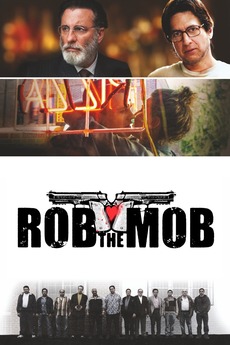
The 2014 film, Rob the Mob, tells the true story of a young couple in love who became minor celebrities when they robbed the mob. Of course, they also ended up with a huge target on their back, which tends to happen when you repeatedly humiliate a bunch of angry men who have weapons at their disposal.
The year is 1992 and Tommy Uva (Michael Pitt) and his wife, Rosemarie (Nina Arianda) are professional criminals who, after getting busted for trying to rob a florist on Valentine’s Day, end up working at a debt collection agency. Their boss (played by Griffin Dunne) spent time in prison for insider trading and he believes in giving convicts a second chance. The problem is that Tommy doesn’t really want a second chance. He’s actually pretty happy being a criminal.
Tommy has some issues with the Mafia, largely due to the fact that his father borrowed money from the mob to open up a shop and spent the rest of his short life being beaten and humiliated by loan sharks. Tommy believes that the pressure is what led his father to an early grave. Tommy’s mother (Cathy Moriarty), on the other hand, claims that it was the stress caused by Tommy being a criminal. Regardless, seeing his father repeatedly mistreated has definitely left Tommy with some anger issues.
Even though Tommy claims that he hates the Mafia, he still seems to be rather obsessed with them. At times, it’s hard to tell if Tommy is angry with the Mafia or if he’s just jealous about the fact that he’ll never be as rich or as powerful as the local neighborhood mobster. Tommy starts to skip work so that he can observe the trial of John Gotti. It’s while doing this that Tommy hears that guns are not allowed in Mafia social clubs.
Soon, Tommy is robbing those same clubs, taking all of the money that he can and humiliating the mobsters at the same time. (He forces one group of paunchy gangsters to march outside in their underwear.) With Rosemarie serving as his getaway driver, Tommy soon becomes something of a legend. The mobsters even nickname the pair “Bonnie and Clyde.” Because the Mafia doesn’t want to attract any unnecessary attention during the Gotti trial, Tommy and Rosemarie are able to get away with their activities for a while. But then they make the mistake of stealing a list that could bring down the entire New York Mafia….
Rob the Mob is a bit of an uneven film. The film starts with Tommy and Rosemarie getting high and then attempting to rob a florist and, in that scene, they both seemed like such idiots that I really wasn’t sure that I wanted to spend 104 minutes of my life watching a film about them. Even after Tommy got out of a prison and got a legitimate job, he still seemed like such an unsympathetic loser that I found myself wondering why I should care.
However, once Tommy and Rosemarie start actually robbing the mob, the film picks up. We meet Big Al, the temporary head of the New York mafia, and he’s played by Andy Garcia, who gives an intelligent and understated performance. Big Al may be a mobster but he’s not an unsympathetic character. The film presents him as being someone who has been unexpectedly thrust into a position of power and who is doing his best to keep everything from falling apart. Then, as the robberies continue, Ray Romano shows up as Jerry Cardozo, a reporter who makes “Bonnie and Clyde” famous but who realizes too late that he’s also put their lives in even greater danger than they were before. Over the past few years, Romano has gone from being a former sitcom star to being a surprisingly effective character actor and his performance here gives Rob the Mob its conscience.
Perhaps even more importantly, during the second half of the film, the chemistry of Michael Pitt and Nina Arianda finally won me over and I actually started to care about what would happen to Tommy and Rosemarie. Tommy and Rosemarie find a reason for living in their criminal activities. They go from being losers to being minor New York celebrities, even if they can’t reveal their actual identities. They may be idiots but their love is real and there’s something very touching about how much they actually do care about each other. It’s hard not to be happy for them, even if it’s obvious from the start that their story is not going to have a happy ending.
Rob the Mob is uneven but, in the end, it’s more than worth watching. This is an offer you should not refuse.
Previous Offers You Can’t (or Can) Refuse:

 Through the Shattered Lens