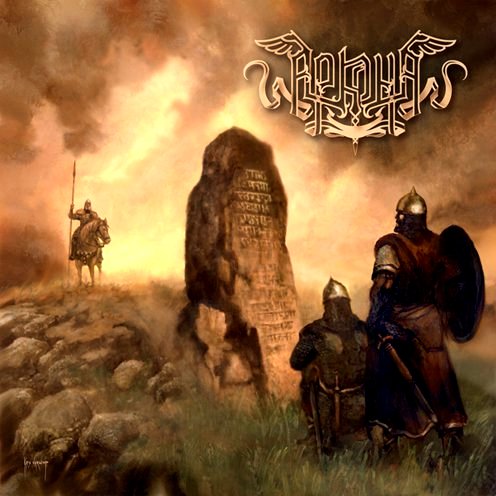
I would like to believe that Аркона, or Arkona for you non-purists, is a band requiring little introduction. They did not create the Slavic brand of folk metal, nor are they necessarily the best of their kind, but I would argue that they are the most accessible. Eschewing the common pagan metal dependence on raw production, Arkona deliver directly, presenting a full sound pervaded with folk and ferocious intensity.
At least, that is how I think of them. My ability to relate to the band is a bit narrow. I have somehow only ever listened to Возрождение (Vozrozhdeniye) and От Сердца к Небу (Ot Serdtsa K Nebu), but I’ve listened to both countless times. I am in no position to describe what precisely has changed here since Гой, Роде, Гой! (Goi, Rode, Goi!), but 2007 isn’t that far removed.
Азъ/Аркаим (Az’/Arkaim)
Following their best introduction track to date, Slovo kicks off in standard Arkona form, exploding briefly and then opening up to Masha’s breathtaking vocals. The instrumentation employed differs little from the past–bagpipe and woodwinds driving over epic synths and intense pagan aggression, with slow, tense interludes setting each stage. In the details though, much has changed.
The first difference that caught my eye was the introduction of a violin to accentuate the tension. This application (not its use in general), as it turns out, is more a feature of the opening track than the album as a whole, but the mood it aims for is a recurring theme: expect softer, subtler means to distinguish Slovo’s dynamics shifts.
The other thing I immediately noticed was a diminishing in the intensity of Masha’s metal vocals, and this, unfortunately, is consistent throughout the album. Oh, she can still belt them out better than just about any female metal vocalist out there, but that Slavic shrillness behind the gutturals seems to be gone, degrading into something a bit deeper and a bit more typical to metal in general.
Никогда (Nikogda)
When I returned to a few Ot Serdtsa K Nebu tracks to confirm this latter observation, a lot of other disappointments surfaced. Masha’s mellowing out from a violent she-wolf to a standard death metal growler is only the tip of the iceberg, though her clean singing might be as good as ever. The entire album is really a step down in ferocity. Primitive folk transitions have been replaced by a more consistent reliance on synth and whispered interludes to create a sound that is perhaps fuller but not nearly as inspiring. The track at hand is a bit of a counterexample, but consider it among the heaviest Slovo has to offer, not par for the course.
Don’t get me wrong though. I consider Ot Serdtsa K Nebu one of the best albums of all time, and that’s a pretty high standard to maintain. On Slovo, Arkona continue to produce absolutely solid pagan/folk metal, they’re just complacently maintaining the genres rather than redefining them. The specifically Slavic sounds of pagan metal are here sharing the stage with a more universal approach to the genre.
The album still brings a lot of uniqueness to the table. The guitar on Nikogda manages to maintain a constant tension that never bores in spite of (or even perhaps specifically because of) its simplicity, and it pairs up with the vocals perfectly. The song Леший (Leshiy) delightfully converts a border-line cheesy, carnival accordion into convincing metal. And though no hammer dulcimer is mentioned in the album’s credits, a sound I can describe as nothing else (perhaps very convincing keyboards?) peppers many tracks like falling snow, giving them a decidedly wintery vibe. (I can’t resist pointing out, to the complete apathy of anyone potentially reading this, a peculiar reminiscence I perceive in this last feature to Midwinter Land, the Sindar Ruins theme of Suikoden III, by Michiru Yamane, Keiko Fukami, and Masahiko Kimura.)
Слово (Slovo)
As for my gripes about intensity, the title track does manage to rise to the level I’d come to expect from Ot Serdtsa K Nebu, and might bring to light the stylistic change I had in mind. What springs to life here around 3:30, THAT is what I was looking for on this album. If brief, it demonstrates the intensity hedging on insanity that Slavic folk can offer to metal. That the sort of impact I got from Ot Serdtsa K Nebu in its entirety can only be compared to a passing phrase in Slovo speaks against the album, but in all fairness, that’s a pretty high measuring stick. Slovo is a really enjoyable album throughout, and it’s taken no effort on my part to keep it on perpetual repeat these last few nights. It’s more mellow than what I’d come to expect, in its folk features even more so than in the metal, and the overuse of whispered/spoken introductions and filler tracks is a mild annoyance, but it’s still a cut above much of the competition. If you’re new to the band and these sample tracks left you unimpressed though, do acquire a copy of Ot Serdtsa K Nebu before you write them off altogether.
 Through the Shattered Lens