Music Video of the Day: Lightning Crashes by Live (1994, dir. Jake Scott)


When I was a kid, this was one of those music videos that never seemed to get played that much, but when it did, I would stop to watch it. I guess there was just something moving about it that I couldn’t resist. I always had a fondness for the books on the floor part. Watching it today, it doesn’t do a whole lot for me except to send me on a bit of a nostalgia trip.

Whenever I listen to the song, it sounds like the story of a an old woman who dies in one room while a woman gives birth in another room. According to Ed Kowalczyk, the music video created a misinterpretation that the new mother died:

“While the clip is shot in a home environment, I envisioned it taking place in a hospital, where all these simultaneous deaths and births are going on, one family mourning the loss of a woman while a screaming baby emerges from a young mother in another room. Nobody’s dying in the act of childbirth, as some viewers think. What you’re seeing is actually a happy ending based on a kind of transference of life.”

I never really thought of it as having a happy or sad ending, but something sadly inspirational. A mystical experience if you will. I think that aspect is captured well in the music video. You could say that the books represent a lifetime of accumulated knowledge haunted by ghosts of people who have come and gone in the form of the band members who seem to either be ghosts or pass on just as the baby is removed and held high before being given to the young mother.

The music video was directed by Jake Scott who seems to have been drawn to this type of music video seeing as he also did Everybody Hurts by R.E.M., Wonder by Natalie Merchant, and When You’re Gone by The Cranberries. He seems to have directed 50 or so music videos.

Salvatore Totino shot the music video. He seems to have shot around 15 music videos usually directed by Jake Scott. He went on to shoot some well-known films such as The Da Vinci Code (2006), Frost/Nixon (2008), Everest (2015), and the upcoming Spider-Man: Homecoming (2017).

Patrick Sheffield edited the music video. He seems to have only worked on a handful of music videos.

Ellen Jackson produced this music video, and that’s all I could find. I highly doubt that is all she has done though. She probably worked for their record company. That’s my best guess.

Enjoy!

Music Video of the Day: Interstate Love Song by Stone Temple Pilots (1994, dir. Kevin Kerslake)


I’ve always found it ridiculous that Stone Temple Pilots seems to be that band from the early 90s that keeps getting misclassified. The one I see all over the place is that they are a grunge rock band. Every time I read that, I wonder if they have ever actually listened to their music. I find it particularly baffling since they are a straightforward hard rock band–if you must classify them. I get the impression that people overthink their music, and tend to lump them in with grunge because it sounds close enough if you only listen to a couple of songs like Creep, Big Empty, or Plush. Also, I think there tends to be some general confusion about what is and isn’t grunge as opposed to just 90s hard rock. It doesn’t help that the term alternative rock can be slapped on just about anything that wasn’t obviously pop or punk in the 90s. That’s my best guess about this non-issue that I see from time to time.

I was introduced to them via the album Tiny Music…Songs From the Vatican Gift Shop, and the song Big Bang Baby in particular. I later picked up Core and Purple. Today I have all six of their studio albums. Out of all of their songs, I would say Interstate Love Song is right up there at the top along with the hidden lounge singer song at the end of Kitchen Ware & Candy Bars.

There isn’t much to say about the music video itself. The beginning of the music video makes me think of Queen Kelly (1929) for some reason. The video has a character from the silent film portion running around with his nose growing in order to fit with the theme of lying that the song is singing about.

The rest is washed out and has Scott Weiland dressed how I imagine Marc Bolan would look like if he had made it to this decade. I think we can just chalk those things up to that it was the 90s and that was Weiland’s style. I really think it’s that simple.

They got director Kevin Kerslake to do the music video who did most of Nirvana’s videos, but also worked with both Stone Temple Pilots and the spin-off group Velvet Revolver on several occasions. He also worked with other major bands of the era such as Sonic Youth, Soundgarden, Red Hot Chili Peppers, and Green Day. He appears to still be working in music videos today since I can find a credit for him shooting Bang Bang for Green Day, but otherwise his credits seem to drop off in the mid-2000s. Like quite a few music video directors, he also has gone on to numerous concert films and music-related documentaries.

Enjoy!

Music Video of the Day: Dear Jessie by Madonna (1989, dir. Derek Hayes)


Wow! I waited a whole 92 music videos of the day to do a Madonna video.

This is one of the oddball songs in Madonna’s catalog, but it’s one of my favorites.

The background story is pretty simple. One of her producers at the time named Patrick Leonard had to bring his daughter Jessie to the studio, Madonna took a liking to her, Leonard gave Madonna a song he had written for Jessie, she changed the lyrics a bit, and the rest is history.

There isn’t much to say about the music video itself either. It’s a very literal interpretation of the lyrics filled with animated characters you would expect from 70s-80s Disney. Madonna appears animated as Tinker Bell. I love that there appears to be some sort of cross between Tigger and Chester Cheetah during the marches of animated characters.

There are quite a few people that I was able to find who worked on the music video. Oddly, the little girl herself is not one of them.

Derek Hayes directed the music video. He seems to have only directed three music videos. I couldn’t find him for sure on IMDb, but there does appear to be two Derek Hayes that worked in animation.

Edit: According to Stephan in the comments section, Hayes is currently teaching animation at Falmouth University in the UK.

Nigel Hadley was the editor. I found a Nigel Hadley on IMDb who seems to have only worked as an editor on Derek Jarman’s The Garden (1990). If that is him, then that’s rather amazing seeing as Tilda Swinton played the Madonna in that movie.

Maddy Sparrow was the producer. She produced at least one other music video for Elton John’s Club at the End of the Street. I imagine she worked on other music videos as well.

There were numerous animators, which included Derek Hayes himself. The other ones I could find are as follows: Jimmy Farrington, Andy Goff, Alison Snowden, Neville Astley, Malcolm Hartley, and Erica Russell. I’ll just talk about a few noteworthy ones.

Jimmy Farrington appears to have worked on a bunch of big films from Who Framed Roger Rabbit (1988) to Harry Potter to Marvel.

Alison Snowden went on to do more work in animation that included winning an Oscar for the film Bob’s Birthday (1994).

Neville Hartley appears to have had great success–going on to be a writer for the British TV Show Peppa Pig. He also co-created the show.

John Stevenson was the Character Technical Director, or Character TD for short. He seems to have been the most successful–going on to direct Kung Fu Panda (2008).

Enjoy!

Music Video of the Day: Down Under by Men At Work (1983, dir. Tony Stevens)


First things first. What exactly was America’s obsession with Australia in the 1980s? Paul Hogan was taming dogs, carrying around big knives, and having no shame when grabbing testicles in New York City. We brought over Bryan Brown to pull pranks on Brian Dennehy in F/X (1986), then battling bad guys in the sequel with a robotic clown. We slowly, but surely coaxed Sam Neill over here because only he could fight velociraptors. The Facts of Life even did a whole film called The Facts of Life Down Under (1987). We snatched up Peter Weir too. The list seems to go on and on.

Edit: Thanks to Gary in the comments–the answer is Mel Gibson in Mad Max. I completely forgot about him and that series of movies.

Now I normally like to focus on the music video and the people who worked on it, but this time around there is quite a bit of backstory on the song to discuss. It’s a mess that is shameful when you think about it.

The main riff of the song is played on the flute. The flute part was based on a well-known Australian children’s rhyme called Kookaburra. There was a woman named Marion Sinclair who was a music teacher that got involved with the Australian equivalent of the Girl Scouts known as the Girl Guides. In 1934 she wrote it, and submitted the song in a contest the Girl Guides were holding. It became rather well-known after that.

She passed away in 1988, which according to Australian law meant that it was still under copyright. The publishing rights are held by Larrikin Music, and those rights are administered by Music Sales Corporation in New York City.

There was an Australian music-themed game show called Spicks and Specks. They asked a question on the show about the use of Kookaburra in the song Down Under in 2008. In June of 2009, Larrikin Music sued Men at Work for copyright infringement. The band’s legal counsel tried to argue that the song was actually held by the Girl Guides. The court ruled in favor of Larrikin Music giving them 5% of the royalties backdated to 2002. You can imagine how large a number that must be. Up till then it was thought that the song was in the public domain.

This song is so beloved by Australia that it was even played by Men at Work during the closing ceremony of the 2000 Sydney Olympics among many other uses. Australians didn’t take kindly to this as you would expect.

What a ridiculous example of greed run amok without any consideration to an entire nation who for all intents and purposes consider the song, and Kookaburra, to be a national anthem.

Speaking of greed, co-writer Colin Hay was quoted in an interview with Songfacts as saying this about the song:

“The chorus is really about the selling of Australia in many ways, the overdevelopment of the country. It was a song about the loss of spirit in that country. It’s really about the plundering of the country by greedy people. It is ultimately about celebrating the country, but not in a nationalistic way and not in a flag-waving sense. It’s really more than that.”

It makes sense when you know that the exterior shots for the music video were shot at the Cronulla sand dunes near Sydney. The Cronulla sand dunes have been a major source of controversy over development and exploitation of the territory for a long time. There’s an article explaining it’s history over on Wikipedia. One of the very noteworthy things about it, considering the lyrics of the song, is that sand mining which lasted from the 1930s till 1990 has left the area more susceptible to storms like those that happened in May and June of 1974. That, and it tying in with the lyrics about thunder. Either that, or the thunder represents a storm of development and exploitation omnipresent in Australia.

You can see the theme that Colin Hay was talking about in the music video itself. The hippies coming for a spiritual experience, which is followed shortly by someone who tells the band that the land has been sold. Then we get the flute riff being played in a tree next to a stuffed Koala bear that appears to have hung itself. You can even see a direct reference to the sand mining during the dance part which has three members digging sand and throwing it behind them. There’s also the obvious references to beer at several points in the video along with the Australian Vegemite Sandwich.

The music video also has the celebration of the country when the band meets Australians, or at least those who are fascinated by the country, in different parts of the world.

In the end, they walk far enough that we can see this vast national treasure has power lines running next to or through it. I’m not sure what the appearance of what looks like a coffin near the end is a reference to except that there was a famous crime committed in Cronulla known as the Wanda Beach Murders. That, or more likely it’s a reference to the way Australians treated the Aborigines who have a history in the Cronulla sand dunes seeing as the ones being whipped are covered in black while the band is dressed in white. The ones in black are even carrying the band’s equipment in what appears like a coffin. You can also see a member of the band on a cellphone as well as another member that appears to be dragging the Koala bear from earlier behind him.

Tony Stevens directed the music video, and seems to have only done several music videos for Men at Work. According to IMDb, he seems to be an editor who is still working today–primarily in documentary films.

Enjoy this music video and song that I had no idea came with so much history and significance.

Music Video of the Day: You Might Think by The Cars (1984, dir. Jeff Stein, Charlie Levi, & Alex Weil)


Well, you might think this came out after A Nightmare On Elm Street (1984), but you’d be wrong. That movie came out in November and appears to have had an early limited release in October of 1984 while this music video premiered in March of that year. If you didn’t know that, then you probably would lump this in with all the other films that were inspired by that movie. It even comes complete with a bathtub sequence. When I was younger this was just that other early computer graphics music video that goes along with Money For Nothing by Dire Straits, but never seemed to get as much play on MTV. That’s probably because The Cars didn’t explicitly mention MTV in the song. The music video actually has less in common with horror movies of its’ era, and relies on classic monster movies such as The Fly (1958), King Kong (1933), and Robot Monster (1953).

This was pretty ambitious for the time, coming in with a budget of $80,000, which according to Wikipedia was about three times as much as was spent on music videos of the time. It also did quite well that year at the VMAs, getting nominated for six awards. It won the first VMA for Video of the Year. It also won awards from Billboard and the Videotape Production Association’s Monitor Awards.

What is amazing to me is how many credits I found attached to this music video.

The obvious one is the girl. That’s Susan Gallagher. I love how her IMDb bio mentions all kinds of things like where she trained to act, that she was cast in commercials, was on the TV Show Safe Harbor, worked for The Home Shopping Network, etc. No mention that she just happened to be the star of one of the most well-known, revolutionary, and heralded music videos of the 1980s. You might think that would be something you would want in your biography seeing as it instantly disambiguates her from just any old actor for a large number of people. Even her “other works” section only mentions that she was a National Guest Spokesperson for Dirt Devil Products. She seems to have largely dropped out of acting till the 2010s. She appeared in I Killed My BFF (2015) on Lifetime and has even gotten into directing recently.

Robin Sloane was the creative director on the music video. She worked/works for Elektra Records. I can only find one more credit for her in mvdbase, but based on IMDb, I am betting she worked as a creative director and producer on more than just Violet for Hole and One for Metallica.

Sloane came onboard after director Jeff Stein showed her some visual effects work that was being done by the company Charlex. He’s worked on around 40 music videos including some other well-known ones such as Don’t Come Around Here No More for Tom Petty & The Heartbreakers and the hilarious Cherry Pie for Warrant.

The music video was also directed by two of the founders of Charlex: Alex Weil and Charlie Levi.

Alex Weil seems to have only worked on one music video, but apparently was a pioneer in the video medium in general. I was able to find two of his short films on YouTube.

I was able to find a few more credits for Charlie Levi. He wrote and directed the movie Childless (2008). I even found an interview with him about the movie.

If that interview is to be believed, then he worked on more music videos than just this one.

There appears to be some disagreement between sources, but I think we can just assume that Jeff Stein, Alex Weil, and Charlie Levi all produced the music video.

Danny Ducovny shot the music video. I can find only a few credits for him, but one of them happens to working as an “additional photographer” on the film Tough Guys Don’t Dance (1987). I’m going to just assume that he shot the infamous scene from that movie. It makes me happy any time I can post it.

Yes, he also happens to be David Duchovny’s older brother despite the slightly different spellings of their last names.

Danny Rosenberg was one of the editors. I couldn’t find many other film credits, but he appears to have worked on two movies in the Wee Sing series. However, I do know what he does today thanks to his LinkedIn profile. He is now “Lord Protector/Chief Engineer” at Meta/DMA. According to their own website, they “write the code that makes the whole world sing.” This guy just can’t get away from working in things that sing one way or another.

The other editor was Bill Weber. There are a lot of Bill Weber’s on IMDb, but I am pretty sure that number III and V are him seeing as they both feature a bunch of LGBTIQ films along with working with Grateful Dead back in the 1980s.

Kevin Jones worked as the Lighting Director. Seeing as IMDb seems to have more Kevin Jones’ than they know what to do with, I have no idea what other credits he may have after this music video.

Bob Ryzner was the Art Director. I can’t find anything on him.

The only other credit I could find is for the company Charlex themselves who appear to have worked on the music video for Jealous by Beyoncé. I’m willing to bet there are many more, much like I completely believe that Robin Sloane was involved in more music videos as well.

That’s it! Enjoy this trip back to the early days of both music videos and computer animation going mainstream.

Music Video of the Day: Here I Go Again by Whitesnake (1982, dir. ???)


Happy Birthday, David Coverdale! I already did the very memorable 1987 version on Kitaen’s birthday. For Coverdale’s birthday I figured it was appropriate to look at the 1982 version. I never knew this version existed. It’s instantly forgettable for sure, but it’s not bad at all. The style of both the song and the music video is quite different from the 1987 version

Aside from the opening bit with Coverdale alone, the rest is a just a well-filmed concert performance. Despite the appearance, Wikipedia seems to indicate that it was indeed still lip-synced. There isn’t a whole lot to talk about here visually. I know it’s simple, but I love that everything appears to be drenched in colorful light. I also like that the band appears to be playing in tight quarters during the majority of the performance. It gives it less of a “We are playing to the back row” and more a “Welcome to the club. Here’s Whitesnake singing Here I Go Again!”

It also is a metal video of its time. The 1987 version is drenched in the 1980s. You could almost hear the director say, “Cut! Accept, you’re next. Europe, you come up right after they are done. We’ll film the scenes with Tawny later.” Here you can imagine that this concert hall is just a short drive from that snow surrounded studio where Rush is in the music video for Limelight. Both of which look like pre-MTV music videos. An even better example is that it looks like the music video from 1978 for Toto’s Hold The Line.

Mainly what I want to say with all these words is that this video is probably only known because EMI decided to post it on YouTube back in 2009, and it too captures the same power and enthusiasm in Coverdale’s performance as the 1987 version does. However, in this version it feels personal for him whereas the 1987 version he is great, but aloof and kind of just having a ball.

As for the song alone, they do say “hobo” instead of “drifter”. I don’t really notice any other lyrical changes. The way they perform the song again plays to the way the video was shot this time. It starts off expansive like the video. Then it gets tight and tough like the close quarters performance belted out with blood and sweat by Coverdale.

Which version do I like better? The 1987 video hands down is the better music video. However, I do like both versions of the song. I like to go hiking when weather and my health permit. This version I can hear as I am powering up hills. The other I can picture playing as I go for a long drive to clear my head when times are tough.

Music Video of the Day: It’s Tricky by RUN-DMC (1987, dir. Jon Small)


When I picked out this music video to feature today, I thought it would just be a catchy song that happens to feature Penn & Teller. I had no idea that the song It’s Tricky is actually an amalgamation of My Sharona by The Knack and Mickey by Toni Basil. The site Who Sampled has a great comparison here for Toni Basil and here for The Knack. They took a small bit of the guitar riff from My Sharona which got them sued in 2006, and was settled out of court. The vocal structure for the song was taken from Mickey. I would have never put that together had I not stumbled upon it on Wikipedia.

As for the music video, I’m a little confused. She gets her chain taken by Penn & Teller, the cops show up, they chase after them, she calls RUN-DMC as you do, and suddenly they are instantly doing three card monte again all in the span of a few minutes in front of the same theater. That’s tricky. Actually I wouldn’t be surprised if director Jon Small meant people to think of it that way.

This music video apparently aired for the first time in May of 1987 while Beastie Boys’ music video for No Sleep Till Brooklyn first aired in April of 1987. I only bring it up because of the similarities between the last scenes where RUN-DMC shows up at their scheduled concert to find that Penn & Teller have taken their place. Beastie Boys do the same kind of thing in No Sleep For Brooklyn, which seems to have borrowed elements from RUN-DMC’s music video for Walk This Way that aired the previous year in 1986. IMVDb says that It’s Tricky first aired in 1986, but 1987 makes more sense, and is in mvdbase that always seems to be the more accurate source for older music videos. Regardless, I find it funny how these things all interconnect whether intentionally via sampling, or what seemed like two different groups who had similar music videos right around the same time.

Director Jon Small seems to have worked on about 50 music videos as well as some concert films.

That seems to be all there is about this simple and fun music video, so enjoy!

Music Video of the Day: Dancing In The Dark by Bruce Springsteen (1984, dir. Brian De Palma)


I love and hate when I end up with a music video like this one. I love it because there isn’t a whole lot to talk about, but that’s also why I don’t like it. At least Cyndi Lauper’s She Bop let me off the hook with a simple joke. That music video really does speak for itself.

Brian De Palma shot this video over two nights in Saint Paul, Minnesota on the 28th and 29th of June 1984. The first was purely shot for the music video. The other was shot on the opening night of the Born in the U.S.A. Tour. Springsteen and the E Street Band performed it twice during the show to make sure De Palma got enough footage. De Palma shot it because he was a big fan of Springsteen. As far as I know, there isn’t anything more to that.

The other major thing is that this is the music video with Courteney Cox getting pulled up onstage to dance with Springsteen. I love how she just launches up onstage with him. It looks like they had some steps or something so that Springsteen wouldn’t be yanking her up there.

As for the music video as a whole, it’s clean, simple, and De Palma obviously knew how to capture the energy of the group. You’d think that Springsteen hadn’t quite picked up acting because he seems starstruck and having the time of his life, but I don’t think so. I have never seen him live, but you can roll back to 1981 and watch the music video for The River to see that simply isn’t true. You can even go back further to 1977’s Thunder Road and see again that it isn’t true. I think the reason Springsteen looks like that is that it was probably the first time he was doing this kind of stage performance music video. I can imagine De Palma telling Springsteen to just let all the energy out regardless of what time they were shooting, and that he would make it look good.

Of course I type of all of that, and then stumble upon something really interesting. This was not the original way the music video was going to be done. It was originally going to be directed by Jeff Stein and shot by veteran cinematographer Daniel Pearl. There was a little falling out between Pearl and Springsteen during shooting that ended up coming around full circle on the shooting of Springsteen’s Human Touch. I would link to the site that explains the whole thing, but it looks like it might have been destroyed since it was posted in 2011, and is in limbo thanks to the Google Cache. Assuming that’s the case, I have repeated it below with a link to their site that may or may not work.

Here is an example of how the music video could have looked. Hopefully the two videos are still up when you read this post.

From the site called Golden Age of Music Video

At the end of July, a video surfaced online of the music video of Bruce Springsteen’s “Dancing In The Dark”, but not the iconic version directed by Brian DePalma where Courtney Cox makes her famous appearance at the end dancing with the Boss. This one is a somewhat blurry, copy-of-a-copy duplicated-tape version with Springsteen and Clarence Clemons on a soundstage, literally dancing in the dark.

So what IS this footage, where was it shot, and why has it never been seen before? Legend told of a first version of the song shot before the DePalma version, but no consensus has ever been reached on what happened.

Now, THE GOLDEN AGE OF MUSIC VIDEO has uncovered the true story of this first attempt to shoot the “Dancing in the Dark” video, straight from the two GAMV luminaries who helmed the original shoot: director of photography Daniel Pearl and video director Jeff Stein.

An award-winning cinematographer whose career spans nearly forty years, Daniel Pearl should be heralded as the MVP of the Golden Age of Music Video. Having acted as director of photography on a multitude of legendary music videos – everything from Michael Jackson’s “Billie Jean” to the Police’s “Every Breath You Take” to Guns N’ Roses “November Rain” – Pearl has always given music videos and commercials their cinematic due by treating each shot with feature film-level attention. Serving as cinematographer on the original “Texas Chainsaw Massacre”, Pearl has made all his music video projects, big budget or small, sparkle and shine in ways only the most gifted eye could.

“What happened was this,” Pearl explained about the first “Dancing” shoot. “I’d never worked with Jeff before, but Jeff is a New Yorker, and a producer named John Diaz put us together. Jeff’s idea was that ‘Dancing in the Dark’ was Bruce Springsteen in a completely dark space — black floor, black walls, black ceiling, stage as well. We’re at Kaufman Astoria Studios. Bruce Springsteen in a room in the dark. And I went, ‘Well, that isn’t really much of a concept,’ but he goes, “Oh no, it will be cool. Don’t worry about it, it’d be cool.’”

“Now for Bruce, this was the first single he’s releasing after Nebraska, which was not that big of a hit for him, so, Bruce is very nervous,” Pearl continued. “We’re all on set now and Bruce is really pumped. I mean, he’s been working out, and he has a little bit of stubble. Now, I would take a look at people when they first show up. I’ll say hello, and I take a quick look at their face to see, if I know them, if anything is changed – I’m seeing how to light them. I’m take a look at their face and where they part their hair — I mean, those all things that matter to me when I do the lighting. So anyhow, he’s got serious sideburns. Big sideburns, he’s pumped, rippling muscles in his arms, good muscle definition, he’s wearing a wife beater sleeveless shirt, sharkskin pants, and black pointy-toe shoes and basically, that’s the New Jersey, sort-of early ‘60s thing going on, right? But very manly, right? So I lit him very hard – hard edge lights for his rippling muscles, and just really chiseled him with light. He comes out and he stands there and he goes, ‘I don’t know. I think you should get like a big silk [lighting filter] out here and just put a big light through the silk, and silk over the camera, the big silk, you put a big light through it and I go, ‘That’s how we light Stevie Nicks.’ I said, ‘You’re not a p*ssy, you’re quite the opposite. You’re super manly here. I can’t light you like I would light a woman.’ And he said, ‘But that’s what I want.’ And Jeff Stein is there, and said, ‘Just try it once doing it Daniel’s way, and if you don’t like it, we’ll change it.’”

“So we shoot [a few takes], right? Then Bruce goes to the green room, and never returns. Bruce leaves. He just disappears. Doesn’t say a word to anybody, and he’s just out the door, gone. I’m like, ‘Oh, f*ck.’ I’m thinking to myself ‘Oh, my God. Am I, like, responsible for this falling apart?’ John Diaz says to me, “Don’t worry about it. It’s not on you, blah blah blah.’” But Pearl blamed himself and his comments for Springsteen’s quick departure.

Director Jeff Stein, a friend of Springsteen’s to this day, said he was brought in to direct this video, but immediately had misgivings about shooting Bruce in anything other than a concert setting. Then, when the concept of Springsteen and Clarence Clemons in an all-black background setting was established, Stein wanted to try shooting the video all in one take. Reluctant to further discuss the details of the shoot on the record with me, but acknowledging that Pearl was to blame for the walkout, Stein would only agree to be quoted as saying, “I love Bruce, and I had nothing to do with it [the video]. I usually take the blame, but not for that (laugh).”

The whole experience left Pearl somewhat scarred, resulting in him deflecting any opportunity to work with the Boss again. Pearl then started shooting various projects for commercial and music video director Meiert Avis, and soon, a Springsteen video was the next gig scheduled. Pearl said no. Three or four Springsteen videos came to Avis, and Pearl could not bring himself to say yes to any of them, still feeling guilt from the “Dancing in the Dark” experience.

“So Meiert goes to me, ‘So what am I going to do? I got a Bruce Springsteen job,’” Pearl recalls. “So I said, ‘I’m not going to shoot Springsteen. No, no, no. I told you, I don’t shoot Springsteen. No.’”

Little did Pearl realize that he was destined to cross paths with Springsteen again.

“So then a few years pass, and Meiert hired me to shoot a band called the Rituals and we’re shooting all the view on materials, it’s always like rituals like ancient African rituals, and we’re shooting in this cave and we got this moving camera. There’s lightning-strikes machine, and we’re shooting weddings and all first strange ritualistic behavior. And then when shoot material with this girl in like a ‘30s or ‘40s apartment. Well, we’re shooting the girl and there’s lightning flashing, and they told me we’re going to New Orleans, and there’s going to a street car and a spark when it goes over the joint. And so I’m playing with that in this shoot as well, and there are interior lights coming through the windows.”

“In between takes, I look, and Springsteen comes walking into the studio. So I go, ‘Oh, f*ck. What the f*ck is he doing here?’ I’m thinkin he’s probably coming out to a meeting with Meiert to talk about either what’s he going to be doing in the future, or look at some video Meiert made for him. So I just keep my eye here on the camera, thinking I’ll just stay with the camera and he’ll leave eventually. I won’t to have to deal with this guy. I’m not going to talk to him. So we’re shooting another take and as we finished the take, I get tapped on the shoulder by Springsteen, and he goes, ‘Daniel, the circle becomes complete.’ He says, ‘You were right on how you wanted to light me. I was wrong. This is my song. We’re shooting here now, and this is the only way we could get you to do it. I want to apologize because you were right.’ And that turned out to be the video for ‘Human Touch’, which I think, is a great video in a lot of ways.”
Music Video of the Day: Float On by Modest Mouse (2004, dir. Christopher Mills)


This is far from the first time I have heard this song, but it is the first time I have watched the music video. I have to imagine that it is based on the now infamous ending of the TV Show St. Elsewhere. In the last episode of that show, it appears that the entire show was actually taking place in the mind of an autistic guy named Tommy Westphall.

St. Elsewhere

St. Elsewhere

The same scene has been redone several times such as the 1996 episode of NewsRadio where it appears the entire show is taking place in the mind of Stephen Root’s character.

NewsRadio

NewsRadio

You might recall Stephen Root’s character as the Alec Baldwin character from 30 Rock since it’s the same show as NewsRadio, but fixed. 30 Rock did a similar episode for it’s series finale.

30 Rock

30 Rock

In the case of this music video, it takes place entirely within a small box being carried around by a drifter. This would fit with what Isaac Brock said about why he wrote the song in an interview with The A.V. Club:

“It was a completely conscious thing. I was just kind of fed up with how bad shit had been going, and how dark everything was, with bad news coming from everywhere. Our president George W. Bush is just a fucking daily dose of bad news! Then you’ve got the well-intentioned scientists telling us that everything is fucked. I just want to feel good for a day.”

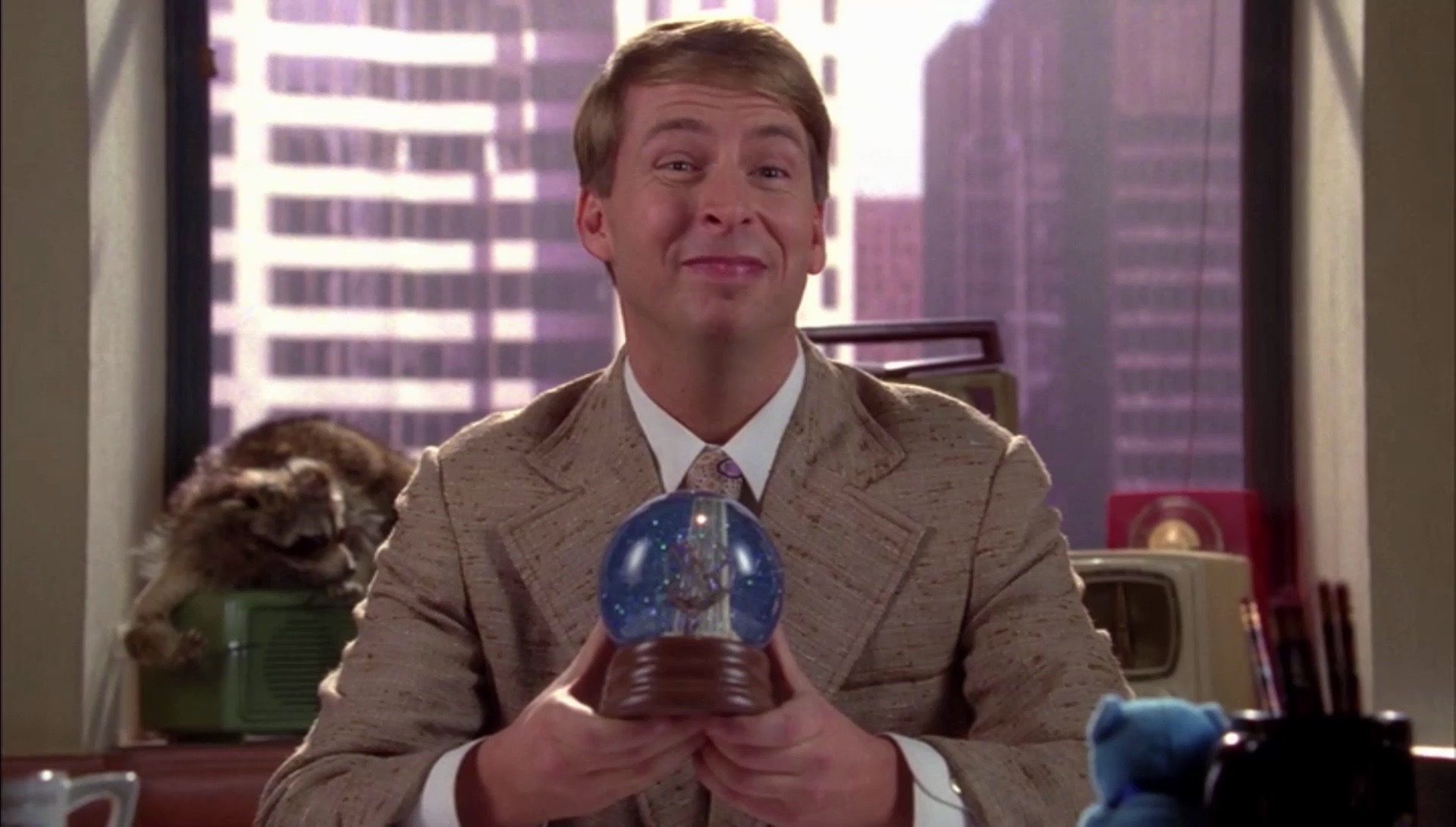
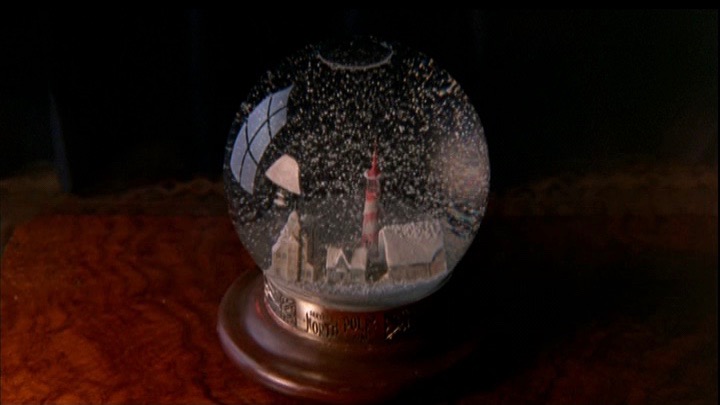
I guess it could also be a reference to One Magic Christmas (1985) where the central point of hope is the North Pole within a snow globe where the little girl visits Santa Claus.

One Magic Christmas (1985)

One Magic Christmas (1985)

The rest of the music video reminds me of the comic book styling of The Alan Parsons Project’s Don’t Answer Me in the way it portrays everything as a two-dimensional pop-up book. That music video has a comic book opening that contains the music video inside itself.

The rest is kind of morbid with the sheep being sent to slaughter, which seems to contrast with the intent of the song.

Still, a pretty music video to look at.

Christopher Mills directed the music video. He seems to have worked on somewhere around 70 music videos. He also wrote and worked as an animator on the video.

Kelly Norris worked as an executive producer on the video. It is a little difficult to tell, but she seems to have produced around 100 music videos.

Danny Lockwood’s work on the music video is new to me. He was the video commissioner. I had to look up what that means. A video commissioner is essentially a creative director in that the music company comes to him, and he goes out to find the appropriate director to make the music video. Lockwood seems to have worked in this capacity on around 140 music videos. He has also done some other work such as co-directing Last Friday Night (T.G.I.F.) for Katy Perry.

Enjoy!

Music Video of the Day: Man! I Feel Like A Woman by Shania Twain (1999, dir. Paul Boyd)


Yep! That is just like I remember. By that I mean, it’s the same music video as Addicted To Love with only minor changes. I recommend watching the two music videos side-by-side because you’ll notice only a couple of things are different:

  1. For whatever reason, they decided not to give the guys as much screen time as they gave the girls. I guess you can chalk this up to numerous things. Perhaps they wanted to send a message by showing that the music video works just as well with guys, but not sexualize them as much. On the other hand, they sexualize Shania Twain herself, so I am not sure. Perhaps it was to tie-in with the song, and make it about pride of female form rather than a simple display while also showing that guys can be just as simplified to an attractive form in the same way as Addicted To Love did with women. It could also just have been that they were told to put the heavy focus on Twain, and so that’s what they did. Given the time-period, that actually makes the most sense to me with maybe those other things being an afterthought.
  2. They throw in a few additional flourishes such as an iris transition, and give Shania some solo-time.
  3. It also looks better. One reason of which was most likely a result of a change in equipment and budget. The other reason is likely due to who they got to shoot the music video.

That’s it. Even the runtimes are only off by one second. This music video is one second longer than Addicted To Love.

Unlike Addicted To Love, where we know who all five girls are, I was only able to track down one of the guys named Bryce Buell. I won’t paraphrase the interview entirely, but the most interesting thing to me was that he noticed that Shania was quite petite, so they kept using some camera tricks to make her look taller than the guys. At about two minutes and fourteen seconds you can see the height difference he’s talking about.

Director Paul Boyd has shot somewhere around 150 music videos. He did several of them for Shania Twain.

I wish I could save the cinematographer of this music video for another day, but he happened to shoot this music video, so I’ll talk about him now.

His name is Daniel Pearl. He has shot at least 430 music videos since around 1982. Not small music videos either. He shot November Rain for Guns N’ Roses, Every Breath You Take for The Police, and Billie Jean for Michael Jackson to name a few. In fact, he’s credited as starting modern music videos back in 1969 when he made an experimental film called Rock ‘n’ Roll Nose using a song by The Byrds as the score. He also has numerous other film credits that are notable. He shot the original Texas Chainsaw Massacre in 1974. He was brought back to shoot the 2003 remake as well. He also did the 2009 Friday the 13th. His credits go on and on. Odds are, you’ve seen something he shot.

If you have only seen the music video for Addicted To Love, then this is well worth watching. For those who have seen this already, then enjoy this time capsule of the late 90’s pop princesses.