
I will be taking a small break from my Retro Television Reviews so that I can celebrate my birthday this weekend and enjoy a little mini-vacation. This feature will return on Monday, November 17th, with reviews of Miami Vice and CHiPs!
I will be taking a small break from my Retro Television Reviews so that I can celebrate my birthday this weekend and enjoy a little mini-vacation. This feature will return on Monday, November 17th, with reviews of Miami Vice and CHiPs!
Another Halloween has come and gone and another Horrorthon has come to a close. We hope you have had a wonderful October and that the Thanksgiving month brings you much to be grateful for!
And remember, just because you didn’t see the Great Pumpkin this year, doesn’t mean that he won’t be there for you next October. As always, Linus puts it best:
To all of our readers and from all of your friends at the Shattered Lens, thank you.
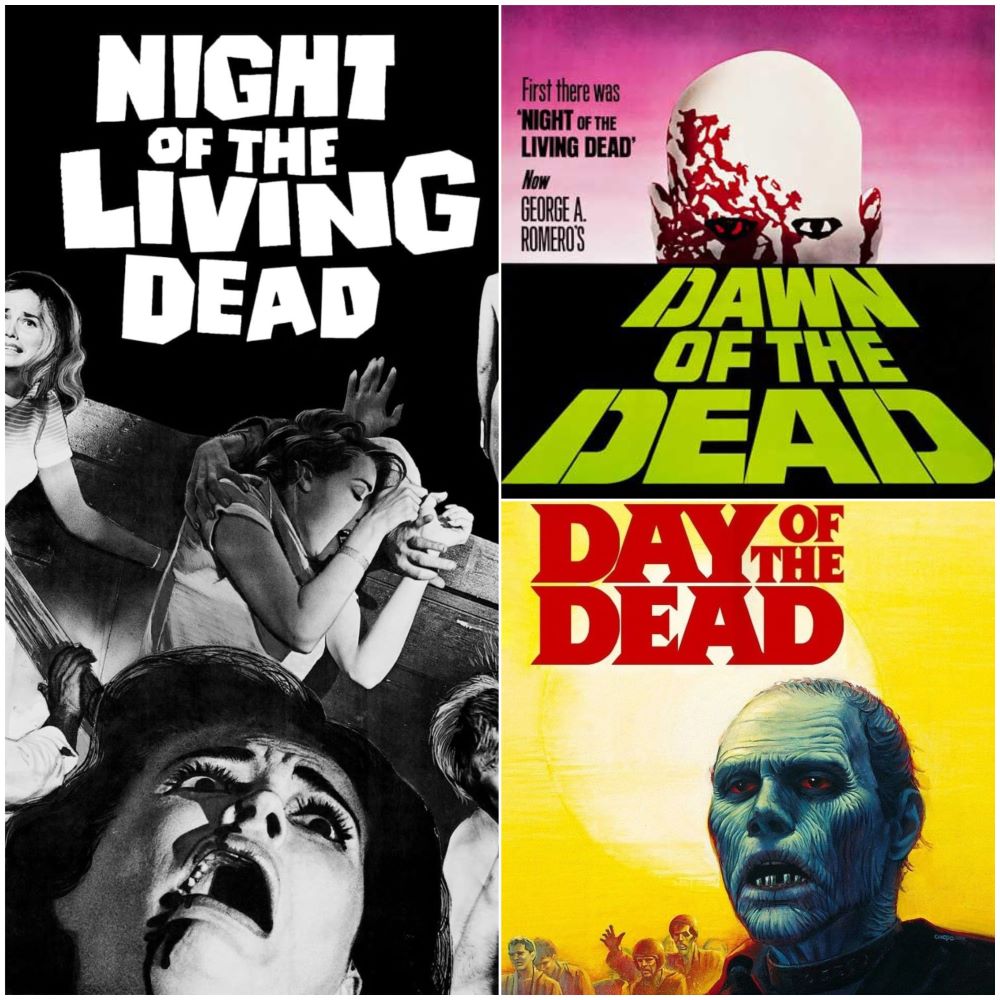
“When there’s no more room in hell, the dead will walk the earth.” — Peter
George A. Romero’s zombie trilogy—Night of the Living Dead (1968), Dawn of the Dead (1978), and Day of the Dead (1985)—stands as a landmark achievement in horror cinema, weaving the evolution of the zombie genre with a profound commentary on human nature and societal collapse. Emerging during periods of significant social and political upheaval, each film reflects the anxieties, tensions, and cultural dynamics of its decade. Romero’s zombies were not merely monsters to instill fear but mirrors reflecting society’s darkest fears, prejudices, and failures. The trilogy explores pressing questions about survival, morality, racial and class structures, and the fragility of human relationships when civilization breaks down, making these films persistently relevant beyond their gore and suspense.
What makes Romero’s trilogy particularly striking is its layered richness—each installment presents a standalone narrative that deepens the conversation about humanity’s response to apocalypse while encapsulating the spirit of its era. Night of the Living Dead confronts issues of race, violence, and distrust within a claustrophobic haven; Dawn of the Dead takes viewers to a sprawling shopping mall, a metaphor for 1970s consumer culture’s hollow comforts and social alienation; and Day of the Dead delves into the psychological and ideological fractures under extreme duress in a military bunker, highlighting themes of authoritarianism, scientific ethics, and the struggle for hope in despair. Together, these films form a powerful, intergenerational critique that resonates with viewers as much for their social insights as for their seminal contributions to the horror genre.
The Real Threat: Humans Versus Zombies
In Romero’s trilogy, the zombies provide relentless external pressure, but it is human flaws that become the dominant threat. Night of the Living Dead introduces the idea that fear, selfishness, and mistrust within small groups erode their chances of survival. The movie’s confined setting in a rural farmhouse encapsulates a microcosm of society teetering on the brink. Ben, played by Duane Jones, stands out not just for his calm leadership but also for the racial and social tensions his presence introduces—especially in conflict with Harry, whose obsession with control echoes real-world social divides. The film’s infamous ending, where Ben is killed by a white posse, resonates as a powerful allegory for racial violence, underscoring that the apocalypse in Romero’s world is as much a societal failure as a supernatural event.
Moving to Dawn of the Dead, the threat shifts toward a metaphorical critique of consumer culture. The survivors’ refuge in a shopping mall represents a modern temple of capitalism, filled with distractions and material goods that provide temporary relief but ultimately expose human weakness. The zombies’ endless wandering in this retail environment ridicule our real-world repetitive consumption, blurring lines between life and death. Human conflicts intensify as greed and recklessness among the survivors hasten their downfall. The bikers’ violent intrusion and consequent chaos symbolize how societal fractures and selfishness can undo fragile pockets of order. Here the zombies are a mirror to humanity’s brainless rituals, and the real menace is people’s inability to rise above base instincts.
In Day of the Dead, the human threat turns authoritarian and fractured. Set in a cramped underground bunker, the story mines the clash between military pragmatism and scientific inquiry. Soldiers and scientists represent ideologies that fail to reconcile, leading to paranoia, cruelty, and betrayal. Dr. Logan’s work with Bub—the zombie who exhibits flickers of memory and humanity—raises ethical questions, while Captain Rhodes’ hardline attitude embodies the brutal will to survive at any cost. The psychological breakdowns and mounting violence illustrate Romero’s grim thesis: when order and communication collapse, humanity itself becomes the deadliest monster. Romero’s zombies evolve here beyond simple horror fodder into symbolic reflections of humanity’s tragic failures.
Reflecting the Decades
Night of the Living Dead uses black-and-white cinematography to invoke a stark, documentary-like immediacy. This choice grounds the horror in a realism that intensifies dread, making the threat palpable and the social commentary more haunting. The film’s sound design—ambient crickets, creaking homes, radio reports—immerses viewers in a palpable tension. The limited setting and raw performances engage the audience emotionally, resembling a tragic stage play with themes of mistrust and panic spiraling out of control.
Dawn of the Dead shifts dramatically in visual and tonal approach. Its vibrant color palette contrasts the black-and-white predecessor, reflecting the mall’s artificial glow and the pop culture that it satirizes. The film balances broad dark humor with shocking gore, crafting an atmosphere that is surreal yet recognizably familiar. Tom Savini’s makeup and effects render the zombies grotesquely vivid, framing the film’s critique of capitalism with visceral impact. The pacing is more expansive, covering diverse spaces and character arcs as the survivors roam the mall’s labyrinthine insides, a metaphor for society’s complex detours and distractions.
Day of the Dead reverts to a darker, claustrophobic visual style in shadowy tunnels and corridors. The lighting is grim, reflecting the emotional suffocation and moral decay of its characters. Savini’s effects reach a gruesome peak here; every bite, wound, and decomposing corpse is rendered with intense anatomical detail. The film’s soundscape—filled with eerie silence punctuated by horrific violence—places viewers deep in the bunker’s oppressive atmosphere. Its pacing allows tension to build relentlessly, mirroring the psychological disintegration on screen. The film’s tone is unyieldingly bleak, underscoring an apocalypse not just of bodies but of hope and humanity.
The Films as Cultural Mirrors
Romero’s films serve as powerful cultural artifacts, each embodying concerns of its time.
Night of the Living Dead arrived in the late 1960s amid civil rights movements and the Vietnam War. The casting of Duane Jones as Ben was revolutionary, providing an implicit challenge to racial norms without overt political messaging. The film’s stark rural setting underscores isolation and vulnerability, while the tense, fractured group dynamics mirror societal conflicts over race, power, and distrust. The film’s haunting finale, with Ben’s death at the hands of a white mob, connects it powerfully to ongoing real-world violence against African Americans and demands reflection on humanity’s darkest impulses.
In contrast, Dawn of the Dead reflects the 1970s’ explosion of consumer and mass culture. Adventure into a shopping mall—a temple of capitalist excess—becomes a metaphor for societal malaise. Romero critiques consumerism’s seductive yet dehumanizing effects, suggesting that even amid an apocalypse, humans cannot escape compulsions to buy, hoard, and consume. The characters’ indulgence in the mall’s resources reveals social and moral exhaustion, and their downfall exposes the fragility beneath the comfortable facade of consumer society. The film’s biting humor and grotesque shocks harbor an underlying sadness about alienation and decay.
Day of the Dead encapsulates 1980s political anxieties around militarism, institutional authority, and distrust. The bunker setting becomes a suffocating arena where ideological conflicts tear apart what little society remains. This film foregrounds questions around science versus brute force, morality versus survival, and communication breakdown as symbolic of a society fracturing under Reagan-era pressures. The mental breakdowns and spiraling violence illustrate a grim view that humanity might be beyond redemption when stripped of trust and compassion. Its darkness reflects the decade’s cultural cynicism and fears of social disintegration.
Microcosms of Society
Romero’s stories unfold through tight-knit groups whose conflicts illuminate broader social themes.
In Night, Ben’s calm and tactical leadership contrasts sharply with Harry Cooper’s selfishness and paranoia. Their tensions reflect generational and racial divides. Ben strives for unity while Harry clings to control, highlighting a central question of cooperation versus individualism in survival. The other characters, including the traumatized Barbara and the fragile family unit, represent varying responses to fear, illustrating fractured human connections intensified by crisis.
Dawn enlarges the survivor group and diversifies personality types: news reporter Francine, biker gang members, military-like figures, and civilians who each represent different social attitudes. Their conflicts—between indulgence and survival, hope and despair—reflect their inability to fully commit to collective welfare. The chaotic intrusion of bikers on the mall roof, desperate to claim resources, accelerates the internal collapse, demonstrating the fragility of constructed order amid human greed.
Day uses a sharply divided group between scientists and soldiers, emphasizing ideological conflict. Dr. Logan embodies scientific curiosity and empathy, while Captain Rhodes champions military control and harsh pragmatism. Their clash catalyzes the group’s disintegration. Supporting characters like Miguel display mental fragility brought on by isolation and stress. Bub, the experimental zombie, emerges as a surprising figure of sympathy and ethical ambiguity, challenging simplistic notions of life and death. The bunker thus becomes a pressure cooker for the darkest human and philosophical dilemmas.
Evolution of the Undead as Symbol
Zombies are initially mindless monsters but become more layered symbols throughout the trilogy.
In Night, zombies are terrifying yet simple threats. Their inexplicable transformation turns death into relentless hunger, symbolizing uncontrollable social forces and fears of decay.
In Dawn, zombies’ repetitive behavior in the mall symbolizes consumerism’s zombification of society—mindless consumption, ritual, and alienation repeated beyond death. They act as dark reflections of the living’s mechanical habits.
Day transforms zombies into tragic figures represented by Bub, whose flickers of memory and social responsiveness invite empathy. This evolution raises moral questions about identity, consciousness, and the possibility of redemption or understanding within terror. The zombies become mirrors not only of societal collapse but of humanity’s potential for both cruelty and compassion.
Legacy and Impact
Romero’s trilogy didn’t merely redefine zombies but transformed horror into a powerful vehicle for social commentary, intertwining visceral storytelling with sharp critiques of society’s deep flaws and fears. Each film uses the undead not only as monsters but as metaphors reflecting the social and political issues of its time, making the horror resonate beyond the screen.
Night of the Living Dead broke ground by embedding racial and societal tensions into the horror narrative during a turbulent period of the 1960s civil rights movement and political unrest. The black lead character’s fate and the film’s stark depiction of fear and mistrust captured fractured American society—highlighting systemic racial violence, distrust, and the breakdown of community bonds. The zombies, once mindless folk creatures, became symbols of societal collapse, indiscriminate and relentless, emphasizing the idea that the real destruction comes from within human systems and relationships.
Dawn of the Dead advanced Romero’s social critique by targeting consumerism and capitalist excess. The setting of the shopping mall as a sanctuary turned trap was a brilliant allegory for how materialism numbs society, creating cycles of empty consumption akin to the zombies’ repetitive wandering. The film studied societal emptiness beneath the comforts of consumer culture, exploring how greed, self-interest, and a loss of empathy undermine collective survival. Notably, Romero touched on economic and racial inequalities, reflecting real struggles faced by minority and marginalized communities, such as urban violence and police brutality, though these themes are more coded than in Night.
Day of the Dead delivers a bleak critique of institutional failure and authoritarianism amid the 1980s political climate. The bunker’s contained setting represents a society strangled by mistrust between military power and scientific inquiry. As paranoia grows, ethical boundaries and communication collapse, showing a dystopia where humanity’s darkest traits rise to the surface. Characters personify ideological conflicts, illustrating the futility of survival without unity or compassion. The ethical complexity introduced through Bub, the almost-human zombie, forces deeper reflection on humanity and monstrosity. The film presciently portrays societal fragmentation, authoritarian impulses, and mental health crises as ongoing threats to civilization, deepening Romero’s grim message that humanity’s greatest dangers lie within itself.
Romero’s films continue to influence horror and popular culture by demonstrating how genre cinema can engage with pressing social issues. They laid the groundwork for zombie stories as allegories for everything from capitalism and consumerism to racial injustice and political dysfunction. Examples of films and shows influenced by Romero’s Dead trilogy are numerous and diverse. The 2004 remake of Dawn of the Dead by Zack Snyder revitalized zombie cinema for a modern audience while keeping the core social commentary, inspiring other fast-paced, action-oriented zombie films. The television series The Walking Dead drew heavily from Romero’s depiction of the undead apocalypse and the struggles of survivors, exploring themes of community, morality, and leadership in a broken world. Films like 28 Days Later introduced a new breed of zombies with ultra-fast infection rates, yet owe a thematic debt to Romero’s human-centric apocalyptic narratives. The video game series Resident Evil incorporates survival themes and social breakdown, reflecting the fractured human relationships Romero explored. Even non-zombie films like The Road invoke similar bleak atmospheres and moral complexities in post-apocalyptic settings. Romero’s influence also extends to comics, literature, and other media, making his trilogy a foundational pillar in modern horror and pop culture.
In sum, Romero’s trilogy remains a vital cultural touchstone. Each film captures the zeitgeist of its era while addressing timeless questions about human nature, survival, and society under crisis. The powerful fusion of gore, suspense, and social commentary in these movies gives them lasting relevance and impact far beyond the horror genre. They compel audiences to confront the monsters outside and the darker forces within themselves and their communities.

To all of our readers
To all of our friends
To every ghoul and fiend out there,
HAPPY HALLOWEEN FROM THE SHATTERED LENS!
May your Halloween bring you more candy than rocks and we hope you enjoy the last day of our annual horrorthon! Be safe, be sincere, and don’t forget the true meaning on Halloween!
I wanted to share one last picture from my mom’s doll collection before Halloween. I can’t remember when or where she got this Casper doll but I know that I always felt happy whenever I saw him.

It was always wondered who wrote “CASPER THE GOD” on him and also why they decided he was a god instead of a ghost. Maybe his original outfit got lost and they labeled him so they wouldn’t forget who he was. But how can you forget Casper?
Happy Halloween, Casper. I’m glad that we were able to give you a home.
Previous Moments:

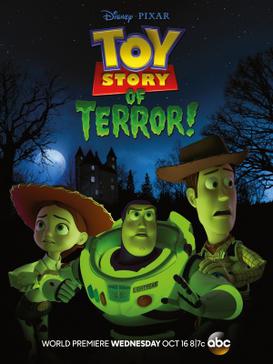
Is it just me or was there a stunning lack of Halloween specials this year? This is the first time in 12 years that Toy Story of Terror wasn’t aired on television. And, of course, It’s The Great Pumpkin, Charlie Brown has been an Apple TV exclusive for a while now.
It’s hard to explain why it bothers me so much. Maybe I just don’t like change. I know that all of the old Halloween specials that I enjoyed when I was younger can still be found streaming online. I can watch them anytime that I want. That’s not the point. When I was growing up, there was something really special about gathering in front of the television with my family to watch those specials, even though I had seen all of them before. They were an event. They were something to look forward to. The waiting and the knowing that everyone across the country would all be watching at the same time was part of what made them so special. Now that you can just watch them whenever you want, it doesn’t feel as special. There’s no anticipation. There’s no thrill of the moment when it finally starts. Worst of all, there’s no communal experience. I could watch It’s The Great Pumpkin Charlie Brown in November if I wanted to. I can watch A Charlie Brown Christmas Special in July.
I never thought I’d be sad over something like Toy Story of Terror not airing on television. (This year, we watched it on Disney+.) I am, though. The world has become a little less fun and we no longer have something that used to bring the people together as a community. I feel bad for a generation that’s never going to know the excitement of having to wait to see or get something instead of getting instant and empty gratification. I worry that people don’t care as much about holidays and traditions anymore. That’s a shame.
At least I’ll always have my holiday memories.
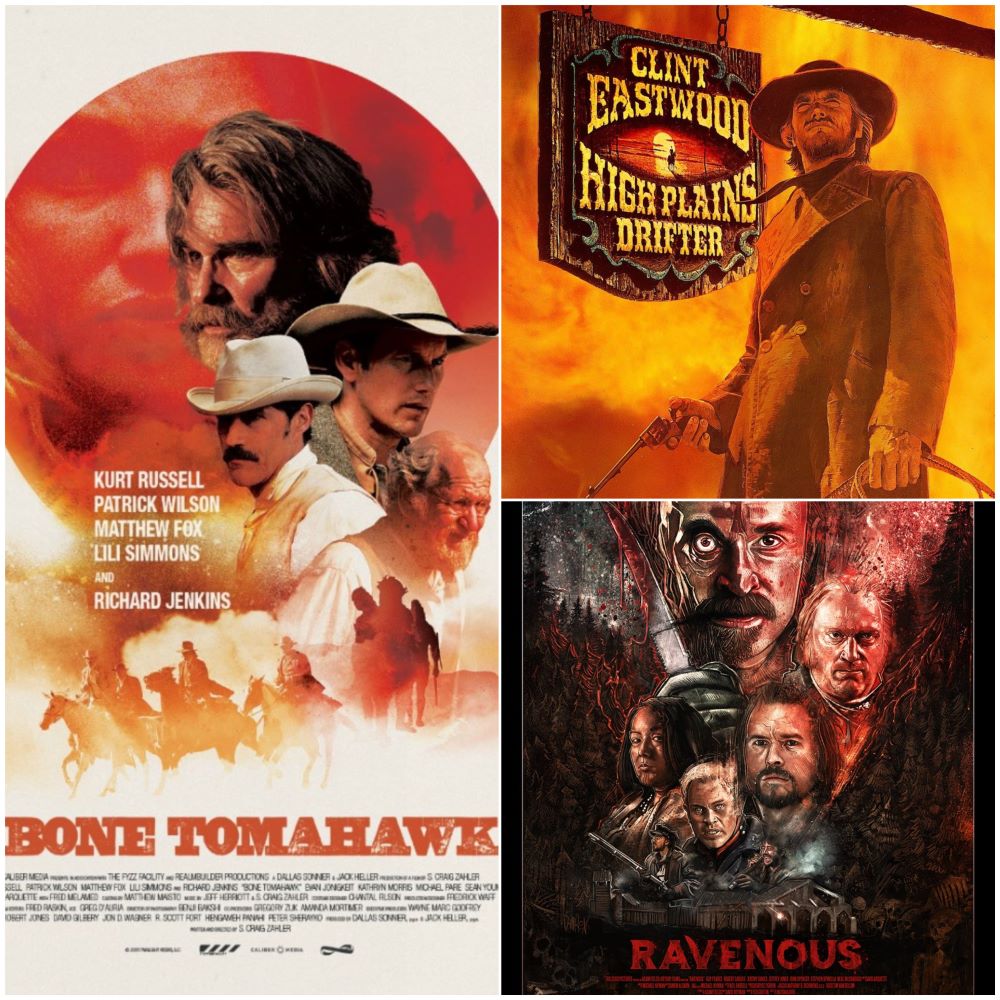
“You want to shoot me, go ahead. It won’t matter. I’ve seen things you wouldn’t believe.” — The Stranger
The Western Wound: Horror, History, and the Haunting of Frontier Mythology
Horror profoundly shapes, distorts, and reframes the American Western, complicating familiar narratives of lawmen and outlaws with the uncanny specter of trauma, dread, and evil. Few films demonstrate this transformation more powerfully than Ravenous (1999), Bone Tomahawk (2015), and High Plains Drifter (1973). These three Westerns push beyond genre conventions, leveraging horror’s capacity to unsettle, destabilize, and haunt—creating experiences that are as philosophically provocative as they are viscerally unsettling. Rather than merely incorporating horror aesthetics into a Western setting, each film employs horror as a core thematic device to interrogate violence, community, morality, and the dark legacies of frontier expansion.
High Plains Drifter’s isolation in the arid Nevada desert is more than a physical setting; it externalizes the moral barrenness and guilt festering within the town of Lago. The oscillation between relentless sunlight and dense fog creates a hallucinatory space where natural laws are suspended, and supernatural retribution manifests. Central water imagery—the fog rolling off the lake, the lake itself—serves as a liminal zone, symbolizing the boundary between life and death, past and present, justice and vengeance. The Stranger’s spectral emergence from the desert heat haze hints at his otherworldly nature, turning the town’s landscape into a haunted battleground where redemption is elusive and suffering endemic.
Ravenous’s setting in the snowy Sierra Nevada mountains during the Mexican-American War imbues its horror with claustrophobic dread. Fort Spencer’s remoteness in the face of towering, hostile peaks and unrelenting winter transforms the natural environment into a gothic prison. This wilderness is both physical and psychological, oppressive in its vastness and merciless in its cold. The film uses this setting to amplify the existential terror wrought by cannibalism, suggesting an inescapable cycle of consumption where survival becomes monstrous. Deep shadows, filtered natural lighting, and long quiet scenes evoke dread as much as extreme violence.
In Bone Tomahawk, the stark, sunbaked deserts and towering rock formations of the American Southwest form an ominous landscape embodying ancient and unknowable horror. The frontier town is a fragile outpost at civilization’s edge, surrounded by a wild, menacing wilderness. The deep canyons serve as metaphorical gateways to past atrocities, echoing the silent histories of indigenous trauma and colonial violence. The oppressive silence and vastness underscore humanity’s diminutiveness and vulnerability, while the jagged terrain symbolizes the harshness of both nature and history’s brutal forces.
The Stranger in High Plains Drifter manifests the blurring boundaries between justice and vengeance, heroism and monstrosity. His actions—including an unsettling rape scene—force a confrontation with the darkest aspects of human nature, showing how violence corrupts even those who claim righteousness. His ghostly status and ruthless methodology suggest he is a representation of collective guilt made tangible, punishing the town’s sins with otherworldly finality. The film invites viewers to question whether vengeance restores balance or merely perpetuates horror.
In Ravenous, cannibalism literalizes the primal urge to consume not only flesh but identity and sanity, transforming survivors into monsters. The character Ives, charismatic and terrifying, embodies this transformation, seducing others into a vortical descent of brutality. The film’s psychological horror arises from the contagion of hunger and madness, the breakdown of social and moral order amid desolation. It probes existential questions about survival, morality, and the dissolution of self.
Bone Tomahawk depicts transformation through the confrontation with an ancient, savage tribe whose brutality transcends ordinary human evil. The characters’ exposure to this primordial terror strips away civilized facades, forcing characters and viewers to acknowledge the latent barbarity within humanity. The film’s horror is both external—in the violent acts of the tribe—and internal—in the psychological unravelling of the rescue party. This duality highlights the wilderness as both physical terrain and psychic landscape of primal fear.
The communal failure in High Plains Drifter reveals how collective cowardice and betrayal corrupt society. Lago’s townsfolk enable the marshal’s murder and face the Stranger’s supernatural justice as a consequence. Their moral bankruptcy transforms the town into a cursed locus of horror, symbolizing how collective sin corrupts the social fabric and invites ruin.
Ravenous portrays community breakdown within the remote outpost, where isolation breeds paranoia, selfishness, and violence. The collapse of trust and order mirrors the broader failure of frontier society to contain human baseness under extreme conditions, suggesting society itself is a fragile construct vulnerable to collapse.
In Bone Tomahawk, the fragile rescue party embodies the precariousness of social cohesion facing profound evil. Their doomed mission stresses how thin the veneer of civilization is, shattering under pressure from ancient horrors. The film critiques assumptions of order and control, emphasizing the ease with which human society can crumble.
Violence in High Plains Drifter is unending, spectral, and morally ambiguous. The Stranger’s vengeance refuses neat closure, illustrating cycles of violence that leave deeper scars rather than justice. The film redefines violent retribution as torment, destabilizing conventional heroic narratives.
Ravenous entwines violence with survival horror and existential dread. The ritualistic cannibalism is a metaphor for moral and spiritual corrosion, forcing characters and audiences to face the horrors wrought by the primal fight for survival at civilization’s edge.
Bone Tomahawk presents violence as slow, ritualistic, and ancient—an elemental force indifferent to human ethics. Its stark, realistic depiction immerses viewers in fear and helplessness, rejecting conventional catharsis and highlighting the terror of primal brutality.
High Plains Drifter blends ghostly and surreal imagery to explore unresolved sin and cultural guilt. The Stranger is both avenger and specter of collective trauma, with symbolic elements—such as the red-painted town and unmarked graves—that deepen the meditation on punishment and desolation.
Ravenous uses cannibalism and wilderness as symbols of consumption and destruction intrinsic to frontier expansion. Horror here reflects existential struggles with survival, cultural annihilation, and moral ambiguity, set against an environment of engulfing nature and history.
Bone Tomahawk evokes frontier horror as a metaphor for repressed histories and cultural erasure. The savage tribe symbolizes ancestral trauma, while the desolate landscapes underscore the lingering presence of buried horrors that haunt the Western imagination.
Ravenous, Bone Tomahawk, and High Plains Drifter deepen the Western genre’s reckoning with violence, morality, and civilization’s fragility. Ravenous allegorizes hunger and expansion’s destructive appetite through cannibalism, revealing survival’s costs to identity and culture. Bone Tomahawk exposes historical violence and trauma encoded in landscape and myth, demonstrating Western justice’s limits. High Plains Drifter dramatizes unresolved guilt and vengeance through spectral retribution, challenging sanitized Western heroism.
The films’ central horrors—the Stranger’s merciless vengeance, the cannibal’s transformative hunger, and the doomed rescue mission into darkness—serve as meditations on violence, communal complicity, and the absence of redemption. They unmask the American West and America itself as terrains haunted by deep, unresolved sins and moral ambiguity. In marrying supernatural and psychological horror, these films offer a complex, layered critique of frontier myth, turning the Western from a tale of conquest into a haunted narrative of trauma, survival, and moral reckoning.
High Plains Drifter uniquely embodies ambiguity between supernatural revenge and psychological torment. The Stranger’s ghostlike qualities and resurrection to avenge his murder firmly anchor a supernatural interpretation. His eerie manifestations—such as the bullwhip’s sound triggering vivid nightmares and his mysterious appearance from the desert heat—signal a spectral force beyond human comprehension. Yet, on a psychological level, the Stranger can be viewed as the materialization of the town’s collective guilt and suppressed trauma. This duality enriches the narrative, allowing viewers to interpret the horror as either literal supernatural vengeance or a psycho-spiritual reckoning of internal moral collapse.
Ravenous blurs supernatural and psychological horror by mixing the tangible terror of cannibalism with metaphysical dread. The figure of Ives carries almost mythic qualities—his charismatic yet monstrous presence suggests an otherworldly evil, a contagion consuming the souls of men. The mountain wilderness functions as a liminal space transcending reality, where madness and primal urges surface. This ambiguity invites readings of the horror as both external supernatural curse and internal psychological disintegration, reflecting survival’s dehumanizing cost amidst isolation and guilt.
Bone Tomahawk grounds itself mostly in realistic terror but invokes mythic supernatural threads through the savage tribe’s almost fantastical menace. Their brutal, ritualized violence carries residues of ancestral curses and primal fears that exceed mere human malevolence. The film explores psychological horror through the characters’ terror and helplessness confronting an unknowable evil, making the wilderness and tribe a metaphor for the abyss of human and historical trauma. Thus, horror emerges as both a tangible threat and a psychological abyss threatening identity and sanity.
This interplay of supernatural and psychological horror amplifies these films’ thematic depth. By refusing to confine horror to one domain, they portray the Western frontier as a space haunted simultaneously by ghosts—whether spiritual, historical, or personal—and inner demons manifesting as guilt, fear, and madness.
Ultimately, horror in these Westerns is not merely a matter of frightening events but a profound engagement with unsettled histories and psyches. This dynamic makes their terror resonate long after the screen fades to black, marking the Western as a genre haunted not only by outlaws and the wilderness but by the specters within us all.
Horror profoundly alters the Western genre’s narrative, revealing it as a cultural wound, a landscape haunted by the ghosts of its own violent history and moral contradictions. By challenging sanitized myths and exposing the fragility beneath civilization’s veneer, Ravenous, Bone Tomahawk, and High Plains Drifter not only frighten but provoke deep reflection on the legacies of violence and the nature of justice itself—capturing the horror at the heart of the American story.
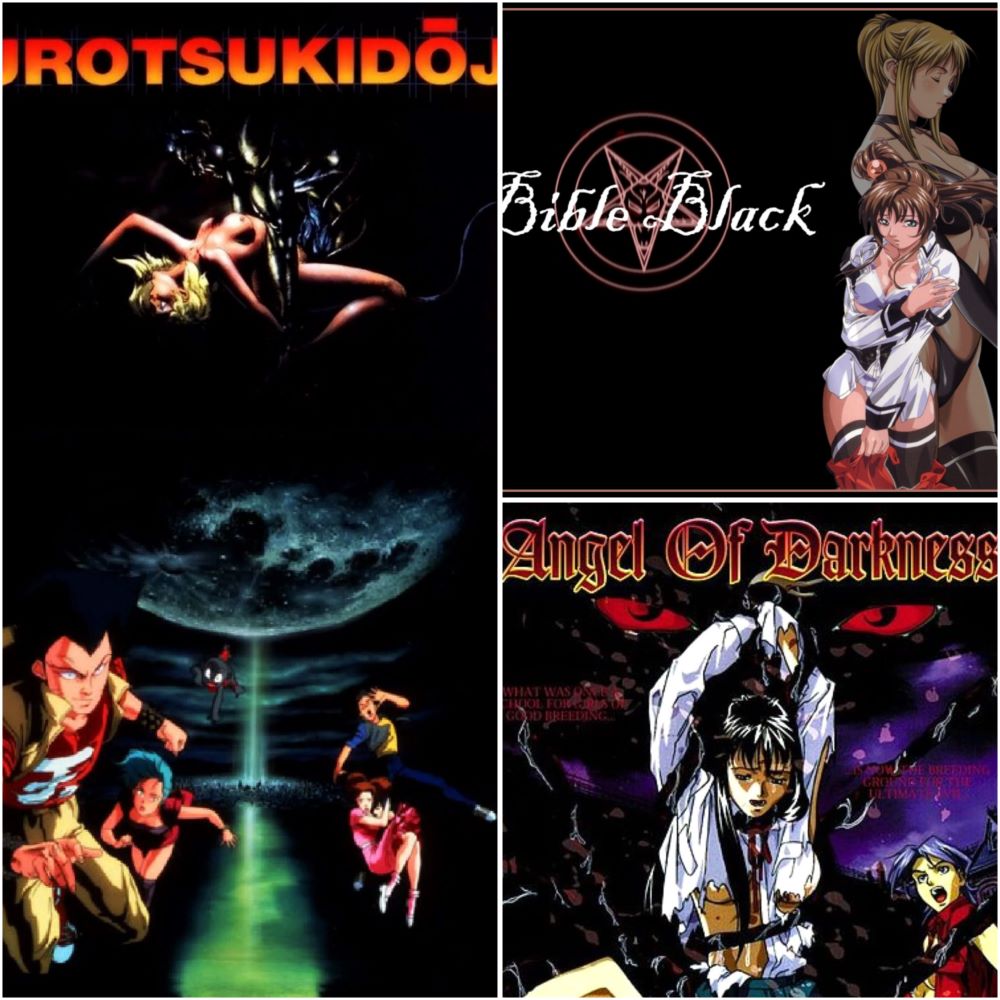
“In desire and dread, horror reveals fragile moral boundaries.”
Hentai, as a genre of adult anime and manga, often explores sexuality in ways that push boundaries and traverse taboo territory. Within hentai, the subgenre of horror hentai stands apart for its unsettling blend of explicit sexual content and graphic violence, creating a distinctly disturbing atmosphere that extends beyond simple eroticism. Iconic titles such as Urotsukidoji, Angel of Darkness, and Bible Black exemplify the dark eroticism where sexuality is woven tightly with terror, gore, and supernatural dread, evoking both fascination and horror in audiences.
These works represent a period in hentai anime history when the medium evolved beyond mere explicit content into a form that combined high-quality animation with rich, complex narratives. Early pioneers like Urotsukidoji brought innovative animation techniques and layered storytelling, blending apocalyptic mythology with intense eroticism and horror. Similarly, Angel of Darkness explored psychological and existential themes within a darkly atmospheric boarding school setting, while Bible Black infused occult horror with morally complex character dynamics and ritualistic narratives. This golden era reflected a moment when hentai was capable of delivering mature, multi-dimensional stories alongside its adult themes.
However, as the hentai industry expanded and commercial pressures intensified, there was a growing shift toward quick production and profit-driven projects. Many recent works have sacrificed the intricate narrative structures and animation quality for formulaic, episodic content designed for rapid consumption. The loss of this narrative depth has diminished horror hentai’s ability to engage audiences emotionally and intellectually, making classic works all the more significant for their artistic ambition.
This analysis explores the crucial role sex and violence play in crafting horror hentai’s unique atmosphere by examining Urotsukidoji, Angel of Darkness, and Bible Black, while also reflecting on the medium’s evolution and the cultural contexts that shape these narratives.
Horror hentai is distinctive because it merges two primal human experiences: desire and fear. Unlike conventional pornography or horror, it uses sex and violence symbiotically, each intensifying the impact of the other. The explicit sexual acts are far from mere titillation; they embody power dynamics, bodily autonomy violations, and often supernatural corruption. Violence is not a separate or accidental feature either, but deliberately intertwined—it amplifies the grotesque, shock, and transgressive qualities of the sexual content. This fusion creates an atmosphere charged with tension, vulnerability, domination, and degradation, engendering a complex emotional response that unsettles while captivating.
In horror hentai, sex often becomes a vehicle of horror itself—ritualistic, invasive, or monstrous. It evokes the taboo and the unnatural, shattering normative boundaries of consent, intimacy, and bodily sanctity. Violence, similarly, departs from mere physical harm and becomes symbolic of decay, corruption, and the invasion of the self. Together, they manifest the darkest aspects of human and supernatural experience, igniting dread and repulsion alongside erotic fascination. This duality is fundamental for horror hentai’s distinctive atmosphere.
Urotsukidoji: Legend of the Overfiend (1987) stands as a landmark in horror hentai, merging apocalyptic mythology with hyper-sexualized violence. The story unites three overlapping worlds—the human realm (Ningenkai), the Demon World (Makai), and the Man-Beast World (Jūjinkai)—through the prophecy of the Chōjin or Overfiend, a godlike being destined to either unify or annihilate these realms. This cosmic setting is filled with grotesque demons, primal lust, and brutal power struggles, establishing a surreal and nihilistic horror atmosphere.
The plot focuses on Amano Jyaku, a sly and chaotic half-demon dispatched to Earth to find and protect the true Overfiend inhabiting the human teenager Tatsuo Nagumo. Nagumo’s ordinary college life—marked by voyeuristic tendencies and a turbulent romance with cheerleader Akemi Ito—collides violently with the supernatural. Akemi herself becomes a victim of monstrous sexual assaults by demons disguised as authority figures. Scenes of graphic rape and tentacle-based body horror fuse sexual transgression with violence, confronting moral boundaries and generating visceral horror.
Jyaku’s relationships with otherworldly beings, including his nymphomaniac sister Megumi and others, amplify the series’ themes of lust, corruption, and spiritual warfare. One poignant subplot involves Niki’s tragic transformation: under demonic influence, he self-mutilates for power, embodying the horror of humanity’s capitulation to hedonism and violence. Set against a decaying Osaka cityscape plagued by monstrous invasions and apocalyptic destruction, Urotsukidoji contrasts the banal and the terrible, heightening unease. The visual style’s vivid, brutal imagery escalates the horror, making sexual violence and grotesque bodily distortions emblematic of cosmic decay. The result is an immersive experience where apocalyptic dread, demonic carnality, and primal lust collide, producing a uniquely disturbing horror narrative rooted in both the supernatural and the deeply personal.
Angel of Darkness (1994) crafts a deeply unsettling atmosphere of horror through its bleak, rain-soaked setting at Siren Academy, a secluded all-girls boarding school cloaked in mystery and shadow. The oppressive environment—with its dark hallways, forbidding chapel, and hidden underground basements—functions as a claustrophobic prison that accentuates the vulnerability and isolation of the characters. The pervasive stormy weather amplifies the tension, underscoring the darkness both physical and psychological that permeates the story.
The narrative centers on Atsuko Yoshikawa and Sayaka Matsumoto, two students whose secret love is fraught with danger, especially given the presence of Atsuko’s possessive older sister Yuko, a teacher tainted by jealousy and entangled in the sinister forces at the school. The introduction of Professor Goda, a young science teacher who becomes possessed by an ancient sex demon called the “Inju,” marks the descent into horror. This supernatural entity is unleashed after Goda breaks a mysterious stone seal beneath a large tree during a thunderstorm, allowing the Inju to inhabit his body and begin a reign of terror.
The school’s underground chapel becomes a horrifying locus of sexual assault and torture, as Goda and the cruel school director exploit the students to feed the Inju, who grows stronger by consuming the girls’ bodily fluids. This fusion of physical violation with demonic possession conveys a potent, symbolic horror of exploitation and corruption, intertwining the personal violation of the girls’ bodies with a cosmic, supernatural threat. Supporting this is the enigmatic figure Rom, a dark fairy-like presence whose role is ambiguous but undeniably ominous, adding a mythic and surreal layer to the nightmare that envelops the academy. The girls’ visible despair and alienation throughout the series reveal the pervasive psychological weight of the evil they endure, highlighting themes of loss, trauma, and shattered identity.
Plotlines featuring ritualistic sexual domination, possession, and brutal abuse map onto broader psychological and existential terrors. The story’s climax reveals the Inju’s plan to use Yuko’s body to birth a demonic female offspring, raising the stakes by entwining personal, familial betrayal with apocalyptic horror. Atsuko and Sayaka’s efforts to confront and halt this dark destiny are fraught with desperation and helplessness, deepening the emotional impact.
The explicit sexual violence depicted in Angel of Darkness is graphic and provocative, but it is employed narratively to symbolize the fracturing of selfhood and the encroachment of darkness into private, sacred spaces. Elements of Japanese folklore and supernatural horror—including tentacled demons, curses, and possession—infuse the work with a cultural resonance that heightens the uncanny and grotesque. Ultimately, Angel of Darkness balances supernatural horror with psychological realism, situating its explicit depictions of sex and violence within a tragic narrative of trauma, loss, and entrapment. Its atmospheric power lies in weaving bodily violation and possession into a story of existential despair, transforming the boarding school into a haunted prison where horror permeates every intimate moment.
Bible Black (2001) blends occult horror with extreme sexuality inside a seemingly typical Japanese high school, subverting the safe, familiar setting with dark rituals and supernatural threats. Central is the titular grimoire, a forbidden tome enabling demonic spells and rituals that require sexual acts as conduits for power. The narrative follows Minako Suzuki, an initially naive student drawn into occult mysteries, alongside Reika Kitami, a manipulative sorceress wielding the Bible Black’s powers for deadly ends, and teacher Taki Minase, who becomes a possessed enforcer of dark magic. The school’s hidden chambers and secretive cults wrap the story in an atmosphere thick with dread and betrayal.
Sex scenes are inextricably linked to violence and domination, involving possession, forced rituals, and psychological torment. Victims are frequently coerced or overtaken by dark forces, reducing their bodies to battlegrounds where pleasure, pain, control, and horror merge. The series’ graphic depiction of rape and torture underscores themes of lost agency and creeping corruption. Juxtaposing everyday student life with nightly occult depravity creates a dissonance that intensifies the horror. Vivid animation accentuates shadows, magical transfigurations, and brutal acts, building a suffocating mood where normalcy is a fragile mask.
Bible Black ultimately explores the destructive fusion of forbidden knowledge, obsession, and corrupted desire. Its horror emerges from depicting the unraveling of morality and identity under the influence of occult lust and violence.
While Urotsukidoji, Angel of Darkness, and Bible Black all employ sex and violence to generate a horror atmosphere, they explore distinct ethical themes that reflect varied understandings of morality, power, consent, and human nature. Urotsukidoji is steeped in cultural-specific moral ambiguity rather than clear distinctions of good and evil. Drawing from a mythic apocalyptic framework, the arrival of the Chōjin (Overfiend) symbolizes both destruction and potential transformation. The series portrays sexuality as a primordial, transformative force—sometimes destructive but essential within a cosmic order beyond human moral judgment. Characters like Amano Jyaku embody chaotic morality, acting as both protector and trickster, blurring the boundaries between right and wrong within spiritual and existential contexts. This moral ambiguity challenges Western sensibilities by embedding taboo sexual violence within a larger allegory of cosmic chaos and renewal.
In contrast, Angel of Darkness shifts the focus toward trauma, violation, and existential despair, emphasizing the intimate human impact of sexual violence and supernatural possession. The horror arises from the devastating effects of such abuses on identity, relationships, and hope within the closed sanctuary of Siren Academy. The series presents bodily and psychological violation as corrosive forces that undermine selfhood, while portraying love and loyalty as fragile bulwarks against overwhelming darkness. Unlike the cosmic ambiguity of Urotsukidoji or the power corruption in Bible Black, Angel of Darkness offers a tragic meditation on suffering and resilience, critiquing institutional predation and exploring the reverberations of trauma.
Bible Black explicitly foregrounds ethical concerns centered on corruption, consent, and the abuse of power. Sexual violence and occult rituals function as tools of manipulation, leading to spiritual degradation and loss of agency. The narrative depicts many sexual acts as violations—forced possession, ritual rape, and psychological torment—highlighting the consequences of unchecked desire and the destruction wrought by forbidden knowledge. The setting of a high school amplifies this tension by juxtaposing youthful innocence with predation and manipulation, resulting in a cautionary tale about power’s capacity to unravel morality and identity.
Together, these works form a spectrum of ethical inquiry: Urotsukidoji invites contemplation on transcultural notions of morality and cosmic destiny, Angel of Darkness humanizes horror through intimate trauma and victimhood, and Bible Black warns against abuses of power and corruption. Though all depict explicit sexual violence and horror, their ethical expressions diverge—ranging from mythic transcendence through taboo (Urotsukidoji), to reflection on suffering and care (Angel of Darkness), to condemnation of manipulation (Bible Black). This layered ethical complexity enriches their horror atmospheres, compelling audiences not only to recoil but to engage with profound questions of consent, power, and human fragility.
The chilling atmospheres and provocative content of Urotsukidoji, Angel of Darkness, and Bible Black are deeply informed by specific cultural and social norms in Japan, shaping how sex, violence, and horror intertwine in ways distinct from Western media. These works reflect a nexus of traditional Japanese folklore, post-war societal anxieties, and cultural attitudes toward sexuality, taboo, and the supernatural.
Japanese horror broadly draws from centuries-old spiritual beliefs and folklore, including entities like yōkai (supernatural creatures), yūrei (vengeful spirits), and obake (shape-shifters), which frequently embody unresolved trauma, injustice, or societal imbalance. This foundation informs horror hentai’s supernatural elements, with demons, possession, and curses recurring as metaphors for spiritual and psychological disruption. For instance, Angel of Darkness’s “Inju” sex demon and its possession ritual can be linked to traditional concepts of spirit invasion accompanied by trauma and retribution, core to many classical Japanese ghost stories.
The pervasive theme of violated purity and corrupted innocence found in all three titles reflects the emphasis on purity and social conformity in Japanese culture, where public discussions of sexuality are often repressed or heavily mediated. Hentai’s graphic sexual content, juxtaposed with grotesque violence and supernatural horror, can be seen as transgressive responses to this repression—externalizing hidden desires, fears, and social taboos. This tension is especially apparent in Bible Black, set in a high school, where innocence and social order clash violently with occult corruption and sexual depravity.
Another culturally distinctive element is the motif of youthful or childlike characters, despite legal adult status, which taps into complex Japanese perspectives on age, purity, and desire. The repeated depiction of tentacle erotica—an iconic and controversial trope originating in Japan—exemplifies how fantastical, non-human sexual violence is used to bypass censorship and symbolize penetrating societal taboos about sexuality and violation. The grotesque yet metaphorical tentacle scenes in Urotsukidoji highlight this distinctly Japanese form of combining horror, eroticism, and fantasy.
Moreover, Japanese post-war history and rapid modernization have infused the country’s horror traditions with themes of trauma, alienation, and distrust of technological or institutional authority. This background resonates in Angel of Darkness’s claustrophobic boarding school setting and corrupt institutional figures, highlighting societal fears of oppression and loss of individual agency. The tension between tradition and modernity, evident in Japan’s urban decay and cultural transformation, animates these horror hentai narratives with an underlying socio-historical anxiety.
A profound and complex cultural layer within these works is the appropriation and reinterpretation of Christian symbolism and ritual. In Japanese cultural context, Christian imagery—such as crosses, holy water, church architecture, and priestly robes—does not uniformly convey purely sacred or redemptive meanings as in Western Christianity. Instead, these symbols often carry a dual or ambiguous function. They serve simultaneously as signs of sacredness and purity and as markers of the demonic, the profane, and corruption within horror hentai narratives. This ambiguous use stems from Japan’s history with Christianity as an imported religion, which has been both admired as exotic and subject to persecution and suppression historically.
In the Japanese cultural imagination, Christian ritual and symbolism are often detached from their doctrinal meanings and recontextualized within native concepts of purity, impurity, and spiritual balance. This cultural reinterpretation infuses Christian iconography with an ambivalent power, making crosses and holy rites potential sites of both spiritual protection and demonic infiltration or desecration. For example, holy water may be used not only to bless but also to exacerbate supernatural crises; the church as a place may become the theater of unholy rituals. This dual use reflects Japan’s syncretism, where imported religious forms are made to interact with Shinto and Buddhist perspectives on spirituality and the sacred.
Such transformations of Christian symbols amplify the horror in hentai by turning what Western audiences associate with sanctity into eerie, unstable signifiers of spiritual conflict and moral reversal. The profane and sacred intertwine, reinforcing the sense of a world where boundaries between good and evil are porous and contested. This dynamic enriches the narratives of Bible Black and Angel of Darkness especially, where Christian motifs become layered signifiers with both protective and threatening resonance.
The influence of traditional Japanese theater styles like Noh and Kabuki also permeates the visual and narrative language of horror. These theatrical traditions emphasize psychological tension, stillness, and emotional trauma rather than explicit violence alone, encouraging viewers to engage with horror on a subtle, psychological level even amidst graphic content. The use of masks, symbolic costumes, and stylized movement has parallels in the exaggerated yet symbolic visual depictions in hentai horror.
In sum, these culturally specific influences enrich Urotsukidoji, Angel of Darkness, and Bible Black with layers of meaning uncommon in Western horror erotica. Far from mere shock or titillation, their sex and violence echo complex dialogues about spiritual imbalance, social repression, trauma, and the liminal spaces where the human and supernatural converge in Japanese cultural imagination. This cultural embedding is essential to understanding their unique and enduring impact within and beyond Japan.
Sex and violence in horror hentai are not simple add-ons but foundational elements that shape tone, narrative, and viewer engagement. The combination evokes a raw emotional cocktail of repulsion, fascination, dread, and arousal. This complex emotional interplay deepens immersion and heightens tension, crucial for horror’s psychological impact.
Sexualized violence challenges taboos, breaking social and psychological boundaries that normally regulate discomfort and arousal. It renders characters highly vulnerable, evoking empathy alongside horror. This vulnerability is instrumental in constructing an oppressive and unsettling atmosphere where horror feels potent and immediate.
The graphic and often surreal visual style of horror hentai amplifies these effects. Distorted bodies, exaggerated features, and unflinching depictions of sex and gore confront viewers with the monstrous and uncanny. This fusion of eroticism and grotesquery crafts a uniquely immersive horror atmosphere that is as shocking as it is intense.
In Urotsukidoji, Angel of Darkness, and Bible Black, sex and violence do not merely coexist but coalesce to generate a distinctive atmosphere of horror in hentai. Through apocalyptic carnality, occult seduction, and psychological trauma, these elements engender an immersive experience that disturbs and compels. The entwinement of sex and violence transcends shock to become a vehicle for exploring power, corruption, vulnerability, and taboo. This dark eroticism forms the backbone of horror hentai’s unique capacity to evoke fear and fascination, crafting narratives where horror is felt in the deepest, most primal human urges.
The synthesis of sex and violence in these works creates a space where horror and desire collide, challenging viewer boundaries and offering a potent psychological impact unmatched by other media forms. Horror hentai, with its extreme and transgressive approach, reveals the intrinsic horror in human sexuality and violence, transforming these primal forces into tools of terror and storytelling mastery.
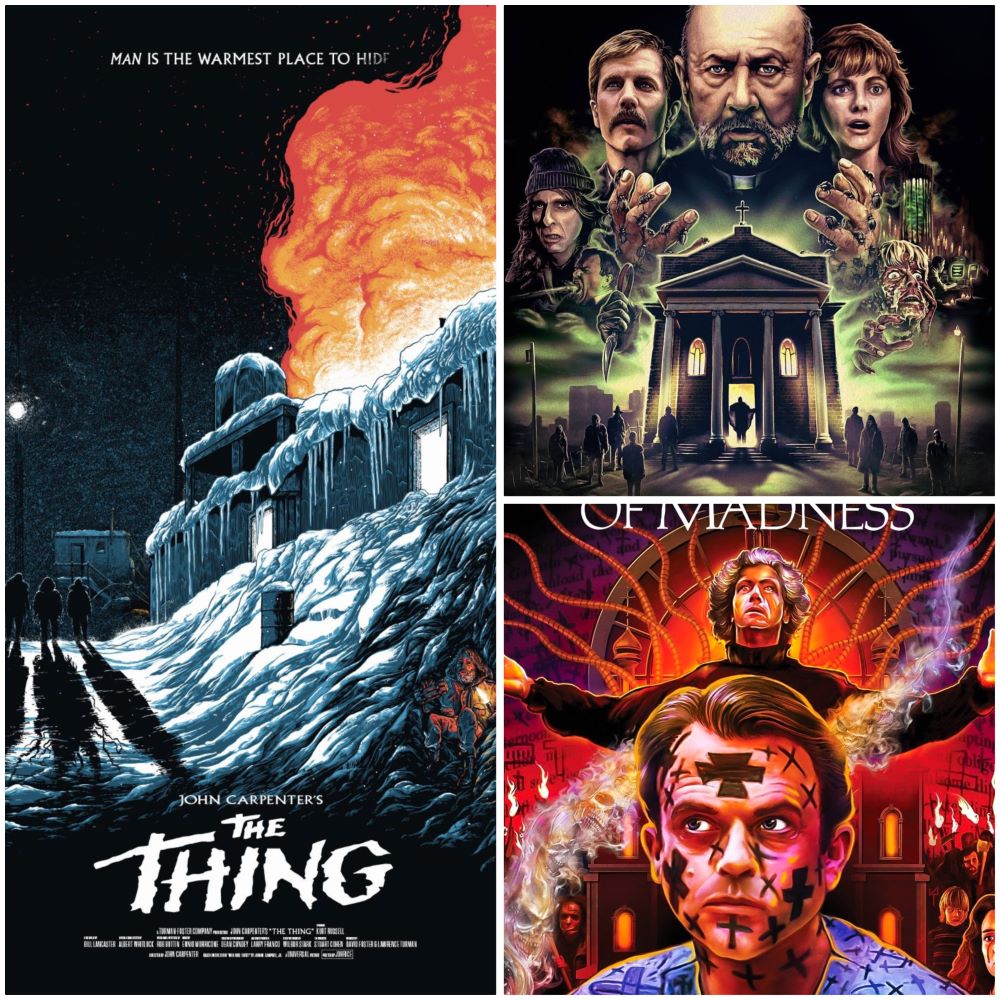
“Reality’s not what it used to be.” – Sutter Cane
John Carpenter’s Apocalypse Trilogy is widely regarded as a foundational pillar of modern horror cinema, uniting three seemingly diverse films—The Thing (1982), Prince of Darkness (1987), and In the Mouth of Madness (1994)—under a singular thematic and philosophical canopy. Together, they explore cosmic horror, a subgenre of horror fiction that emphasizes humanity’s profound insignificance in a vast, indifferent, and often hostile universe. This trilogy traces a carefully crafted trajectory of escalating menace—from tangible physical fears to metaphysical anxieties, culminating in deep epistemological crises. By doing so, Carpenter’s trilogy challenges the audience’s very perceptions of reality, identity, and trust, pushing viewers to confront existential questions cloaked within horror narratives.
This study offers a comprehensive analysis of each film in sequence, revealing their major thematic concerns and unpacking Carpenter’s distinctive stylistic choices that unite the trilogy into one cohesive vision of apocalypse and despair. The analysis reveals that the trilogy extends beyond horror storytelling, engaging instead with the anxieties surrounding human perception, the limitations of knowledge, and cosmic insignificance.
John Carpenter is celebrated for his ability to move beyond conventional scares, crafting atmospheric and philosophical horror that delves deeply into existential dread. While his debut with Halloween secured his place in slasher cinema, Carpenter’s Apocalypse Trilogy marks his most profound engagement with the tradition of cosmic horror, heavily influenced by the works of H.P. Lovecraft. These films focus less on conventional monsters and more on entities and forces beyond human comprehension that systematically erode sanity, faith, and the familiar social order.
In essence, Carpenter’s cosmic horror examines the frailty of human understanding in the face of vast, unknowable forces. His films suggest that the perceived stability of reality, morality, and identity are slender constructs that can unravel rapidly when exposed to those cosmic truths. This philosophical underpinning provides the connective tissue for the trilogy, positioning it as a sustained meditation on humanity’s precarious and often deluded sense of place within the universe.
Carpenter combines his hallmark minimalist aesthetic with unsettling soundscapes to create settings steeped in dread and uncertainty. These environments refuse to offer comfort or clarity. Instead, they become spaces where reality’s veneer thins, paranoia grows, and the audience is drawn into the slow disintegration of order.
The trilogy begins in the frozen desolation of an Antarctic research station—a brutally unforgiving landscape depicted through Carpenter’s distinct minimalist style. The opening, consisting of sweeping, stark aerial shots paired with Ennio Morricone’s haunting bass synth score, plunges viewers into an environment defined by isolation and claustrophobia.
The physical environment functions as an active force in the story, enhancing tension and alienation. It becomes impossible for the characters—and the audience—to escape the oppressive atmosphere, emphasizing themes of entrapment and despair.
Carpenter’s adaptation of Campbell’s Who Goes There? foregrounds psychological horror, centering around an alien organism that perfectly imitates any living creature it infects. This ability destroys the survivors’ social cohesion, as the possibility that anyone might be the alien breeds constant suspicion and fear. The alien infection acts metaphorically, symbolizing humanity’s deepest anxieties about identity, otherness, and contamination.
Rob Bottin’s practical special effects remain iconic, transforming the concept of body horror into palpable cinematic terror. Scenes such as the infected dogs blending with the humans visually communicate the indivisibility of friend and foe, reinforcing the thematic belief that not even one’s own body is fully trustworthy.
The film’s ambiguous finale, where the surviving characters share an uneasy, silent distrust, masterfully underscores existential despair. Echoing Sartre’s famous assertion that “Hell is other people,” Carpenter closes with no clear resolution, reinforcing a bleak worldview that permeates the entire trilogy.
The second chapter shifts from Antarctic physicality to a metaphysical siege within a Los Angeles church, where scientists and clergy confront a cryptic green liquid imprisoning an ancient quantum entity identified as Satan. Carpenter weaves a thematic collision between faith and science, positioning the characters in a supernatural standoff that tests the limits of rational belief.
This paradigm collision is central to the film’s tension. Characters engage in empirical inquiry and theological reflection, yet neither fails to fully grasp or control the cosmic forces unleashed. Dreams broadcast across neural networks, quantum mechanics concepts, and disorienting visions unravel the sense of coherent reality and blur lines between the physical and the spiritual.
Mirrors act as critical motifs, symbolizing portals or gateways that problematize identity and perception. As reality itself becomes infected and fractured, the boundaries between natural and supernatural, self and Other, disintegrate. This thematic decay anticipates the disintegration of reality that reaches its apex in In the Mouth of Madness. The siege allegory encapsulates humanity’s futile attempts to impose order over chaos.
The trilogy culminates in a meta-textual horror narrative tracing John Trent, an insurance investigator ensnared by the vanishing horror novelist Sutter Cane. This film explores the erosion of reality and identity as Trent journeys into a fictional world that becomes concrete, gradually dissolving the distinctions between fact and fiction, sanity and madness.
Drawing explicitly on Lovecraftian ideas of forbidden knowledge and cosmic despair, Carpenter situates the archetypal theme in a modern media environment. Cane’s novels exert a parasitic force upon readers, triggering apocalyptic psychological and ontological shifts that implicate society itself.
The narrative layering intensifies to a climax wherein Trent watches a film adaptation of his destructive unraveling, collapsing the barrier between spectator and spectacle. This recursive structure evokes chilling reflection on the instability of identity and reality.
The phrase “losing me” becomes a haunting leitmotif. Characters’ gradual loss of selfhood illustrates cosmic horror’s existential core: the dissolution of individuality under the weight of incomprehensible cosmic forces, a theme central to the trilogy as a whole.
This collection of films explores a profound and unsettling meditation on humanity’s place in an uncaring, vast cosmos, using horror as a lens to examine themes of isolation, paranoia, faith, knowledge, and the tenuous nature of reality. Without explicitly presenting themselves as a connected series, they create a rich thematic tapestry that invites viewers to contemplate not only external terrors but the fragility of human systems meant to protect meaning and identity.
The opening confronts the visceral and physical: a mysterious alien force invades bodies, dissolving trust and social cohesion. This invasion is deeply symbolic, reflecting fears of contamination, loss of self, and the breakdown of community ties. The body becomes a battleground where identity is no longer stable, and the enemy might be anyone—including oneself. This phase grounds horror in concrete fears but already sows the seeds of existential uncertainty.
From there, the narrative moves to a metaphysical plane where science, religion, and philosophy—humanity’s traditional pillars of understanding—struggle and fail to contain an ever-spreading cosmic evil. This shift from physical threat to metaphysical chaos illustrates how human knowledge and faith are insufficient to explain or confront the vast, dark unknown. The intermingling of scientific inquiry and religious dread reveals a universe that defies compartmentalized understanding, forcing a reckoning with ambiguity and the unknown. With reality itself starting to fray at the edges, the threat becomes more abstract yet no less terrifying.
The final movement confronts the fragility of perception and reality itself. As realities collapse, identities dissolve, and narrative and truth blur, the horror becomes psychological and epistemological—loss of sanity, loss of self, loss of a stable world. This breakdown reveals the highest level of terror, where nothing can be trusted, no truth is certain, and reality is malleable. It captures the profound human fear of mental disintegration and the obliteration of meaning in an indifferent universe.
Together, these stages chart a journey from external bodily threat to metaphysical disruption and ultimately to existential collapse. They reveal horror not just as fear of outward monsters but as internal decay of mind, belief, and identity, underscoring human vulnerability not only to external forces but to the fragility of cognition and existence. This arc reflects deep anxieties about human limitations: no matter the knowledge or faith, cosmic forces remain beyond control, making certainty an illusion. By layering escalating horrors, the films engage on emotional and intellectual levels, inviting lasting reflection on fear, reality, and humanity’s place in the cosmos.
Across all three films in John Carpenter’s Apocalypse Trilogy, the limits of human knowledge are a central theme. Characters—whether scientists, clergy, or ordinary people—try to impose order and meaning on forces they cannot understand or control. But they consistently face phenomena far beyond their cognition, revealing the fragility of human certainty. This motif challenges anthropocentrism and critiques human arrogance by exposing absolute truth and certainty as illusions in a vast, indifferent cosmos.
In The Thing, the alien defies identification or control, sowing paranoia among the survivors. Scientific tests fail, and certainty dissolves into fear that anyone could be the monster. The alien symbolizes the unknown randomness and uncontrollability threatening human identity and social bonds.
Prince of Darkness deepens this theme by confronting the limits of both science and faith. A cosmic evil trapped in a mysterious liquid defies both scientific and religious understanding. The film blurs boundaries between science, theology, and metaphysics, suggesting human knowledge is incomplete and vulnerable to forces beyond comprehension. The inevitability of apocalypse underscores the insufficiency of human understanding.
In In the Mouth of Madness, epistemological collapse is central. Reality and fiction merge, and the protagonist loses grip on truth. Carpenter suggests reality depends on belief and narrative, making truth unstable. This reveals the ultimate vulnerability of human cognition and identity.
Together, these films show that no human system—scientific, religious, or cultural—can fully grasp or control the universe’s nature. This breeds existential horror, highlighting human fragility and limited knowledge on a cosmic scale.
Carpenter’s trilogy aligns with Lovecraftian cosmic horror, updating its themes with contemporary anxieties. The films go beyond simple scares to challenge viewers to confront the fragility of knowledge, reality, and identity, giving the trilogy lasting philosophical weight and emotional power.
Carpenter’s hallmark minimalist style is a key part of what makes the Apocalypse Trilogy so effective and enduring in its impact. His careful framing often restricts what the audience can see, focusing attention on essential details while leaving much to the imagination. This approach compels viewers to fill in unseen gaps themselves, which creates heightened suspense and engages the viewer’s own fears. Rather than overwhelming the audience with explicit gore or frantic action, subdued movements and carefully controlled pacing allow tension to build slowly and organically. This slow burn style deepens engagement by forcing the audience into a state of heightened alertness and anticipation.
Carpenter’s sound design is equally important to the films’ mood. Low-frequency drones and eerie synth scores envelop viewers in an unsettling sonic atmosphere that mirrors the creeping dread in the story. These soundscapes don’t seek to startle but to create pervasive unease—a feeling that danger lurks just beyond perception. The music often mimics the alien or supernatural presence itself—unpredictable, cold, vast—helping to reinforce themes of existential dread and the incomprehensibility of the cosmic forces involved.
The combination of minimalism in visuals and sound creates a liminal space where reality feels unstable and disorienting. Audiences experience not only the narrative horror but also a profound sense of ambiguity and existential uncertainty. This stylistic restraint deliberately avoids clear answers or visual excess, underlining the theme that the real terror is ineffable and beyond human understanding. The unknown and unseen become the most frightening elements, much in line with the tradition of cosmic horror that Carpenter’s trilogy embodies.
In addition, ambiguity in character behavior and narrative direction invites multiple interpretations. Questions are often left unanswered—What exactly is the alien’s goal? How much control do the characters really have? What is the nature of the “darkness” in Prince of Darkness? This lack of closure compels viewers to wrestle with uncertainty and the limits of human cognition, mirroring the trilogy’s philosophical concerns.
In integrating this stylistic mastery, Carpenter crafts a cinematic experience that is not merely about monsters or scares but about immersing viewers in the unsettling, unstable space where human understanding falters. This immersive uncertainty evokes the core cosmic horror concept: that our place in the universe is fragile, our perceptions unreliable, and the forces around us ultimately unknowable.
These three films transcends traditional horror by engaging deeply with contemporary anxieties about faith, knowledge, identity, and the influence of mass media on how reality is perceived. It reflects the emotional and intellectual struggles of postmodern individuals trying to navigate a fragmented, uncertain world. Rather than offering simple resolution or catharsis, Carpenter’s bleak vision portrays apocalypse as a slow, creeping dissolution of human confidence and coherence. This approach adds philosophical weight and emotional resonance that have secured the trilogy’s lasting impact on horror cinema and cosmic horror traditions.
The films challenge viewers to confront fears beyond the supernatural or monstrous, focusing instead on the fragility of belief systems and the vulnerability of identity in a world where truth is unstable. By threading themes of epistemological uncertainty and spiritual crisis throughout, the trilogy mirrors the postmodern condition, where mass media distorts reality, and personal and collective certainties erode. Carpenter’s work thus becomes an exploration not only of cosmic terror but also of cultural disintegration and psychological fragility.
This subtextual richness extends the trilogy’s legacy beyond genre boundaries, influencing later horror films and narratives that explore existential dread and the human condition’s limits. The trilogy’s refusal to simplify or resolve its themes encourages ongoing reflection on the nature of fear, reality, and human understanding — making it a profound philosophical statement as well as a cinematic achievement.
The Enduring Power of Carpenter’s Dark Vision
The Apocalypse Trilogy by John Carpenter is far more than a collection of horror films; it is a profound meditation on humanity’s fragility, the dissolution of trust, and the shattering of reality itself. Through The Thing, Carpenter explores the primal fear of isolation and the collapse of social bonds when faced with an enemy that hides among us, perfectly embodying the horror of paranoia and mistrust. Moving into Prince of Darkness, the trilogy confronts the collision of science and faith, unraveling the foundations of knowledge and belief as cosmic evil seeps into the rational world and forces characters to confront metaphysical chaos. Finally, In the Mouth of Madness pushes this existential crisis to its zenith, dismantling the very concept of reality and identity through a meta-narrative that implicates not only its characters but also its viewers in the apocalypse of the mind.
What ties these films together, beyond surface narrative dissimilarities, is their shared thematic obsession with the limits of human understanding and the erosion of the self. Each film intensifies the scale of horror—from bodily invasion to spiritual contagion to the complete annihilation of the individual’s perception of reality—revealing Carpenter’s uniquely bleak worldview steeped in Lovecraftian cosmic horror. Through restrained yet evocative stylistic choices, utilizing minimalist visuals and sound design, Carpenter immerses audiences in atmospheres of claustrophobia, dread, and creeping madness. This underlines a core message: true horror lies not in external monsters but in the internal unravelling of everything we rely on—trust, faith, and the coherence of reality.
The Apocalypse Trilogy is a quintessential study of “losing me,” a phrase echoed in In the Mouth of Madness but foreshadowed throughout the series. It captures a universal existential anxiety about identity’s fragility in the face of implacable, incomprehensible forces. Carpenter’s films, in their relentless exploration of despair and dissolution, resist offering hope or redemption, instead presenting apocalypse not as spectacular destruction but as a slow, inevitable erosion of the human condition itself.
John Carpenter’s Apocalypse Trilogy stands as a landmark achievement in horror cinema and cosmic horror literature adaptation. It confronts viewers with unsettling questions about what makes us human and how easily those foundations may crumble. More than a trilogy of scares, it is a dark genius unfolding in three acts—charting a terrifying journey “from isolation to madness” that challenges the very nature of reality, faith, and the self. It demands that we not only watch the horror but reckon with the unsettling possibility that within each of us lies the capacity for both fear and dissolution in equal measure.

“Revenge reveals the darkest reflection we hide within.”
Horror cinema has long functioned as a reflective surface, exposing humanity’s deepest fears, desires, and moral uncertainties. The films I Saw the Devil (2010), Cold Fish (2010), and Revenge (2017) serve as “blood mirrors,” revealing not merely the visceral violence inflicted upon their characters but also the profound psychological and ethical transformations that vengeance ignites. Emerging from South Korean, Japanese, and French cinematic traditions, respectively, these works reconceptualize the trauma of retribution into nuanced explorations of identity, power, justice, and morality. This essay unpacks how such acts of revenge fracture and distort the avengers themselves—blurring the boundary between hunter and hunted—and challenge audiences to consider the complicated ethics of vengeance.
Kim Jee-woon’s I Saw the Devil opens with searing loss. Government agent Kim Soo-hyun’s fiancé is gruesomely murdered by the psychopathic serial killer Jang Kyung-chul. Rather than delivering immediate justice, Kim embarks upon a merciless cycle of capture and release aimed not at ending Kyung-chul’s life but extending his suffering to mirror the anguish Kim feels. This circular vengeance becomes a vehicle for exploring grief’s corrosive power, blurring the avenger’s and victim’s identities.
The film’s structure, with its repetitive cat-and-mouse dynamic, becomes a visual metaphor for obsession and moral degradation. With every brutal encounter, Kim sacrifices more of his humanity, evolving into the very monster he’s vowed to destroy. Lee Mo-gae’s cinematography blends stark clinical detachment with visceral brutality; meticulously framed shots contrast vividly with the film’s emotional chaos, compelling the audience into uncomfortable identification with Kim’s dark crusade. The snowy landscapes and cold colors evoke spiritual desolation, emphasizing the film’s existential chill.
Kim’s work transcends procedural thriller conventions by resisting catharsis—vengeance is portrayed not as liberation but endless torment. Critics laud the film for masterfully challenging traditional revenge narratives by suggesting that acts of retribution can perpetuate cycles of violence, consuming both victim and perpetrator. The tension not only lies in physical danger but in the moral disintegration of a man who becomes what he hates.
Sion Sono’s Cold Fish presents revenge as an eruption of buried rage within the façade of mundane suburban existence. The gentle tropical fish store owner, Nobuyuki Syamoto, leads a restrained, law-abiding life until meeting the domineering and psychopathic Murata. Their relationship becomes a dance of psychological and physical domination, exposing latent violence simmering under cultural conformity.
Unlike the clinical precision of I Saw the Devil, Cold Fish captures chaos and collapse. Syamoto’s eventual violent revolt is neither heroic nor cathartic but an enactment of existential despair born of oppressive social codes emphasizing politeness, hierarchy, and silence. The oppressive suburban setting becomes almost a character itself—sterile, suffocating, and emotionally barren. The circling fish motif highlights the recursive cycles of repression and violence that trap the characters.
Sono’s cinematic approach balances absurdist, at times black humor with grim horror. This tonal dissonance destabilizes viewer complacency, forcing reflections on how individual suffering is structured and concealed by social and cultural norms. Syamoto’s dissolution challenges viewers to reconsider traditional narratives of justice and victimhood, emphasizing the fragility of identity under systemic pressures.
Coralie Fargeat’s Revenge radically revisits the “rape and revenge” genre notorious since 1970s grindhouse cinema. While drawing inspiration from films like I Spit on Your Grave and The Last House on the Left, Revenge rejects those works’ often exploitative male gaze, recasting the survivor’s story through a fully realized lens of autonomy and violent reclamation.
Jen’s transformation—from a sexualized object within a hyper-saturated, colorful visual palette to a mythic force of nature marked by the symbolic phoenix brand—signifies death and rebirth. Fargeat’s use of chiaroscuro lighting, surreal settings, and visceral violence elevates physical trauma to the level of mythic metamorphosis.
This film subverts traditional victim and villain binaries. Jen’s ascent dismantles deeply embedded patriarchal structures, underscoring a reclamation of body, gaze, and power. The climactic chase, drenched in blood and primal energy, becomes a ritualistic unshackling rather than mere revenge. Through this revival of grindhouse aesthetics, Fargeat forges a new grammar of feminist survival and cinematic empowerment.
These films foreground power dynamics traditionally gendered but reinterpreted here in ways promoting gender-neutral critique. In Cold Fish, toxic masculinity manifests as violent domination versus passivity within strict social codes, both Syamoto’s submission and Murata’s cruelty reinforcing systemic violence.
I Saw the Devil portrays injured masculine pride and control as drivers of vengeance. Kim’s obsession symbolizes fragile protector ideals collapsing into moral ruin. Female characters often exist as symbolic voids, underscoring systemic gender violence and erasure.
Revenge, by contrast, deconstructs these codes. Jen transcends rigid gender norms and victimhood, suggesting power as a fluid, elemental force beyond biology. The film’s desert setting serves as a symbolic womb of transformation, projecting possibilities of autonomy and sovereignty through defiance of hierarchical structures.
Each film emerges from distinct cultural anxieties and historical trajectories. I Saw the Devil reflects South Korean skepticism about institutional justice amid rapid modernization and lingering traditionalism. Private vengeance becomes a desperate, isolating reaction to systemic failure.
Cold Fish critiques a Japanese culture steeped in social conformity and emotional repression, revealing the violent potential beneath controlled civility. The film reflects post-war tensions and growing awareness of societal alienation.
France’s Revenge draws from the New Extremity movement, blending philosophical and visceral approaches to suffering, reflecting intellectual and artistic responses to modern oppression. Fargeat’s fusion of grindhouse with feminist critique signals contemporary cultural struggle for voices outside dominant systems.
The narrative architectures differ but complement one another. I Saw the Devil’s repetitive structure illustrates cyclical moral decay; Cold Fish depicts downward spiral into absurd chaos; Revenge follows mythic death-and-rebirth arc.
Their visual languages communicate complex ethical positions: Kim’s symmetrical, controlled shots reflect calculated cruelty; Sono’s frenetic, disorienting camera work conveys mental disintegration; Fargeat’s vivid, stylized imagery channels surreal transcendence.
Each film implicates the viewer uniquely. I Saw the Devil seduces with calculated violence; Cold Fish overwhelms with chaotic brutality; Revenge reorients the gaze empathetically to survivor experience. Together, they articulate a profound inquiry into horror spectatorship and ethical engagement.
These films manifest collective crises of modernity—gendered hierarchies, failed justice, fractured communities—within intimate personal revenge stories. They diagnose alienation and fragmentation, transforming revenge into language for voicing trauma and injustice. This intersection exposes how power, violence, and identity intertwine in contemporary cultural narratives.
Ultimately, I Saw the Devil, Cold Fish, and Revenge frame horror as a meditation on transformation rather than pure evil. Vengeance reshapes the self, often toward destruction. Kim becomes the hunted devil; Syamoto lives his oppressor’s violence; Jen transcends human limits through fiery renewal.
Together, they depict revenge as curse, collapse, and painful rebirth—a global meditation on violence and selfhood. Their shared revelation: revenge unmasks the darkness dwelling quietly within us all, proving that horror’s deepest mirror reflects ourselves.
 Through the Shattered Lens