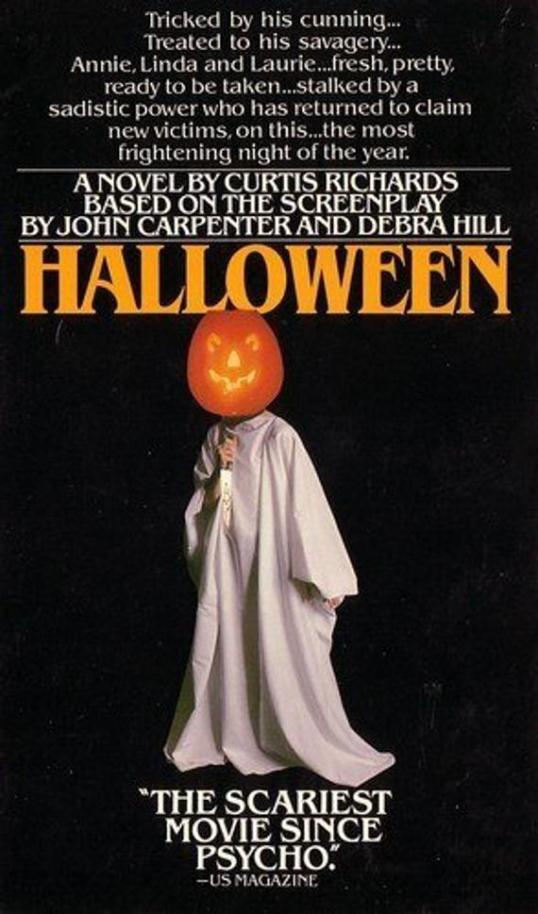
Horror Book Review: Halloween by Curtis Richards


This is not an easy book to find.

Based on John Carpenter and Debra Hill’s original script for Halloween (which is a fancy of saying that it features scenes that were either not shot or left on the cutting room floor), Curtis Richards’s novelization of Halloween was published in 1979 and it went out of print in the 80s.  It’s subsequently become popular with both horror fans and paperback collectors.  On Amazon, you can order it used for $123.

Of course, if you’re lucky like me, your cousin might have a copy and he might be willing to loan it to you for the weekend.  Boom!

The novelization of Halloween tells the same basic story as the film, just with a few important differences.  For instance, the novelization doesn’t open in Haddonfield, Illinois.  Instead, it opens in Northern Ireland, at the “dawn of the Celtic race.”  It tells about how a disfigured young man named Enda went mad and killed the king’s daughter on the eve of Samhain.  Enda’s murderous spirit was cursed to wander the Earth.

Jump forward several centuries and we’re in Haddonfield!  However, instead of opening with Michael murdering his sister, the novel spends a bit of time telling us about Michael’s family.  Much like Rob Zombie’s version of the story, the novelization of Halloween spends almost as much time detailing Michael’s background as it does “the night he came home.”  His grandmother fears that little Michael Myers might be dangerous.  Michael says that he hears voices, telling him to hurt people.  Could that be the voice of Edna?   It’s also revealed that Michael’s grandfather was a murderer who also heard voices, suggesting that the entire family is cursed.

Along with more information about Michael’s background, we find out more about Michael’s time at Smith’s Grove Sanitarium.  We learn more about Dr. Loomis, as well.  We discover that Loomis is married and that his son thinks that Loomis is kind of lame.  (Reportedly, during filming, Donald Pleasence specifically objected to a scene that would have established Loomis as a family man because he felt that Michael should be Loomis’s sole obsession.)  Michael, who actually does a talk a bit in the early part of the book, comes to control his wing of the sanitarium, largely because everyone is scared to death of him.  The book does a good job of showing how Loomis came to be convinced that not only was there no way to get through to Michael but that he was also pure evil.  Basically, if you’re a Sam Loomis fan, this is the book to read.

Once Michael escapes, the film pretty much settles into the story that we all know from the original film.  Laurie Strode and her friends are stalked by Michael on Halloween night while Loomis desperately searches for him.  The book does a good job of getting into Laurie’s mind while she’s being pursued by Michael.  If you’ve ever wondered why Laurie kept doing illogical things while being pursued by Michael, this book makes clear that she was in a state of shock.  Trust me — if you were being chased by Michael, you’d probably be so scared that you would make a lot of the same mistakes.  I know I would.

The Halloween novelization is surprisingly well-written.  Curtis Richards does a good job of bringing the characters to life, beyond just transcribing their dialogue.  He gets into the heads of Michael, Loomis, and Laurie and forces us to see the story through their eyes.  That said, the most interesting thing about the book is the chance to see what Carpenter’s original vision of the film would have looked like.   Whereas the finished film is a masterpiece of editing that keeps the focus almost entirely on Laurie being stalked, the book is just as concerned with what makes Michael tick.

It’s interesting to contrast why both the film and the book work.  The film works because Michael is largely motiveless.  He’s a force of malevolence and you can understand why Carpenter cut the scenes that went into Michael’s time at Smith’s Grove.  Those scenes aren’t necessary because all of that information is supplied to as visually and, by cutting the store down to only its absolute essentials, the film duplicated Michael’s relentless pace.  In the book, of course, you don’t have the benefit of Carpenter’s visuals.  The book would be pretty boring if it was just Michael showing up and killing people.  Instead, the book works because Richards takes the time to get into the heads of his characters and make them more than just killer and victim.  What wouldn’t have worked for the film works wonderfully for the book.  And vice versa.

Anyway, this novelization of Halloween is not easy to find but if you’re a horror fan, it’s worth the effort.

Horror Book Review: The Exorcist by William Peter Blatty


Which is better, the movie or the book?

That’s a question that’s often asked and I think the knee jerk reaction is always to say that the book was better but that’s certainly not always true.  There are a few notable cases where the film has been dramatically better than the book.  Just check out The Godfather, if you don’t believe me.  Occasionally, you’ll run into something like the recent two-part adaptation of Stephen King’s It.  The first film was dramatically better than the novel while the second film was significantly worse.

And then occasionally, you’ll have a case where the book and the movie are equally good, albeit for different reasons.  That’s the case with William Peter Blatty’s 1971 novel, The Exorcist.

The book and the movie both tell the same story.  Perhaps because Blatty served as both the writer and the producer of the film version, the movie sticks closely to the basic plot of his novel.  Regan McNeil, the daughter of an atheist actress named Chris McNeil, is possessed by a demon called Pazuzu.  It falls to Father Merrin and Father Karras to perform an exorcism.  Unfortunately, Merrin is old and in bad healthy while Karras fears that his faith might not be strong enough to defeat the demon.

Though the plot does remain the same, there are, of course a few differences between the film and the book.  As befits a novel written by a screenwriter, the book gets a bit more gossipy when detailing the production of Chris’s film.  The book also spends a good deal more time on Inspector Kinderman’s investigation into the deaths of characters like film director Burke Dennings.  In the film, Kinderman only appears in a few scenes.  In the book, he’s as important a character as Karras and it’s rather obvious that he was Blatty’s favorite character to write.  (It’s not a surprise that Kinderman was subsequently the main character in Legion, which was filmed as The Exorcist III and which starred George C. Scott as Kinderman.)  The book also spends a good deal more time on Karras’s crisis of faith.  In the film, Karras was portrayed as being initially hesitant to accept that Regan was possessed.  In the book, Karras researches the history of exorcisms and considers almost every other alternative before committing himself to performing the exorcism.  When the book was first published, those scenes were included to make the reader themselves question whether or not Regan was actually possessed.  Modern readers, however, already know that answer to that.

Myself, I appreciated the extra time that the novel spent with Kinderman and Karras.  As written by Blatty, they’re both engaging characters and Karras’s crisis of faith is actually handled with a good deal more skill in the book than in the movie.  If the movie is a nonstop roller coaster of terror, the book is a bit more thoughtful.  Whereas the movie shocks you into accepting its premise, the book actually tries to convince you that demons are real and that they’re responsible for the evil in the world.  (The books opens with a series of quotes from real-life dictators and mobsters.)  The movie aims for your gut while the book’s horrors are often more cerebral but they both get under your skin and inspire you to make sure that every door is locked and every window is closed.  Not that any of that would protect you, of course.  Both the movie and the novel understand that the scariest thing about what happens to Regan is that it’s out-of-her-control and could, in theory, happen to any of us.  Demons are going to do whatever they can.  Both the book and the film are fantastically effective and worthy of being known as horror classics.

This October, definitely be sure to watch The Exorcist and The Exorcist III.  Hell, maybe even watch The Exorcist II.  It’s not that bad!  (Okay, well, actually, it is.  But still, it’s kind of …. fun, in its way.)  But also take the time to read the books.  Doing one without doing the other is only getting half the story.

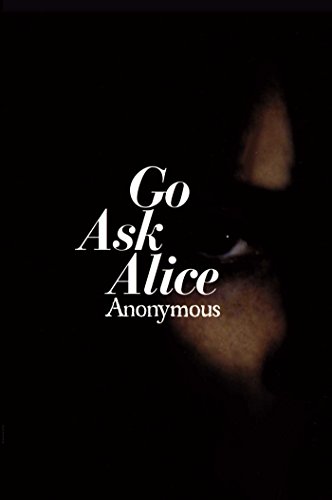
Book Review: Go Ask Alice by “Anonymous”


“Another day, another blow job,” writes the anonymous author of Go Ask Alice.

It’s only been a few months since she first dropped acid and smoked weed for the first time and the narrator has already run away from home and turned to prostitution to support her raging drug habit.  First published in 1971 and continuously in print since then, Go Ask Alice is presented as being the narrator’s journal, found amongst her belongings after she died of a drug overdose.  (Despite popular belief, the narrator is not named Alice.  Her name is never actually mentioned in the journal.)  That one line — “Another day, another blow job” — pretty much sums up Go Ask Alice.  It’s very dramatic.  Depending on who is reading it, it’s very shocking.  And it’s so perfectly quotable that it’s hard to believe that someone just scrawled it down in a journal.

Of course, some of that’s because Go Ask Alice isn’t actually a diary.  Though it’s never been officially confirmed, most researchers believe that it was actually written by Beatrice Sparks, a therapist who originally presented herself as being the diary’s editor.  Sparks later went on to “edit” several other anonymous diaries, all written by teenagers who had gotten involved with things like Satanism, eating disorders, and gang violence.

Even if I hadn’t read (on, I’ll admit it, Wikipedia) that Go Ask Alice was not actually written by a 15 year-old girl, it would be obvious just from some of what it is written in the diary.  I reread it a few weeks ago and the thing that immediately jumped out at me was that the narrator apparently didn’t write much about anything that didn’t have to do with drugs.  There’s none of the banal stuff that you would typically expect to find in someone’s personal journal.  The narrator doesn’t mention television or movies or music or books.  She barely even talks about the boy she likes, other than to mention that he exists and she’s not sure if he likes her back.  Instead, she pretty much goes straight from drinking a coke that’s been dosed with acid to running away to Berkeley.  She spend several hundred words meticulously detailing an acid trip but she tells us very little about anyone that she goes to school with.  (And I have to say that, for someone who has just taken acid for the first time, she’s remarkably coherent and detailed when it comes to writing about her trip.)  She also includes a lot of statistics about how how many people her age are estimated to have experimented with drugs, which doesn’t doesn’t seem like the usual behavior of a 15 year-old addict.  It’s not something that I would have done at 15 and, trust me, I was a very smart 15 year-old.  (It’s vaguely like something you would expect to hear in an old sitcom.  “Can you believe it?  That child’s 15 years old and already hooked on speed.”  “Oh, honey, it’s not that unusual.  I was reading an article that said 40% of children under the age of 16 have tried some sort of narcotic substance.”)

Another thing that I found to be interesting about Go Ask Alice is how generous everyone was with their drugs.  Even after the narrator goes through rehab, her classmates still walk up to her and casually drop drugs in front of her.  Maybe it’s a generational thing but my experience in high school was the exact opposite.  At my high school, the few people who regularly had drugs tended to be pretty stingy with them.  They certainly weren’t going to waste any just to play a joke on someone.  (Indeed, I’ve never been able to relate to people who claim that people pressured them into trying drugs because, at my high school, everyone was too greedy to share.  “You want a hit off this joint?  This is mine, get your own!”)  But I guess that maybe in 1971, drugs were cheaper and people just had a more generous spirit.

Anyway, Go Ask Alice is a quick read and it fulfills the number one rule of successful propaganda: it takes it story to the worst possible conclusion, even though a less dramatic conclusion would have been more realistic and perhaps more effective.  From the minute you start reading the diary, you know that the diarist is going to end up dead of a drug overdose because that’s the type of story that Go Ask Alice is.  Over the course of a year, our narrator goes from being sweet and innocent to being dead because stories like this don’t work unless the narrator dies at the end.  Simply having the narrator write, “I did a lot of drugs and I wish I hadn’t but now I’m going try to rebuild my life,” just does’t carry the same punch as, “A week later, the writer of this diary was found dead of an overdose.”  Go Ask Alice understands the importance of embracing the melodrama and it does so fully.  As a result, it’s not as convincing as a realistic look at drug abuse would have been but it’s considerably more entertaining.

Go Ask Alice was a huge success when it was first published.  They even turned it into a movie, which can currently be viewed on YouTube and Prime.  Somewhat inevitably, William Shatner’s in it.   The movie is actually better than the book but you should read the book as well, if just to see what frightened your grandparents back in the day.

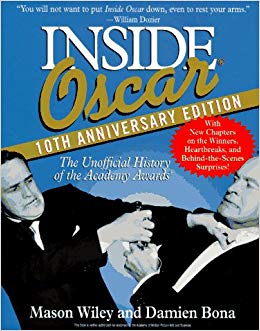
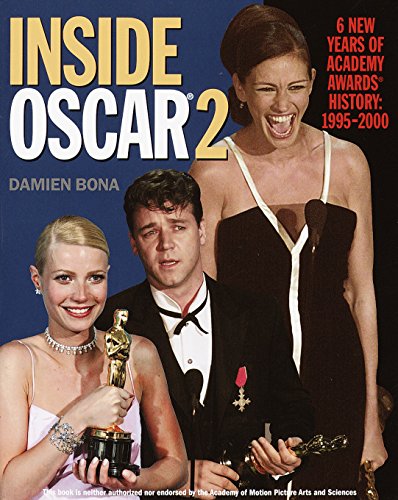
Book Review: Inside Oscar by Mason Wiley and Damien Bona and Inside Oscar 2 by Damien Bona


If you’re an Oscar fanatic or if you’re just a film lover who thinks that the Oscars are a joke, these are two books that you simply have to have.

As you can probably tell from the titles, Inside Oscar and Inside Oscar 2 are all about the Academy Awards.  Inside Oscar starts with the founding of the Academy and ends with the 1994 Oscar ceremony.  Inside Oscar 2 picks up with the 1995 ceremony and takes us through the year 2000.  The books were written by two Oscar fanatics and, as a result, it contains just about every bit of trivia that you could hope to find about the Academy, the Oscars, and Hollywood during the previous century.  (Unfortunately, both Mason Wiley and Damien Bona have passed away so we probably won’t be getting an Inside Oscar 3.)  The books contain not only every detail that you could possibly want about the ceremonies themselves, they also touch on what was going on in America and the rest of the world during each year.  For example, it’s quite interesting to read about how different the 1958 Academy Awards ceremony was to the 1968 ceremony.  (Essentially, in 1968, longtime Oscar host Bob Hope made a joke about the ceremony being moved back a few days out of respect for the recently assassinated Martin Luther King, Jr.  For the first time in Oscar history, the audience booed one of the host’s jokes.)  As a result, Inside Oscar and its sequel aren’t just books about Hollywood.  In their way, they also serve as an examination of the ever changing cultural and political landscape of the United States.

It’s not just the books are full of snarky details, though they are.  It’s also that the books serve as a great reference to the history of the Oscars.  In the appendixes, you’ll find every year’s list of nominees, some genuinely interesting trivia, and — perhaps most importantly — a list of notable films (and, in some years, songs) that were not nominated.  As you might guess, it’s those lists of unnominated films that I find especially interesting.  Every year, some very good films are ignored by the Academy.  That was true in the past and it’s true in the present and it will probably continue to be true in the future.

Taken together, Inside Oscar and Inside Oscar 2 are the two best reference books out there for film lovers like you and me.

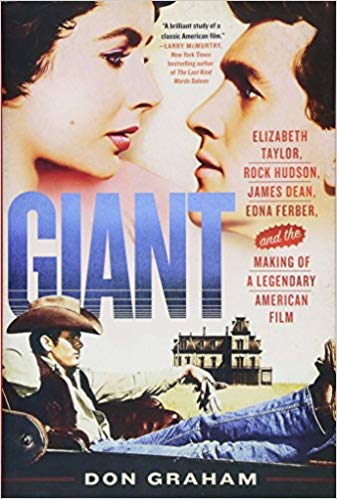
Book Review: Giant — Elizabeth Taylor, Rock Hudson, James Dean, Edna Ferber, And The Making Of A Legendary American Film by Don Graham


Wow, that Edna Ferber sure was a bitch.

That was my first thought as I read Giant, Don Graham’s history about the making of the film of the same name.  In the early 50s, Edna Ferber, a writer who was born in Michigan, raised in Wisconsin, and lived in New York, wrote a novel about Texas.  The novel was called Giant and it told a story of ranchers, oilmen, and casual racists.  It was meant to be an attack on Texas, a warning to the rest of the country to not allow itself to turn into Texas.  Ferber presented Texas as being a land where everything was big and everyone owned a jet and an oil well and all the rest of the usual stereotypes.  When Ferber’s novel was turned into a movie, she was apparently not happy to discover that the film was not the vehement denunciation of the state and its citizens that she wished it to be.  In Don Graham’s book, Edna Feber often seems to be hovering in the background of every scene, throwing a fit about every detail of the movie.  She comes across as a certain type of character that every Texan has had to deal with: the angry Northerner who can’t understand why we’re not as impressed with them as they are.

That’s not to say that Giant, as a film, was blindly pro-Texas.  The film featured a subplot that deal with the prejudice that Mexicans faced in Texas.  But the film also indicated that things could change and that people could grow and that was something that Ferber apparently did not agree with, at least as far as Texans are concerned.

If Graham’s entire book was just about Ferber’s displeasure with Giant, it would make for a fairly tedious read but, fortunately, Edna Ferber is just a minor part of the sprawling story that Graham tells.  Instead of worrying too much about Ferber, Graham focuses on the filming of Giant and how it not only brought Hollywood to the citizens of Marfa, Texas but also what it meant to George Stevens, the film’s director and it’s three stars, Rock Hudson, Elizabeth Taylor, and James Dean.  Giant was the film that proved that Elizabeth Taylor could act.  It was also the film that brought Rock Hudson some rare critical acclaim.  And, perhaps most importantly, it was the last film that James Dean made before his death.

Perhaps not surprisingly, the book is at its most interesting when it deals with James Dean.  Graham does not make the mistake of blindly idolizing Dean.  Indeed, Dean often comes across as a brat.  Graham writes about Marlon Brando’s well-known dislike of Dean but he also shares anecdotes from the set that reveal that Dean was incredibly talented but also very self-destructive.  Reading about Dean’s behavior and his frayed relationship with George Stevens, one gets the feeling that, even if he had survived the car accident, Dean’s acting career probably would never have survived his own self-destructive impulses.  Graham celebrates Dean’s talent without idealizing his character.

Much as in the movie, Rock Hudson is frequently overshadowed by Dean.  In the book, Hudson comes across as being …. well, he’s come across as being a bit of a jerk.  Elizabeth Taylor, on the other hand, comes across as being driven, fragile, and committed to her stardom.  She also comes across as possessing an unexpectedly sharp wit.  If both Dean and Hudson were both a bit too self-impressed, Taylor possessed the knowledge of someone who had spent her entire life in the film industry.

Don Graham’s Giant is an entertaining book. Full of anecdotes and more than a little bit juicy speculation about what went on behind the scenes, Giant is a great read for Texans and film fans alike!

Lisa Marie’s Top 10 Novels of 2019


  1. This Storm by James Ellroy
  2. A Friend Is A Gift You Give Yourself by William Michael Boyle
  3. Imaginary Friend by Stephen Chbosky
  4. The Girl in Red by Christina Henry
  5. The Lost Night by Andrea Bartz
  6. The Twisted Ones by Ursula Vernon as T. Kingfisher
  7. One Night At The Lake by Bethany Chase
  8. Sherwood by Meagan Spooner
  9. An Anonymous Girl by Greer Hendricks and Sarah Pekkanen
  10. Blood Oath by Kelly St. Clare and Raye Wagner

Lisa Marie’s Top 10 Non-Fiction Books of 2019


  1. White by Bret Easton Ellis
  2. Best. Movie. Year. Ever.: How 1999 Blew Up the Big Screen by Brian Raferty
  3. Monster, She Wrote: The Women Who Pioneered Horror and Speculative Fiction by Lisa Kruger and Melanie Anderson
  4. Catch and Kill by Ronan Farrow
  5. The Lady from the Black Lagoon: Hollywood Monsters and the Lost Legacy of Milicent Patrick by Mallory O’Meary
  6. Make My Day by J. Hoberman
  7. Boom: Mad Money, Mega Dealers, and the Rise of Contemporary Art by Michael Snayerson
  8. The Trial of Lizzie Borden by Cara Robertson
  9. Justice on Trial by Mollie Hemingway and Carrie Severino
  10. Hollywood’s Eve: Eve Babitz and the Secret History of L.A. by Lili Anolik

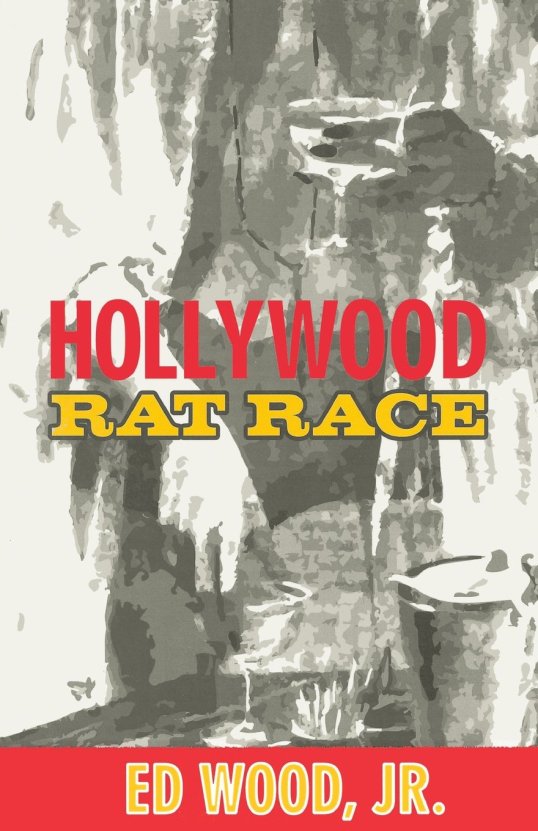
Book Review: Hollywood Rat Race by Ed Wood, Jr.


Are you a teenager in the late 50s or the early 60s?

Are you planning on running off to Hollywood to become a star?

Do you need someone to tell you what to expect once you find yourself on the Boulevard of Broken Dreams?

Hollywood’s most successful director — the one and only Ed Wood, Jr. — is here to help!

Okay, maybe I’m going a little bit overboard with the hyperbole here.  Though Ed Wood is today best known for being played by Johnny Depp in a Tim Burton film, he was not just a movie character!  Nor was just a filmmaker!  Ed Wood was also an author.  When Wood didn’t have the money to make a movie, he would write a book.  In fact, it’s speculated that Wood actually made more money writing books than he did making movies.

Unfortunately, the majority of these books have been lost to time.  The ones that survive are generally either sex manuals or pulpy novels about hitmen who love to wear angora.  However, Hollywood Rat Race was Wood’s attempt to write, in the first person, about the industry and the city that he both loved and hated.  Hollywood Rat Race is Wood’s warts-and-all look at the film industry.  It’s his guide for how to make it in Hollywood.

What is Wood’s advice?

Be physically attractive.  Do whatever the director tells you to do.  Don’t be shocked when an executive chases you around a desk.  Sleep your way to the top if you have to but just be aware that no one will respect you once you get old.  Wood presents Hollywood as being a cold and unfeeling place but, at the same time, he also describe working in movies and television as the greatest career that anyone could hope for.  Wood will often start a chapter on a cautionary note but his enthusiasm for Hollywood always wins out in the end.  Reading the book, you realize that Wood loved the business too much to reject it, even if it did often reject him.

Hollywood Rat Race is not, despite what is claimed on the book’s back cover, a memoir.  Not really.  Yes, Wood does mention that he was friends with Bela Lugosi.  And he does talk about how Tom Tyler came out of retirement to appear in Plan 9 From Outer Space.  He mentions thar another member of his stock company didn’t complain about being attacked by an octopus in Bride of the Monster.  But those looking for juicy behind-the-scenes stories will be disappointed.  Instead, the book gives the impression that every experience Wood ever had with an actor or a film was a positive one.  Rather touchingly, it’s kind of easy to see Hollywood Rat Race as representing the Hollywood that Ed Wood dreamed of, as opposed to the Hollywood where Wood eventually went broke and drank himself to death.

Hollywood Rat Race was not published in Wood’s lifetime.  He wrote it shortly after the release of Plan 9 but the book was not published until after Tim Burton’s film reignited interest in Wood in 1994.  It’s a good book for all of he Wood completists out there.

And, before anyone asks, yes — he does recommend wearing an angora sweater to your next audition.

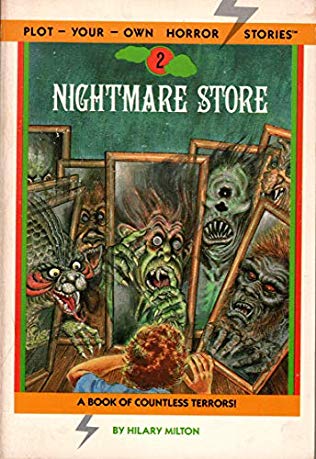
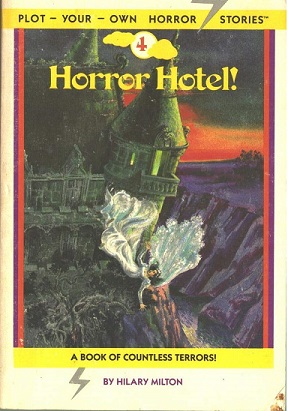
Book Reviews: Nightmare Store and Horror Hotel by Hilary Milton


You are trapped in a department store overnight!  Can you survive even while being pursued by ghosts, monsters, and killer mannequins?

Or

You are trapped in a hotel!  No one else seems to be around!  Can you survive even while being pursued by ghosts, monsters, and a crazy doctor with a scalpel?

It all depends on which one of these two books you read!

These are two books that I ordered off of Amazon two years ago and they’re both enjoyable reads.  They’re choose your own adventure-style books, where you get trapped in a location overnight and you have to try to survive while various monsters and ghosts try to kill you.  Every few pages, you’re given an option for what you want to happen next in the story.  What’s interesting is that, instead of it being the usual “If you run got page 75” sort of thing, it’s instead more like, “If you hear a noise, go to page 33.  If you see something out of the corner of your eye, go to page 28.”  So, to an extent, you get to decide how your scary story plays out.  These books were written for children, of course but both of them still get surprisingly grisly and intense at time.

Of the two, I preferred Horror Hotel.  The hotel was just a more interesting locations than the store and there was a lot more variety to the options and storylines in Horror Hotel.  I mean, yes, it’s obvious that Horror Hotel is basically just The Shining for kids but so what?  It had some scary moments!  It also had some scary pictures to go along with the text.  I wonder how many children in the 80s were traumatized by that picture of a scaly hand reaching out from underneath the bed and grabbing your ankle?  Or how about the picture of the crazy-haired scientist running at you with a scalpel in his hand?  AGCK!

Anyway, these are fun books.  They can orered off of Amazon and and they’re an enjoyable way to kill a little time in between hauntings.

Horror Book Review: Save The Last Dance For Me by Judi Miller


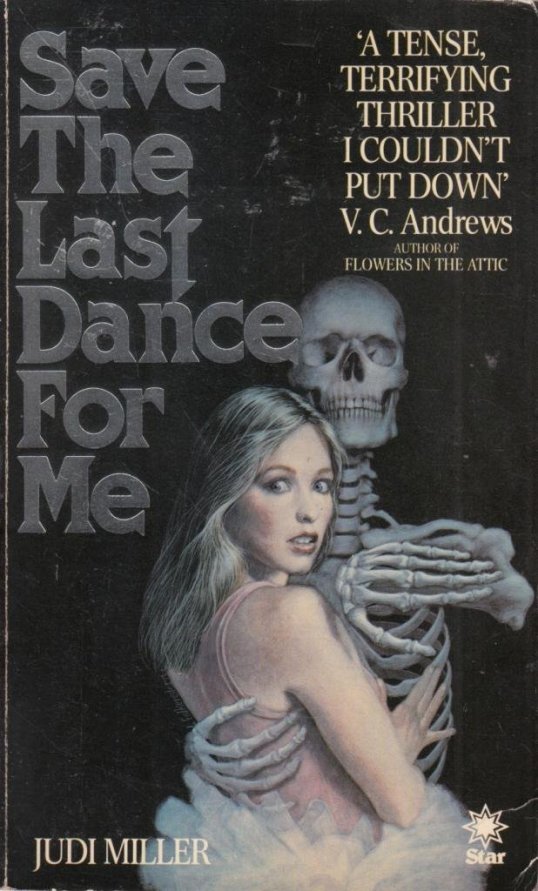
The 1981 novel, Save The Last Dance For Me, is another book that I found in my aunt’s paperback collection.  I have to admit that I got really excited when I found it.  This is a book that I had wanted to read ever since I came across the cover in Paperbacks From Hell.

Jennifer is blonde, beautiful, young, and ambitious.  She’s a driven dancer who is totally obsessed with becoming a soloist for one of New York’s best dance companies.  She’s got an older boyfriend, of course.  He’s a podiatrist who hopes that Jennifer will abandon her dreams and marry him.  Jennifer, however, is not so eager to settle down for a boring domestic life.

Max is a pianist who was raised by a narcissistic alcoholic who continually pressured her young son to learn ballet.  Neither Max nor his mother may have had much of a career as a dancer but that hasn’t stopped him from dreaming and obsessing.  Max has a basement and a bathroom that is full of ballet slippers.

Together …. THEY SOLVE CRIMES!

No, sorry.  (I know, I know.  I use that joke a lot but what can I say?  It amuses me.)  Instead, they have a drunken sexual tryst after Jennifer has an argument with her boyfriend and this leads to Jennifer not only getting locked in the basement but also being forced to eat a totally disgusting hamburger!  (EEEEEK!)  Max demands that Jennifer learn a terrible solo and he demands that she practice and practice it until she collapses.  It turns out to all be an elaborate revenge scheme, with a hint of Phantom of the Opera tossed in.  (It’s perhaps not a coincidence that Judi Miller also wrote a book called Phantom of the Soap Opera.)

There’s actually quite a bit going on in Save The Last Dance For Me.  This is a very plot-heavy book.  It’s full of bitchy and duplicitous characters, all of whom have their own agendas.  It also turn out that Max has been killing ballerinas for years.  The two detectives who are investigating the murders have to deal with a lot of pervy suspects, all of whom have their own fetishes when it comes to dancers.  As someone who grew up dancing, I can tell you that, in its hyper and melodramatic way, this book gets a lot of things right.

Anyway, not surprisingly, I really loved this book.  This was one of the most wonderfully trashy books that I’ve ever read, full of twists and subplots and red herrings and even a memorably overdone sex scene.  Basically, imagine the most melodramatic and sordid Lifetime movie ever but in book form.  In fact, I’m actually kind of surprised that Lifetime hasn’t ever made a movie out of this book.  I mean, if they can turn V.C. Andrews novel into an “event,” why not Save The Last Dance For Me?  Get on it, Lifetime!