Four Color Apocalypse 2021 Year In Review : Top Ten Special Mentions


Next in our year-end lists we come to TOP TEN SPECIAL MENTIONS, a “grab-bag” category I came up with a few years back to encompass everything adjacent to comics that isn’t comics “proper” per se — so in short we’re talking about art books; ‘zines, books, and scholarly works about comics and/or cartoonists; non-comics projects by people who usually do comics; and, perhaps most nebulously, sequentially-illustrated narrative works that don’t quite fit the standard operating definition of comics in that they don’t contain word balloons, thought bubbles, or in-panel caption boxes. Read on and all will, hopefully, become clear :

10. Bubbles, Edited By Brian Baynes (Bubbles Publications) – Baynes’ “independent fanzine about comics and manga” had another strong year, and if there’s one thing I’ve come to appreciate about this publication above all else it’s the unabashedly fannish tone the editor and writers bring to the table. There’s not an ounce of cynicism to be found in these pages — everyone who contributes to this ‘zine literally loves the medium, and it shows.

9. Please, God – Help Me Be Normal! By John Trubee (Mucus House) – A long-overdue comprehensive collection of Trubee’s “Ugly Men” drawings, plus other miscellany, that not only doesn’t disappoint but might even exceed expectations. A gallery of grotesqueries for the ages that is a required item on the coffee tables of all who read this blog.

8. Queen City By Karl Christian Krumpholz (Tinto Press) – A unique narrative and visual history of Denver by the cartoonist who knows it best, as well as a heartfelt lament for the its pre-gentrification glory days. this feels very much like the work Krumpholz has been building toward his entire career. Gorgeously illustrated, evocatively written, and altogether engrossing.

7. Strangers, Edited By Eddie Raymond (Strangers Fanzine) – The old-school print ‘zine that specializes in old-school content branched out a bit in conceptual terms this year, covering more new stuff and featuring tons of original comics by a “murderer’s row” of talented cartoonists. Every time a new issue comes in the mail I devour it from cover to cover, and it always leaves a big, shit-eating grin on my face.

6. Discipline By Dash Shaw (New York Review Comics) – Sure to be a fixture on many a “best comics of 2021” list, Shaw’s meditation on the Civil War, the limits of pacifism, and the human toll of conflicts inner and outer fits the SPECIAL MENTIONS category here in that it is a series of illustrations derived and adapted from letters written at the time. Innovative, exquisitely drawn, and instantly memorable, this is a powerful and poignant work from a contemporary master fully in command of all his storytelling gifts.

5. Francis Bacon By E. A. Bethea (Domino Books) – You can expect to find this on any number of “best-of” list as well — this one included, obviously — but again, due to the absolutely unique nature of Bethea’s work, I’m more comfortable categorizing it as “narrative sequential art.” Deeply personal, evocative, and as always using its subject as springboard to a long-form reverie that unfolds like a vividly-remembered dream, this is, in my humble estimation, Bethea’s most fully-realized and emotionally resonant ‘zine to date.
4. According To Jack Kirby By Michael Hill (Self-Published Via Lulu) – The necessary historical corrective we’ve all been waiting decades for is here, as Hill meticulously combs through thousands of “on-the-record” quotations and statements to present a persuasive and comprehensive case for Kirby as the pre-eminent creative genius in mainstream comics history as well as the sole creator of most of the so-called “Marvel Universe.” An exhaustive forensic examination of the facts written in an engaging, page-turning style that might even make the most hardened of Stan Lee partisans think twice about all the bullshit their guy spewed to line his own pockets and enrich his corporate paymasters at the expense of an undisputed — and still under-appreciated — true artistic visionary.

3. Mysterious Travelers : Steve Ditko And The Search For A New Liberal Identity By Zack Kruse (University Press Of Mississippi) – Without question the finest work of Ditko scholarship ever committed to print, Kruse re-contextualizes the iconoclastic creator’s singular body of work within a more expansive framework that gives new insights into the motivations behind, and philosophy of, one of comics’ most uncompromising auteurs. More than a historical re-analysis, this is a meticulously-researched and eye-opening critical appraisal of some of the most important work in the history of the medium that has only been partially understood by far too many who have laid unearned claims of expertise on it in the past.

2. A Cockeyed Menagerie : The Drawings Of T.S. Sullivant, Edited By Conrad Groth (Fantagraphics) – Years in the making, and clocking in at well over 400 pages, this utterly sublime monograph covers every phase of Sullivant’s groundbreaking career from the 1880s up to the 1920s, and to say no stone has gone unturned and no expense has been spared in its preparation and presentation is an understatement of criminal proportions. This is the prestige release of the year, perhaps of the last several years, and balances historical essays, critical appreciations, and painstakingly-restored artwork to give a full and complete picture of a true artistic trailblazer. Lose yourself in this one and you may find you never want to come out of it.

1. I Never Promised You A Rose Garden By Mannie Murphy (Fantagraphics) – A lyrical melding of the personal, political, social, and historical into one gorgeously expressive and darkly harrowing journey through both the streets of Portland and Murphy’s own life, this is bold and revelatory work that stands with the best art created in any medium this year. A love letter to an idealized vision of a city that never was, a requiem for a dream that nobody even tried to realize, a righteous call to action for a future that is hopefully still worth fighting for — this is a modern masterpiece in every respect that elicited a reaction I wasn’t even sure I was capable of anymore after so many years in the critical trenches : awe.

And with that, I’m taking a short holiday break. The end-of-year recaps will resume next week with my picks for TOP TEN VINTAGE COLLECTIONS, TOP TEN CONTEMPORARY COLLECTIONS, and TOP TEN ORIGINAL GRAPHIC NOVELS. Hope to see you then — in the meantime, should you want more of my content for whatever reason, including a couple of posts on my thought processes as I was cobbling these lists together, I humbly remind you that I have a Patreon that I update three times per week and that you can join for as little as a buck a month. Here’s the link : https://www.patreon.com/fourcolorapocalypse

Four Color Apocalypse 2021 Year In Review : Top Ten Comics Series


As we trudge on with our year-end review, we come next to a category that’s fairly easy to explain : TOP TEN COMICS SERIES refers to any ongoing or limited comic book series that saw more than one issue released in the past calendar year. As you’re about to see, anthologies — both solo and multi-creator — ruled the roost in 2021, a trend I’d be most happy to see continue. But we’ll worry about that in the future, for now here are my personal picks for best comics series in the present :

10. Bubblegum Maelstrom By Ryan Alves (Awe Comics) – Alves just plain tore it up in 2021, producing two issues of this now-concluded solo anthology title, the last of which was an 80-plus-page monster. Fitting, I suppose, given that monstrosity itself was a core concern of so many of the strips in this series. Bu turns grotesque and exquisite, sometimes both, Alves really went for the conceptual jugular with this comic, and I’m more than anxious to see what he does next.

9. Flop Sweat By Lance Ward (Birdcage Bottom) – Don’t you dare say memoir is dead until you’re read this. Ward’s autobio series is harrowing, heartfelt, sometimes even humorous — but never less than painfully honest. When the abyss that gazes back is your own life, and you can still make compelling art from that? You’ve got guts to match your skills. Never doubt Ward’s abundance of both.

8. Love And Rockets By Gilbert And Jaime Hernandez (Fantagraphics) – If you find a best-of list that this title isn’t on, you’ve found yourself one lazy-ass critic. Or a stupid one. Down a few spots from where I normally place it simple because, sorry to say, Beto’s current stuff isn’t registering with me to the degree it usually does, but hey — Jaime is continuing to produce some of the best comics of his career.

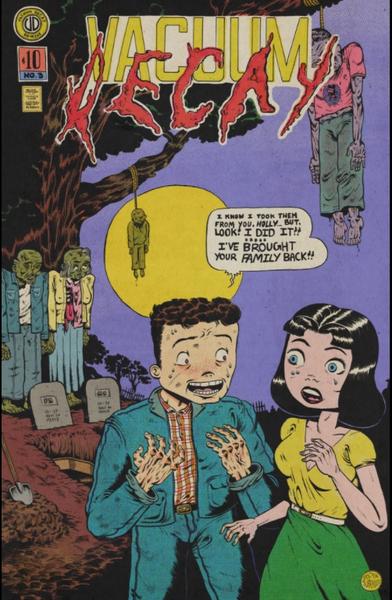
7. Vacuum Decay, Edited By Harry Nordlinger (Self-Published) – The most uncompromising underground horror anthology in decades continued to push the envelope with issue three — and with issue four, it just plain wiped its ass with it. To quote my own tweet back at me (speaking of lazy critics) : this is a comic that goes there. Whether you want to go with it or not, well — that’s your call. I know I’m down for the ride.

6.Rust Belt Review, Edited By Sean Knickerbocker (Self-Published) – Knickerbocker’s own strips about the tribulations and travails of life in “flyover country” set the tone for this diverse, oversized anthology centered on the big dreams and big problems of people with so-called “small” lives. Quintessential reading for everyone who understands that neither neoliberalism nor Trumpian neofascism (nor, for that matter, ‘tech bro” libertariansim) offers any solutions to those ground under by the wheels of what some still laughably term “progress.” Real stories about real people are the order of the day here.
5. Goiter Comics By Josh Pettinger (Tinto Press/Kilgore Books) – Two issues in one year from two publishers? Pettinger was one busy cartoonist in 2021, and the increased workload seems to be agreeing with him — from his strongest character studies to the opening salvo of an OMAC-esque dystopian fable by way of the Amazon warehouse, this was the year this title well and truly came into its own and left any Clowes and Ware comparisons firmly in its rear view.

4. Acid Nun By Corinne Halbert (Self-Published) – Psychedelic cosmic interdimensional Satanic nunspolitation with a generous helping of BDSM fetishism not just on the side, but front and center? Sign me the fuck up for that any day, and when you factor in Halbert’s astonishing compositions and use of color what you’ve got is one of the most visually literate comics of the year as well as probably the most deliciously pervy. Plenty to turn your crank whether you’re gay, straight, somewhere in between, or completely undecided, but there’s something more going on here than erotic stimulation for its own sake (not that there’s anything wrong with that) — if you appreciate a cartoonist who’s clearly playing a “long game” of stimulating you libidinally as foreplay to stimulating you intellectually, you’ve come to the right place.

Future By Tommi Musturi (Self-Published) – A web that draws you in by continuing to expand outward, Musturi’s various (and variously-styled) narratives never cease to impress, even as they bob and weave between confounding and illuminating. Everything is building toward something here — a conceptual singularity, at least, and perhaps even a narrative one —but I’m enjoying the individual journeys far too much to be ready for a destination yet. It doesn’t get much more unique than this, folks — a series you already miss before it’s even over.

2. Reptile House, Edited By (I’m Assuming Here) Nick Bunch (Reptile House Comix) – Created and published by a de facto artistic collective out of Philly, this is exhibit B for my contention that locally-focused anthologies are the future of comics. A heady mix of long-form continuing narratives and hilariously visceral one-offs, 99% of the cartoonists appearing in these pages are folks that I’ve never heard of before, but their work — like this series itself — just gets stronger and stronger as it goes on. And they wrapped up an already amazingly strong year with a killer 3-D issue. This is grassroots comics-making the way you remember it — and the way you’ve never seen it before.

1. Tinfoil ComixEdited By Floyd Tangeman With Co-Edits On #4 By Austin English (Dead Crow/Domino Books) – As for exhibit A for my contention about locally-based anthologies, this is it right here. Tangeman’s Bay Area anthology will, mark my words, go down as the most important signifier of not just where comics are, but where they’re going, since Kramers Ergot 4. This series burned as quickly and brightly as one can imagine, and the mark it left is going to be felt for years to come. We’ll see if the new bi-coastal “successor” series Tangeman and English are cooking up can keep the creative momentum going, but if the job they did together on #4 is any indication, we’ve got plenty to be excited about.

Next up we’ll do the “grab-bag” category that is TOP TEN SPECIAL MENTIONS, but in the meantime please consider helping me crank out more of this kind of theoretically enjoyable content by subscribing to my Patreon, where I serve up exclusive thrice-weekly rants and ramblings on the worlds of comics, films, television, literature, and politics for as little as a dollar a month. Here’s a link : https://www.patreon.com/fourcolorapocalypse

Four Color Apocalypse 2021 Year In Review : Top Ten Single-Issue Comics


And so it begins : with the end of the year breathing down our necks, it’s time to take stock of the best (by my estimation, at any rate) comics of 2021, broken down, as usual, into six different categories so as to avoid the goofy shit you find elsewhere — like, say, a 12-page mini having to “compete” against a 400-page graphic novel, or a book of reprinted material being judged by the same standard as all-new stuff. My goal is to get three lists done this week, then do three more next week, beginning with the TOP TEN SINGLE-ISSUE COMICS, which means stand-alone “floppy” comics or minis, or single issues of ongoing series which were one-offs — any series (limited or ongoing) which saw two or more issues released in 2021 will be eligible in the TOP TEN COMICS SERIES category. Sound good? Let’s do this :

10. God Bless The Machine By Connor McCann (Strangers Fanzine) – An acid-trip science fiction conceptual free-for-all that takes dead aim at vapid celebrity worship and global media consolidation while never forgetting to be a ton of fun along the way, McCann’s comic is equal parts timely as hell and decades ahead of its time. If you miss the days when comics were insane, fun and insanely fun, I’ve got good news : they’re back.

9. Birth Of The Bat By Josh Simmons (The Mansion Press) – Simmons’ latest “Bootleg Batman” comic continues his trend of de facto deconstruction by taking the character of the Caped Crusader to its logical extremes — which is to say, well past the point of disturbing absurdity. Where some are content to merely mine the so-called “Bat mythos” for all its worth, Simmons strip mines it — and yet always seems to have more to say on the subject.

8. Epoxy #6 By John Pham (Self-Published) – Another sumptuous riso-printed feast for the eyes from the modern master of hand-printed comics. Who can say no to more “J+K” hijinks, another installment of “Deep Space,” and fold-outs and inserts galore? I know I sure can’t. Long may this series continue.

7. BUM : Unsmooth #2 By E.S. Glenn (Floating World Comics) – Glenn blows the doors wide open with this formally experimental, genre-hopping tour de force that plays with convention in the best way possible : by utilizing it for the artists’ own ends. Shifting styles as frequently as it shifts tone and perspective, this is one of those comics that leaves you with more questions than answers while all the time making its own kind of highly-specialized “sense” along the way. Ambitious, multi-layered, and metatextual, this is auteur work of the highest order.

6. The Future Is An Open Mouth By Dustin Holland (Self-Published) – Speaking of auteur comics, Holland produces nothing but, and this represents probably the most successful synthesis of his idiosyncratic creative vision with the always-nebulous concept of reader “accessibility.” Which is to say, it’s fucking ecstatically weird, but you’re never lost within its hermetic “universe.” Like all the best art, its borderline-impossible to define what makes Holland’s work so special, you just know that it is.

5. Dear Mother & Other Stories By Bhanu Pratap (Strangers Fanzine) – Arguably the year’s most disturbing work both conceptually and visually, Pratap’s full-length debut challenges notions of identity, bodily autonomy, and intrinsic need on levels both macro and micro. If you don’t think there can be beauty in nihilism, think again, but be warned : the more you do think about this comic, the more sleep you’ll lose.

4. Burg Land 1 – Sleemore Gank By Alexander Laird (Self-Published) – The most imaginative sci-fi comic to come down the pike in a hell of a long time, Laird’s loosely-paced but tightly-plotted opening salvo of what promises to be a sprawling sci-fi opus is breathtaking on every level, creatively and technically, rivaling the riso production values of even the esteemed (and aforementioned) Mr. Pham. Sure, this comic is a clinic on the art of so-called “world building,” but it’s got more than enough heart to match its brains, and that makes all the difference.

3. Speshal Comics, Edited By Floyd Tangeman (Dead Crow) – Essentially a “bonus issue” of Tangeman’s groundbreaking Tinfoil Comix, and showcasing the work of many of the same cartoonists who have appeared in that anthology, the strips in this one all honor the late Bay Area artist/tagger Evan “Spesh” Larsen, and while I admit I never knew the guy, this comic sure makes me wish that I had. This is no mere “tribute” publication, however — rather it’s a celebration and examination of an artist, his ethos, and his body of work as seen from multiple points of view, and well and truly runs the stylistic and tonal gamut. “Spesh” himself may be gone, but this comic is a monumental legacy in and of itself.

2. Scat Hog Volume One By Cooper Whittlesey (Self-Published) – Every year it seems a comic comes from out of left field and knocks me for a wallop. This year, that dubious “honor” belonged to this collection of Whittlesey’s straight-from-the-id strips, scrawled with all the energy and urgency of self-exorcism and not so much released into the world as it was thrust upon it. Still, in my defense, nothing can really prepare anybody for this torrential onslaught of unleashed artistic imperative. Shock and awe, baby — emphasis on the latter.

1. Crashpad By Gary Panter (Fantagraphics) – A bit of a cheat here in that this is an oversized hardcover book as well as a “floppy” single issue, but if anything is worth bending the rules for it’s this, Panter’s love letter to the underground. And while it holds true to many of the precepts of its artistic progenitors, it never takes the easy way out by wallowing in nostalgia — instead, Panter takes inspiration from the past to do what he does best : show us a way forward. Far out? Sure. But don’t be surprised if this one takes you on a journey inside, as well.

Okay, that’s one down, five to go — next up we’ll be looking at the TOP TEN COMICS SERIES. Until then, a reminder that my Patreon is updated three times a week with whatever is on my mind on the subjects of comics, films, television, literature, and politics. Depending on who you are, your support either is or would be greatly appreciated. https://www.patreon.com/fourcolorapocalypse

The Eternal Abjectness Of Life : Bhanu Pratap’s “Dear Mother & Other Stories”


“As only the unreal is not ignoble and empty,” wrote J-K. Huysmans, “existence must be admitted to be abominable.” And while most of us enjoy the pleasures of the flesh to one degree or another, every once in awhile something comes along that makes you think Huysmans was probably on to something with that thought. So let’s talk Bhanu Pratap’s full-length debut (as far as I’m aware, at any rate) Dear Mother & Other Stories (Strangers Fanzine, 2021), shall we?

There’s a fair amount of “buzz” circulating about this comic in the corners of the internet I’m assuming most readers here pay attention to, and it’s not hard to see why : Pratap fucks with so many conventions and formalities those of us who rightly or wrongly consider ourselves to be possessed of a certain degree of “comics erudition,” if you will, like to see fucked with, from chronology to physicality to perspective to proportion, that it’s almost like an aesthete’s wish list on paper — but (and you saw this coming), I think much of the discussion misses something vital. This is no collection of “body horror” stories — it’s a collection of psychosexual horror stories that have bodily consequences.

First order of business with this comic, though, is getting one’s bearings within it, and sometimes that’s no easy task, both in terms of deciphering what Pratap is showing us, and when what we’re seeing takes places in relation to other events. More or less all of the more interpretive imagery is overtly sexual in nature, but hell — the same is true of the shit that’s easy to figure out. There’s sublimation galore to be found in these strips, but nothing particularly subliminal about its portrayal. And while the transformations and transmutations and transfigurations of bodies (or, sometimes, what used to be bodies) that Pratap delineates with such a Garo-informed eye toward the disturbingly lyrical are certain to grab your attention, by my reading almost all of them come about as a result of unmitigated (if not always unrequited) need. Indeed, to the extent we can be said to get to know the characters in these stories at all, we get to know them though the sheer force of their desperation — as well as the equally-desperate lengths to which they’ll go in order to try to sate it.

The “title track” story is the most obvious example of this, as a sex worker is literally sucked dry (though not of blood) by one of her customers who may or may not be an older iteration of the son who she’s breast feeding well past any sort of socially acceptable “cut-off point” in the first place, but if there’s one thing that’s perfectly clear throughout it’s that whatever she provides is never gonna be enough for either giver or receiver here, so bottomless is the hole they’re each trying to fill. Over at TCJ, Jog pointed out in his review (which, in fairness, is also where I poached these scans from, not finding sample pages online anywhere and not trusting my own shitty phone to do the art justice given this comic’s generous, magazine-sized dimensions) that the women in Pratap’s stories don’t fare too well, and that conclusion is certainly inescapable : just as the women in much of David Lynch’s work suffer for the redemption of others, Pratap’s are called upon to be instruments of psychological and biological sacrifice, only nobody’s coming out ahead in the deal. The men take all and still want more, the women offer all and still wish they had more to give. I told you Huysmans had it right — this whole corporeal existence thing is a goddamn abomination.

Pratap himself seems to acknowledge as much in “An interrogation Of A Man’s Body,” wherein a hapless asshole meets his end courtesy of his asshole — yup, you read that right, fatal flatulence — but even this wretched creature had a woman who loved him and can’t bear to let him go. I’m not in a position to psychoanalyze any cartoonist based on their work — after all, it could very well be that Pratap’s simply playing us all for suckers, and I’d actually congratulate him if that turned out to be the case — but the degree to which the very same themes pop up in these strips again and again can certainly lead a reasonable person to conclude that he’s working through a very particular set of issues, and ultimately finding no more resolution than his characters do. In that respect, there is a core of existential bleakness here that’s pretty difficult to deny, but equally undeniable is the “command to look” power with which the cartoonist imbues his work, both visually and conceptually. It’s one thing to ask whether or not our desires can ever truly be fulfilled, but Pratap takes it a step further by asking if we even deserve for them to be.
This, then, is some pretty weighty stuff any way you slice it — and trust me when I say things get sliced a lot of ways here, many of which you had likely never considered before. Whether or not it’s the year’s best work, as some seem to be inching toward proclaiming it, I couldn’t say, but in all likelihood it’s 2021’s most challenging comic, so don’t be surprised if your view of it is as fluid as the forms it depicts. Existence sucks and all, sure — but hey, at least it offers us plenty to think about.

**********************************************************************

Dear Mother & Other Stories is available for $12.00 from Strangers Fanzine at https://strangersfanzine.bigcartel.com/product/dear-mother-other-stories-by-bhanu-pratap-strangers-fanzine-presents

Also, this review is “brought to you” by my Patreon site, where I serve up exclusive thrice-weekly rants and ramblings on the worlds of comics, films, television, literature, and politics for as little as a dollar a month. Subscribing is the best way to support my continuing work, so I’d be very appreciative if you’d take a moment to give it a look by directing your kind attention to https://www.patreon.com/fourcolorapocalypse

Standing On The Shoulders Of Giants : “Burg Land 1 – Sleemore Gank”


It takes some real guts to set your comic 100 years after the fall of an imaginary civilization readers aren’t familiar with in the first place — and to give said comic a title composed of made-up words — but if there’s one thing you can’t say about Alexander Laird, it’s that he’s a cartoonist lacking in either ambition or confidence. And that confidence and ambition carries over into every aspect of his new self-published number, Burg Land 1 – Sleemore Gank,

Indeed, from its masterful use of riso printing to its slick publication design (including a deliberately tor-out page that, bet you anything, was fully drawn regardless) to its immersive narrative to its idiosyncratic, colored-pencil art to its thick supplemental insert written entirely in a coded alien language invented by the artist that, if you wish, you can take the time to decipher fully, this is clearly and obviously a work that has been executed in exact accordance with its initial conceptualization. It’s fucking breathtaking across the board, and my hat is off to Laird for this, no exaggeration or hyperbole, monumental achievement.

Anyway, it would appear that whatever Burg Land was, it’s over with by this, the first issue, and it’s up to intrepid explorers such as our protagonist, one Baida Bandorious, to discover both what the hell happened and how the other half lives by means of hot air balloon expedition to parts far and wide. That’s all a tricky wicket in and of itself, of course, but when you consider than every city that remains on this used-to-be world is housed atop its own towering, lumbering, decidedly alien giant, well — that’s when the scope of the dilemma faced by those such as Baida, who would try to make sense of this entire scenario, comes into view. Each giant is entirely unlike the others in terms of appearance, and each city is entirely unlike the others in terms of culture, customs, and practices. Diversity abounds atop the remnants of Burg Land, then, but pluralistic multi-culturalism, well — not so much.

Okay, sure, we’ve got some allegorical “cautionary tale” stuff going on here, but Laird is in no way heavy-handed about it — the overall tone and temperament of his work is as light and deft as the even-weight line of his drawings and the delicacy of his rich color scheme. The aesthetic values of this comic are well and truly inseparable from its narrative values, which means of course that the inverse is also true. I yammer on at great length on this site about so-called auteur comics, well, this is the apex and perhaps even apotheosis of that term — it simply doesn’t get any more auteur than this, to the point that some new sort of designation, one that encompasses every aspect aspect of a comic’s production both creatively and technically, may be required. Don’t ask me what that would be, but as I hold this comic in my hands I am fully and keenly aware that it’s one of those things , like John Pham’s Epoxy, that take the idea of full artistic control from start to finish to unprecedented heights.

So, yeah, Laird is in some pretty select company as a cartoonist and, in the broader sense, as a creator, but at the end of the day what matters most is whether or not this project can stand on its own — and so far that not only seems to be the case, it seems to be the only possible way to envision this work even, well, being. That sounds grandiose as all get-go, I’ll be the first to admit, but apart from telling a story by means of sequentially-arranged art and text, this is not a comic that owes much of anything to what other people have done with this medium. Indeed, so singular is the rulebook that it’s playing by that Laird can literally stop the action halfway through to expound upon the history and geography of this fictitious world for 20-ish pages, all written in that complex cipher very few people will take the time to decode mentioned earlier, then jump right back into the main narrative without missing a beat. Don’t ask me how that works, because I have no real idea, but if I had to hazard a guess I would say such a deliberate flouting of the norms of traditional storytelling can only succeed when there is an iron-clad creative vision propelling the entire work forward. If there’s any slack in your act, a comic like this will expose it in a frigging heartbeat — there’s no slack in Laird’s act.
And to think — even though, okay, this world is over, this is only the beginning of this series. Where it goes from here is anybody’s guess, but I know it’ll be unlike anything we’ve experienced before because it already is. Chances to get in on the ground floor of projects that bear all the hallmarks of being once-in-a-lifetime artistic events don’t come along too often — you’d be a fool to pass on just such an opportunity here.

***********************************************************************

Burg Land 1 – Sleemore Gank is available for $17.00 directly from Alexander Laird at https://sensitiveathletes.bigcartel.com/product/sleemor-gank-burg-land-1

Also, this review is “brought to you” by my Patreon site, where I serve up exclusive thrice-weekly rants and ramblings on the worlds of comics, films, television, literature, and politics for as little as a dollar a month. Subscribing is the best way to support my continuing work, so I’d be very appreciative indeed if you’d take a moment to give it a look by directing your kind attention to https://www.patreon.com/fourcolorapocalypse
“Clusterfux Comix” Proves The Underground Ain’t Dead Yet


Violence! Depravity! Sacrilege! Perversion! All played for prurient and juvenile laughs! Par for the course in, say, 1969, sure — but in 2021? Not really so much.

By and large comics are either classy, formulaic, or both now — on the one hand we’ve got the high-brow releases from respected, dare I say institutional, independent publishers, while on the other we’ve got both the staid, editorially-managed offerings of the “Big Two,” which primarily seek to protect the brand identity of their so-called “IP,” and the creator-driven wares of your Images and your Dark Horses that aspire to become the next profitable “IP.” In between, well — there’s a whole lot, actually, but not a lot of that “whole lot” openly takes its cues from the spirit, if not the actual aesthetic, of the late 1960s/early 1970s underground. Maybe the medium has simply grown up, or maybe the backlash against cartoonists such as Johnny Ryan who have picked up that gauntlet has become so severe that other artists who might aspire to do work in at least a tonally similar vein have decided to do something else (say, something that might actually pay the bills) instead. Whatever the case may be, while there’s a shitload of variety in comics these days — perhaps more than there ever has been — there’s not a ton of stuff coming out that I wouldn’t feel comfortable showing to just about anybody.

Enter editor/publisher Cameron Hatheway, whose Clusterfux Comix seeks to redress the balance, at least to the extent that a relatively obscure (and I mean that as a compliment) “neo-underground” anthology can. This, friends, is indeed stuff I wouldn’t feel comfortable showing to just about anybody, and while I’d be lying if I said I found the contents of its first three issues to be uniformly impressive, that’s okay, because these magazine-sized comics aren’t uniformly anything — and that’s what makes them exciting.

Monstrosities of the real and decidedly unreal nature populate these pages, and while much of the cartooning fits somewhere along a broadly-delineated spectrum of amateurishness, there’s no mistaking the energy and vitality that goes into most of these strips, be they by reasonably-established names in the small press community such as Isaac Roller and Adam Yeater, or relative newcomers to the so-called “scene” such as Miguel Elias Aguilar or Hannah FitzGerald (which I take to be a sort of “okay, yeah, I get it” nom de plume). No one here is fucking around, which is good, but no one gives a fuck, either, which is even better.

I should, however, be specific in terms of what I mean by that : it’s not that no one gives a fuck about their craft, it’s more that no one gives a fuck about who they might offend. And yet, as a general rule of thumb, the cartoonists who seem to be coalescing into Hatheway’s stable of de facto “regulars” aren’t out to get cheap shocks and even cheaper thrills — there’s none of the racism or misogyny of the old-school undergrounds, for instance, on offer in this comic. Rather, there is a very deliberate eschewing of delicacy here, of refined sensibility — these are comics designed to have an impact, to make a mark, to leave you wondering what it was you just read and whether or not you liked it. If you need a comparison to other contemporary anthologies (and you don’t, but let’s go with it anyway), this one hews closer to a Reptile House than it does to, say, a Now, but it’s worth noting that just three issues in it seems to have staked out a ground entirely its own, even if it’s still not entirely clear what that ground is composed of.

Again, though, rather than taking this to mean that this is an unfocused or scattershot publication, I think it’s more accurate to view it as one still in the process of carving out its own territory, and deciding along the way how expansive it wants that territory to be. Certainly most of the cartoonists whose work Hatheway has presented to date are concerned with narrative to one degree or another, but that doesn’t mean they all are, nor that the ones who are have much interest in being slavishly beholden to conventional definitions of it — indeed, if you like comics where everyone is “doing their own thing,” including discovering what “their own thing” even is in the first place? You’ve come to the right place.

Yes, that means there are going to be out-and-out misfires — although there seem to be fewer with each successive issue — and yes, that means there will be strips where one can clearly discern the artist’s intent despite said intent not necessarily being achieved. And hey, yeah, there will also be strips that just plain don’t register with individual readers for equally-individual reasons. This is an anthology, after all, and that’s how they tend to roll. Taking full stock of it as I am here though, rather than doing individual reviews for each issue, leaves me with the distinct impression that things are coming together, and the wonderfully inventive long-form strip by Dylan Henty — whose work echoes both Gary Panter and Rory Hayes at the margins while at the same time establishing a unique voice and point of view unto itself — that rounds out issue three probably stands as the strongest piece to appear in this series so far. If Hatheway continues to attract talent of this caliber, then who knows? A year or two from now we might be talking about this as one of the very best anthologies out there.

For now, what I can say with certainty is that it has the potential to be, and that it would appear to be determined to live up to that potential. If you don’t offend easily, you’ll find plenty to like here — and if you don’t impress easily, you’ll still find plenty to like here.

**************************************************************

Issues 1-3 of Clusterfux Comix are available directly from the publisher at https://clusterfuxcomix.bigcartel.com/products

Also, this review is “brought to you” by my Patreon site, where I serve up exclusive thrice-weekly rants and ramblings on the worlds of comics, films, television, literature, and politics for as little as a dollar a month. Subscribing is the best way to support my continuing work, so I’d be very appreciative indeed if you’d take a moment to give it a look by directing your kind attention to https://www.patreon.com/fourcolorapocalypse

Greater Than The Sum Of Its Parts : Matt MacFarland’s “More Seasons Of Gary”


Owing to my previous positions as lead critic at the comics website SOLRAD and board member of its parent entity, Fieldmouse Press, I wasn’t comfortable with the notion of reviewing Matt MacFarland’s comics before, given they frequently run on said site, but now that I’m a purely “solo act” again, I have no ethical reservations when it comes to opining on his work, and so I was happy to receive a copy of his latest 48-page mini, More Seasons Of Gary (Zines & Things, 2021) and give it a thorough going-over. Admittedly, I’d already seen some of this stuff, but that’s okay — reading them one strip at a time online is an entirely different experience to reading a print collection of them, and in this case that distinction works to MacFarland’s advantage because this is material that is best consumed in its entirety rather than piecemeal.

Strict formalist work tends to be that way, I think, and in MacFarland’s case in particular his adherence to a classic four-panel grid is absolutely unwavering — he’s clearly quite comfortable with the pacing inherent to such a format and well-versed in its unique storytelling properties and capabilities, so credit’s due him for knowing both what he wants to do and how to best go about achieving it. Finding your footing is a taller order than it sounds on paper, and MacFarland’s not only found his, he’s also committed himself to it. Sub-dividing his strips according to the seasons of the year, as the title of this comic implies, represents a further layer of logical and artistic stratification that, again, he wrings maximum efficacy from, and this also holds the key to why reading these strips in collected form, one after the other, is the way to go — there’s an narrative fluidity that’s part and parcel of MacFarland’s overall framework that’s lost when you’re absorbing his material in scattershot, one-at-a-time fashion.

Anyway, MacFarland’s now-late father, Gary, is the subject of these strips — or, more specifically, the artist’s relationship with his father is — and in that respect he’s not doing anything “new” per se, but so what? The list of cartoonists who have mined their own past, and that of their family, for their best and most resonant material is a long and distinguished one. Efficacy is of primary concern here, as well as overall sequential narrative literacy, and on both of those scores this comic stands as an excellent representative example of graphic memoir done right. Autobio as a de facto “genre” is well past the point where it’s gonna “blow your mind” or whatever, so it’s just as well MacFarland isn’t concerned with trying to do so : his concerns lie far closer to home, as well they should, and there’s a real sense that what he wants to do here is to utilize memory as a tool for achieving a better understanding of both who his father was and what, at the end of the day, the guy meant to him.

Tonally, it’s fair to say MacFarland adds a dash of humor to most of these strips, but it tends to be exceptionally dry and sometimes even borders on the dark — but that’s also the case for many of the reminiscences contained herein, particularly those directly related to his dad’s struggles with the bottle and his parents’ divorce. If this is all starting to sound a bit “warts and all,” well, that’s because it is, but it’s in no way reductive or overly-simplified on the one hand, nor awash in cloying sentimentality on the other. The picture of Gary that emerges is complex, multi-faceted, and at times overtly contradictory, but that’s the case with almost anyone — at least anyone remotely interesting — and the degree to which MacFarland resists the “easy out” of character and emotional uniformity here is admirable. It’s no small task to look at oneself or one’s parents honestly and without flinching — I know I’d never wanna do it — but admitting no one is even close to perfect is only step one in this journey. Finding peace with those imperfections is considerably more difficult than merely accepting them, after all, and while it would be a reach to say some sort of catharsis is achieved by this comic’s end, that’s mostly Hollywood bullshit anyway : all most of us can hope for when it comes to saying goodbye to a loved one is a sense that the things that can come full circle have done so, and that those that can’t are okay remaining forever incomplete. Such is life — and death — and MacFarland’s skill with regard to narrative authenticity really comes though in his book’s final pages, when he’s absolutely counting on it most.


“I dunno, man, sounds kinda heavy” is a fair enough reaction to have at this point, particularly if you’re reading this while high (hey, I know my audience), but it’s not just or only heavy — it’s no stretch at all to say that these strips run the same emotional gamut that life itself tends to, and in certain key instances, while the seasonal demarcation always prevails, strict chronology is temporarily shelved in favor of thematic and tonal linkages between events and occurrences. That probably sounds more confusing than it actually is — assuming it even sounds confusing at all — but it strikes me that this is pretty well in line with how our minds tend to operate : more often than not, we mentally organize things based on how they made us feel or what was going on rather than when they happened, and in that respect, not to get too grandiose or anything, we free ourselves from time’s unyielding (and, according to most quantum theorists at any rate, largely illusory) linear trajectory. This comic works in much the same way our actual memories work, and you need only consult your own memory for proof of that which I speak.

All that being said, as a matter of pure practicality there may be no trickier task in today’s comics landscape than producing a work of memoir or autobio that well and truly stands out from the crowd. MacFarland, however, has managed to do precisely that with this one — and I seriously doubt I’d have said that if I hadn’t read these strips in succession, collected between two covers. I highly encourage you to experience them the same way, even — maybe especially — if you’ve already read some, most, or all of them in serialized form online.

***********************************************************************************

More Seasons Of Gary is available for $7.00 from the Zines & Things website at https://zinesandthings.com/shop/msog

Also, this review is “brought to you” by my Patreon site, where I serve up exclusive thrice-weekly rants and ramblings on the worlds of comics, films, television, literature, and politics for as little as a dollar a month. Subscribing is the best way to support my continuing work, so I’d be very appreciative if you’d take a moment to give it a look by directing your kind attention to https://www.patreon.com/fourcolorapocalypse

Intriguingly Mixed Signals : Isaac Roller’s “Transmissions From Dreamtown”


The recent resurgence of so-called “solo anthology titles” or “single-creator anthologies” has been a welcome development for those of us who literally grew up on comics of that nature (Yummy FurEightballDirty PlotteNeat Stuff, etc.), but there’s no doubt that this latter-day veritable onslaught of them has been a mixed bag — which is rather the point of anthologies in general, I suppose. And yet many of the newcomers to “the scene” are often a mixed bag, conceptually and qualitatively, in and of themselves, as well, irrespective of the broader comics landscape in general. This shouldn’t be terribly surprising — people tend to forget, but not every strip in Eightball was a winner, especially in the series’ early going — but it also shouldn’t be viewed as a negative : seeing a cartoonist finding their footing, establishing their voice, or whatever other cliche you’d like to use in place of “figuring their shit out” is often a damned interesting thing to have a front-row seat to, and one would do well to keep that in mind as we delve into New York-based artist Isaac Roller’s self-published Transmissions From Dreamtown.

Roller’s been at this for two years now, producing four issues to date, and while it wouldn’t be quite accurate to say the trajectory of them has been uniformly upward, the general character of his series is such that things appear to be moving in the right direction on the whole, and he seems quite comfortable with the de facto “self-apprenticeship” that is learning on the job with no boss to tell you what to do — which, for the record, is not the same thing as fumbling your way forward in the dark. It’s a tricky business, this whole “following your artistic instincts for good or ill, wherever they may lead you” thing, and in a manner not entirely dissimilar to that of Brian Canini, whose work we’ve discussed on this site several times in the past, Roller doesn’t seem particularly anchored down to any one way of doing things — tonally or aesthetically.

Perhaps the best example I can give of this is the third issue of this comic, which makes an abrupt detour from the urban hustle and bustle of the first two installments to tell an extremely satisfying self-contained tale set in BF Alaska, where wooly mammoth meat has become the new haute cuisine, and Roller adopts a more clean-lined art style with clear roots in classical cartooning as opposed to the deliberately “rough around the edges” look of numbers one and two in order to more effectively communicate the needs of this particular narrative. The fourth and more recent issue, focused on an alien visitation, returns the focus to the big city, but with the more refined aesthetic approach of number three — so, yeah, you can see him pretty clearly figuring out not only what he wants to do, but perhaps even what sort of cartoonist he wants to be. That doesn’t always make for a “smooth” reading experience, granted, but it does make for an exciting one — after all, any new comic in this series could be about literally anything at all, and may even look completely different to what’s come before.

Does this make roller a genuine artistic chameleon by default? Possibly, but there is a definite unifying overall sensibility in terms of his page layouts, spot use of wash effects, and the like that clues you into the fact that these books are all made by the same person regardless of the obvious differences that are front and center. I’m not sure he’s fully committed to any one “path,” so to speak, but he appears firmly committed to discovering one, and that means everything’s still on the table and the future of this comic is well and truly wide open.

One thing Roller is clearly getting a firm handle on is using his stories to communicate a distinct authorial point of view, usually via allegorical means, and he’s got a really good balancing act going there — he’s not subtle, nor does he clobber you over the head with his messaging, and threading that needle is, more often than not, the mark of a natural storyteller. Some of his subject matter is specific not so much to him personally but to the artistic community as a whole (issue two’s primary focus is on the physical handling of art), while other things he’s expounding upon are more universal in nature (the aforementioned third issue has plenty to say about man’s exploitation of the natural world and the nauseating excesses of so-called “foodie culture”), but there’s a definite sense of passion underpinning all of it that can’t be faked and makes for enjoyable, if again occasionally uneven, reading. It’s earnest stuff, to be sure, but naturally earnest as opposed to self-consciously earnest, and that makes all the difference right there.
Just to remove any doubt, then, I absolutely recommend this series — and Roller’s work in general. I have yet to read his pandemic diary comics collection My Plague Year, but I did come across some of his stuff in Clusterfux Comix (another title that’s due for a review on here soon) and found that to be engaging, as well. It’s too soon to say whether or not we’re witnessing the emergence of the next great cartooning talent or what have you, but seriously — who the hell cares? I’m plenty interested in seeing Isaac Roller become whatever sort of cartoonist he wants to become, and there’s no question in my mind that he’s committed to putting in the work necessary to establish a true auteur sensibility and methodology. Art is a process of experimentation, of trial and error, and the truly determined artist in never content to rest on his or her laurels. How much of the transformation happening before our eyes with this particular artist is down to an evolutionary process and how much is down to simple restlessness I couldn’t really say, nor does it necessarily matter all that much : as long as Roller doesn’t stand still, I’ll be interested to follow him wherever he’s going.

***********************************************************************

Issues 1-4 of Transmissions From Dreamtown are available from Isaac Roller’s website at http://www.isaac-roller.com/shop

Also, this review is “brought to you” by my Patreon site, where I serve up exclusive thrice-weekly rants and ramblings on the worlds of comics, films, television, literature, and politics for as little as a dollar a month. Subscribing is the best way to support my continuing work, so I’d be very grateful if you’d take a moment to give it a look by directing your kind attention to https://www.patreon.com/fourcolorapocalypse

So — Wuzza “Buzza Wuzza,” Anyway?


The short answer to the question posed by the headline of this review would likely be “a self-published comic by cartoonist Jeff Ralston (or, as he credits himself, Buzza Wuzza, which also happens to be both the series’ title and the name of the anthropomorphic cat who is its nominal “star”) presented in a generously over-sized magazine format,” but that’s really only scratching the surface. It’s quite clearly a labor of love, perhaps with emphasis on the labor : Ralston produced no less than 19 issues of Buzza Wuzza Comics And Stories during the recent pandemic-engendered lockdown, and unlike any number of artists who are understandably happy enough to send yours truly a comic or two for purposes of reading and reviewing them, he actually went so far as to send me all 19 of his comics this past August. Hence the still-inexcusable delay on my part in getting this analysis/appraisal written — that’s a big ol’ pile of comics to read, and I never like to half-ass anything. If Ralston wanted me to read ’em all, then read ’em all I shall — and did.

Early on in said reading, though, it became apparent that tackling these in small chunks was the way to go — Ralston has created an idiosyncratic world unto itself here, where only his own made-up-on-the-fly rules apply, and given that none of the strips he’s put pen, ink, pencil, brush and occasionally even magic marker and collage cut-out to have carried over from issue to issue, there was no need to worry about my always-tenuous memory failing me altogether or, less drastically, requiring some sort of jolt or kick-start to get back into the flow of things. Issue, say, 12 is every bit as accessible as issue one, and there’s a kind of beautiful simplicity to that which should appeal to anybody out there either bored to tears with, or simply seeking respite from, long-form comics narratives. Complexity is great and all, but who needs it all the fucking time?

Which, come to think of it, isn’t a bad segue into a discussion about Ralston’s art. By and large this is agreeably simple stuff, done with no particular concern for the trappings of visual sophistication, and while I’m not sure this is down to this being as “good” as Ralston can draw or a deliberate stylistic choice on his part, it doesn’t really matter : what he’s come up with, by dint of either decision or default, is an immediately accessible and utterly cohesive visual language that doesn’t necessarily “impress” per se, but intuitively feels right for the kind of vaguely absurdist humor strips that are, it’s fair to say given the large sample size at my disposal, his stock in trade. Ralston’s ensemble generally partake in what can loosely be described as “madcap adventures,” and as such it helps to not only have them delineated in a kind of free-for-all scrawl by the artist, but also to be in the right frame of mind yourself to absorb this kind of intellectually non-taxing stuff — for my own part, I found reading an issue to cap off a long day at work was the way to go, and while that may sound like me damning this entire project with faint praise, I assure you it’s not : after all, who can’t use a couple stupid laughs after eight or more hours of workplace drudgery?

And so it is that Ralston can accurately be said to be more concerned with doing a particular thing and doing it reasonably well than he can be “accused” of being too overly ambitious. Issue 11 breaks the mold by being a prose and mixed-media affair, and it’s plenty interesting as a one-off, but there’s a definite sense by the time it’s over with that Ralston is perfectly content to return to regularly-scheduled programming for his next installment, and I have a hunch most readers will be on board with that decision, as well : when you’re in a bit of a creative groove, after all, there’s no need to rock the boat too terribly much, and by that point in the series it’s plainly obvious that such a groove has, indeed, been achieved. If I can level any specific criticism at this comic as a whole it would probably be that it boasts little to no progression, either in pure storytelling terms or in terms of the methodology behind the creation of said stories, but again, I should stress that I don’t have a huge problem with that given the project’s aims, which strive for a kind of tenuous balance between unpredictability and consistency, with Ralston more often than not succeeding at delivering both.

Anyway, characters come and go from the revolving door of Ralston’s imagination according to their utility to each issue’s particular story (or stories), but it’s a pretty damn likable bunch of animals (Buzza Wuzza, Judy Moon, Clancy The Cop, Dr, La Paz, Wuv Bunny, Messy Rabbit, Smokey The Cat) and people (Pal, Stressy) as well as the occasional ghost, robot, monster, and devil (among others) that populate the series’ core cast, and if you wonder what all they get up to beyond “hijinks ensue,” it’s generally stuff like going to Mars, solving mysteries, fighting crime, playing in shitty bands, visiting Stonehenge, serving in combat, going to jail, etc. — in other words, yeah, “hijinks ensue.” My favorite issue is of the bunch is probably #17, a full-length story called “Friends Of The Library,” but on the whole each installment isn’t too far removed from every other in terms of both overall tone and overall quality. I’m not sure if Ralston took much by way of breaks when writing and drawing these things, but they very much feel the end product of an artist who got a head of steam to do something quite specific and stuck with it until he’d done everything he wanted to do within the parameters he’d set for himself.

Which wouldn’t, I suppose, necessarily preclude Ralston from spinning more yarns set in his little de facto “universe” should he feel so inclined — after all, “just kinda doing whatever” is about as open-ended as premises come — and I certainly wouldn’t be opposed to checking out more if he makes more. These aren’t comics that will turn your world upside down or anything, but they will entertain you, especially if your sense of humor is just a touch off-kilter, and despite what the self-styled “intelligentsia” out there may tell you, there’s nothing at all wrong with cartoonists who want to entertain their readers. In fact, it’s a pretty damn noble goal in our increasingly dark world.

*********************************************************************

There doesn’t seem to be much by way of distribution for Buzza Wuzza Comics And Stories, but interested parties are directed to contact Jeff Ralston directly at buzzawuzza1@yahoo.com if you’d like to order up and issue or two — or even all 19, I suppose.

Also, this review is “brought to you” by my Patreon site, where I serve up exclusive thrice-weekly rants and ramblings on the worlds of comics, films, television, literature, and politics for as little as a dollar a month. Subscribing is the best way to support my continuing work, so I’d be very appreciative if you’d take a moment to give it a look by directing your kind attention to https://www.patreon.com/fourcolorapocalypse

Circle Of Life : Mike Freiheit’s “Go F❤ck Myself : The F❤ckpendium”


While one could argue that the prospect of seeing a cartoonist “work through their shit” on the page is something that should have played itself out a long time ago, I’m not too self-consciously cool to admit that such exercises still hold some appeal to me, especially when they’re approached in a unique or novel manner. Mike Freiheit’s latest, Go Fck Myself : The Fckpendium (Kilgore Books, 2021), however, is something that’s well beyond merely “unique” or “novel” — it’s downright ambitious, in that it offers a reasonably detailed analysis of problems and challenges, both personal and societal, that hold us back by dint of their repetition throughout history. Oh, and just for good measure, he posits (not without justification) they’ll continue to haunt us well into the future, too.

I should, I suppose, be clear here — by “us,” I’m primarily referring to Freiheit himself, since he’s his own subject here, but much of the self-doubt, self-loathing, guilt, anxiety, and fear that serve as constant stumbling blocks for him are felt, to one degree or another, by all (or at least almost all) human beings, so for a book ostensibly rooted in autobio, it’s fair to say this one has a borderline-universal appeal. Provided, of course, that comics of this nature even “appeal” to you in the first place.

I’ve gotta say, though, that there’s literally no reason why this one shouldn’t — Freheit’s artistic sensibilities are pretty damn populist on the whole, and while he spends an awful lot of time putting his flaws under the microscope, he doesn’t appear to actively despise himself, a la an R. Crumb or an Ivan Brunetti, so much as he seeks to understand why breaking old and established patterns is such excruciating fucking work. Simply put, he knows he’s far from perfect, but he’d at least like to try to get better — if he can. And, really, that strikes me as the healthiest way to begin the process of overcoming a decidedly unhealthy batch of neuroses.

To that end, this particular piece of long-form cartooning therapy bobs and weaves through three separate timelines populated by three distinctly different, yet also undeniably similar, versions of Freiheit himself : in the present, he’s a befuddled and anxious jobbing artist trying to navigate married life and the workings of his own mind; in the past, he’s a befuddled and anxious caveman trying to navigate married life and the base struggle for survival; and in the future —well, he’s probably a bit stereotypically “more together” on the surface, but as you’ve no doubt already worked out, many of the same dilemmas his other selves grapple with are still present and accounted for, plus some additional ones.

Such a flexible approach to self-centeredness affords Freiheit ample opportunity to expound upon topics ranging from economics to politics to religion to pop philosophy (plus others), but this is no simple series of monologues or dully-presented observations — rather, it’s a dynamic and engrossing look into one person’s point of view of just about everything under the sun, even if that “one” person is actually three people. And while I admit to being partial to the textured, shaded artwork Freiheit has employed on more generally “somber” or even “dark” projects such as his horror graphic novel The Woods or the strip “Walk A Mile In My Shoes : A Jonestown History” that he did in collaboration with some out-of-his-depth comics critic or other for the American Cult anthology, there’s no question that the more clean, crisp line he employs here (with, it should be pointed out, increasing confidence as the book goes along — likely owing to the fact that parts one and two were originally self-published as minis and part three is all new, therefore this project can truly be said to have been several years in the making) is pitch-perfect for the expository-bordering-on-confessional tone of this material. It’s necessary for him to draw readers into this comic in a way that’s cordial to them so that he can be far tougher on himself without alienating anybody in the process, and he pulls off that conceptual tight-rope act with considerable aplomb here — not only visually, but narratively, as well.
Still, one could certainly be forgiven for operating under the assumption that this thing must be scattered and haphazard almost by definition, so perhaps the fact that it’s actually a remarkably cohesive piece of work on the whole stands as its most notable accomplishment. There are no easy answers to any of the questions Freiehit poses — if, indeed, there are any answers at all — but by taking us along for the ride rather than throwing us in at the deep end and seeing if we sink or swim, by laying out his “warts and all” truth without being overly precious about it, and by reminding us frequently along the way that there’s a funny side to just about everything, he’s created something both special and very nearly singular : a conversation with himself (or maybe that should be himselves) that speaks to us all.

**********************************************************************************

Go Fck Myself : The Fckpendium is available for $20.00 from the Kilgore Books website at http://www.kilgorebooks.com/shop/go-fck-myself-the-fckpendium-mike-freiheit

Also, this review is “brought to you” by my Patreon site, where I serve up exclusive thrice-weekly rants and ramblings on the worlds of comics, films, television, literature, and politics for as little as a dollar a month. Subscribing is the best way to support my continuing work, so I’d be very appreciative if you’d take a moment to give it a look by directing your kind attention to https://www.patreon.com/fourcolorapocalypse