Grindhouse Classics : “Pick-Up”


pick_up_poster_01

One word that doesn’t usually (if ever) come to mind when you’re talking about the drive-in fare churned out by Crown International Pictures in the 1970s is weird.

Yeah, okay, fair enough — I suppose just about any CIP flick looks a little bit “weird” to a contemporary audience, given that they’re all very much  products of their time, but honestly, pretty much everything released under their banner boils down, story-wise,  to a simple morality play with a generous helping of sex (always) and violence (sometimes) thrown in — and more often than not, as with most exploitation fare, the most common themes in the Crown back catalog are “don’t set your sights above your station in life” and “don’t talk to strangers.”

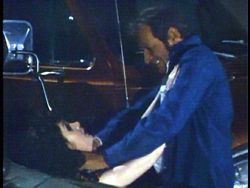
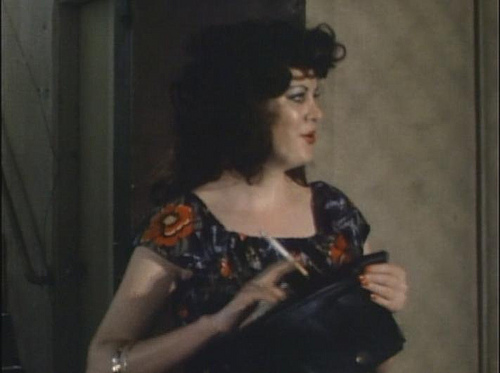
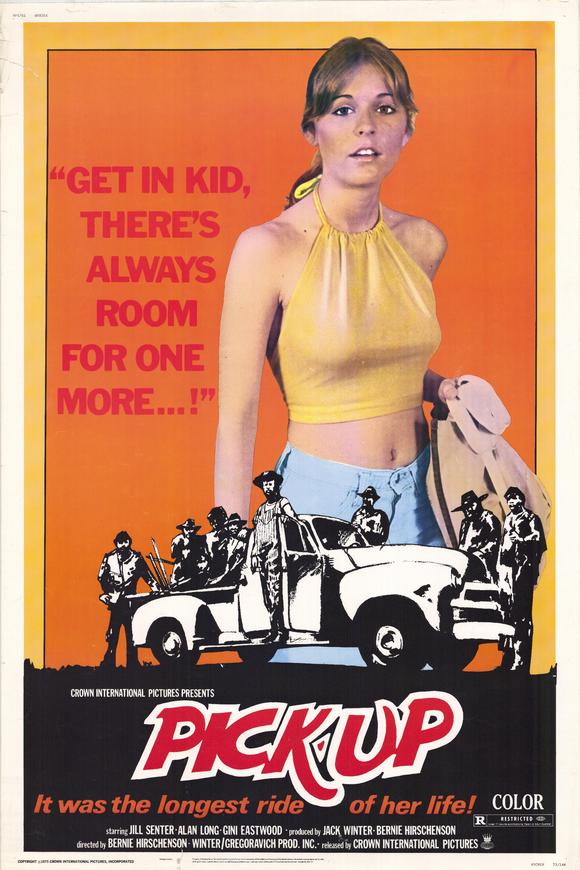
At first glance, 1975’s Pick-Up, directed (and produced, and shot, and edited) by Bernard Hirschenson, would appear to fit comfortably into the “don;t talk to strangers” category, since it’s the story of two footloose-and-fancy-free hippie chicks named Carol (Jill Senter) and Maureen (Gini Eastwood — no relation, at least that I know of, to you-know-who), who hitch a ride across Florida with a far-out guy named Chuck (Alan Long) who is, like them, at loose ends and just “taking in what the world has to offer, one day at a time, man” in his fuck-pad RV.

Come on — he’s gotta be trouble, right? I mean, he’s an Aries, and according to the supposedly-metaphysically-tuned-in Maureen, Aries guys are bad news these days because of some state of flux going on in the universe or something. Still, the girls hop in for a ride anyway —

31361

Trouble eventually does come their way, but Chuck isn’t the cause. After a deluge, the RV gets stuck in the Everglades mud, and that’s when things, as I promised at the outset, get weird. Chuck and Carol get busy screwing their brains out, but Maureen in between reading star charts and tarot cards and having waking (and sleeping) visions of her childhood, is visited by Pythia, a priestess of Apollo, who gives her a sacred dagger for some reason or other. And if you think that sounds strange, wait until the slimy politician and latex-faced clown show up.

Okay, yeah, none of this makes a tremendous amount of narrative sense — or even common sense — but it sure is interesting. It turns out that Maureen was molested by a priest as a child (guess they were into girls in the ’70s) and this is at the root of her psychological disturbances, which culminate in quite possibly the most bizarre  scene (of many contenders) in the film, where she and Chuck finally “make it” on a stone altar with the clown, the politician, and the priestess watching on. And all this right after Chuck kills a wild boar (be warned, this film does feature genuine animal slaughter, although hardly of Cannibal Holocaust proportions) What does it all mean? Who knows. And honestly, who really cares? Pick-Up was clearly made with the stoner crowd in mind and, frankly, was probably made by members of the stoner crowd, as well. It’s all good, man. Just go with the flow.

4517859_l2

There are some notable things to point out in relation to this film while we have a moment — the Florida Everglades locations are authentic, and were probably an absolute bitch to film in (good thing everybody was probably high), and both Senter and Eastwood are not only reasonably talented actresses, but absolutely gorgeous, as well — yet neight ever made another film. Go figure.
Drive-in-cult-classics

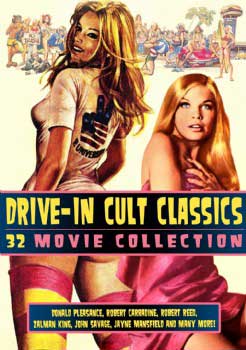
Like most of the Crown stuff we’ve covered both here and at my “main” site — http://trashfilmguru.wordpress.com , for those of you who don’t know — Pick-Up is available on Mill Creek’s 12-disc, 32-movie “Drive-In Cult Classics” DVD boxed set collection. There are no extras, but the remastered widescreen transfer looks surprisingly crisp and clean and the mono sound is, at the very least, perfectly adequate. This may not be the best film in the collection by any stretch, nor is it the most fun, but it’s definitely one of the most interesting, and it’s well worth the 80 minutes of your life it takes to watch it.

Enough With The “Bates Motel” Stuff Around Here, How About Some “Mayhem Motel” ?


mayhem-motel

Don’t get me wrong, folks — by and large I kinda like Bates Motel, and I certainly enjoy reading Lisa Marie’s write-ups on each episode here on TSSL, but let’s not kid ourselves —- that show is a soap opera less- than- cleverly-concealed beneath some standard horror genre trappings. You can, of course, say the same for The Walking Dead, another show which I also dig for the most part, but it’s high time we stopped pretending either of these were anything but — well, crap. Enjoyable crap, sure, but crap nonetheless. And I’m certainly not above enjoyin’ me some crap.

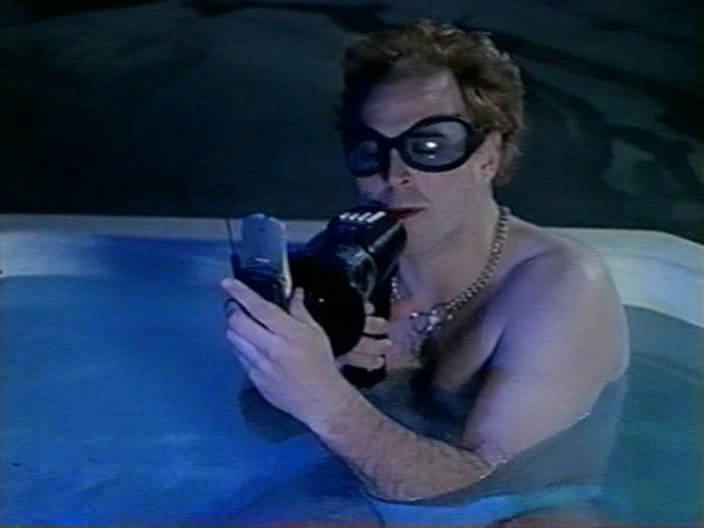
Writer/director Karl Kempter’s 2001 shot-on-video offering Mayhem Motel, for instance. This is most definitely crap — hell, it’s even weird crap, disgusting crap, nauseating crap (less than five minutes into the proceedings a character billed in the credits as “Pukey” throws up in a bathtub — for real — and then proceeds to sit down in his own regurgitated mess), but then, it never pretends to be anything else. There are no affectations  here toward “quality character drama,” Kempter isn’t fooling himself that his film has anything “important” to say, and in fact there’s no real story here to speak of at all, just a series of vignettes centered around a bunch of degenerate fuckwads and various other products of the gene pool’s decidedly shallow end who all happen to be staying (perhaps at the same time, perhaps not — it’s never made clear and frankly doesn’t matter anyway) at the same fleabag motel.

I don’t know about you, but I find that refreshing lack of anything even remotely approaching an agenda to be a strangely noble thing.

mayhemmotel1

It also means that Mayhem Motel  is both a difficult movie to explain, and an easy one to review — plot recaps are completely unnecessary since there literally is no plot, but at the same time simply saying “you’ve really just gotta see it and decided for yourself” sounds like something of a cop-out, even though — well, you really do just gotta see it and decide for yourself. There’s definitely not much of anything resembling a “point” to be taken away from this at-times-self-consciously-weird-for-its-own-sake string of mish-mashed, completely unrelated events — apart from maybe some vague overall suggestion that sex with strangers can get ya killed — and most (okay, all) of the scenes seem more designed to provoke some sort of visceral reaction (even if it’s only “okay, what exactly was that all about?”)  from the audience rather than actually involving you in them, but what the hell — it certainly makes for a one-of-a-kind 70-minute viewing experience.

1234195828_31536

What I can’t say with any certainty, however, is whether or not it’s actually a good one — that’s up to you. The movie’s a mass of contradictions — I mentioned that’s it’s both unpretentious and self-consciously-weird-for-its-own-sake, and trust me, both are true — but the acting (roughly half the parts are played by a guy named Matthew Biancaniello, the other almost-half by a woman named Sara Berkowitz) is of a generally high standard for this type of production (i.e. one shot for a reported $22,000), the lighting is uniformly interesting (if not uniformly effective), and in between the midget, the floating plastic Easter eggs, the guy with a tracheotomy, and the blow-up rubber fuck doll, Kempter really does succeed in creating both a sleazy and genuinely otherworldly atmosphere here. And besides, we ll know that most people will do just about anything for money, but seeing what they’re willing to do for no money is so much more interesting.

So yeah — it’s fair to say that Mayhem Motel does what it sets out to do, I just can’t say whether or not what it sets out to do is really worth doing. That’s a purely subjective call, and while I enjoyed it for what it was, I can certainly see why some folks might turn this off a few minutes after the opening credits. I’m not prepared to say this is one of those things you’re either gonna absolutely love or absolutely hate — like, say, White Castle hamburgers — since I don’t see it as being able to elicit strong reactions along either of the emotional poles like that, but you’re either gonna find it interesting or completely pointless.

Or, perhaps, both interesting and completely pointless.

MV5BMTcwNzE5MzM1M15BMl5BanBnXkFtZTcwMzU5MTk5MQ@@__V1_SY317_CR4,0,214,317_

Mayhem Motel is available on DVD either as a stand-alone release from Brain Damage films (I can’t speak to its technical specs or any extras on that version as I haven’t seen it), or as part of the “Decrepit Crypt Of Nightmares” 50-film, 12-disc box set from Pendulum Pictures, the Mill Creek sub-label that specializes in zero-budget indie and homemade horror. That’s how I caught it and it’s presented full-frame with fairly lousy stereo sound (something of a surprise since Kempter apparently makes his living as a sound mixing guy on various other projects) and no special features or other frills of any sort. Considering the whole package retails for no more than twenty bucks, whaddaya want, anyway? I’d say give it a go if you’re feeling adventurous —  beyond that, you’re on your own.

Trash TV Guru : “Hannibal,” Episode 1 : “Aperitif”


hannibal_nbc

Okay, here’s the deal — if you follow my “writing” (am I being too generous already?) either here on TTSL, on my own site,  http://trashfilmguru.wordpress.com, or on other places where my “byline” (again with the generosity!) occasionally appears such as dailygrindhouse.com, geekyuniverse.com, or what have you, it’s probably become apparent to you by this point that I don’t talk TV that much. Movies? Sure, all the time. Comics? Yeah, what the hell, I opine on those plenty, as well. But TV? This is, to my knowledge, a first. A new frontier. A new era. A new beginning. A bold, vast, wide-open, new horizon.

Okay, now I know I’m being far too generous. And grandiose. So I’ll cut it the fuck out right now.

Seriously, though, there’s a reason I don’t talk TV that much — I don’t watch TV that much. Alright, fair enough — I more or less never miss a Wolves or Wild game, so what I mean to say is that I don’t watch series TV that much. It’s just not my bag. Even with DVR and cable on demand, both of which negate the need to be in front of your screen at a set time every week,  it’s fair to say that continuing, serialized television just ain’t my thang for the most part. I’m a die-hard Doctor Who fan and have been since age, I dunno, six or seven, but my absolute, long-standing love for that show precludes me from saying what I really think about its current, depressing, lowest-common-denominator iteration too publicly. And I watch The Walking Dead and Bates Motel but Arleigh and Lisa Marie, respectively, have got those bases covered around these parts already. I’d been kind of wanting to dip my toes into the metaphorical waters of TV criticism on this site for awhile now, but there just didn’t seem much to be much point.

Then, I heard that the network suits at NBC had become either adventurous or desperate enough to green-light a series based around Hannibal Lecter, and furthermore that said new series was actually good, so I figured here’s my chance. Fair enough, the new show, simply (and unimaginatively) called Hannibal, shared a title with Ridley Scott’s genuinely atrocious entry into the Lecter cinematic canon, but why hold that against it? Especially since the territory it was going to mine, the backstory set before both the very best (Michael Mann’s Manhunter) and very worst (Brett Rattner’s Red Dragon) of the cannibal shrink’s celluloid exploits, seemed ripe for mining. Plus, rumor had it that the first episode was going to be directed by David Slade, who gave us 30 Days Of Night  and Hard Candy, two films I absolutely loved (we won’t hold the Twilight flick he did against him).

So, I figured, here it was — a show I could get in on the ground floor of and review every week for the edification of you, dear Through The Shattered Lens reader, whoever you are.

hannibal2

Confession time — I still missed the first episode anyway, despite my best intentions. The Wild were playing that night, so sue me. But I dutifully watched it on Comcast On Demand the next evening, and went in with pretty high hopes. It seemed that pretty much everyone liked this thing, from the most cynical corners of the internet to the most pompous and self-important to the most populist to, frankly, the dumbest (Entertainment Weekly, for instance, raved about it). Yup, everybody seemed to be in agreement — TV is bad bad for you, except for Hannibal.

So, yeah — maybe my expectations were too high. Maybe I just don’t “get” how series TV works. Maybe I stupidly wanted it to look and feel like Manhunter on, probably, a fraction of that film’s budget. And maybe — just maybe — I don’t know what the fuck I’m talking about, but I thought that episode one of Hannibal, titled (again rather unimaginatively) “Aperitif,” sucked.

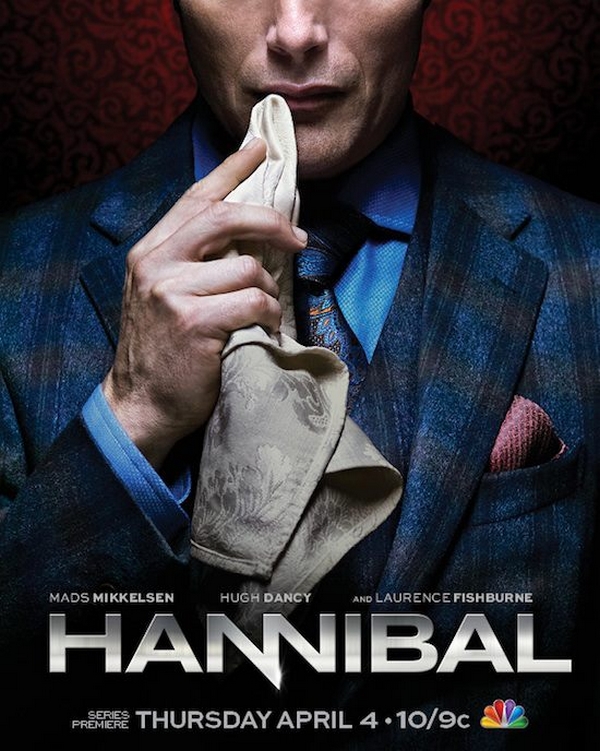
The setup, developed/dumbed down for television by series semi-creator Bryan Fuller (Thomas Harris should still get the lion’s share of the credit in my book) probably should work (and maybe on paper it does) — FBI special agent Will Graham, here played by Hugh Dancy (he of the bloodied glasses in the photo below) is paired with noted psychoanalyst Dr. Hannibal Lecter , here played by Mads Mikkelsen (he of the refined table manners pictured above) by Bureau big-shot Jack Crawford, here played by Laurence Fishburne (he  of the admittedly rather uptight appearance pictured far below). Yup, Graham and Lecter are, for all intents and purposes, partners.

Cool, right? And let’s just for the time being leave aside the fact that Dancy is no William Petersen circa the mid-1980s and that Mikkelsen is no Bryan Cox (still the best screen Lecter, I don’t care what anybody says) or Anthony Hopkins. This is TV, we gotta set our sights lower. But even making allowances for all of that, this was still a thoroughly lifeless, clinical, dull affair. Mikkelsen’s Lecter is closer to the version seen (by those who actually did bother to see it) in Hannibal Rising, which I guess makes sense given that he’s still in the early stages of his cannibalistic career here, and by that I don’t just mean that his vaguely eastern European accent is still present. I mean he’s not the older, accomplished, seen-it-and-done-it-all super-genius criminal of the Cox and Hopkins variety — he’s still, for lack of a better way of putting it, nothing but a pompous ass who happens to eat people. Which I guess makes him more interesting than a pompous ass who doesn’t eat people, but only marginally so.

Hannibal - Season 1

As far as Dancy’s interpretation of Graham goes, he probably does a better job in the role than Ed Norton did in Red Dragon, but the ultra-trendy twists Fuller gives the character — placing him somewhere in the autistic disorder spectrum, making him single so he can apparently spark up a love interest a few episodes down the line with co-star Caroline Dhavernas — are both unnecessary and, frankly, kinda patronizing. A lot of people seem to love the the way that this show has Graham mentally “re-live” the murders he’s investigating (all of which in this opening episode supposedly take place in my home state of Minnesota — probably by way of either rural California or Vancouver) by re-casting himself in the role of the killer, but I found it to be pretty gimmicky, to be honest, and already thoroughly predictable by the second time the conceit was employed.  I’ll take William Petersen’s anguished-and-angry version of the character from Manhunter any day of the week, even if I did promise not to hold the series to the same standards as the films.

And, since I opened that door anyway — one thing that both Michael Mann and Jonathan Demme understood about Hannibal Lecter that, frankly and depressingly, no one else has seemed to be able to figure out is that, underneath his civilized and erudite trappings, this is essentially a blackly comic character.  The greatest flaw of Hannibal the TV series — even greater than the lame-as-hell, wrapped-up-way-too-quickly-and-conveniently murder “mystery” here in episode one — is  its insistence on continuing the humorless, morose trend previously established by Ridley Scott, Brett Rattner, and whoever the hell it was who directed Hannibal Rising. Fuller and Slade just plain don’t seem to get this guy at anything beyond the most surface level, and that’s a shame, because apparently we’re in for 12 more weeks of this shallow, thoroughly unsatisfying interpretation of the character.

Serie 'CSI'

Or, should I say, you are. My days as an armchair TV critic are over (at least for now). Hannibal had a few good things going for it, I suppose — particularly Laurence Fishburne’s spot-on take on Jack Crawford and the nifty little scene where Lecter feeds human meat to Graham (unbeknownst to him, of course) — but not enough to get me to tune in for more.  I’m going back to what I know best. CSI with a cannibal just doesn’t do it for me. Now, Cannibal Holocaust on the other hand —

Everyone Else Is Talking About The “Evil Dead” Remake, So I Guess I Will, Too


Evil-Dead-Poster

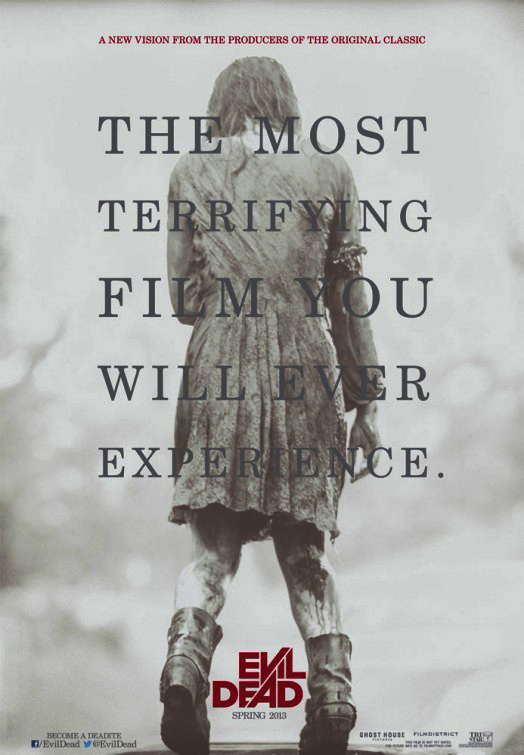
Let’s get one thing straight right off the bat — first-time director Fede Alvarez’s new remake/”reimagining” of Sam Raimi’s 1981 classic The Evil Dead (this time going out minus the article at the beginning of the title, so it’s just Evil Dead, thank you very much) is not, as its ad poster claims, “the most terrifying film you will ever experience.” That’s actually a gutsier tag line than it sounds on first reading, since it’s essentially promising that not only is this flick scarier than anything you’ve already seen, it’s scarier than anything else you’re ever going to see for the rest of your life. It can’t live up to that, period — and truth be told, it’s not even very scary at all.

Which isn’t to say that it’s bad or anything. In many key respects — eschewing CGI for “real” special effects, not even trying to cast somebody new in the role of Ash since  absolutely anyone would suffer in comparison to Bruce Campbell (who, along with Raimi, is on board as at least an air-quote producer on this one) — Alvarez and  his cohorts (including, it pains me to say, co-screenwriter Diablo Cody, who I was fairly certain was going to fuck things up here in some way, shape, or form but, pleasingly, doesn’t) get a lot of what they’re trying to do here right. The film is gory beyond belief, moves at nearly the same breakneck pace as its ’81 template, there’s a sublimely wrong tree-rape (yes, you read that correctly) scene,  the script provides a believably updated reason for why our five protagonists are getting together in a remote cabin in the woods — that looks very much like the original, might I add — in the first place ( I won’t spell it out too specifically but it gives new meaning to the old “withdrawal’s a bitch” cliche), and the performances are, on the whole, fairly solid.

They’ve also wisely chosen not to mess with the whole “haunted book inked in human blood and bound in human skin that releases untold evil onto the world” premise, so points all around for not only not messing with what worked in the original, but also for not trying to catch  lightning in a bottle twice by hewing too closely to it. Alvarez seems to have gone into this one knowing what he should and shouldn’t play around with, and that puts him a step ahead of your average horror remake director.

Here’s the rub, though — whenever you’re trying to update the look and feel of a $375,000 production on a budget of $14 million, something’s bound to get lost in translation, and no matter how hard it tries, Evil Dead circa 2013 just can’t capture the grittiness, the grime, the immediacy and, dare I say it, the heart of its progenitor. Alvarez is definitely going for an old-school approach here, and I commend him for that, but it’s still (and obviously) not old-school in actuality. Once you poke beneath the paper-thin surface, it becomes fairly obvious that any successes the new film has are more or less of the cosmetic and superficial variety. It looks good, sure — but it still feels kinda wrong, even though it’s doing its level best to cover that up by, again to its credit,  not giving you too much time to think.

I mentioned before that I by and large liked the cast — Shiloh Fernandez, Lou Taylor Pucci, Jessica Lucas, Elizabeth Blackmore and, especially, Jane Levy as our doomed (or is she?) central “heroine,” Mia — all do a nice job. But none of them especially stand out, either, which isn’t too bad a mini-metaphor for the movie itself as a whole — it’s thoroughly competent in terms of its execution, but there’s not much extra “spark” to the proceedings. Alvarez seems to understand the essential ingredients for making a solid, respectful, won’t-piss-you-off updating of a classic, but he’s got some way to go before he can create a genuine classic from whole cloth himself.

In some respects, there’s really not a whole lot he can do about that — The Evil Dead was shot in a remote Tennessee cabin while Evil Dead constructed its own location in New Zealand that set out to ape the look and feel of middle-of-nowhere USA as best it can — but that’s just endemic of the greater problem at work here, namely that this is a story that just plain not only doesn’t need a so-called “upgrade,” but literally can’t survive one with its celluloid soul intact. I give Alvarez all the kudos in the world for trying, and for at least understanding the surface elements of what made the original the undeniable classic that it’s rightly hailed as, but so much of what made Raimi’s flick the singular triumph that it was can never be duplicated. Hence, I guess, why I just referred to it as a “singular” work. In short, while we’re still talking about the first one some 32 years after its release, I’ll be damn surprised if people are talking about this remake very much even a year from now.

Still — they did what they could here, I suppose. I had an exchange with a couple of friends on facebook earlier today about the endless stream of remakes in general that we’re forced to navigate, and it made me realize that at some unspecified, silently-arrived-at point, I went from going into these things thinking “I hope they get it right this time” to  “dear God I hope they don’t fuck this one up.” It’s a subtle shift, sure, but it  certainly speaks volumes about the general performance of the studios’ big-budget-remake machine. I’m pleased to say that Alvarez et. al. don’t fuck this one up (and whatever you do, hang around until the credits are over — you’re guaranteed to leave with a smile on your face even if you don’t actually like the film at all), but it is what it is. The Evil Dead 1981 was a product of blood, sweat, tears, determination, and — weird as it may sound — love, put together by folks who didn’t always know what they were doing but were always giving it more than their best effort. Evil Dead 2013 is, for all its attempts to duplicate the trappings of its predecessor, a professionally-executed Hollywood production. You tell me which is gonna be better.

Hell —  tell me which has to be.

Any Takers For “Spring Breakers” ?


spring-breakers-IGN-poster-debut-610x903

So, we’ve finally discovered what it takes for Harmony Korine to go mainstream — a couple of  established stars, a little T&A, and hey! — he’s in the club. Hell, he can even manage to get himself invited onto Letterman outta the deal — although apparently he can’t stick around for long. Still, the fact remains — long (hell, decades) after you’d given up on the very notion it would ever happen, Hollywood has opened its doors to the guy who gave us GummoJulien Donkey-Boy, and Trash Humpers. And truth be told, he didn’t have to dumb down his sensibilities all that much in the process.

Okay, yeah — Spring Breakers is full of Girls Gone Wild-type footage of hot young flesh parading around in bikinis (or less), muscle-heads partying in jock straps, beer bongs being poured on impossibly tight stomachs, impromptu lesbian make-out sessions, yadda yadda yadda. But it’s piled on so thick and so repetitiously that there’s no way Korine can possibly be engaging in anything but parody of the Bacchanalian subculture he’s depicting. The film never takes itself too seriously, even when it ventures into some pretty dark territory, and it seems to me  that our guy Harmony is sending a none-too-sly message to the Tinseltown suits who previously wouldn’t have touched his work with a 50-foot pole : “this is what you want? Okay. But we’re doing it my way.”

And frankly, that “way” hasn’t changed much — the ultra-naturalistic hand-held camerawork, hallucinatory pacing and editing, and free-from improvisation (as usual, the story per se here doesn’t seem to follow any set “script” as you or I understand the term and appears mostly to consist of the actors getting into character and then ad-libbing from there) of his earlier efforts remains, and the end result is more akin to a series of “found footage” snippets pieced together pretty haphazardly than anything else. The setting may be different this time around, but the basic Korine modus operandi is essentially the same.

In short, if you’ve been following this guy’s career over the course of the pas couple of decades, you’ll only think you’re getting into something different with Spring Breakers, but by the time Ellie Goulding’s “Lights” plays over the end credits, there’s no doubt that this work fits in very comfortably with the rest of his directorial oeuvre. Think Trash Humpers in bikinis, or Gummo with “hotties” rather than genetic rejects, and you won’t be too far off thSo, here’s the deal — four friends (Selena Gomez, Vanessa Hudgens, Ashley Benson and Korine’s wife, Rachel) at a piece of shit college in piece of shit Kentucky are bored out of their minds and want to go down to St. Pete to live it up over Spring Break. There’s just one problem — they don’t have enough money. In order to alleviate that situation, three of them (Gomez’s character — named, appropriately enough, Faith — a devoutly religious young woman most of the time sits it out) decide to pull a heist at a local fast-food chicken stand using those purportedly realistic-looking squirt guns the cops are always telling us fooled ’em whenever they shoot some poor kid who was holding one dead. They get away with it and head down for a week of sun, fun, sex, booze, and drugs — but they don’t get away with that, because they’re busted at a party that gets out of hand. Don’t fret too much, though, friends, as they aren’t forced to cool their heels in jail for very long. A local dope dealer/wannabe-rapper who goes by the handle of Alien (James Franco, doing his best impression of Gary Oldman in True Romance , just substitute hip-hop for reggae) takes a liking to them when he sees them in court and bails ’em out en masse. Does he have ulterior motives? Of course, and watching him use pimp-like “turning out” psychological manipulation on the ladies in order to seduce them into into being hench-women in his pot-selling-and-armed-robbery enterprise (his only other “employees” are two identical twin brothers that Korine taps from the low end of that gene pool he’s always wading in  ) is both creepy and cool at the same time.

That being said, Alien’s not a one-dimensional character (even though most of the girls, frankly, are) and he does seem to develop a genuine emotional bond with his new recruits. Faith doesn’t fall for his shtick and hops a bus home, but the rest are in. And that, of course, is where the troubles really begin.

Korine follows a pretty delicate balancing act the rest of the way — he eschews standard “don’t aim higher than your station in life or it’ll end in tears” morality-play-style sermonizing even though the material could be played that way pretty easily, while simultaneously upping the ante on the over-the-top-ness of it all in a manner so sly that you almost don’t even notice that it’s happening. The ladies get Alien to fellate a gun silencer and it feels perfectly natural, fer cryin’ out loud! But what the hell, they all appeared before the judge in nothing but their bikinis a few short scenes ago, so anything goes here, right?

sb_05886_wide-06c6935db4ddef9146576f2e298d85bd0682b527-s6-c10

The final shoot-’em-up at the end, at which point another of the former-foursome has made her way northward after taking a bullet in the arm, does in fact strain credulity a bit, but by then the ethos of the film —in short, presenting the blatantly absurd in the most free-form, unforced manner possible — is so firmly established that, even if you don’t exactly buy it, you don’t mind it. The flick’s firing on all its admittedly warped cylinders, and your choices are either go with the flow or pull your hair out. Since I don’t have all that much hair left, the decision is  a pretty simple one.
2477-Spring_Breakers_Harmony_Korine

I suppose, at the end of the day, there will be those who go into this thing for no other reason than to see three-and four-way sex or former “Disney Girls” gone bad. If that’s your thing, fair enough — but I have to warn you, if that’s what put your butt in the seat, you’re destined to head for the exits scratching your head, even though the film delivers everything you want to see in even more ample proportion than you’d probably been expecting. The rest of us? We’ll have thoroughly enjoyed a movie that’s never as stupid as it pretends to be.

“Alienator” : Fred Olen Ray Gives “The Terminator” A Sex Change


Screen Shot 2012-10-19 at 4.59.15 PM

Give Fred Olen Ray credit — the guy’s a survivor. While his name has never been attached to a genuine B-movie classic — although Hollywood Chainsaw Hookers definitely has its fans — he’s found a way to remain, if not exactly relevant, at least employed for decades now and has , according to official IMDB totals, written 56 films, produced 80, starred in 143, and directed a staggering 128! Granted, directing 128 movies isn’t nearly as difficult as it sounds when most have two-or three-day production schedules, but still —

Anyway, Fred seems to be settling comfortably into the tail end of his career now helming SyFy network made-for-TV numbers and “Skinemax” fare such as Busty Housewives Of Beverly Hills, but back in the late ’80s/early ’90s the straight-to-video market was  wide open territory for low-budget mavens such as himself and he was more than willing to help blaze the  magnetic tape trail once the celluloid one he’d been treading previously dried and crinkled up with the demise of the drive-ins and downtown exploitation houses that had helped put food on his table (and we’ll get back to gastronomic analogies at the end of this review, just you wait and see!). A true visionary never gives up, he just gives it his best in another venue, right?

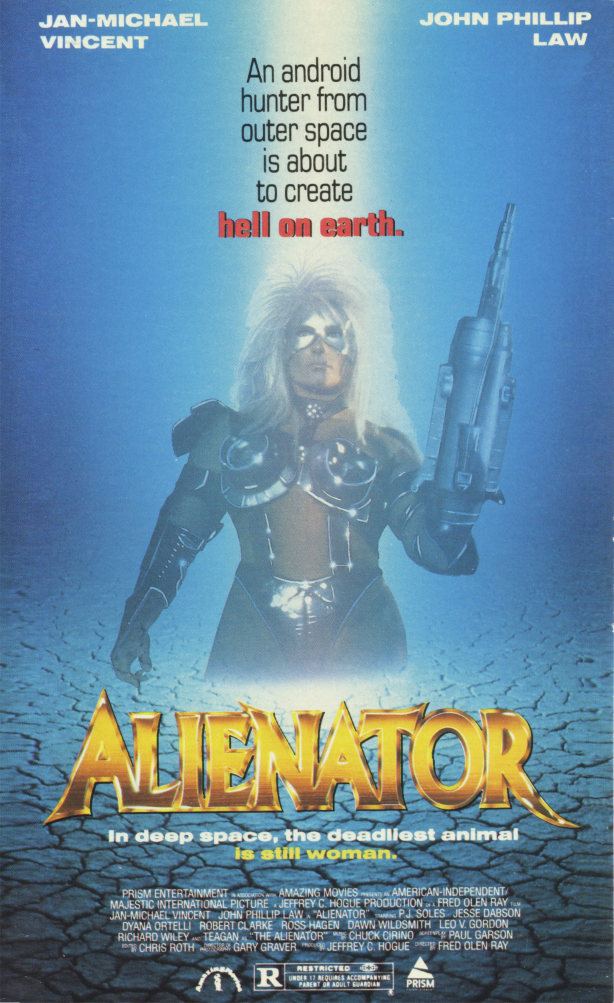
Unfortunately, even Fred’s best was never all that great, and the movie in our proverbial crosshairs today, 1990’s Alienator is far from his best indeed, although you’d never know it based on its drop-dead awesome premise, to wit : a supposedly evil intergalactic criminal genius/madman named Kol  (Ross Hagen) is about to be executed on a distant spaceship-prison thingie but , of course, manages to affect a semi-daring escape in a shuttle that  eventually crash-lands in a forest on Earth. There he makes friendly with a  park ranger (who’s got  the park ranger-iest name you’ll ever come across),  Ward Armstrong (John Phillip Law) and a bunch of annoying teenagers, but little do Kol and his new-found comrades suspect that the spaceship commander (named, simply, “Commander,” and played by Jan-Michael “anything for a buck” Vincent) from whose deadly clutches he managed to free himself has sent a Terminator-esque super-tracker after him, the ultra-deadly — and titular — Alienator herself!

alienator

Yes, I said herself — the Alienator, you see, is played by a female ( I think, at any rate, although it wouldn’t surprise me if she had some chromosomal issues going on, and I wouldn’t bet on her ability to pass an Olympic-style genetic screening test) bodybuilder who went by the snappy one-word name of Teagan at this, the apex (such as it was) of her career. She’s basically a cyborg — or maybe android, I never could tell the the difference — chick in a metal bikini who is damn hard to kill and displays, as you’d expect, the emotional range and affect of, say, a walnut. A single-minded killing machine with what appears for all intents and purposes to be a giant pair of binoculars on her boobs, arms that are thicker than my legs, and legs that are thicker than the trunk of the tree in my backyard. Are you afraid yet? You should be — but not so much of the Alienator her(him? it?)self as the unfortunate movie that bears her name.

I know, I know — you read about it on paper (or, as the case may be, your computer screen) and think to yourself “my God, how can you go wrong here?,” but trust me, friends, you can — this flick is a drag. All the actors play it disarmingly straight when by all rights they should be hamming things up, the pacing is dull as toasted rye, and the special effects aren’t good enough to be — well, good — but aren’t bad enough to be hysterical. In short, it’s all an exercise in sleepwalking, “get-it-in-the-can”-style movie-making, and can barely hold your interest despite the fact that by all rights it sure should given its appealingly blatant absurdity.

alienator-1

Still, if you’re in the (entirely advisable under most circumstances) habit of ignoring me, you can check it out for yourself as Alienator came out last week on DVD from Shout! Factory as part of their new “4 Action-Packed Movie Marathon” two-disc set where it shares billing with another early-90s DTV number from Ray, the Heather Thomas (yeah, I forgot about her, too) “starring” vehicle Cyclone, as well as the pretty-decent-all-things-considered Gary Busey revenge flick Eye Of The Tiger and fan favorite Cannon actioner Exterminator 2. The technical specs for Alienator are as follows : digitally remastered (and darn good) widescreen transfer, remastered mono sound, and no extras. Which is fine, really, especially since this package retails on Amazon for eight bucks.

51cAg+l+wbL._AA300_

Look, we might as well be honest here —odds are that if you’re gonna get this thing it’s for Exterminator 2 (I know that’s why I picked it up) so anything else is literally (okay, metaphorically — told you we’d get back to that)  just gravy, but ya know, sometimes turkey (or beef, or chicken, or whatever) tastes better plain, and Alienator is a cinematic condiment you can definitely skip and still get more than your money’s worth out of the main entree on offer here.

Which is kind of a  shame, really, because it sure sounded good on the menu.

“The Las Vegas Serial Killer” Goes Back To A Dry Well


lv

As we painstakingly established around these parts a few days back, The Hollywood Strangler Meets The Skid Row Slasher was not exactly Ray Dennis Steckler’s finer hour (okay, hour and ten minutes). It’s a definite head-scratcher of a movie, to be sure, but as mind-bogglingly weird as Steckler’s idea to shoot a silent slasher flick on a budget of $1,000 in 1979 was, that decision seems positively logical in comparison to his decision to actually make a sequel to said silent $1,000 slasher flick seven years later!

Still, in 1986, for reasons known only to the the pseudonymous “Cash Flagg” himself, that’s exactly what he did. Sort of. I think.

vegasserial2

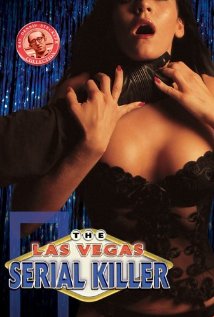
The setup here is, as you might expect, something of a puzzler in spite of its simplicity. Pierre Agostino is back as our strangler, but he’s called “Johnathan Glick” rather than “Johnathan Click,” and his stomping grounds have changed from Tinseltown to Sin City. He’s let out of the joynt  on the flimsiest technicality you can possibly imagine — they never found any bodies, so his convictions for a series of murders are all overturned — and he hits the streets again and starts killing.

Now, that might seem to make sense apart from the inexplicable swapping of the C in the character’s last name for a G, but that’s really just the tip of the iceberg. What’s he doing in prison in Nevada when his kill-spree took place in California, for instance? And, oh yeah — what he even doing alive, since he was murdered by the Skid Row Slasher at the end of the last one?

You begin to see the problem here. But “problems” are a relative concept, I suppose, and the logical gaps in the story’s basic premise are absolutely nothing compared to the problems in this film’s pacing and execution.

4080196602_815a9d0305

Steckler, here operating once again under his “Wolfgang Schmidt” nom de plume, has opted, no surprise at this point, to shoot the proceedings without sound — but instead of just telling the whole story via voice-over narration, he’s dubbed in actual, honest-to-goodness dialgoue in this one, and it’s never synched up even close to properly. Not that it really matters, because no one’s saying anything interesting — and nothing interesting is happening, either, with Click/Glick/whatever cruising downtown Vegas, the Strip, and neighborhood streets for ladies to choke with his bare hands. It’s, as you’ve no doubt come to expect, a pretty drawn out and tedious affair, and the killings themselves, when they do finally happen after interminable set-up periods, are all uniformly blase and aggressively nondescript.

Then we’ve got the subplot about two low-rent hoodlums who stand around making cat-calls at women, snatching their purses, and taking long lunch breaks. They always seem to show up in roughly the same locales as G(C)lick, and at roughly the same times, but their importance —  and I use that term very loosely, trust me — to the goings-on isn’t fully explained until very nearly the end, at which point you’ll have long since stopped giving a shit, and this little “revelatory twist” is so underwhelming that it would almost be insulting if you weren’t so begrudingly impressed at Steckler’s bravado for thinking he could get away with an “explanation” so lame.

MV5BMTc1MTk5NjMwNl5BMl5BanBnXkFtZTcwMjg5NzkyMQ@@._V1_SY317_CR4,0,214,317_

Unleashed  on a by-and-large uncaring populace via the straight-to-VHS route, The Las Vegas Serial Killer is, naturally, available on DVD these days (it’s presented full-frame with mono sound, both of which are, I guess, adequate enough all things considered), and while Media Blasters, under their Guilty Pleasures sublabel, have given us a nice (-r than this flick deserves) set of extras, including an on-camera interview with the director and a full-length commentary track where he opines at length on the making of the production, at the end of the day it still makes no sense, simply because all the explanation in the world  couldn’t begin to shine any light on why this was made and who Steckler thought his audience was.

Shit, I’ve seen this thing a few times now, and I’m still none the wiser. Is it a sequel to The Hollywood Strangler Meets The Skid Row Slasher? Is Agostino playing the exact same guy? How did he manage to survive when it sure as shit looked like he was dead? Why was he doing his time in a state other than that in which his (first) crimes were committed?

Fortunately, all of these questions have the exact same, simple answer — it doesn’t matter.

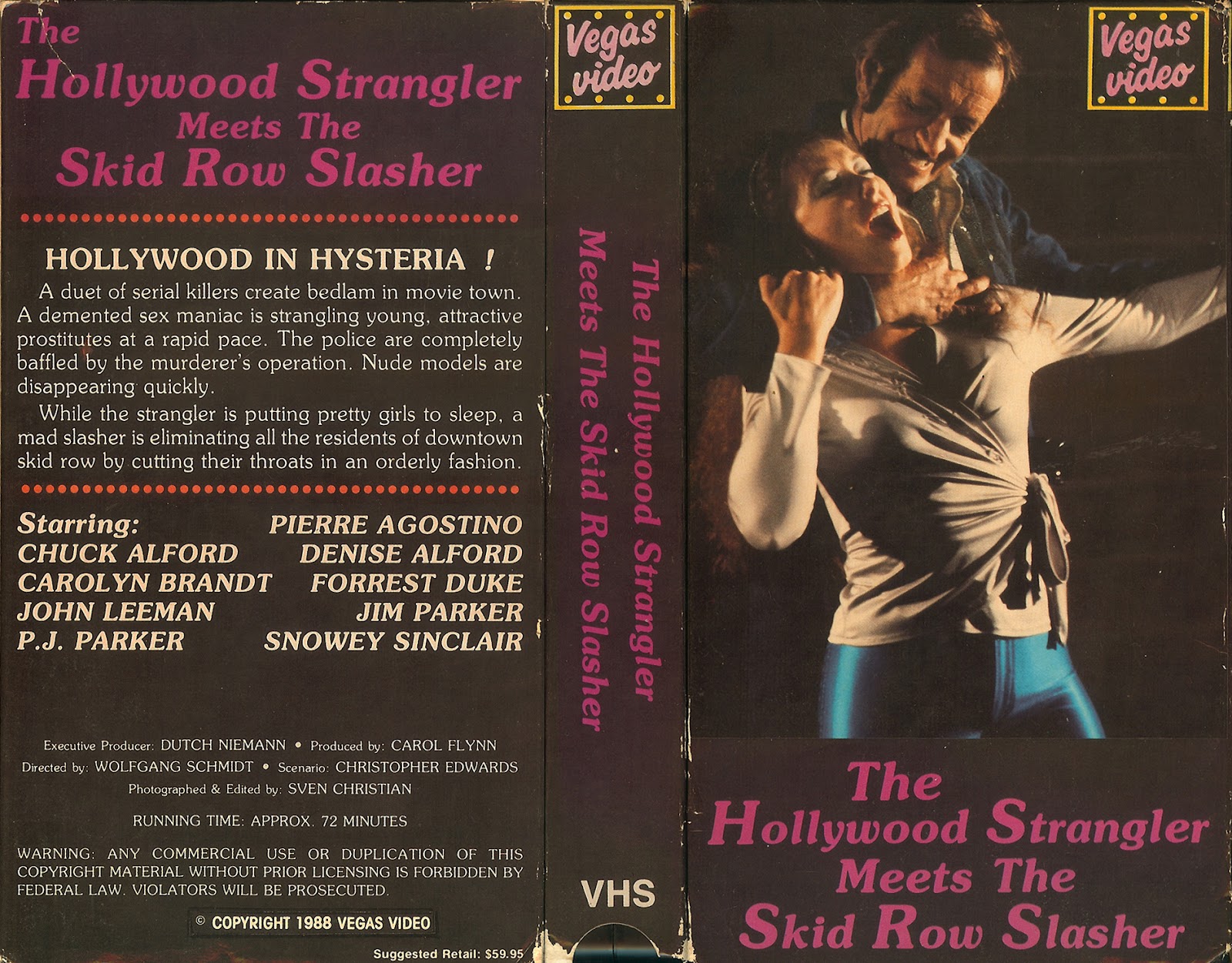
Grindhouse Classics : “The Hollywood Strangler Meets The Skid Row Slasher”


l_79300_4d2680e6

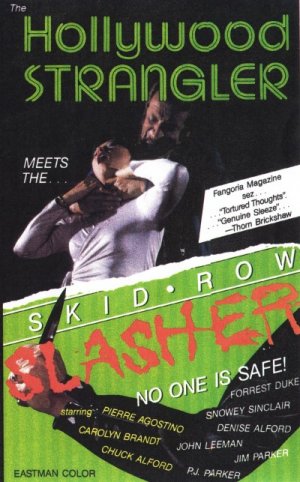
Sometimes, it’s almost impossible to know where to begin. Watching cult auteur Ray Dennis Steckler’s less-than-no-budget/dual-slasher mash-up The Hollywood Strangler Meets The Skid Row Slasher feels like a step back in time to the late 50s/early 60s, when ultra-cheap productions like The Creeping Terror and The Beast Of Yucca Flats were shot not only without sound, but with what sound was dubbed in later in post-production coming primarily in the form of voice-over narration, since the producers were too stingy and/or lazy to match up dialogue with actors’ moving mouths and only wanted to have to hire one person to tell their “story” anyway.

There’s just one wrinkle — Steckler (under his often-used “Wolfgang Schmidt” pseudonym) made this thing in 1979, hoping for a quick cash-in on the success of John Carpenter’s Halloween and the fly-by-night slasher genre that was then burgeoning in its wake! Honestly, by this point even Doris Wishman wasn’t cooking up her home-baked celluloid casseroles in a manner this frugal.

hwood vhs

Still, you’ve gotta give RDS at least some credit here — his dialogue-free, ultra-minimalist approach results in a style that can only be described as uber-naturalist, simply because when you spend this little on a production (the film’s total budget is reputed to be somewhere in the range of $1,000 — yes, you read that right) it literally can’t come out any other way. Honestly, his more “well-known” 1960s efforts such as The Thrill KillersThe Adventures Of Rat Pfink And Boo BooThe Lemon Grove Kids Meet The Monsters and, of course, The Incredibly Strange Creatures Who Stopped Living And Became Mixed-Up Zombies feel like big-money blockbusters in comparison with this effort, which is more akin in terms of its production “values” and “standards” to one of those old 8mm (although this was shot on 16) “educational” films they used to show you in school (if you’re old enough to have been around for them) on subjects ranging from photosynthesis to slaughterhouse operations and everything in between.

Purely as a side note,  I have to say that I have no idea what teachers do when they’re feeling lazy these days — I guess give a power-point presentation or something, but I do know what Ray Dennis Steckler does when he’s feeling like mailing it in — he makes a movie like this one.

Hollywood Strangler Meets Skidrow Slasher 271 - 273

This was made at the apex of our guy Ray’s so-called “dark period” — when he got divorced from actress Carolyn Brandt (although she continued to star in his features, including this one), split LA broken-hearted, set up shop in Vegas, and generally spent his time seething with bitterness toward the Hollywood system that had rejected his admittedly unique — if not good by any standard definition of the word — brand of film-making. Returning to the streets of Hollywood Boulevard for the first time in many years for this one, there is, in fact, a palpable sense of rage that oozes from the frames of The Hollywood Strangler Meets The Skid Row Slasher, and if you do a little game in your head while you’re watching it whereby you replace the young, female victims of the strangler and the derelict, destitute victims of the slasher in your mind with the various exploitation producers and distributors that ripped Steckler off over the years, the flick becomes a lot more interesting.

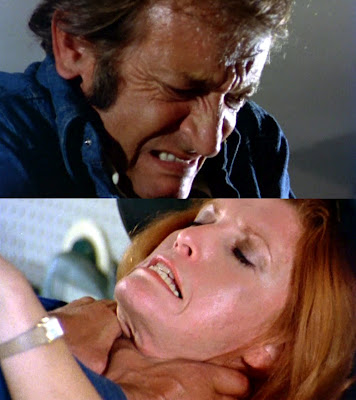
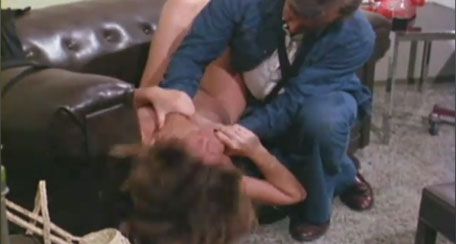
Truth be told, though, that’s about the only way you can draw any sort of “entertainment” from this 71-minute snooze-fest because Ray doesn’t really do anything on his part to keep you involved in the proceedings — it falls entirely on your shoulders as a viewer to invent a reason to keep watching. The “plot” alone’s certainly not gonna do it — our psycho narrator, one “Johnathan Click” (Pierre Agostino) poses as a nudie photographer in order to lure women whose phone numbers he’s obtained via the various hooker newspapers littering the boulevard over to his pad, where he dutifully proceeds to strangle them after they’ve disencumbered themselves of most or all of their clothing, while just a few block over an unnamed used bookstore clerk played by the aforementioned ex-Mrs. Steckler gets so sick of the bums and winos coming into her shop drunk off their asses that she starts slitting their throats (sometimes, curiously enough, with a knife that’s already got blood on it before she even sticks ’em ). As they both go about their business slicing,dicing, and choking their way through tinseltown, their paths are bound to cross — especially once Click rumbles his fellow traveler’s identity — but when they do, will they become uneasy allies in their mutual quest to, as they see it, clean up the streets, or will they have to duke it out to the death, figuring the town’s not big enough for the both of them?

the-hollywood-strangler-meets-the-skid-row-slasher

Don’t worry — by the time their confrontation finally does take place, you won’t give a shit about the outcome. Hell, if you’re a normal human being, you won’t even be awake anymore. Even as a morbid curiosity piece centered around the less-than-burning question of “how can Ray Dennis Steckler  make a movie with absolutely no money?,” this one runs out of gas pretty fast, and once the end credits (such as they are) roll, it feels more like a relief than anything else.

Perhaps the weirdest of all weird things in relation to this production, though, is that Steckler somehow, for some reason, must have felt that it worked (or at the very leaast turned a profit), because seven years later — long after what very few people who would have cared stopped doing so — he decided to make a sequel, this time featuring only “Mr. Click,” called The Las Vegas Serial Killer. I think he spent even less on that one since he didn’t have to  leave town to make it, and most of Hollywood Strangler‘s micro-micro-micro budget was, I’m guessing,  probably consumed by the director’s own travel and lodging expenses, given that the on-screen product looks like it didn’t cost  so much as one thin dime.

All that being said, Steckler performs something of an entirely accidental occult ritual here, by managing to warp our perceptions of the passing of time itself. At barely over an hour, this feels more like seven. You’ll swear that you can sit through the entire Godfather trilogy plus Lawrence Of Arabia  in the time it takes to watch The Hollywood Strangler Meets The Skid Row Slasher. At some point along the way, this passes the point of being merely dull and obtains the power to warp the laws of the universe merely through the force of its lethargy. This is a movie that works hard to be as boring as it is, goddamnit, and as a result it manages to completely take over our minds even if it can’t sustain our attention.

Don’t ask me how that works. I have no idea. Nor does Steckler. This kind of thing just comes naturally to a master of the craft such as himself.

Untitled-2

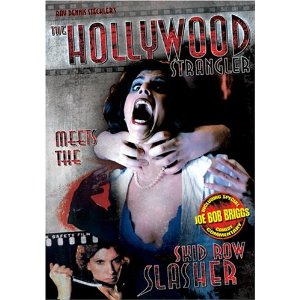
Fortunately, if you spring for either the purchase or rental of The Hollywood Strangler Meets The Skid Row Slasher on DVD, Media Blasters (under the auspices of their “Guilty Pleasure” sublabel) has done some things to make sure this can, indeed, sustain your interest. The widescreen transfers looks, well, as good as it can, the mono sound is bearable enough (not that it really matters that much), there are on-camera interviews with Brandt and Steckler, and we get two commentary tracks — one from Steckler which is pretty good, and one from the inimitable and legendary Joe Bob Briggs, which is, as you would expect, packed full of awesome from start to finish. A better overall package than this movie deserves, to be sure, but you’ll be grateful for it nevertheless.

51KK023JF3L__SL500_AA300_

All of which leads this review to one of those schizo conclusions that only seem possible with bottom-of-the-barrel exploitation cinema — the film sucks, but the DVD is great. At this point in his career, Steckler’s admitted one over-riding goal was to spend as little on his productions as possible, and here it really shows. He also prided himself on his intense hatred for actors and refused to hire any real ones, but that doesn’t matter much in this instance, since even the most talented performers in the world couldn’t save this thing. This is still, however,  a film worth sitting through, if not actively or actually watching — and not just as an endurance test (even though those can be fun sometimes). I know a statement like that positively demands an explanation, so try this — pop this disc into your player and keep one eye on your watch. Hell, keep both eyes on your watch since it’ll be more interesting than the movie. I guarantee you, at some point, the hands will stop moving, and they won’t start up again until “The End” comes up on the screen. That, my friends, is some real movie magic.

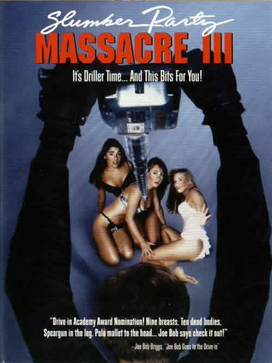
The SPM Trilogy Revisited : “Slumber Party Massacre III”


SLUMBER-PARTY-MASSACRE-III-DVD

What the heck, let’s wrap this up, shall we?

While the appearance of Slumber Party II may have surprised some being that it came five years after the original, it’s safe to say that when Roger Corman unleashed Slumber Party Massacre III  on the direct-to-video market in 1990, nobody was shocked in the least.

Shot primarily at one beach location and one residential home for exteriors, and with all the interiors being filmed at Corman’s Venice, California studio, the third installment in the SPM series cost a grand total of $350,000 and took somewhere in the neighborhood of one week to get “in the can,” as the saying goes, so yeah — it’s cheap , quick stuff we’re talking about here.

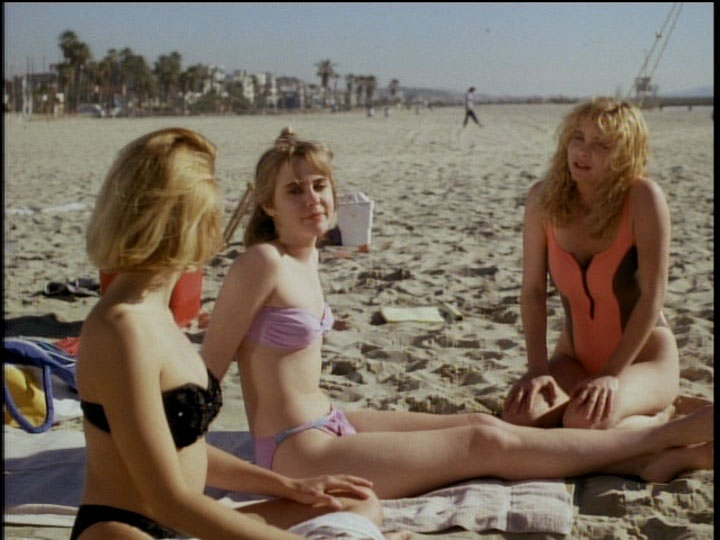
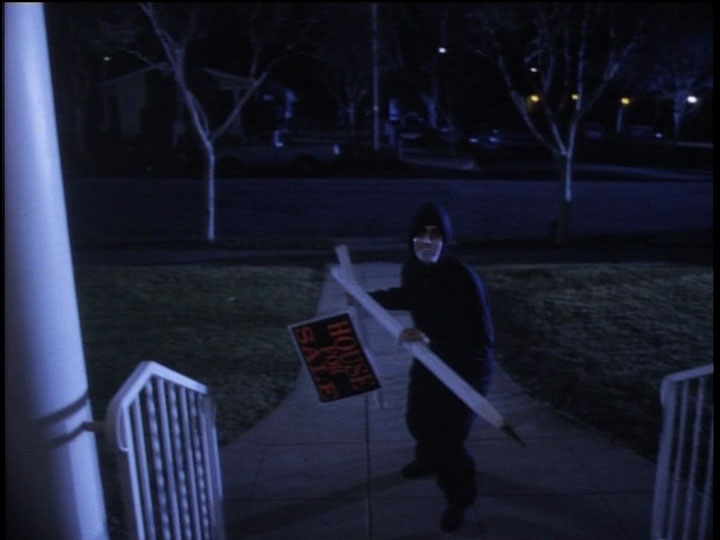
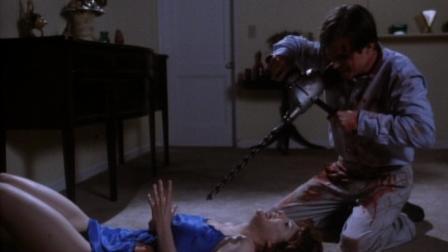
That being said, that certainly doesn’t mean it’s bad. What starts as a pretty bog-standard tale of stereotypical SoCal bimbo Diane (Brandi Burkett) and her friends ( a crew that features a few  young-at-the-time ladies, such as Hope Marie Carlton, Maria Ford, and Keely Christian, whose faces — and other parts — you may recognize from similar early-90s “slasher”/sexploitation fare) playing volleyball at the beach and then returning to Diane’s parents’ place for a weekend slumber party, where they are set upon, in turn, by their prankster-ish boyfriends, a voyeuristic “nosy neighbor” type, a mute Albino creepy dude, and finally a pyscho killer with a power drill, actually morphs somewhere along the way into a flick with a pretty wickedly sadistic, even black-hearted, sense of humor — with a pretty heavy dose of the misogyny you’ve come to expect from these things thrown in, of course.

As a brief case in point, instead of the standard bathtub-electrocution with either a hair dryer or toaster, in SPM III one of the nubile young co-eds is dispatched in the tub by means of a vibrator gone haywire! Nasty stuff, to be sure, but clearly not something that takes itself too terribly seriously while it’s dishing out its feminist-unfriendly — hell, female-unfriendly — goods.

slumberpartymassacre3girls

As with the previous two entries in this series, Corman again opted for an all-female writing and directing team here in order, one would assume, to help deflect any criticism this one might bet from the usual quarters (not that very many people were paying attention by this point), with those duties falling to Catherine Cyran (one of his regular screenwriters at the time) and Sally Mattison (a semi-veteran of Hollywood’s low-budget fringes best known for her work as a producer), respectively, and while it’s fair to say that this film is the most “seems-like-it-coulda-been-directed-by-a-man-ish” of the bunch, given that it ups the ante a bit in terms of its misogyny and plays it much “straighter,” if you will, than its predecessors in terms of sticking to the standard and much-maligned slasher formula, at the end of the day it’s still a pretty tongue-in-cheek affair  that’s just a bit more self-indulgent and gratuitous in terms of the T&A and overall mean-spiritedness.

To their absolute, credit, though, Mattison and Cyran, while carrying over the blatant phallo-centrism of the whole power drill thing, at least decide to throw in a bit of “whodunit?”-style mystery into the proceedings vis a vis their killer’s identity. Yes, folks, for the first time in a Slumber Party Massacre movie, the psycho might actually have some motivation for his murder spree here!

Or, ya know, he might turn out to be just some random stranger after all. I guess I won’t “spoil” anything in case you haven’t actually seen it. I will say, however,  that the mystery angle isn’t a particularly involving one — but hell, at least it’s there. We’ve already firmly established that “take what you can get” is the order of business with these things, haven’t we? The same — ahem! — “philosophy” applies here.

spmpt32

All in all,  though, you do get the sense that everyone involved here is giving it their best go on what they’ve got — which admittedly isn’t much in terms of time, talent, and money — but I’d rather watch so-called “D-listers” actually try than “A-listers” sleepwalking through yet another mega-budget production any day of the week. Slumber Party Massacre III may not be particularly ambitious stuff by any stretch, but it’s put together and performed by people who gave an honest day’s effort at the office. That’s worth a little something right there,  and after the absolute clusterfuck of wanna-be “trippy-ness” in the second flick, the “return to roots” sensibility in this one is very welcome indeed.

slumber-party-massacre-iii

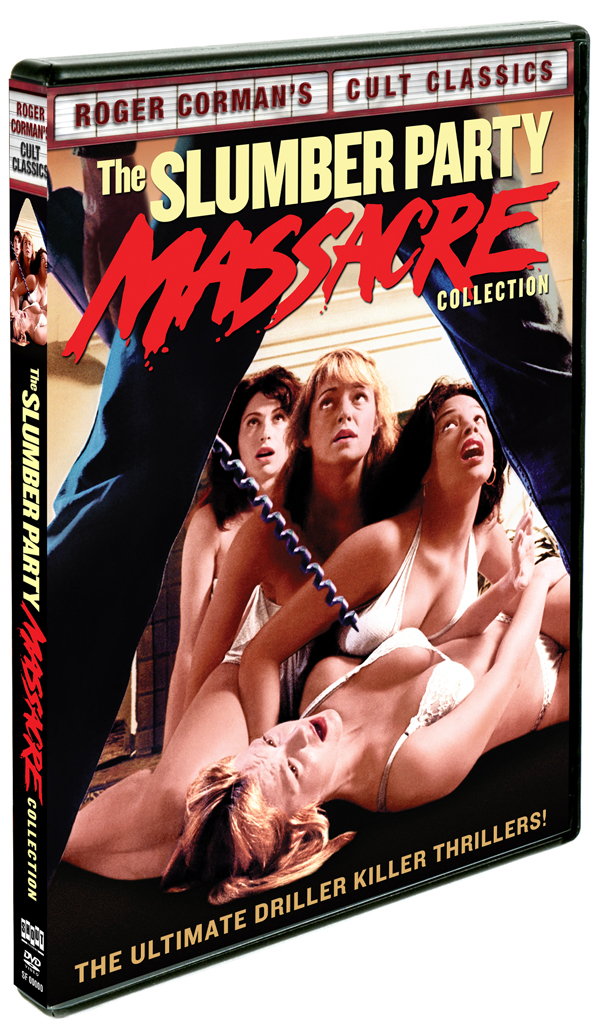
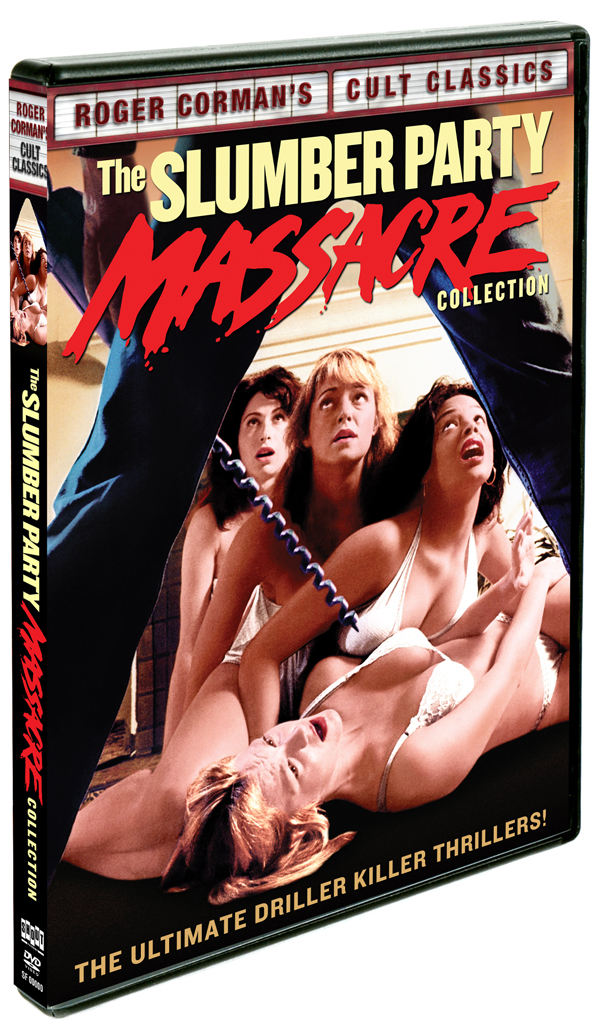
As always, the third and final outing (to date) in the SPM “oeuvre” is available on DVD from Shout! Factory packed together with its older celluloid sisters in a two-disc set under the heading “The Slumber Party Massacre Collection,” part of the “Roger Corman’s Cult Classics” series. It’s presented full-frame with 2.0 stereo sound — and while if there’s been any remastering done with either it’s certainly minimal, the whole thing looks and sounds generally decent enough. Extras include a good little “making-of” featurette, a feature-length commentary with director Mattison, the original trailer, a few trailers for other titles in the Corman series, a poster and still gallery, and a liner notes booklet by Slumber Party Massacre fanatic/filmmaker Jason Paul Collum. A very comprehensive package well worth your time.

slumber082710

Look, who are we kidding? This isn’t a movie out to set the world on fire — hell, it’s not even out to set the DTV slasher world on fire. It’s there to give two distinct parties their money’s worth — Roger Corman and you, the viewer. It manages to deliver on both fronts, even if just barely. That doesn’t mean it’s necessarily worthy of a ton of respect, but it’s not worthy of any sort of scorn, either. Don’t expect too damn much, and you’ll walk away satisfied.

Not, I suppose, that anyone who might be inclined to “expect much” as far as their entertainment choices go  is even watching this in the first place.

The SPM Trilogy Revisited : “Slumber Party Massacre II”


Slumber%20Party%20Massacre%202%201987

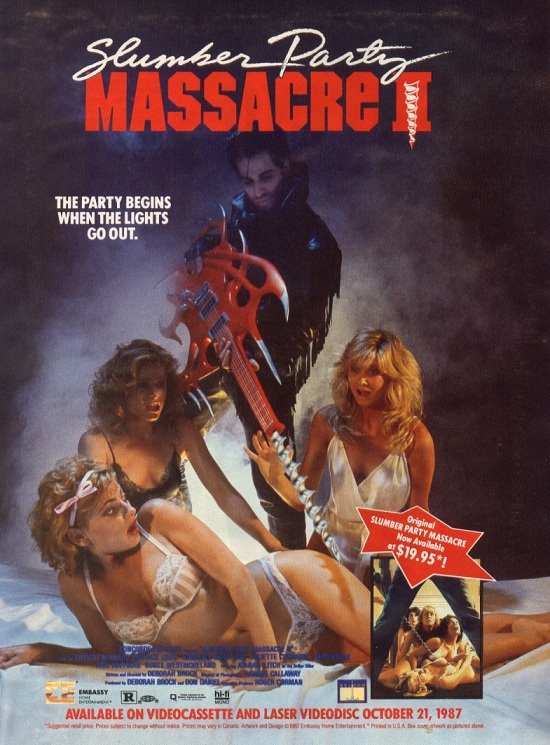
By 1987, I’m not sure that anyone was expecting Roger Corman to trot out a sequel to The Slumber Party Massacre. Sure, the movie had gained something of a cult following thanks to the VHS rental market (it did rather middling business at the box office upon its initial release), but it had been a few years and since most “slasher” sequels at the time tended to pop up within a year or two of the first flick (heck, that’s pretty much still the case), I think it’s pretty safe to say that the general feeling at the time was  that SPM was a one-and-done deal.

We all should have known better, or course. When you’ve got an ultra-simple premise that can be filmed cheaply and quickly using just a couple of different locations, and the original turned a profit (however modest), then there’s no way Corman’s not gonna go back to that well at some point. And so it came to pass that, five years on from its progenitor, Slumber Party Massacre II saw the light of day.

jurkohdkcrtibig

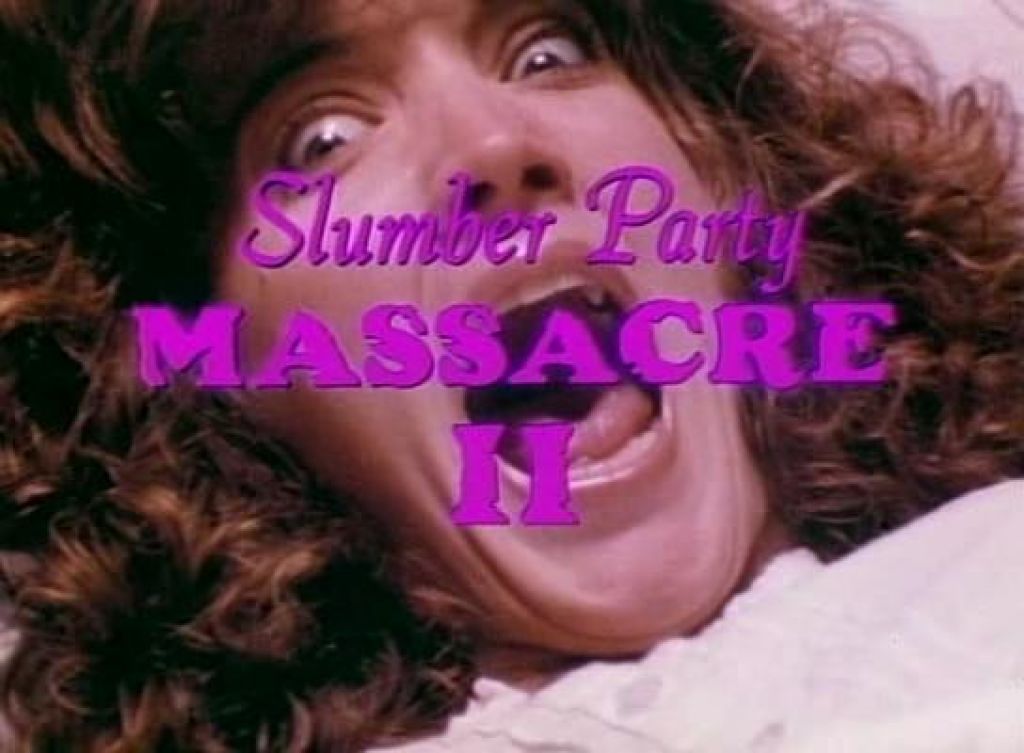
Needless to say, times had changed in the half-decade between the two films. While not strictly a straight-to-video release since Corman was still pulling together limited theatrical runs for all his product at the time (mostly in the Southern California area), those were really just a clevver way to essentially pull “focus group” test audiences together (and have them pay for the privilege of being guinea pigs rather than vice-versa!) to make sure the end result more or less had the effect on folks that it was supposed to. Pretty much all the action for the second Slumber Party Massacre was going to be on home video, and ol’ Roger knew it  — hence a smaller cast, fewer sets, and, I’m willing to bet, probably an even smaller budget (at least in terms of adjusted-for-inflation dollars). Heck, this thing even clocks in with a slightly shorter run time than its predecessor, if you can believe that, at a paltry 75 minutes!

One thing about the SPM modus operandi that Corman didn’t change, though, was hiring a young, relatively fresh-outta-film-school woman to direct the thing, his hire in those case being one Deborah Brock, who also wrote the script.

slumberpartymassacre2killer

To Brock’s credit, she tried to do something a little bit different — and, dare I say, maybe even a little bit more ambitious — than the average low-budget, essentially-DTV slasher sequel allows for with this movie. To her discredit, what she tried doesn’t exactly work. To wit:

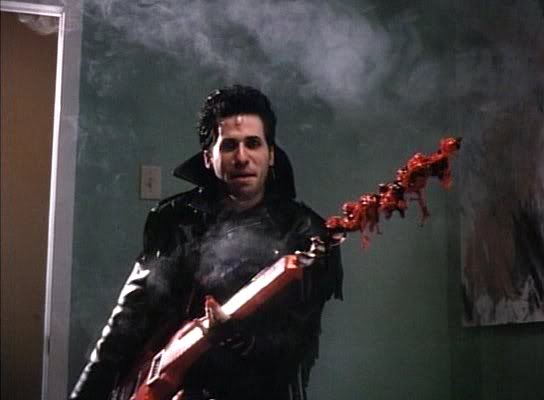
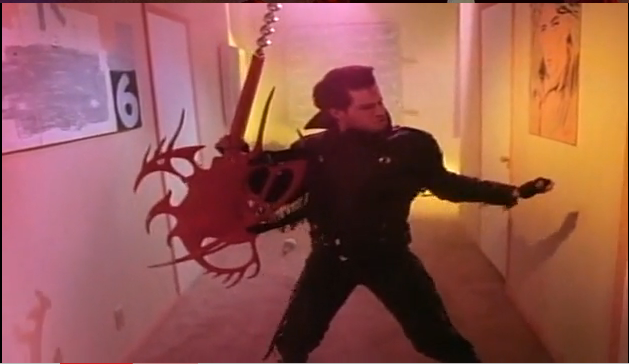
Our story here centers around a young gal named Courtney (Crystal Bernard, who would go on to star on the long-running TV sitcom Wings), who just so happens to be the younger sister of the “final girl” from the first Slumber Party Massacre flick. Courtney fronts an all-girl rock band (gotta vary it up from the high school basketball team premise at least a little bit) that’s headed to a rental condo for weekend of fun n’ semi-naked games with their boyfriends. There’s just one problem, though — she’s also been suffering from horribly vivid nightmares involving things like refrigerated whole chickens coming to life and her friend’s acne boiling, pulsating, throbbing, and eventually exploding all over the place. The one constant in all of these bad dreams, though, is an unnamed “devil rocker” (he’s referred to in the credits only as the “Driller Killer” and is played by Atanas Ilitch, who looks more than just a bit like a young Andrew Dice Clay) who terrorizes Courtney and her gal pals with a murderously-retrofitted guitar that’s equipped with a long, uber- phallic (again) power-drill for a neck.

spm23

Needless to say, once the weekend revelries get going, things don’t go quite as planned, and Courtney, her fellow girl-group rockers, and their fellas are soon experiencing a very violent reduction in their numbers at the hands of the “driller killer,” who turns out to be very real indeed.

Or is he? And that, my friends, is the crux of Slumber Party II‘s problem in a nutshell (besides the fact that the “real” killings don’t start taking place until just after the halfway point of the flick). At first, the whole “is this the real life, is this just fantasy?” (sorry, Freddie!) gimmick is kinda neat, but it definitely starts to wear on the average viewer’s nerves after awhile, and Brock’s decision not to delineate in much of any way what’s actual from what isn’t ultimately makes for kind of a confusing experience. Still, you figure that in a genre this (for the most part) cut-and-dried, things are bound to make sense by the end, right?

zit

Well, not so fast. Brock throws us not one, not two, but three rapid-fire concluding twists that never end up leaving  us with a satisfactory explanation as to whether or not the events we’ve just witnessed “really” happened or not. When we finally learn that Courtney’s locked up in a loony bin, three distinct possibilities emerge —  either it  was all a dream-within-a-dream in her disturbed mind, or she killed all her friends and this “driller killer” is some alternate persona she’s created in order to absolve herself of any guilt, or it all actually happened, she survived, and the ordeal drove her over the brink. And when the “driller killer” pops up again right before the credits roll, this time in the sanitarium with Courtney, Brock doesn’t in the least bit clue us in as to whether he’s there in the flesh or only in her erstwhile heroine’s admittedly traumatized psyche.

Some folks might find this lack of anything even resembling a concrete resolution interesting, maybe even a bit exciting. Hell, we all like to think for ourselves, right? Unfortunately, Courtney and her cohorts are such a largely uninteresting lot that most of us can’t really be bothered to care all that much about solving this film’s wanna-be-mind-fucking puzzle. And the “driller killer” himself is so OTT, and stripped of any pretense of motivation for his murder n’ mayhem, that he never seems “real” enough to make the purported “mystery” all that involving. The whole thing rings both flat and hollow to this wannabe-critic, at the very least.

slumber082710

Like the other pics in this soon-to-be-concluded little mini-round-up we’re doing here, Slumber Party Massacre II is available on a two-DVD set from Shout! Factory entitled, appropriately enough, “The Slumber Party Massacre Collection,” which is part of their larger “Roger Corman’s Cult Classics” series. It’s sporting a nicely-remastered widescreen transfer, has good 2.0 stereo sound, and there are extras aplenty including a fairly comprehensive little “making-of” featurette, a full-length commentary from writer/director Brock, a poster and still image gallery, the original theatrical trailer, some trailers for other flicks in this series, and a liner notes booklet by SPM historian Jason Paul Collum. While I may not consider this a great movie by any means, this is certainly a great DVD package.

Still,  ya know what? Flaws n’ all, I’d still go so far as to say that the film itself is at least worth a look. I do admire Brock for her willingness to break the mold and think outside of the usual slasher box. Her intentions for this flick strike me as being pretty solid, and as almost-innovative as her budget would allow for — she just fails in her execution. And let’s face it — a slasher movie that can’t execute properly is saddled with a problem it can never overcome.