Happy Holidays! It’s that special time of the 5125 year cycle where friends and family all come together in celebration. From the writers of Shattered Lens, wishing you and yours a wonderful Mayan Apocalypse. Remember to enjoy the total annihilation of the human race responsibly!
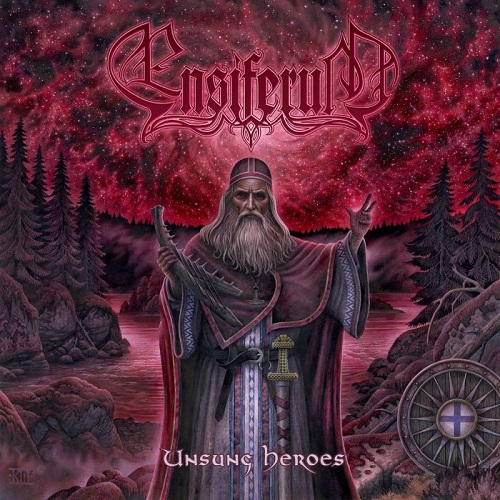
I read so many negative reviews of Unsung Heroes that I actually avoided listening to it for four months. My acquaintance with Ensiferum goes all the way back to their 2001 full-length debut, and I was in no hurry to hear such an essential and formative band for me fall by the wayside. I finally gave it a spin for the first time last night, and frankly I don’t know what everyone is bitching about.
In My Sword I Trust
I mean, sure, Unsung Heroes isn’t the explosive powerhouse of Victory Songs and From Afar. But was I the only person who got the feeling on From Afar that their standard formula was growing really stale really fast? Ensiferum may have set the standard for folk metal as we know it today, but beneath the fist-pumping and epic folk interludes of even tracks like Twilight Tavern and Stone Cold Metal I got the sneaking suspicion that they were beginning to succumb to the very genre stereotype they established. Victory Songs certainly stands as my favorite Ensiferum album to date, but I kind of felt like From Afar was riding too much on its success. Almost every song followed the formula that made Victory Songs so great, and while this certainly facilitated a fresh batch of great songs, it was less than I’d hoped from a band that had consistently paved their own way over the years.
Is Unsung Heroes a washed out version of Victory Songs and From Afar? Only if you claim that those albums capture exactly what Ensiferum ought forever more to sound like. I for one think it’s a breath of fresh air. It reminds me, if anything, of their 2001 self-titled. It humors the possibility of rocking out without lightspeed double bass. It dares to occasionally divorce overbearing synth and “epic” orchestrated overlays from the folk passages. It drops, I think, the degree of pretentiousness that concerned me on From Afar. I have no interest in listening to the musical equivalent of 300 spin-offs ad nauseam. The total testosterone indulgence of Victory Songs was exciting in its day, but in music and film alike it grows old quickly.
Pohjola
I really feel like Unsung Heroes is Ensiferum’s most mature work to date. That doesn’t make it their best; Victory Songs was just too perfect and the self-titled too nostalgic to be trumped any time soon. But on Unsung Heroes I can again feel like I’m listening to a band who share my nerdy lust for all things fantasy. There’s none of the glam and special effects that dazzled me on Victory Songs but made me begin to feel distanced from the band on From Afar. I’m absolutely thrilled to be able to connect with these guys again in the more personal way I felt on their first album.
And really, what can you possibly complain about on a track like Pohjola save that it doesn’t fall into the formula of their last two albums? I’ve heard people say they’re becoming a Turisas knock-off. That’s absolutely ridiculous. Post-Battle Metal Turisas has served as the ultimate Hollywood blockbuster band–glossy and refined, if Victory Songs was Ensiferum’s 300, Varangian Way was Turisas’s Lord of the Rings. Tracks like Pohjola might have epic operatic vocals and orchestration, but the surrounding atmosphere is completely different from either of those works. The viking metal riffs that really start to pick up at the 3 minute mark ought to be a revealing sign that this song is all about the steady drive. The orchestration ebbs and flows without many hard, dramatic stops. The synth whistle that accompanies the main riff in the earlier stages of the song gives it a light-hearted, positive feel that carries throughout. The acoustic guitar outro is beautiful, but it’s also accessible. It’s something you the listener could pick up your guitar and play.
Unsung Heroes isn’t perfect. Sami Hinkka’s clean vocals leave a bit to be desired, especially on “Last Breath” where they take center stage. That, the ninth track, is really the first moment on the album where I begin to see where any complaints might have a leg to stand on. If the 17 minute-long closer which follows–“Passion Proof Power”–was as good as we’ve come to expect from an Ensiferum grand finale, any petty complaints about “Last Breath” might be easily forgotten. The problem is that “Passion Proof Power” is frankly pretty bad. It starts off a lot slower than the rest of the album’s non-acoustic tracks, more inclined to bore me than build anticipation. When it does pick up there’s no clear direction as to what’s going on. The song gives way into some really, really lame progressive rock, coupled with boring, unconvincing spoken passages and completely misplaced operatic vocals. The song never really builds up into anything. There are moments here and there where you might find yourself drawn back in–at the 13 minute mark for instance–but as the song continues to go nowhere you’ll forget about it again soon enough. I can’t make any excuses here; “Passion Proof Power” is a waste of 17 minutes, and if you skipped ahead to it expecting to hear Ensiferum’s finest effort–a reasonable thing to do considering how they’ve concluded past albums–you may well be left with the impression that Unsung Heroes is terrible. Follow that up with an embarrassing bonus track cover of Gypsy Kings’ Bamboleo and yeah, you definitely have a right to demand the last 20 minutes of your life back.
Burning Leaves
In conclusion, this is perhaps Ensiferum’s most down to earth album to date. It’s all about moderation and maintaining a steady drive while never over-extending or burning out into a bore. It doesn’t crush or dazzle; it rocks along, and does so with some really compelling orchestration that’s uniquely accessible. I think there’s this common misconception that fantasy-themed music has to sound larger than life, but for me that’s a detriment in all but the most perfect, Victory Songs/Varangian Way-level instances. If it sounds fake it’s not doing a very good job of creating fantasy now, is it? Unsung Heroes paces itself and transitions in ways that feel legitimate. I love it, at least for the first 40 minutes. It doesn’t so much progressively decline from there as stall mid-air and nose dive; they should have put “Last Breath” before “Pohjola” and made the latter the finale. “Passion Proof Power” and “Bamboleo” are garbage B-sides better suited for some bonus disc on a collector’s edition. (I suppose Bamboleo technically is a “bonus” track.) To say Unsung Heroes is a great album while chucking out a full 20 minutes of its content is a bit of a stretch, but because the weak points are condensed on the fringe rather than interspersed throughout the album, and because 40 minutes of outstanding new Ensiferum is certainly sufficient, I am content to delete the last two tracks from my playlist and call it a success.
I was pretty shocked when Krallice released Years Past Matter this August. If I remember an interview with the band I watched correctly, their first three albums–Krallice, Dimensional Bleedthrough, and Diotima–had all been written by Mick Barr and Colin Marston at roughly the same time. A very clear progression distinguished each, and by Diotima significant influence by drummer Lev Weinstein and bassist Nick McMaster was apparent, but the foundation had been there all along. I expected a rather lengthy break between Diotima and their next release, as I figured the band would be working more from scratch at that point. Instead, Years Past Matter appeared on the scene just a little over a year later.
The surprise worked out rather nicely, because I didn’t have time to build up unrealistically high expectations. Diotima was the best new album I’d heard in a decade, and I really doubted Krallice would be able to top it any time soon. They didn’t, and that’s just fine, because Years Past Matter is still outstanding.
I feel like it is a somewhat subdued work in comparison, far less explosive and dynamic than Diotima. Almost every Diotima track had a total mind-fuck moment or two: The intro track, Inhume at the beginning and at 5:25, Diotima at 5:35 and 8:50, Telluric Rings at 2:55, 6:40 and 10:35, Dust and Light at 4:45. I’ve yet to find any moment on this album where the music slaps me upside the head with a brick and makes me stair wide-eyed mouthing “holy fucking shit”. That being said, last.fm claims I’ve listened to Diotima over a hundred times. Krallice isn’t the sort of band you can fully appreciate on short notice.
It also seems like the drumming and bass have reverted to the secondary roles they had on Krallice and Dimensional Bleedthrough, not function as equal players in the manner of Diotima. There were a lot of instances on Diotima, especially on Inhume, where I think the drumming actually managed to trump the guitars in delivery. That might not be a matter of performance so much as production, and it’s worth noting towards this end that my dear, beloved cd player in my 2005 Nissan Sentra finally passed away this summer. I swear its stock model had better sound quality than any high-end sound system I have ever heard. It might just be the case that these elements on Years Past Matter feel slightly less overwhelming because my shoddy computer headset fails to do them justice.
But in light of the lofty and exclusive pedestal I place Diotima upon, these are modest complaints. Over all Years Past Matter feels a lot like Dimensional Bleedthrough to me. That was an album which, unlike their 2008 debut, I completely failed to appreciate initially. It wasn’t until Diotima had raised my opinion of the band through the roof that I began to revisit Dimensional Bleedthrough and really recognize its quality. I’m not going to make the same mistake with Years Past Matter, but it’s going to take more than the few dozen listens I’ve given it so far to really grasp its full worth. The myriad subtle complexities only become apparent bit by bit over time, and in the absence of Diotima’s explosiveness there is little to immediate grasp hold of. Like Dimensional Bleedthrough, the songs progress slowly and require a substantial attention span to fully engage. What works so well for both that album and Years Past Matter is that the atmosphere they generate makes for ideal background music. You can let it play all evening without ever growing tired, and when you do temporarily tune in what you encounter is always outstanding. My experience with these albums has been one of a gradual piecing together of the parts I happen to engage, building up over countless rewarding listens into a big picture that I know by heart from start to finish.
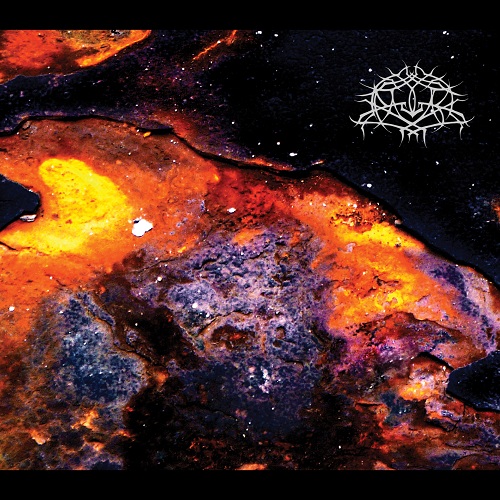
The physical presentation of the album actually adds a lot too. Along with one of the most compelling album covers I’ve seen in a while, Years Past Matter offers no printed lyrics or meaningful track titles. I haven’t gotten a chance to try and decipher any of the lyrics as sung, but I don’t think they are meant to play an essential role in the songs the way they do on Diotima. The feeling is more of some abstract, dehumanized vision of outer space. This isn’t so much a change in the sound–the vibe I get from it is essentially the same as on Dimensional Bleedthrough–but it places the music in a slightly different context from the outset.
If you don’t care for what you’re hearing on first listen, this band probably isn’t for you. Their unique take on black metal has remained fairly consistent throughout the years. But if you do appreciate the technical precision and the overall atmosphere, don’t be too quick to write off their song-writing. What may sound meandering at first will in time coalesce into a brilliantly crafted song. The big picture is a lot more accessible on Krallice and especially Diotima, but it was there to be had on Dimensional Bleedthrough too; I just tried too hard at that time to extract it. Years Past Matter has been a great experience for me this year because I’m not trying at all. I’m enjoying the ride and letting the full vision of their songs emerge naturally over time.
Blut aus Nord generated a lot of waves in the metal scene last April when they released Sect(s), the first installment in their 777 trilogy. The album was a gripping ride through a vivid musical nightmare, merging industrial music and a particularly demented take on black metal to paint its demon-ridden post-apocalyptic landscapes. The Desanctification, released in last November, flew much lower under the radar. Lacking all of Sect(s)’s shock value, it was a more contemplative plod which capitalized on the industrial side of their 777 sound and presented the devastation inflicted first-hand on Sect(s) from a less intimate angle. If the listener was the victim on Sect(s), Desanctification offered the role of witness.
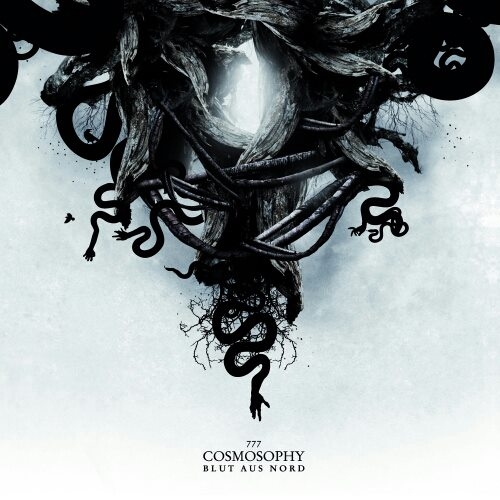
Cosmosophy, the final installment in the 777 trilogy, was released this September, and a lot hinged on it. Sect(s) and The Desanctification were drastically different and yet inseparable, the second naturally flowing from the first. How did Blut aus Nord intend to bring it all to an end?
In the very last way anyone could have ever expected: They repeated the exact same thing they did on The Desanctification. It’s a brooding, visually stunning bird’s-eye view of a cyberpunk holocaust, and as such it’s just as outstanding as its predecessor. But where is it going?
If Blut aus Nord released two albums like this every year they might well become my favorite band. I’ve been dying for this kind of material, and The Desanctification and Cosmosophy both fill that niche with a degree of excellence that surpasses all other attempts I have heard. But I guess for me the 777 series was telling a story, vague though it need necessarily be, and Cosmosophy just kind of waves that off. It’s an outstanding album in its own right, but it does not feel appropriate in the context of the trilogy.
Epitome XVII and XVIII are somewhat of an exception,and they’re the tracks I’ll be sampling here. XVII has a definite sense of conclusion about it. It’s not an optimistic one, especially given the lyrics–“How many seasons beyond this sacred life? How many treasons beyond this clever lie?” But the feeling is one of profound revelation, as if the listener in this nearly wordless narrative has finally come to see the grand vision we were all hoping Cosmosophy would offer. The transition that spans from about 4:20 to 6:20 is pensive, serving to reintroduce the darkness that resolution has by no means abated. As this fades and we reach the final track in the trilogy, you can definitely see the story coming to an end:
Epitome XVIII is one of the finest of those bird’s-eye perspectives on the greater 777 landscape, and in its context it offers something of a new, esoteric light on the devastation below. The outro that begins to fade in after the 7 minute mark is the perfect conclusion and perhaps the darkest moment in the entire trilogy, epic in its silence. Of Cosmosophy’s two concluding tracks I have no complaints. It’s the first three that get us there that leave a lot to be desired.
If you care to revisit The Desanctification, it ends on a completely twisted industrial groove that offers all of the madness of Sect(s) without any of the fear–a sense that the subject (the listener) is breaking down into utter insanity, becoming a part of the surrounding chaos. I desperately wanted Cosmosophy to pick up on this note. I wanted to hear a merging of Sect(s)’s black metal and Desanctification’s industrial that, if you’ll humor my manner of description, merged the victim and the witness into one. I expected a juxtaposition of the sweeping landscapes and the frantic madness that could, in the context of the trilogy, depict a sort of out of body experience in the subject/listener. Epitome XIV and XVI instead feel like unused (though equal) tracks from Desanctification, while XV offers three minutes of obnoxiously spoken French which quite frankly fails to invoke anything but annoyance before plunging into an outstanding but compromised semi-operatic sweep that could have found a place on the album but lacks appropriate context as presented.
Epitome XV is the only track I dislike in the trilogy, while XIV and XVI seem out of order. In the meantime, I feel like an essential step between Desanctification’s XIII and Cosmosophy’s XVII is missing. In short, Cosmosophy does not live up to my ridiculously high expectations. If Blut aus Nord were to come out with a surprise Part 4, I certainly would not deem it overkill. But if we view Cosmosophy as just another 2012 metal album there is hardly room to complain. It is only in light of the standard set by Sect(s) and The Desanctification, and in expectation that the conclusion ought to be the 777 trilogy’s finest hour, that it slightly disappoints.
Norway’s Enslaved formed as a black metal band in 1991. That means Grutle Kjellson and Ivar Bjørnson have been playing together for at least 21 years. Most–I’d say the vast majority–of bands are pretty washed up by the 20 year mark. But Enslaved is a fluke. An anomaly. They stand on the cutting edge of the metal scene today, and their last three albums have been phenomenal.
Thoughts Like Hammers
Maybe some of it stems from their age. Bjørnson and Kjellson were 13 and 17 respectively when they began releasing demos as Enslaved. It’s hard to imagine a 20+ year old band whose founding members are in their mid-30s, but that’s what you get here: two artists in their creative prime.
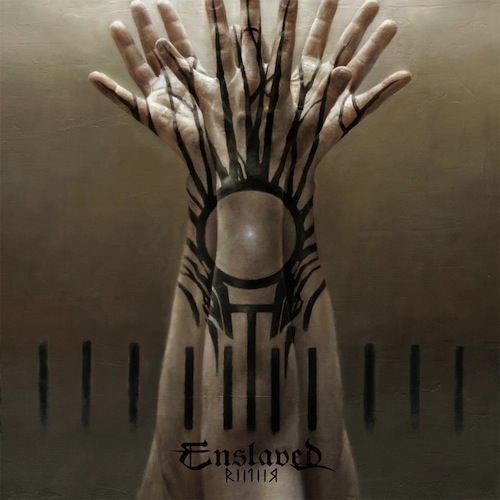
RIITIIR’s aptly-named opening track, “Thoughts Like Hammers”, starts out with a bit of incoherent chaos before busting into a crushing viking metal plod that immediately answers any question as to whether RIITIIR is going to follow the same path as Vertebrae and Axioma Ethica Odini. The relatively new viking-prog-black mix they’ve landed on is faultless, and about the only thing they could do wrong is change it. RIITIIR picks up right where Axioma Ethica Odini left off.
It would be kind of odd to speak of post-viking metal when so few bands have defined the original style in the first place. But what makes Enslaved perhaps the best metal band to ever make a late-career venture into the world of progressive rock is their impeccable ability to maintain all of their heavy metal credentials. Kjellson’s growls are some of the most distinct and cutting in the scene, and there can never be any question about the band going soft. The lofty progressive movements are lush with sound in just the sort of way that has made viking metal bands like Enslaved and Týr consistently great throughout the years. Their juxtaposition of uplifting musical sweeps and crushing, dark passages transition flawlessly, with none of the grating clash of styles that you might hear in bands inclined to force the issue.
RIITIIR
As for how RIITIIR matches up to Vertebrae and Axioma Ethica Odini, I think RIITIIR maintains the much needed improvement in production quality that distinguished Axioma from its predecessor. The major riffs and choruses are just as instantly memorable. I think Axioma had perhaps a stronger black metal side to it, but the difference is slight. What I really feel in RIITIIR more than the other two is the consistent drive–a sort of all-embracing power that gives the album no down time to speak of. Even the slowest folk interludes are exceptionally well constructed to fit the context of their songs and maintain a tense, brooding atmosphere.
My immediate impression of RIITIIR is that it’s the best album to date from a band that has at this point thoroughly proven their standing among perhaps the top ten metal bands making music today. I don’t really need to go into exceptional detail on this one; it’s exactly what they did on their last two albums, only even better. Don’t let this year-end contender pass you by.
Vegard Tveitan released his fourth solo album this year, giving “Ihsahn” a discography almost as extensive as Emperor’s. Eremita offers the eclectic and exquisitely well-executed sound we’ve come to expect from him in recent years. What it does not offer is very much in the way of black metal. This was a predictable turn, as his sound continued to evolve and incorporate more and more progressive elements. Eremita continues from the major shift taken on After.
Arrival, the album’s opening track, is something of a caricature of everything I don’t really like about Eremita. (Considering the almost total lack of Eremita references on youtube, I have no doubt this video will be removed pretty soon for some copyright nonsense, but the guy who shared it’s account is still active for the time being if you want to go explore the album more thoroughly before buying it.)
The power of the driving opening riff is obviously lost in a youtube sample. Don’t let that be a turn-off. But it’s still a relatively unvaried chug-a-chug, with Ihsahn’s unique distorted vox intermixed with soft, sung breaks. Shortly after the 3 minute mark the song explodes into a pretty wild 30 second guitar solo, and then it’s back to what we started with. I do think Ihsahn’s eclectic guitar doodling is pretty impressive. That’s something I’ve yet to tire of. The getting there, however, is kind of a tedious path for me. Prog bands so often lose focus of the importance of creating an overall vibe, and I fear that “Arrival” too runs the serious risk of amounting to little more than a stereotypical build-up to wankfest. Pretty consistently throughout this album I struggle to get into the moments where not much is going on. I never had any such issue with After, despite its equally drastic break from black metal.
On another note, I loved Ihsahn’s vocals when he was doing black metal. Something about their lack of depth always came off as exceptionally more sinister than the stylistic norm. But when they’re taken out of that context, they just seem to clash with the rest of what’s going on. When he layers them it tends to work, but the single vocal track that characterized a lot of The Adversary does not function as well here. It’s an odd comment coming from a black metal fan, but I really wish there was a lot less screaming and a lot more singing on this one.
That being said, I think Eremita starts off with one of its weakest track. The aspects that make me yawn are somewhat less prevalent further in.
“The Eagle and the Snake” is a good example of what works exceptionally well on this album. The return of jazz saxophonist Jorgen Munkeby is a huge plus, making the breaks between Ihsahn’s outstanding solos valuable in their own right and not merely means to an end. The passage from 2:30 to 3:00 is rescued by the subtle addition of a second distorted vocal track to flush out the screams and avoid the sometimes grating contrast in “Arrival”. The song structure doesn’t feel pre-determined, and the dark, jazzy vibe glues the whole thing together. Ihsahn here offers some of his most imaginative guitar solos to date, in a context appropriately conditioned to present them without feeling forced.
Ihsahn doesn’t forget about black metal altogether, either. There’s nothing on Eremita as wild as “A Grave Inversed” (which, I think, might be the best song of his solo career), but “Something Out There” definitely satisfies any cravings to hear some old school Ihsahn in the mix. Ihsahn also takes frequent dives into the realm of death metal, especially on “Departure”. To me, the really pleasant intro/outro and occasional sax appearance aside, this track runs all the same risks as “Arrival” with no epic solo pay-out at the end to reward you for listening to it. But then, there is a reason I don’t like death metal.
Right now, having listened to Eremita attentively maybe four times, I can honestly say I don’t like it. The sort of mood and atmosphere Ihsahn is attempting to create is just completely lost to me on tracks like “Arrival” and “Introspection”, while “The Eagle and the Snake” is more the exception than the norm. But except where something is exceptionally bad (and nothing on Eremita is), it is always hard to put your finger on exactly what you don’t like about it; it is not as though we are in any position to say “the artist should have done this instead”. Ihsahn is a metal legend deserving of the title, and plenty of other people seem to love this album. For me, the difficulty lies in engaging it; I struggle to sit back and give most of the songs my undivided attention without feeling impatient. Eremita lacks a consistent driving force to hold everything together.
You would be hard-pressed to find an album which more reviews have simultaneously labeled generic and beautiful than Les Voyages De L’Âme. It’s an odd situation. Neige has definitely found his sound. I have to imagine that he personally is more satisfied with his work now than ever. The catch is that a lot of people appreciated his music best when he was still searching for something. Les Voyages De L’Âme is beautiful, no doubt about it. It’s a journey through a mysterious, fanciful world that I have taken for 50 minutes frequently this year; it was released in early January, so it’s technically a year old at this point.
Là Où Naissent Les Couleurs Nouvelles
But such descriptions cannot characterize all of his works. Neige’s music has a bit of a narrative in it, told not so much in a single album as in the scope of his career. His first release, Tristesse Hivernale (2001), was a poorly produced sinister ride not particularly unlike the debuts of the Norwegian legends. It also happened to feature an early appearance by Famine, whose Peste Noire took a drastically different and equally admirable path in the years to follow.
Neige didn’t release an Alcest follow-up until 2005, but “Le Secret” revolutionized metal. The two-track EP was an odd consequence of Neige continuing to play black metal while aspiring towards the atmospheric polar opposite. What you got was something beautiful but perpetually fragile; a glimpse at something angelic in music’s darkest corner, which threatened to fade away at any given moment. It’s the sense that what you’re hearing reveals itself in temporary, fleeting form that really places Le Secret above the rest of Neige’s work for me.
Neige was openly bothered by the reviews Le Secret received. A lot of people just didn’t get it, or more likely did get it but felt some bone-headed sense of masculinity in jeopardy should they admit to getting it. Neige regarded the album as a failure. I think the failure was on the part of the listeners who reviewed it, and I was borderline devastated when Neige re-recorded Le Secret last year. But in any case, the fleeting nature of Le Secret’s sound reflected a real fleeting feature of Neige’s style: It wasn’t what he was ultimately aiming for. It was, rather, the last step on the way to getting there. Souvenirs d’un autre monde was the full realization. We might for stylistic purposes label it shoegaze black metal, but it was really post-black metal in the most literal sense.
Souvenirs d’un autre monde was, to me, all about the triumph. It reached for that light buried within Le Secret and made it through to the other side. Neige’s music finally entered that fanciful world of light and beauty that he had envisioned all along. If Le Secret was all about getting there and Souvenirs d’un autre monde was the overwhelming awe he felt when he reached it, Écailles de Lune might be understood as a more orchestrated exploration of what waited on the other side.
Faiseurs De Mondes
This might seem a very peculiar and abstract way to go about describing a discography, but I think it reveals the reason why Les Voyages De L’Âme feels in some sense generic or repetitive. I don’t think Neige planned out any sort of progression from Tristesse Hivernale through to Écailles de Lune. Rather, he is one of those truly great musicians capable of effectively recreating his thoughts in music, and as Neige the man/musician developed his vision over time, his music progressed to reflect it. In the two years that separate Écailles de Lune from Les Voyages De L’Âme not much appears to have changed, and what Les Voyages De L’Âme lacks has absolutely nothing to do with quality. The music is superb. It’s just that we have come over the years to expect perpetual transition, and Les Voyages De L’Âme instead continues to explore the other-worldly landscape Neige first fully entered on Souvenirs d’un autre monde. Les Voyages De L’Âme is in every way Écailles de Lune Part 2.
Given Neige’s past responses to criticism, who knows how he might react to the labels of “generic” being pasted on Les Voyages De L’Âme in otherwise positive reviews. I think the aspect of his sound that is being criticized in this regard isn’t really something he can help, and anyway the context in which the album may be called “generic” is a major stretch from the normal sense of the word. Better to say that it is a continuation of Écailles de Lune, and outstanding as such.
If there are any further doubts, I should inform you that Sophie loved it. She has impeccable taste.
VGM Entry 68: Final Fantasy VI
(Thanks to Tish at FFShrine for the banner)
Square released quite a number of games for the Super Nintendo, but everyone looked forward above all else to their annual blockbuster, appearing in the latter half of the year, from 1993 until 1995. Secret of Mana was the first of these. Final Fantasy VI was the second.
There is only one logical place to begin a discussion of the music of Final Fantasy VI.
And that would be at the beginning. Final Fantasy VI did not begin like other games. Sure, it was by no means the first to fade out on the title screen and play through an introduction to the plot, but this was different in a lot of respects. It provided barely any background to the story. Ok, there was a devastating war 1000 years ago in which the destructive art of “magic” was lost, and an emerging industrial revolution is beginning to recover remnants of that past. That’s all you directly get. The rest plays out more like a movie. You get hints and clues to what’s going on–a new face here, a key term there–but you’re left curious rather than informed. The intro to this game doesn’t set the plot; it sets the mood. (The revised English translation tragically lost sight of this, such that the original SNES “Final Fantasy III” is really the only port of the game worth playing.)
Nobuo Uematsu’s music went hand in hand with this approach. There is no opening anthem–no catchy piece to hum along to. The sinister organ, the harp-like transition, the windy sound effects, and ultimately the opening credit music all flow from one point to the next, breaking only for the sake of the cinematic experience, not because a particular track is over or the next scene has new “bgm”. Final Fantasy VI had perhaps the first really cinematic introduction for a video game.
It might be argued that Nobuo Uematsu revolutionized the use of music in video games from the very opening sequence, but nothing made this more apparent than the events at the Jidoor Opera House, where an odd twist in the plot leads the cast of heroes to become involved in a backstage operation during a musical performance. Not only does the opera take place in the backdrop as you work your way through the mission, but as part of the plot device the heroine Celes takes on the lead female roll in the show. Events transition back and forth between action behind the scenes and the live show, and part of the outcome is determined by your ability, as a player, to regurgitate Celes’ lines from the script.
The video I’ve linked here includes the first two songs in a four-part performance. What makes this sequence so important for the history of gaming music is that Nobuo Uematsu’s amazing score plays a direct role in the plot and gameplay. While the simulated pseudo-vocals might sound silly in hindsight, this was also a real first in gaming music in its day. Square’s sound team might not have possessed the technology to incorporate real words, but nothing prevented them from displaying them as part of the script. As an odd consequence, one of the first video games to make extensive use of lyrics had no vocals.
Uematsu’s third major accomplishment, the indisputable quality of his score aside, was to completely derail the limits of acceptable song length. Granted Commodore 64 artists had been busting out 6-8 minute epics back in the mid-80s, the standard by and large still remained firmly below the 3 minute mark. If we take the opera as a single piece (it’s divided into four tracks), Final Fantasy VI had three songs that pushed 20 minutes.
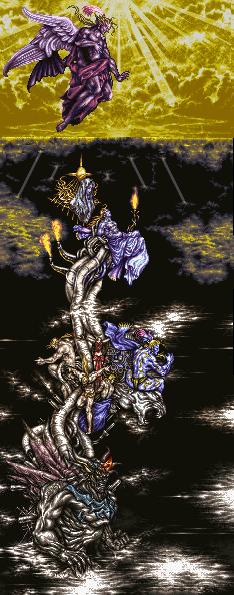
“Dancing Mad” probably remains today the longest final battle music ever written, with the original ost version clocking in at 17 minutes and 39 seconds. This might seem excessive if you haven’t played the game, but within its context nothing less could have possibly sufficed. Kefka was pretty much the greatest video game villain of all time (Luca Blight from Suikoden II might surpass him), and Final Fantasy VI might have had the most apocalyptic plot in the series. Sure, series fans had saved the world from imminent destruction five times before and plenty more since, but Zeromus, Exdeath, they were just icons of evil. In Final Fantasy VI, Square’s obsession with mass destruction finally found a human face. Kefka’s psychopathy was something you could buy into. He was entirely capable of emotion even as he slipped progressively further into insanity. He just attached no moral value to life. Where enemies before and since sought to destroy the world for destruction’s sake, Kefka was in it for the experience of the ultimate tragedy. For once it actually made sense for a final boss to let the heroes creep up on him; the whole agenda would have been pointless if no one was there to experience it with him.
Both visually and musically, the final battle of Final Fantasy VI was beautiful. Nothing else–certainly no 1-2 minute fight theme–would have been appropriate in the context of the story.
VGM Entry 67: EarthBound
(Thanks to Tish at FFShrine for the banner)
Hirokazu Tanaka and Keiichi Suzuki composed Mother in 1989, and it would remain perhaps the most eclectic soundtrack in all of video gamedom until 1994, when they teamed up again for Mother 2.
Better known to western gamers as EarthBound, Mother 2 (Nintendo, 1994) was… well… on the new game ‘name your characters’ screen you are asked the crucial question “What is your favorite homemade food?”, and that’s about as normal as it ever got. Since Mother was never released here, EarthBound was our first experience with Shigesato Itoi’s madness, and the already ridiculous events and dialogue were made all the more bizarre by a sometimes incredibly awkward (though fairly grammatically sound) translation. (Consider that the most powerful spell in the game is called “PSI Rockin Omega”.) Perhaps this was not originally by intent, but I like to pretend NOA fell in love with it and let a few oddities through intentionally.
The EarthBound soundtrack was huge, or so it seemed to me. With no comprehensive ost on the market it can be a bit hard to tell, but at least one fan rip I came across contained 78 tracks. Every town had a theme. Every combat zone had a theme. There were easily a dozen or more different battle themes. The new music just never stopped coming from start screen to the ending credits. According to Wikipedia, Keiichi Suzuki claimed in a Famitsu interview only available in Japanese that he wrote over 100 songs for the game. Many of these obviously were not used, but Suzuki also only accounts for half of the music.
EarthBound‘s finest musical moments took place in combat. This video presents a compilation of eight battle tunes (by no means all-inclusive) which should give you a good idea of what the game had to offer. The music was a mix of smooth grooves like the first track played here and corny absurdities like the second, with the former typically representing aliens and tougher bosses and the latter such detestable foes as “New Age Retro Hippie”, “Scalding Coffee Cup”, and “Big Pile of Puke”.
The corny tracks are more representative of the larger gaming environment, but the groove numbers are where Tanaka and Suzuki really excelled, culminating with “Kraken of the Sea” (6:27).
I’m not actually sure who was responsible for the combat music throughout this game, or whether the individual tracks were collaborative efforts. (Many songs in the game in fact were.) It would certainly make sense, considering how they all fall into two neat categories, to reason that one composer made the groove tracks and another did the comedy ones, but I certainly can’t confirm this. The track “Another 2” on the highly mutilated official Mother 2 ost contains quite a few samples from the former and none from the latter, and it’s credited to Tanaka specifically, but that might simply mean he was responsible for the remix. “Another 2” contains the bicycle theme as a hidden track after a half minute of silence, and that was definitely written by Suzuki, so there’s really no clear evidence here pointing to one musician or the other.
The two best songs in the game are the last two you’ll hear before the ending. Both are combat tunes, and they couldn’t be more different. “Pokey Means Business” was my favorite song in any video game as a kid, and I don’t think I need to tell you why.
Or are you not there yet? Wait for it…
Ok so, maybe it’s not decisively the best song on the SNES, but it’s definitely the heaviest. Funny that for all the dozens of games out there marketing their edginess as their selling point, none came anywhere near goofy little EarthBound. Once again I am not sure if this is a product of Suzuki, Tanaka, or both. I just know that Pokey meant business alright…
And then there was Giygas. Credits suggest this was all a product of Tanaka’s twisted mind, and it may well go down in history as he most disturbing boss music ever written. Everything about Giygas was completely abstract, from his form to his combat moves. (The game would just say “You cannot grasp the true form of Giygas’ attack!” and deal out damage.)
There are a lot of hairbrain theories out there as to what Giygas represents, especially in connection with how his final form outlines the shape of a fetus. Frankly I think if you’re playing EarthBound for the plot you’re probably reading too much into it.
This song does have a little bit of relevance to what’s going on though. The transition starting around 1:40 and the music box charm it leads into at 2:32 reflect a break in the gameplay action where Paula uses her psychic powers to ask various friends for help. So while its inclusion certainly adds to the creepiness of the overall piece, it’s also intended to be a bit heartwarming. And anyway the song as it appears here, 4:03 in length, is a little arbitrary. The song isn’t a single continuous piece, and the transitions take place as a result of progression in the boss fight.
The song and its visual counterpart have earned quite a bit of internet popularity for its unorthodox behavior. You’ll have to forgive me for sharing this last one with you:
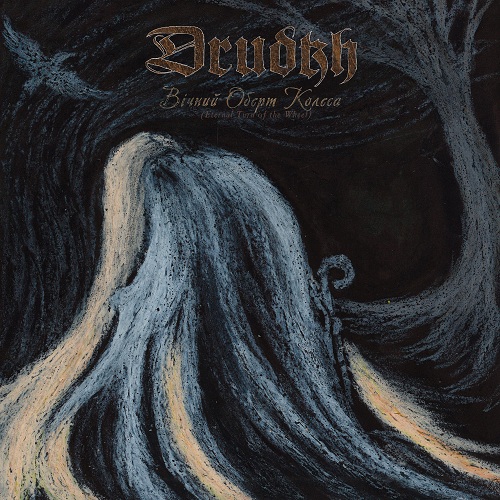
Another year, another Drudkh album. It’s something we’ve come to expect from a band that’s pumped out 9 full length albums in the past decade. Their last release, Handful of Stars, was pretty universally denounced as their weakest album to date, and perhaps there is something to be said for the fact that they skipped over 2011 without a new one. Eternal Turn of the Wheel makes a clear shift away from the direction they had been heading in, returning to a style more in keeping with their earlier releases.
Breath of Cold Black Soil
The question is what they gained from that transition. The sound is certainly in touch atmospherically with the old vibe fans have been clamoring for a return to. If you’ve been following Drudkh from the get-go, there is definitely something refreshing about this one. I am instinctively inclined to engage it, whereas Handful of Stars kind of lost me and I never gave it the proper listening time a Drudkh album deserves.
But that’s not to say they’ve gotten better, nor that they were getting progressively worse before. Drudkh have always had their ups and downs. When you come close to releasing an album every year for a decade, it’s bound to happen. It’s difficult as a fan to even keep up with them. If the music doesn’t strike me pretty readily I put it off for a bit, and by the time I do get around to it the next release is already in the mail.
Eternal Turn of the Wheel will gain some attention because it presents at the surface what people have been looking for for a while now. I think if Drudkh had, alternatively, stuck to the same general sound all along, this one would be pretty readily forgotten.
Night Woven of Snow, Winds and Grey-Haired Stars
Beneath the surface, it’s just a little lacking in creative song writing. It’s quite nice by the standard of average atmospheric black metal, but from Drudkh I tend to expect a little bit more. On Swan Road and Blood in Our Wells especially they managed to merge this sound with absolutely superb song writing, and the latter was the selling point that really projected them from just another Ukrainian black metal band to legends of the genre.
I think the Microcosmos haters heard a stylistic watershed and immediately cashed in their opinions. The shift didn’t phase me at the time, because I think the song writing that really propels them was present in full form. The further changes on Handful of Stars were a bit more of an immediate turn-off, but I’ll venture to make the potentially bogus claim that the song-writing, not the style, ultimately accounts for my having never given it a good and thorough listen.
I’d argue that the song-writing on Eternal Turn of the Wheel is really not appreciably better, but in returning to an old school Drudkh sound they at least compelled me to leave it on repeat for a day. Don’t expect any of the tracks to overwhelm you the way Eternity or Solitude do, or Ars Poetica for that matter. It’s pretty cut-and-dry, generic Drudkh, and it’s crucially lacking any sort of subtle Ukrainian folk undertone. I would be lying if I pretended to not appreciate their return to black metal, but all in all this album is nothing special… at least by Drudkh standards. It will still rightfully go down as one of the better releases of 2012.


 Through the Shattered Lens