Hail, Hero! (1969, directed by David Miller)


After going away to college, Carl Dixon (25 year-old Michael Douglas, in his film debut) has returned to his rural hometown.  Though Carl comes from a family with a long military tradition, he’s against the war in Vietnam and is considered to be a hippie by his family.  As soon as his stern father (Arthur Kennedy) sees Carl, he sits him down in the kitchen and, after declaring that no one is going to mistake his son for a girl, cuts his hair.  Meanwhile, Carl’s mother (Teresa Wright) stays out of the conflict between her husband and her son while Carl’s older brother (Peter Strauss) continues to resent Carl for the accident that injured his spinal cord and kept him from going off to war.

Carl has an announcement to make.  Despite being against the war in Vietnam, he’s joined the army.  He will soon be going overseas, where he’ll get a chance to be a hero and where he says he hopes to love the enemy.  No one in his family can understand his decision, though they certainly spend a lot of time talking about it.  Carl can’t explain it either, though he certainly keeps trying.  Eventually, Carl ends up going for a swim with a local girl (Deborah Winters), smoking weed with a woman who lives in a cave with a mummified baby, and painting the family barn with a mural that’s supposed to explain it all.

Hail, Hero! is an extremely talky film that wants to say something about the war in Vietnam but it doesn’t seem to know what.  The film’s too sincere in its confusion to be a disaster but it’s also too muddled to really be effective.  Carl is opposed to the war but he drops out of college and enlists because it’s what his father would have wanted him to do but his father doesn’t seem to be impressed with the decision and Carl doesn’t seem to like his father to begin with so why volunteer for something that you find to be immoral?  The film would have been effective if Carl had been drafted into the war and had to choose between reporting for duty or fleeing to Canada.  But having him drop out of college and volunteer to serve makes it more difficult to sympathize with him when he talks about how opposed he is to the war.

If the film gets any attention today, it is probably because of Michael Douglas in the lead role.  This was Douglas’s film debut.  He was 25 when he made the film and he was already a dead ringer for his father.  Unfortunately, he doesn’t give a very good performance.  He’s miscast in the lead role.  Carl Dixon is supposed to be insecure and conflicted.  Insecure is not something that comes to mind when you think about Michael Douglas.  Instead, Carl just comes across as being petulant and self-righteous.  Hail, Hero! tries to say something about the war in Vietnam but Carl Dixon’s the wrong messenger.

Music Video of the Day: Just Can’t Get Enough by Depeche Mode (1981, directed by Clive Richardson)


Just Can’t Get Enough is about as upbeat of a song as you are ever going to get from Depeche Mode.  That has a lot to do with the fact that it was written by Vince Clarke, who was a founding member of the band and who was considered to be the band’s leader until he left in November of 1981.  While Clarke went on to become best known as a member of Erasure, Depeche Mode went in a harder, less pop-orientated direction, with Martin Gore eventually taking over Clarke’s role as the band’s main songwriter.

Just Can’t Get Enough was the third single from Depeche Mood’s debut album, Speak & Spell.  The song was written as the punk scene was winding down and London club kids were looking for new music that wasn’t quite as aggressive and self-destructive.  Just Can’t Get Enough was the first Depeche Mode song to become a top ten hit in the UK.

The video, which was directed by Clive Richardson, was the band’s first and it remains the only Depeche Mode video to feature Vince Clarke.  The outdoor scenes were filmed at the Southbank Centre in London.  Though the video did occasionally air on MTV, it wasn’t placed in the station’s regular rotation.  In fact, MTV didn’t really embrace Depeche Mode’s videos until the release of Personal Jesus in 1989.

Enjoy!

Fatal Instinct (1993, directed by Carl Reiner)


Ned Ravine (Armand Assante) is a cop who is also a lawyer.  His shtick is to make an arrest and then defend that person in court.  He’s married to Lana (Kate Nelligan), who is having an affair with a mechanic named Frank (Christopher McDonald).  Lana has taken out a life insurance policy on Ned, one that has a triple indemnity clause.  If he’s shot on a northbound train and then falls off and drowns in a nearby stream, Lana and Frank will make a lot of money.  However, Lana and Frank are not the only people who want to kill Ned Ravine.  One of Ned’s former clients, Max Shady (James Remar), has just been released from prison and is seeking revenge.  The main reason why Ned hasn’t figured out that everyone is trying to kill him is because he’s been distracted by the seductive Lola (Sean Young), a client who asked him to look over some legal papers and who has an improbable connection to Lana.

As you might guess by the plot and Carl Reiner’s directorial credit, Fatal Instinct is a spoof of detective movies, with the majority of the jokes being inspired by Basic Instinct, the remake of Cape Fear, Double Indemnity, and Body Heat.  How much you laugh will depend on how well you know those films.  There’s a scene in Ned’s office where Ned notices that Lola isn’t wearing panties.  He helpfully produces a pair from inside his desk and hand them to her.  In 1994, that scene was funny because Basic Instinct and whether or not Sharon Stone was aware of how her famous interrogation scene was being filmed were still a huge part of the pop cultural conversation.  Today, it might just seem weird.

Carl Reiner has always been an uneven filmmaker and that trend continues in Fatal Instinct, where he tries to do to erotic thrillers what Mel Brooks did to westerns and Airplane! did to disaster films.  Unfortunately, Reiner often gets bogged down by the film’s plot, which should really be the last thing anyone should be worried about when it comes to a spoof like this.  Some of the jokes are funny and some of them aren’t but, because Reiner doesn’t duplicate the joke-every-minute style of a film like Airplane!, there’s a lot more time to think about the jokes that fall flat.

Fatal Instinct does have a good cast, featuring a lot of actors who probably should have become bigger stars than they did.  I especially liked Kate Nelligan’s and Christopher McDonald’s performances as the two triple indemnity conspirators.  Sherilyn Fenn plays Ned’s loyal secretary and seeing her give such a fresh and likable performance in this otherwise uneven film makes me regret even more that, outside of Twin Peaks, she never really got the roles that she deserved.

Music Video of the Day: If You Leave by Orchestral Manoeuvres in the Dark (1986, directed by ????)


The year was 1986 and director John Hughes had a problem.

Test screenings for his latest film, Pretty in Pink, indicated that his target teen audience loved the film up until the final scene, which featured Molly Ringwald going to prom with her geeky best friend, Jon Cryer.  Audiences booed when they saw Ringwald dancing with Cryer instead of with Andrew McCarthy.  Realizing that he would have to refilm that entire final scene in order to give the audience what they wanted, Hughes also realized that he would need a new song to fit the mood.

As OMD’s Andy McCluskey later told Songfacts:

“We were delighted to be asked by John, and went to the set where Molly and John Cryer were shooting. Unfortunately, the original song that we wrote didn’t fit after they changed the whole ending. We had 2 days to write a new track at Larabee Studios in L.A. We worked until 4 a.m. writing a rough version and sent a motorbike to Paramount. John heard it, liked it, and our manager phoned us at 8 a.m. and told us to go back in and mix it. That’s how ‘If You Leave’ Happened! The song had to be 120 BPM cos that’s the tempo of ‘Don’t You (Forget About Me),‘ which is the track they actually shot the prom scene to. Unfortunately, the editor obviously had no sense of rhythm because they are all dancing out of time in the final film.”

The popularity of Pretty in Pink led to If You Leave becoming OMD’s biggest hit in the United States.  As a band, OMD was always more popular in the UK than in the US.  Interestingly enough, just as none of OMD’s UK hits were big in the U.S., If You Leave was not a hit in the UK.

The video is typically 80s, made up of footage of the band performing intercut with a few scenes from Pretty In Pink.  About halfway through the video, the lead singer starts to knock out pieces of a pink wall, as if they’re showing Roger Walters that tearing down a wall isn’t anywhere near as difficult as he made it sound.

Enjoy!

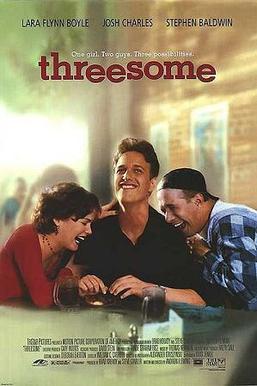
Threesome (1994, directed by Andrew Fleming)


Due to the type of administrative mix-up that always happens in the movie but rarely in real life, a college has assigned female student Alex (Lara Flynn Boyle) to share a dorm room with two males, Eddy (Josh Charles) and Stuart (Stephen Baldwin).  Stuart is an outwardly obnoxious jock while Eddy is a sensitive and gay film student who is obsessed with Jules and Jim.  It does’t take long for Alex to fall in love with Eddy but Eddy is in love with Stuart while Stuart is in love with Alex.  See where this is leading?  The three of them become close friends, to the extent that they actively drive away anyone else who shows any romantic or sexual interest in either one of them.

The title is not a lie.  There is an eventual threesome, though it’s a very tastefully shot threesome and it only happens once.  After all, this was a studio film, not a late night, direct-to-video Cinemax offering.  Unfortunately, things fall apart for the roommates after their threesome, as they are forced to reconsider all of their previous feelings towards each other and one of them is driven to a melodramatic breakdown.  The film’s story would work better if we cared about the characters but they’re all so shallowly written (and Eddy’s overwrought narration doesn’t work) that it’s hard to care about them.  They just come across as being three snobs.  Eddy may be obsessed with Jules and Jim but he doesn’t seem to have learned much from watching the movie.  As for the cast, Josh Charles and Lara Flynn Boyle are both likable but too bland to really hold your attention.  (There’s a reason why both of these actors found more success on television than on the big screen.)  Stephen Baldwin actually brings some depth to his character though I doubt he spends much time bragging about starring in a film called Threesome nowadays.

Threesome is a film that seems to think that it has much to say but it’s impossible for me to think about it without being reminded of the Menage a Trois episode of Seinfeld and Jerry’s plaintive declaration of, “I’m not an orgy guy!”  With those five words, Seinfeld said more about the reality of threesomes than Threesome does in its entire 93 minute running time.


Music Video of the Day: Counting Blue Cars by Dishwalla (1996, directed by Chris Applebaum)


“It was a conversation between myself and the child within myself, but it was sparked by having a conversation with someone who was really young and around that time thought about God and those kinds of things, and just being really curious about it but hadn’t been taught to think a specific way. I just loved the innocence and honesty of having that conversation with someone who didn’t care either way how you would describe this or that – they were just curious.”

— Dishwalla’s JR Richards on Counting Blue Cars

If you were, for some reason, challenged to come up with the epitome of a generic 90s alternative band, that band would probably look a lot like Dishwalla and the song that they sang would probably sound a lot like Counting Blue Cars.  That doesn’t mean that it’s necessarily bad song.  It just means that both the band and the song definitely belong to a very specific era.

Counting Blue Cars may have been their only big hit but, for a period of time, it was inescapable.  You could not turn on the radio without hearing that familiar chorus of Tell Me All Your Thoughts On God.  The song also received attention because it described God as being female.  According to Wikipedia and Songfacts, that made the song controversial.  I can’t remember any controversy about it at all.

The video also feels like the epitome of a generic 90s alternative video.  You would think that the video would at least feature a child asking questions or maybe a blue car but instead, it’s the band playing in some sort of new age trailer park.  New age trailer parks were very popular in the 90s music videos.

What kind of weird child asks for all your thoughts on God?

Enjoy!

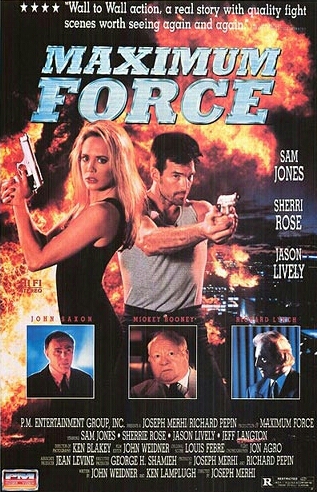
Cinemax Friday: Maximum Force (1992, directed by Joseph Mehri)


Max Tanabe (Richard Lynch) is Los Angeles’s biggest crime lord, involved in everything from prostitution to illegal fight clubs.  But, because he’s rich, no one can touch him.  He plays golf with the mayor.  He’s paid off the police commissioner (Mickey Rooney).  The police commissioner spends the entire movie riding around in a limo.  How do you think he was able to afford that?

Captain Fuller (John Saxon) needs some new jack cops to take down a new jack gangster so he goes out and recruits three.  Cody Randal (Sherries Ross) works vice.  Rick Carver (Jason Lively) is a “tech expert” who rigs toy cars with explosives.  Mike Crews (Sam J. Jones) is looking to avenge the death of his partner.  Fuller brings them together and put them through an extensive training course.  At the end of it, he tests their skills and their teamwork by bringing in a secret team of ninjas to attack them.

Which begs the question: If you already have a secret team of ninjas, why do you have to recruit and train three detectives to take down Tanabe?  Why not just have the ninjas do it?

So, logic is not exactly Maximum Force‘s strong point but it still has some good points.  For instance, you have to respect any movie that can bring together Richard Lynch and John Saxon, not to mention Mickey Rooney!  Of course, there’s not really much of a reason for Mickey Rooney to be there.  All of his scenes feature him in the limo and they are edited together so awkwardly that it seems probable the he never actually acted opposite any of his co-stars.  But it doesn’t matter because he’s Hollywood legend Mickey Rooney, picking up a paycheck in his twilight years.  As for Saxon and Lynch, they do what they do best and bring gravitas to their otherwise stock roles.

As for the three heroes, they’re adequate even if none of them really shine.  I liked the tech expert the best but that was just because he rigged all of those remote control cars to explode.  Sam J. Jones and Sherrie Ross are both better at throwing punches than showing emotion but that’s what a film like this demands.  Some of the fight scenes are exciting.  There’s a helicopter attack early in the film.  Towards the end of the film, when Mike decides that the team needs some extra help, he calls in an amateur wrestler named Bear who just randomly shows up during the final battle.  Maximum Force knows what its audience wants and that’s the important thing.

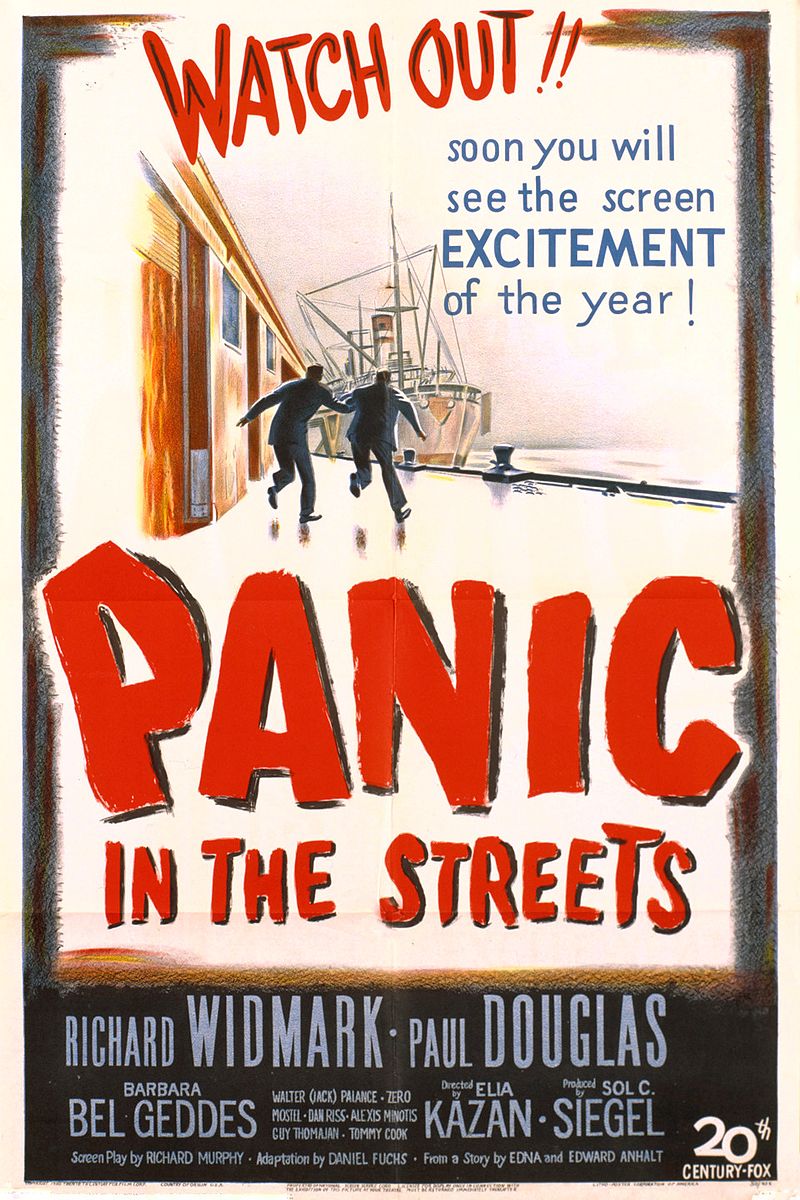
Panic In the Streets (1950, directed by Elia Kazan)


The plague has come to New Orleans.

A dead body is found on the New Orleans wharf.  He’s dead because he was shot several times but an autopsy reveals that he would have died anyways because he was suffering from a form of the bubonic plague!  In order to keep the plague from spreading through the city (and also to hopefully save the lives of anyone who has been infected), Dr. Clint Reed (Richard Widmark) and police captain Tom Warren (Paul Douglas) have to isolate everyone who the man came into contact with.  But first, they’re going to have to discover that man’s identity and also how he came to end up dead on the docks of New Orleans.

What Dr. Reed doesn’t know is that the man was named Kolchak and that he was murdered by a small-time gangster named Blackie (Jack Palance, making his film debut).  Now, Blackie and his associate, Fitch (Zero Mostel) are both infected and are both looking to get out of town.  Of course, if either one of them succeeds in leaving New Orleans, they’ll spread the plague through the entire country.

Largely filmed on location in New Orleans and focusing as much on Dr. Reed as it does on the criminals that he’s pursuing, Panic In The Streets is an effective mix of film noir, medical drama and police procedural.  Seen under normal circumstances, Panic in the Streets is a good thriller.  Seen during a time when the news is dominated by COVID-19 and riots in large cities, Panic in the Streets feels damn near prophetic.

Richard Widmark does a good job playing Dr. Reed, who is portrayed as being a no-nonsense professional.  He’s type of doctor who you want on your side if there’s a plague coming to town.  Not surprisingly, though, the film is stolen by Jack Palance as the smirking Blackie.  This was Palance’s film debut but he already knew how to be the most intimidating man in the room.  Zero Mostel also has some good scenes as Blackie’s associate and his sweaty and fearful performance provides a good contrast to Palance’s more controlled villainy.

One interesting thing about Panic in The Streets is that Dr. Reed and Capt. Warren are actually able to convince a newspaper reporter to delay filing a report about the plague, mostly to avoid a mass panic in the streets.  Though he takes some convincing (and Warren’s methods aren’t exactly Constitutional), the reporter finally agrees to hold off on reporting for four hours.  With the 24-hour news cycle and the dominance of social media, that’s not something that could happen today.

Gang Related (1997, directed by Jim Kouf)


LAPD vice detectives DiVinci (Jim Belushi) and Rodriguez (Tupac Shakur) have a pretty good racket going.  They sell cocaine to drug dealers and then, once they get their money, they murder the dealers and take their drugs back so that the cocaine can be resold.  The murders are written up as being “gang-related” and because no one cares about dead drug dealers, Divinci and Rodriguez don’t have to worry about anyone actually investigating their crimes.

This all changes when they kill the wrong dealer.  It turns out Lionel Hudd (Kool Mo Dee) was actually an undercover DEA agent and now that he’s been murdered, his partner (played by Gary Cole) is investigating the murder.  Needing a patsy to take the fall, they arrest a homeless man who is known as Joe Doe (Dennis Quaid).  Joe can’t even remember what his real name is and, because he’s intoxicated when he’s arrested and interrogated, it’s easy for DiVinci and Rodriguez to talk him into believing that he killed Hudd.

At first, it seems like a perfect plan because the only people that the citizens of Los Angeles care about less than gang members and drug dealers are the homeless.  But then it turns out that Joe Doe is actually a wealthy surgeon and his family hires a prominent attorney (played by James Earl Jones, so you know he’s good) to defend him.  Meanwhile, the stripper (Lela Rochon) who DiVinci and Rodriguez coerced into identifying Doe as the murderer is having second thoughts.  And so is Rodriguez.

The plot of Gang Related may be convoluted and sometimes difficult to follow but that works to the film’s advantage as Divinci and Rodriguez find themselves plunging further and further down the rabbit hole of their own lies.  The audience may be confused but so are they so everyone’s the same page.  It seems like no matter what scheme DiVinci comes up with to try to cover for his own crimes, there’s always an unforeseen complication and most of the film’s narrative momentum comes from watching two corrupt cops go from being cocky to being desperate to save their own lives as their maze of deception becomes increasingly difficult to navigate.  Neither DiVinci nor Rodriguez is a likable character (though Rodriguez is, at least, troubled by what he’s become) so there’s a lot of pleasure to be had by watching these two finally face justice.

Gang Related was Tupac Shakur’s final film and it was released over a year after his death.  It’s a B-movie but it’s a well-made B-movie and Shakur gives a good and complex performance.  So does Jim Belushi, whose mounting desperation is really something to see.  Gang Related may be a B-movie but it’s portrayal of two criminal cops being empowered by a corrupt system is still relevant today.

Operation Thunderbolt (1977, directed by Menahem Golan)


On June 27th, 1976, four terrorists hijacked an Air France flight and diverted it to Entebbe Airport in Uganda.  With the blessing of dictator Idi Amin and with the help of a deployment of Ugandan soldiers, the terrorists held all of the Israeli passengers hostage while allowing the non-Jewish passengers to leave.  The terrorists issued the usual set of demands.  The Israelis responded with Operation Thunderbolt, a daring July 4th raid on the airport that led to death of all the terrorists and the rescue of the hostages.  Three hostages were killed in the firefight and a fourth — Dora Bloch — was subsequently murdered in a Ugandan hospital by Idi Amin’s secret police.  Only one commando — Yonatan Netanyahu — was lost during the raid.  His younger brother, Benjamin, would later become Prime Minister of Israel.

A year after the the raid on Entebbe, Menahem Golan would direct a film the recreated that heroic moment.  Originally, Operation Thunderbolt was intended to be a Hollywood production, with none other than Steve McQueen playing the role Yonatan Netanyahu.  When McQueen withdraw for the project (as he did from a lot of productions in the 70s), Golan and the project returned to Israel, where it was produced with the help of the Israeli military and the Israeli government.  (Yitzhak Rabin and Shimon Peres are among the notable Israeli leaders who appear as themselves.)  Singer and comedian Yehoram Gaon was cast as Netanyahu while veteran exploitation stars Klaus Kinski and Sybil Danning were cast as the German terrorists.

The end result is a rousing action film that takes a semi-documentary approach to telling its story.  Imagine a less flamboyant version of Golan’s The Delta Force, one that tells a similar story but without the oversized personas of Chuck Norris, Robert Forster, and Lee Marvin.  Though the film celebrates the bravery of Yonni Netanyahu, the emphasis is more on the IDF working as a team than on individual heroics.  (The film open with the IDF running a drill that mirrors the eventual raid on Entebbe, a reminder that Israel and the IDF were determined not to be caught off guard.)  The film is not only a celebration of the strength of the Israeli people but, with the Germanic Kinski and Danning cast the villains, it’s only a very loud cry of “NEVER AGAIN!”  It may be an exciting action film but it’s an action film with a message: Don’t mess with us.

(At the same time, the hijacker portrayed by Klaus Kinski is not presented as being cardboard villain, which may seem surprising given Kinski’s reputation as an actor and Golan’s reputation as a director.  Kinski’s terrorist does get a chance to explain his ideological motivations, with the film presenting him as being more misguided than evil.)

Though I will always consider The Delta Force to be the greatest film ever made (if just for it’s cry of “Beer!  America!” at the end), Operation Thunderbolt features Golan’s best work as a director.  Menahem Golan was a frequently crass director but, with Operation Thunderbolt, it’s obvious that he was motivated by more than just making a hit movie.  Golan’s aim with Operation Thunderbolt was to make a film that would celebrate both Israel and the strength of the Jewish people.  With Operation Thunderbolt, Menahem Golan succeeded.