Shaq, rap superstar! It’s a thing that happened. Briefly.
While Shaq’s rap career didn’t exactly set the world on fire and his attempts at film stardom didn’t go much better, he was fortunate enough to have another career to fall back on.
At least now you know what Shaq and the General are listening to while they’re driving around the country and telling people about car insurance.
I don’t have much to say about this video but then again, you don’t have to say much when it comes to Rick James. James was one of those artists who didn’t need an elaborate video to get people to realize that he rocked. All he had to do was get out there and perform.
I hope this song and music video serves as a good start for your weekend!
“It’s not about anything. Like all my songs, it’s a portal into your own mind where I give you a guided meditation. It’s a blank, abstract canvas for people to lose themselves in.”
— Steve Kilbey on Under the Milky Way
Written while Steve Kilbey and his then-girlfriend were visiting Kilbey’s mother in New South Wales, Under The Milky Way would go on to become The Church’s biggest hit. Ironically, the other members of the band didn’t care for the song and had to be pressured to include it on their album, Starfish.
As Kilbey later put it, after the song became a hit:
“It changed everything in our lives, it put me on a new level of temptation and opened more doors that maybe shouldn’t have been opened… and made a lot of money and so we did a lot of touring. But saying that, the guys in the band all hated each other and they all hated me. Instead of being grateful that I’d written this song which had dragged them into the spotlight they were sort of envious and miserable about it as well.”
Part of the problem is that audiences would show up to see Church play and then, once they had heard Under the Milky Way, they would promptly leave before the show was over. Eventually, the members of the band got so frustrated by what they called “Milky Way gigs” that they refused to play the song for several years in the 90s. I probably would have just played the song at the end of the show so the audience stayed for the whole show but still got what they wanted but I’m not a rock star.
Considering how much the band dislikes it, I almost feel guilty about liking Under The Milky Way. It is a really good song, though, and the video is a good fit.
Operation: Mindcrime is the title track from Queensrÿche’s third studio album. The album was considered to be the band’s breakthrough album and, unlike a lot of heavy metal from the 80s, it still has a good critical reputation to this day. I’m not a huge Queensrÿche fan but I have to admit that the bass line in the title track is pretty awesome.
The album was a concept album, about a junkie named Nikki who was turned into an assassin by the evil Dr. X. (As with most concept albums, the plot was actually much more complicated but I’ve only got so much space for this post.) For the album, this song was about how Dr. X could program Nikki to kill simply by saying, “Mindcrime.” The video, while containing all of the themes from the overall album, simplifies things to two men playing Russian Roulette while sitting in an office that’s decorated with a portrait of Stalin.
This video was directed by Chris Painter, who directed several other Operation: Mindcrime videos and who also did the video for Rush’s Roll The Bones.
Ship of Fools was the second single to be released from Robert Plant’s fourth solo album, Now and Zen. Now and Zen was the most financially and critically successful of all of Planet’s solo albums, though Plant himself has said that he feels that the album’s music “got lost in the technology of the time.” I would be disappointed if Robert Plant didn’t decry “the technology of the time” but, in this case, he’s being too hard on himself. Now and Zen is a very good album.
This song is mood piece, a love song. In the video, Plant appears to be singing in the rain and it works. The song was later used in “Freefall,” the final episode of Miami Vice, the show that epitomized the 80s and the technology of the time like no other.
It was a story that he told often, about how he was a struggling, 30 year-old actor with a few film credits to his name when he was offered the lead role in The Graduate. Even though producer Lawrence Turman said the role would make him a star, Grodin turned it down because of the low salary that Turman offered. The role was then offered to Dustin Hoffman, who went on to become a star and spend several decades as an unlikely box office draw.
It’s easy to imagine Grodin in the role of Benjamin Braddock. He probably wouldn’t have been as insecure as Hoffman was in the role. He would have been a less passive Benjamin. Grodin’s Braddock would probably have been more obviously frustrated with Mrs. Robinson and his parents. Nobody played frustration quite as well as Charles Grodin. Audiences might not have been as quick to sympathize with Benjamin if Grodin had played the role but I think he would have eventually won them over. Grodin was an actor with a talent for making unlikable characters somehow funny and relatable.
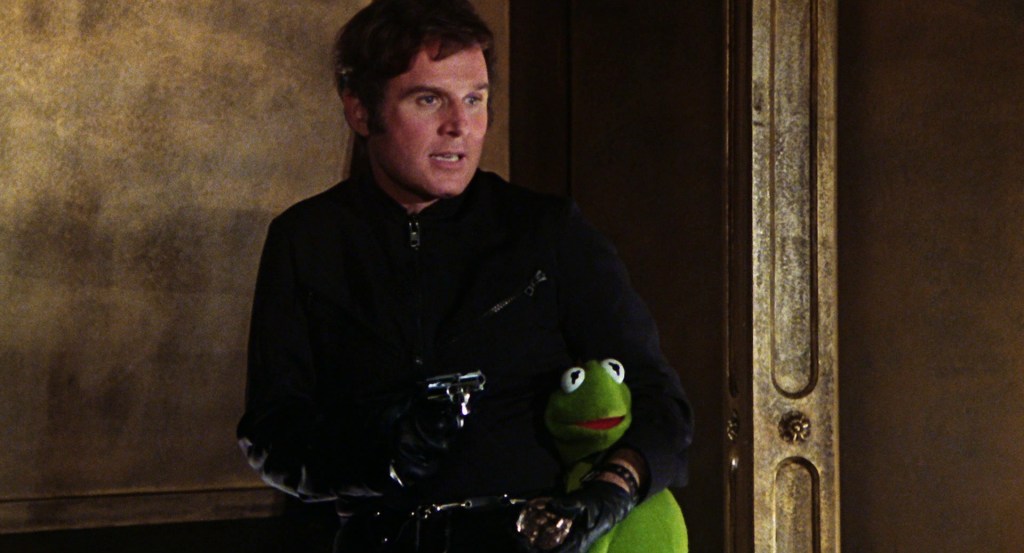
Though Grodin may not have played Benjamin Braddock, he still went on to establish himself as one of the funniest character actors in the business, a master of deadpan humor. He was often the best thing in the moves in which he appeared. In Heaven Can Wait, he was funny even while he was trying to kill Warren Beatty. In Real Life, he was a suburban father who found himself trapped in an early version of reality television. In Seems Like Old Times, he gets more laughs with one annoyed expression than Chevy Chase gets in the entire film. In The Great Muppet Caper, he fell in love with Miss Piggy and tried to kill Kermit. He was one of the few actors to make it through Ishtar with his dignity intact. In Midnight Run, he was the perfect comedic counterbalance to Robert De Niro. In Dave, he taught the government how to balance a budget. Though he was often cast in supporting roles or as a co-lead (as in Midnight Express), he proved that he could carry a film with his starring turn in The Heartbreak Kid.
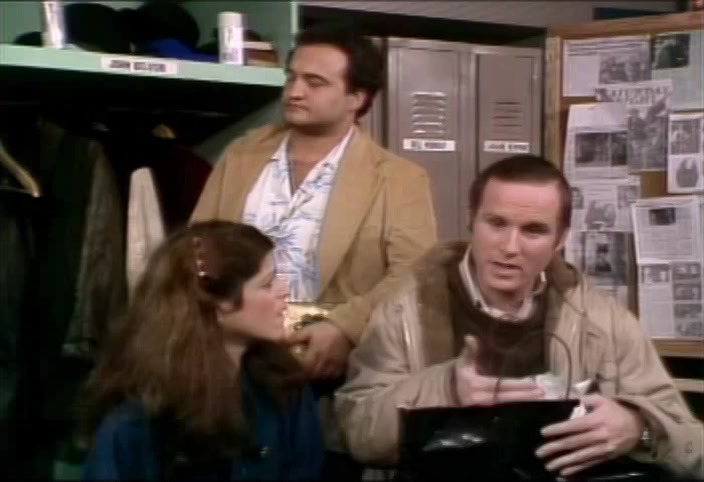
A lot of people knew Grodin best as a late night talk show guest, where he always seemed to be annoyed about something. He would get into mock arguments with the hosts and leave audiences confused as to how serious any of it was. (According to David Letterman, none of it was.) He briefly hosted his own talk show, from 1995 to 1998. Legend has it that Lorne Michaels banned him from Saturday Night Live after he hosted the show, apparently because he was so difficult to work with. How much of that is true and how much of that was just Grodin doing a bit, no one knows. I’ve seen Grodin’s episode. It’s fine. He’s funny.
Charles Grodin died today of bone marrow cancer. He was 85 years old. I’m going to miss him.
Gilda Radner, John Belish, and Charles Grodin on Saturday Night Live
This lengthy music video finds Phil Collins playing a drummer-turned-singer in the 1930s. With the help of his friend, a guitar player named Eric (and played, of course, by Eric Clapton), Collins auditions for a demanding theater owner (Jeffrey Tambor). While he auditions, he imagines what his life would be like if he becomes a success. He might even win an Oscar, probably for writing a song for a Disney film.
This video is more like a short film than a traditional music video, with over two minutes of “acting” before the singing even begins. This video came out at the time when Collins was still trying to make a career as an actor. I like the video but I wouldn’t be surprised to find out that, for some people, it probably represents everything that they didn’t like about Phil Collins back in the day.
This video was directed by Jim Yukich, who directed several videos for Collins. Yukich’s name can be spotted on a clapboard when Collins is imagining what it would be like to be a film star.
In the scenes in which Collins is acting opposite of Humphrey Bogart, Bogart is played by Robert Sacchi. Sacchi built an entire career out of his resemblance to Humphrey Bogart. Whenever a sitcom in the 80s or the 90s needed Humphrey Bogart to appear in a dream sequence, the call went out to Sacchi. Sacchi also appeared in several movies, playing characters with names like Sam Marlowe, Inspector Bogie, and The Bogeyman. According to the imdb, he also appeared in The Erotic Adventures of Three Musketeers as Athos. I’m not sure if I believe that.
Today is Tax Day here in the States so this music video of the day feels especially appropriate.
George Harrison originally wrote this song in 1966. It appeared on Revolver. The song was inspired by the fact that, even tough the Beatles were making a huge amount of money, they were also expected to give a huge amount of that money to the government. Harrison said that the music was inspired by the theme song for the Batman TV series and once you learn that, it’s impossible to listen to this song without thinking, “Batman!”
This performance is from a 1991 concert in Japan and features Harrison’s frequent collaborator and friend, Eric Clapton. Eric Clapton has said that he originally disliked the Beatles because he felt that they were too “poppy,” and that he preferred the blues. Clapton, of course, went on to collaborate with all four of the Beatles on several different projects. When it appeared that Harrison had left the Beatles during the tense recording of the album that would become Let It Be, John Lennon briefly speculated about replacing him with Clapton. Harrison, however, returned to the band and the Beatles broke up shortly afterwards.
(Clapton, for his part, says that if Lennon ever had made the offer, he would have refused because of his friendship with Harrison.)
In 1969, following his famous spiritual awakening, George Harrison would tell BBC Radio, “”No matter how much money you’ve got, you can’t be happy anyway. So you have to find your happiness with the problems you have and you have to not worry too much about them.”
Every story has to end somewhere and for Survivor, it was pretty much with the release of this single. Though Across The Miles was one of their biggest hits, the album from which it came, Survivor’s seventh studio album Too Hot To Sleep, was not. The album was considered to be a commercial disappointment and the band went on hiatus after it was released. There would not be another Survivor album until 2006’s Reach.
To date, Across The Miles is Survivor’s final original single. (Eye of Tiger reentered the singles chart in 2007, coinciding the release of Rocky Balboa and the Best of Rocky soundtrack compilation.) The video for Across the Miles does feature one woman waiting for a phone call in a lonely room but it’s mostly just a clip of the band performing. Like many of the videos from the time, it’s shot in noirish black-and-white.
Director Jim Yukich directed music videos for almost everyone. If you were a band whose music appeared on the Adult Contemporary charts, it’s probable that Jim Yukich did a video for you.
Yes, that’s a youngish and less crazed-looking Randy Quaid, playing the truck driver who asks the Bangles if they want to walk like an Egyptian. It can sometimes be surprising to remember that, before he dedicated his life to exposing the Star Whackers, Randy Quaid was a busy and popular character actor.
Little Richard also shows up towards the end of this video. There’s no chance of ever mistaking Little Richard for being anyone other than Little Richard.
This video was directed by Gary Weis, who is best-known for directing short films for the first few seasons of Saturday Night Live. You know that black-and-white film where John Belushi goes to a cemetery and talks about how he outlived the entire cast? Weis directed that. He also directed Steve Martin’s first stand-up special and several concert films.
 Through the Shattered Lens