“Now when they remember us, they ask themselves: Why didn’t we all get to come back? What does it all mean? You’ll need to find out yourselves. ‘Cause the answer is in you.” — Numa Turcatti
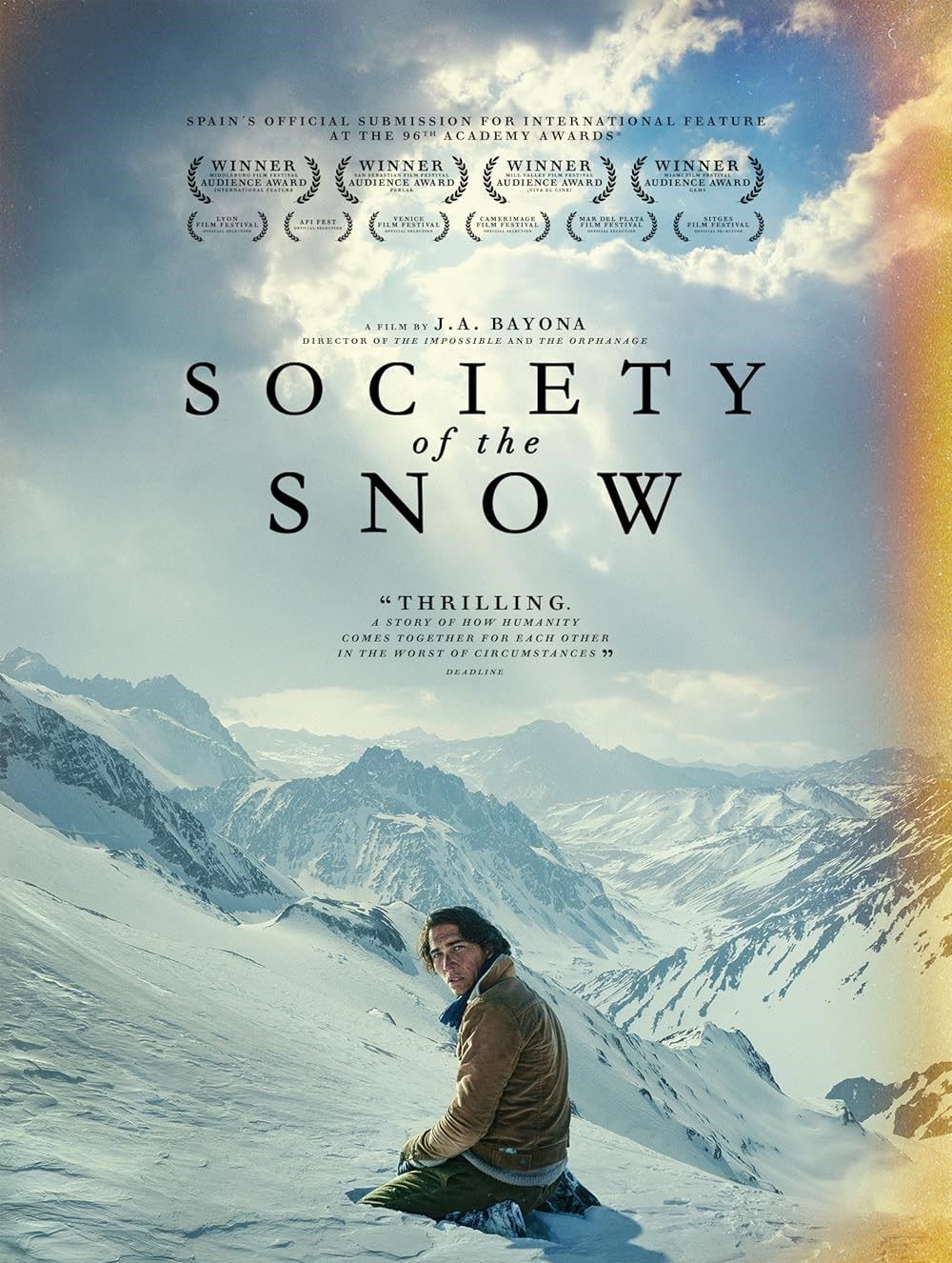
Society of the Snow is the kind of survival movie that sneaks up on you, starting as a rugby team’s joyride and morphing into an existential gut-punch about faith, God, and what binds people when hell freezes over. Directed by J.A. Bayona, it revisits the 1972 Andes crash of Uruguayan Air Force Flight 571, stranding the Old Christians rugby club, pals, and kin in a snowy nightmare 72 days long. No heroes hog the spotlight; it’s an ensemble of mostly newbie Uruguayan and Argentinian actors embodying a group forged by crisis, tackling taboos like cannibalism not as shock value, but as a collective leap of desperate faith.
The setup hooks you quick: carefree banter on the flight from Montevideo to Santiago, singalongs, rugby dreams bubbling. Then boom—the wings shear off, the fuselage cartwheels into a glacier, and 45 souls face subzero isolation with slim rescue odds. Bayona’s crash sequence is visceral chaos: screams swallowed by crunching metal, bodies tumbling, sudden silence under starlit peaks. It’s not Hollywood gloss; it’s the indifferent brutality of nature claiming lives, leaving the rest to improvise in a metal tomb.
Early days blur into tending wounds, rationing snacks, scanning skies for choppers that never come. Characters emerge gradually—Numa Turcatti’s narration grounds us, Nando Parrado’s grit shines later, Roberto Canessa’s smarts anchor medicine—but it’s the group’s dynamic that carries the load. Some introductions rush by, making deaths more statistical than soul-crushing at first, a fair knock since 16 eventually perish from crashes, avalanches, exposure. Still, that haze mirrors real panic, where faces and flickers of personality become your lifeline.
As weeks grind on, Society of the Snow almost becomes an existential exercise in the meaning of faith, belief in God, and how disaster can pull survivors together despite their differences to make that collective decision to perform something that others safe and sound would consider abhorrent. These devout Catholics debate God’s role: Is the crash punishment, test, or sheer accident? Priests invoke Eucharist parallels—body of Christ sustaining the living—while doubters rage at a silent heaven amid freezing nights and howling winds. Disaster doesn’t just bond them through shared misery; it forces this collective buy-in, where atheists, believers, and everyone in between hash it out in the fuselage’s dim light, snow piling up outside.
Differences in personality or background fade fast when hypothermia and starvation make every choice a referendum on humanity itself; rugby jocks, quiet thinkers, hotheads form a tribe, voting on the unthinkable: eating the dead to cheat death themselves. Safe outsiders might recoil in horror, but up there, it’s reframed as sacred reciprocity, a group oath blending survival instinct with spiritual rationale. Bayona doesn’t linger on gore—he shows enough to unsettle, focusing on the hushed consent, the tears, the way it reshapes their souls without breaking the bond.
Visually, it’s stunning restraint: Pedro Luque’s cinematography paints the Andes as majestic jailer, vast whites dwarfing ant-like survivors. Makeup sells the toll—cheeks hollow, skin ashen, eyes haunted—as bodies waste away on meager flesh. Sound design immerses: fuselage creaks like a dying beast, wind a constant roar, silence after avalanches deafening. Score stays subtle, melancholic strings underscoring faith’s quiet wrestling rather than cueing cheap tears.
Mid-film drags a tad, the routine of despair—avalanche buries them alive, failed expeditions limp back—testing patience as it mirrors their grind. At 144 minutes, repetition risks numbing, though it aptly conveys time’s cruelty. Humor peeks through: dumb jokes, rugby chants, home stories keeping spirits flickering, proving they’re not just victims but vibrant lives interrupted.
Climax shifts to Parrado and Canessa’s epic trek—shoeless, rag-wrapped, scaling cliffs with rugby posts as ice axes. Physically punishing to watch, it culminates in that eerie rescue meet: a gaucho across a torrent, civilization’s whisper after eternity. Their return sparks media frenzy, but the film ends introspective, faith renewed not in miracles, but in human will and collective defiance.
Bayona’s take earns widespread acclaim, including Oscar nods for International Feature, makeup, and score, praising its dignity over prior adaptations like Alive. It honors survivors’ input, shot partly on location with Uruguayan authenticity. Downsides? Ensemble sprawl blurs some arcs; heavy themes demand stamina, no popcorn thrills here. If gore or bleakness turns you off, skip it—but for raw humanity amid atrocity, it’s top-tier.
Ultimately, Society of the Snow lingers because it asks: What’s faith when God seems absent? How does abhorrence become salvation through unity? Just as Frank Marshall’s 1993 Alive left an indelible mark on that generation’s filmgoers, grappling with survival’s raw ethics amid the early ’90s thirst for true-story grit, this film resonates powerfully in today’s fractured world. In an age of endless online division and existential dread—from climate crises to global unrest—it spotlights unbreakable human bonds forged in the worst conditions, reminding us that shared ordeal can still transcend differences and redefine what we’re capable of. Disaster doesn’t divide; it welds them, turning horror into testament. Powerful, flawed, profoundly human.
 Through the Shattered Lens