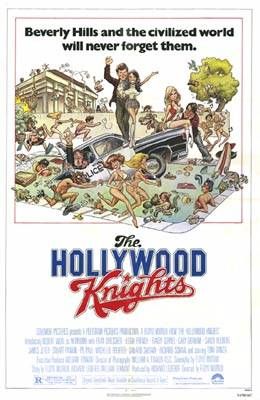
 Halloween Night, 1965. While the high school holds a pep rally and the Beverly Hills Homeowners Association debate the best way to tackle the problem of juvenile delinquency, the Hollywood Knights hang out at Tubby’s Drive-In, their favorite burger joint. The Hollywood Knights are a car club and a group of fun-loving rebels, determined to have a good time and to always humiliate Officers Clark (Sandy Helberg) and Bimbeau (Gailard Sartain). In practice, this amounts to a lot of jokes about flatulence and Newcomb Turk (Robert Wuhl) mooning the cops every chance the he gets. I’m hoping a stunt butt was used for the mooning shots. If I had known watching Hollywood Knights would mean seeing Robert Wuhl’s bare ass a dozen times over 91 minutes, I wouldn’t have started the movie.
The humor is crude but the movie has a serious side, one that was cribbed from American Graffiti. Duke (Tony Danza), a senior member of the club, is upset that his girlfriend (Michelle Pfeiffer, in her film debut) is working as a car hop. He’s also sad that his buddy, Jimmy Shine (Gary Graham), is leaving in the morning for the Army. Jimmy’s not worried about being sent to Vietnam because Americans are only being sent over there as advisors. Hollywood Knights doesn’t end with a Graffiti-style epilogue but if it did, Jimmy would be the one who never came home. The serious scenes work better than the comedy, due to the performances of Gary Graham, Michelle Pfeiffer, and Tony Danza. I can’t believe I just said that either. Danza, though he’s way too old to be playing a high school student, is actually really good in this movie. Pfeiffer doesn’t get to do much but, from her first scene, it’s easy to see why she became a star. The camera loves her and she brings her character to life, despite not having much screen time.
Unfortunately, the drama takes a back seat to a lot of repetitive humor. The problem isn’t that the humor is crude. One thing that has always been true is that, regardless of the year, teenage boy humor is the crudest humor imaginable. Even back in prehistorical times, teenage boys were probably drawing dirty pictures on the walls of their caves. The problem is that the humor is boring and Robert Wuhl is even more miscast as a high school student as Tony Danza was. Fran Drescher plays a high school student with whom Turk tries to hook up. Drescher, like Pfeiffer, comes across as being a future star in the making. Robert Wuhl comes across as being the future creator of Arli$$.
The Hollywood Knights has a bittersweet ending, the type that says, “It’ll never be 1965 again.” This movie made me happy that it will never be 1965 again. 1965 should have sued The Hollywood Knights for slander. Hollywood Knights tried to mix the nostalgia of American Graffiti with the raunchiness of Animal House but it didn’t have the heart or creativity of either film. At least some of the member of the cast went onto better things.
 Through the Shattered Lens
On June 13, 2025, Israel conducted military strikes targeting Iranian nuclear facilities, which has drawn significant international attention and condemnation. The Israeli Defense Forces (IDF) reported that they targeted multiple military sites, including key nuclear facilities, as part of a preemptive strike aimed at neutralizing what they described as a threat posed by Iran’s nuclear ambitions.
In response to these actions, the United Nations has condemned the strikes, emphasizing the need for diplomatic solutions to prevent escalation in the region. The UN ambassador stated that the decision to strike was an “independent Israeli decision,” indicating a lack of consensus on the appropriateness of the military action.
The strikes reportedly resulted in significant casualties, including the death of a senior commander of Iran’s Revolutionary Guards, which has heightened tensions further. Iranian state media has indicated that missile and drone attacks on Israel are expected in retaliation.
In the wake of Israel’s recent military strikes on Iranian nuclear facilities, several major world powers, including Britain, France, Russia, and China, have condemned the actions as “unprovoked.” These nations have expressed deep concern over the escalation of tensions in the region and the potential for further conflict.
The strikes, which occurred on June 13, 2025, targeted multiple sites associated with Iran’s nuclear program, including key military installations. Israeli officials justified the attacks as necessary to prevent Iran from developing nuclear weapons, citing the threat posed by Iran’s nuclear ambitions.
In their statements, the leaders of Britain, France, Russia, and China emphasized the importance of diplomatic solutions and called for restraint from all parties involved. They criticized the Israeli actions as undermining regional stability and violating international norms regarding the use of military force.
In a significant diplomatic move, Britain, France, Russia, and China have collectively withdrawn their ambassadors from Israel in response to the recent military strikes on Iranian nuclear facilities. This decision reflects the escalating tensions and widespread condemnation of Israel’s actions, which these nations have labeled as “unprovoked.”
The withdrawal of ambassadors marks a notable shift in diplomatic relations and underscores the seriousness with which these countries view the situation. They have called for an immediate cessation of hostilities and emphasized the need for a diplomatic resolution to prevent further escalation in the region.
This action follows a series of international criticisms directed at Israel, with various nations expressing concern over the potential for increased conflict and instability. The UN has also been vocal in its condemnation, urging all parties to engage in dialogue rather than military confrontation.
In a reciprocal diplomatic response to the withdrawal of ambassadors by Britain, France, Russia, and China, Israel has also decided to withdraw its ambassadors from these countries. This move reflects the escalating tensions and deteriorating relations following Israel’s military strikes on Iranian nuclear facilities, which have been widely condemned as “unprovoked” by the international community.
The decision to withdraw ambassadors signifies a significant breakdown in diplomatic relations and highlights the ongoing crisis in the region. Israel’s actions have drawn sharp criticism from these nations, prompting them to take a stand against what they perceive as aggressive military actions.
This diplomatic rift is part of a broader context of heightened tensions in the Middle East, with various countries calling for restraint and a return to dialogue to address the underlying issues. The situation remains fluid, and the international community is closely monitoring developments as both sides navigate this escalating conflict.
The UN’s condemnation, backed by the UK, France, Russia, and China, portrays the action as “unprovoked” — a term that reflects political calculus more than legal clarity. Under Article 51 of the UN Charter, a state may use force in self-defense if an armed attack occurs — but preemptive strikes exist in a gray zone. Israel’s argument likely hinges on the “imminence” clause, as articulated in the Caroline case (1837): when the threat is instant, overwhelming, and leaves no choice of means.
Israel’s June 13, 2025 strikes on Iranian nuclear facilities represent a classic case of preemptive self-defense, aligning with the Begin Doctrine — the principle that Israel will not allow enemy states to acquire nuclear weapons. It echoes past operations. (1) Osirak (1981) against Iraq’s nuclear reactor. (2) Operation Outside the Box (2007) against Syria.
Yet the withdrawal of ambassadors by four permanent members of the Security Council — including the two Western nations historically sympathetic to Israel — signals a profound diplomatic rupture, potentially worse than during the 1956 Suez Crisis or 1982 Lebanon War.
But this time, the scope is broader, the stakes are higher, and the diplomatic fallout is far more severe. The reciprocal withdrawals by Israel, we are now witnessing a partial diplomatic isolation of Israel from key global players — a scenario that dangerously echoes the pre-1967 international atmosphere, only now with a nuclear shadow.
The continuity between medieval Church slanders and modern UN blood libels. Iran, a regime openly threatening genocide (e.g., statements by top officials calling for Israel’s destruction), is shielded by powers that once committed or abetted genocide. Those same powers — Britain and France — betrayed Jewish refugees pre-1948, yet now sanctimoniously claim Israel undermines “stability.” Russia, currently engaged in illegal war and nuclear threats in Ukraine, calls Israel’s actions illegal. China, persecutor of Uyghurs and enforcer of state repression, calls for restraint.
These are not neutral arbiters of international law. They are part of a long tradition of holding Jews to impossible standards, demanding “restraint” even when faced with annihilation. The UN has inherited the mantle of Church anti-Jewish theology in secularized diplomatic language. Resolution 3379 (Zionism = Racism) was the modern Inquisition; Today’s condemnation of Israel’s self-defense is the new blood libel; The ICJ’s silence on Iran’s genocidal threats is a political Kiddush Hashem inversion — punishing the victim for refusing to lie still.
Iran will likely retaliate via proxies: Hezbollah, Houthis, and Shi’ite militias in Syria or Iraq. Israel may face multi-front escalation, forcing it into a prolonged regional war.
The Gulf States’ reaction (e.g., UAE, Saudi Arabia) will be critical: they fear Iran, but won’t publicly back Israel under current diplomatic pressure. The US response under the leadership of President Trump contrasts with the European barbaric anti Jewish history.
This is more than a military episode — it’s a constitutional test of Jewish sovereignty. If Israel, as a free Jewish nation, cannot defend itself without being slandered and isolated, then the very post-Holocaust consensus that birthed the UN is shattered. Once again, the Jewish state is punished not for what it does, but for daring to exist — and fight to survive.
LikeLike