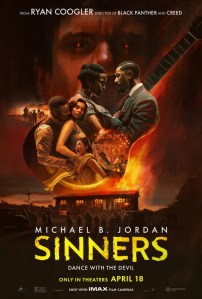
I’m on a 2 day Vacation from my DayJob, for a four day Easter Weekend. I caught Sinners earlier Thursday afternoon, having purchased a ticket the Sunday before. That I stood up and slow danced with the credits and mid/post credit scenes of the film says a lot for me. It says I need to frequent more packed showings so that I don’t do such things. More importantly, it says the blues was as seductive as most of the movie, playing a crucial part in every scene. I dare say that Sinners could almost be a musical in the same way that the Coen Brothers’ O Brother, Where Art Thou? was. There was not a musical moment in this movie where I wasn’t bobbing my knee or nodding my head (thanks to either Academy Award Winner Ludwig Goransson or whoever had the vocals at any particular moment). I even sang along at one point with a song I recognized. I’m kicking myself in the pants for not staying at the movie theatre for another showing. I really should have. That just felt so good.
I like to think I knew a lot about Vampires. I mean, I’ve been a fan for like 3 decades now, but Sinners puts a spin on the genre through myth and music that caught me off guard. Granted, if you’ve watched all of the trailers, you’ve seen most of the film already (trailers being what they are these days), but I’ll try to keep it as vague as possible. Despite what’s shared, there’s a lot left out.
Ryan Coogler’s Sinners takes us to Mississippi in 1932, where two brothers, Smoke & Stack (both played by longtime Coogler associate Michael B. Jordan) return home with a plan to open up a juke joint. It involves picking up a few friends and associates along the way, particularly their guitarist cousin Sammie (Miles Caton, in his Introductory role). Sammie’s father, a Preacher, wants him to turn away from the music he makes and join the Church, proclaiming that the blues will lead to the Devil. Sammie, however, loves what he does and he’s damn good at it.
The brothers are smooth talkers and quick dealers, a pair of gangsters working off the notion that anything’s possible at the right price. They also have some unresolved relationships with the women in their lives. Grief drove a stake through Annie (Wunmi Mosaku, Deadpool & Wolverine) and Smoke’s relationship, while Stack can’t seem to get rid of Mary (Hailee Steinfeld (Spider-Man: Through the Spider Verse), no matter how hard he tries. Take all that and add living in Mississippi as a person of color in the 1930s, and things are kind of rough all around. There’s a scene that suggests life in Chicago could be brighter, but “better the devil you know”, suggests otherwise.
Granted, Coogler isn’t shy in showing the effects of racism (as Fruitvale Station showed), and Sinners doesn’t detour from that. For it to be historically accurate (even if fictional), shades of that darkness have to exist in the film, though it may not seem as heavily showcased at first. At best, one could say that any racism or segregation elements take a back seat to the bloodsuckers prowling the night.
Jordan’s twin set up is really good. Both Smoke and Stack have their distinctive styles, though there are a few moments where you may get lost in figuring who’s who. Jayme Lawson (The Batman‘s Bella Real, who I didn’t even realize until this write up) also did well here. Li Jun Li (Babylon) and Delroy Lindo’s provided some the more comedic moments than anything else. Although every actor does well in Sinners, it wouldn’t be half as powerful as it was without Miles Caton’s Sammie. He felt like the audience’s lens through all this, and when he sings, it’s rich, kind of reminiscent of Aloe Blacc’s style a decade ago. Another stand out is Jack O’Connell (Ferrari, 28 Years Later), whose character has all the best of intentions, yet may not have everyone’s best interests at heart.
I unfortunately didn’t get a chance to see the film in the Panavision 70 or IMAX formats it was filmed in. To do that means a trip into Manhattan, which I simply don’t really do much anymore since moving out (though I may make an attempt before the weekend’s out). Coogler makes some fantastic use of space, framing the camera for some beautiful wide shots when needed, along with a nice one shot, but the real magic happens during the 2nd half. The party sequence itself is worth the price of admission, possibly rivaling the one in Damian Chazelle’s Babylon. The camera flows just as well as did during the fight sequences of the Black Panther films. I’d imagine those sequences must look really awesome in those formats.
The only real complaint I have over Sinners is that I felt that some of the decisions made in the 2nd half didn’t fully make sense to me, which ironically was some of the same issues I had with Robert Rodriguez’ From Dusk Till Dawn, which moves along similar lines. I get why the decisions were made, but at the same time, I kind of hoped for a little more there. That might be more of a nitpick than anything else. It’s has horror, someone’s bound to make a decision that threatens everyone else. Additionally, not every loop is closed. Most of the important ones were from a story standpoint, but there were one or two elements I would have like to have found out about. It’s not a total loss.
Oh, while you’re going to watch this, it may be best to send the little ones off to watch Minecraft. Sinners is seductive in a number of ways, and there are a few steamy scenes that aren’t for their eyes. Additionally, there’s also a copious amount of blood, that may also be a little off putting. Parental Guidance suggested, indeed.
Overall, I loved Sinners. I’ve already scooped up Ludwig Goransson’s Score (which should be be available in about an hour, as of this writing) and would happily watch it again. Note that if you are going to see it, there is an extended Mid Credits scene that is longer that I expected it to be. Really, when it starts, you might as well sit back down if you stood up to go. There’s also a post credit scene as well, which isn’t as impactful, but fun to watch, all the same.
 Through the Shattered Lens
From Brit to Blasphemy: How Galatians 3:13 Subverts the Sinai Oath brit with replacement theologies later echoed by the Muslim koran.
Both this and that ignore the responsibility to impose Government rule that establishes ‘National Justice’. Both av tuma religions of avoda zarah prioritize alien Greek and Roman Imperial Metaphysics as the primary vision, which their followers emphatically embrace as truth.
A profound rupture between Torah oath brit Blessing vs. Curse. Where the chosen Cohen people either live and rule the Promised land with righteous judicial common law justice … or … due to returning back to Egypt, wherein Israeli leaders duplicate the injustice of Par’o, who withheld straw – and his courts justified the beating of Israelite slaves. When the Promised land becomes full of oppression, theft, incest, and judicial perversion of justice: an exact duplication of the Israelite slavery in Egypt, then the Torah curse of g’lut exiles Israel unto foreign lands that likewise do oppression, theft, incest, and judicial perversion of justice.
Paul’s Substitution Theology (Galatians 3:13), reinterprets the Torah “curse” of g’lut/exile: as sin and guilt transferred from humanity to Jesus. He redefines the t’shuva solution, not as national return (t’shuvah, brit renewal, prophetic mussar — but as a one-time cosmic transaction—a metaphysical sin-substitution achieved through the crucifixion of Christ. The Torah context – no longer Israel’s oath brit cohen history, but rather a universalized anthropology: “all have sinned,” and all must be redeemed through faith in the crucified Christ (see Gal. 3:28).
This Hellenistic-legal concept of guilt and atonement bypasses the oath brit sworn at Sinai. The משל\נמשל Mishkan-korbanot\Sanhedrin common law court-rooms pursuit of righteous judicial justice. Wherein the leaders of the chosen Cohen people strive to make fair compensation of damages inflicted by Party A upon Party B. Paul’s universal “one size fits all” Original Sin uproots the chosen oath brit Cohen people, the children of Avraham, Yitzak, and Yaacov. His replacement theology condemns the Caine-Jews, these eternal Christ-Killers; condemned to wander as cursed stateless refugees with no country of our own, enforced by church oppression, theft, sexual perversion, such as baptizing Jewish children against the will of their parents, and judicial and economic injustice.
Paul universalizes “sin” as the human incurable condition doomed to eternal damnation, without the “salvation” belief in the Christ-crucifixion ‘Good News’. Roman torture … the Gospel flips and makes it into a reformed righteous event! Paul and later Augustine — not the prophets, not Sinai, not the brit — these ‘latter day saints’ introduced the perverted ‘salvation from Original Sin guilt’. The Torah concept of national exile as a Torah curse, a intrinsic Torah theme expressed through the oath brit faith, seeks to inspire t’shuva and ultimately g’eulah redemption – based upon the model of Moshiach Moshe, who brought Israel out of Egyptian slavery.
The legal פרדס inductive logic of Torah (mishpat), replaced by faith in both Christ & Greek deductive logic alone (Galatians 2:16); the Torah dynamic of interpreting subtle distinctions between cases, מאי נפקא מינא, heard before the Courts to determine fair compensation of damages in each and every different case, replaced by and with a static one size fits all – believers go to heaven and sit with Jesus and unbelievers burn and rot in the depths of Hell tortured by Satan for eternity.
The New Testament framers substitute righteous justice, this most basic requirement: the living chosen cohen peoples’ generations continuum either choose to accept or reject. Replacement theologies superimpose belief in life in the world to come, eternal life in Paradise Heaven. Muhammad redefined this perversion that abandons judicial justice in this world with 71 virgins in the world to come, utter Pie in the Sky ‘chicken little’ fairy tale nonsense. Galatian 2:16 rejects the obligation to rule the Promised land with righteous justice, replaced by faith in Jesus as the Son of God. Muhammad later replace this new unheard of new testament “scripture” with his koran: latter day saints “scripture”, which makes him the star of the show. These Latter-Day Saints new scripture revelations, make it crucial for Man to believe in these theologically constructed God or last prophet, Heaven or Hell bi-polar insanity theologies.
The framers of the New Testament declare that the crucified Christ became the redemption for Adam’s Original Sin. This curse, the exile from the Garden of Eden, unto belief in the World to Come of Jesus or sexual paradise. The church fathers transposed their ‘Original Sin’ guilt upon the hated and despised Jewish refugees in Europe, despised for their crime of being the chosen Cohen nation. But even if Jews converted to Xtianity, the Inquisition proved that the burning of Xtian hatred for Jews reaches no limits. Cursed Jews – a race rejected by God, guilty of killing Christ, fit for torture, exile and humiliation. Church theology favored forced baptism, medieval pogroms, ghettos, blood libels, which culminated in the Shoah slaughter of 75% of European Jewry in less than three years.
This shift of the New Testament framers replacement theologies–it emerges organically from Paul’s decoupling of the oath brit sworn by the Avot and remembered – as the inheritance of all generations of Jews – who likewise swear these Avot oaths sworn within the Yatzir Ha’Tov within our hearts, when we da’aven tefillah (a mitzva from the Torah) – kre’a shma. Both Xtianity and Islam today despise detest and abhor the re-establishment of the Jewish state of Israel within the borders of Judea. UN Resolution 3379: Zionism is Racism detests the Balfour Declaration of 1917 or that 2/3rds of the UN member states in 1947 voted their approval of Jewish equal rights to achieve self-determination as a nation state in the Middle East. The UN to this day maintains its racist Apartheid policy of rejecting Israel as a member of the Middle East voting block of nations!
The New Testament framers, specifically Paul, collapses all complexity of justice where Torah common law weighs each case heard before Sanhedrin courts into a perverted faith in Jesus or eternal burning in Hell type of Jesus Frankenstein monster; human suffering, no longer rectified in courts with justice, but spiritually bypassed via faith in a crucified savior, and life in a world to come paradise.
The New Testament framer replace Hellenistic metaphysics, prioritized over the Torah requirement that faith needs as an absolute minimum the righteous pursuit of judicial justice, within the borders of Judea. Muhammad serves as an echo rather than a tikkun correction of the basic fundamental flaws exposed by the tuma theology espoused by the new testament framers av tuma avoda zarah.
Both the new testament and koran reject Israel as a nation, with its unique concepts of oath brit, rooted in land, language, common law, and Jewish lineage, and T’NaCH and Talmudic established culture and customs traditions. Both sets of replacement theologies vainly re-imagines revelation as a final top-down declaration, displacing the generational oral-dialogical tradition established by both Sinai and Horev revelations.
These ‘Latter-Day Saints’ bi-polar insane theologies, they simplify belief unto their newly established and declared Gods as: Believe or burn. Follow the last prophet or be lost. Oppress the Jew scapegoat or be condemned. Such Av tuma avoda zarah theologies obliterates the Torah vision of justice in this world.
LikeLike
I love a good vampire tale that’s DIFFERENT.
LikeLiked by 1 person
My wife and I are going to watch this tomorrow! Great review, Leonard!
LikeLiked by 1 person
Pingback: Lisa Marie’s Week In Review: 4/14/25 — 4/20/25 | Through the Shattered Lens