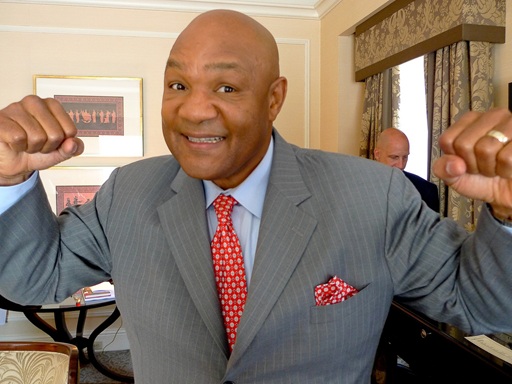
George Foreman was one of those guys who I expected would be around forever.
When I was growing up, I knew George Foreman as the good-natured boxer who would throw punches for 12 rounds and then make jokes immediately afterwards. On HBO, he was usually the commentator who showed the most concern for the well-being of the fighters in the ring. On that infamous night in 1997, when Oliver McCall had an apparent mental breakdown while facing Lennox Lewis in the ring, while the other ring announcers spent their time talking about how bad the night was for the sport and how Don King was destroying the integrity of HBO Boxing, George Foreman was the only one to express any concern about what was happening in Oliver McCall’s head and to say that he hoped McCall would be okay once the fight ended. That made a big impression on me. George Foreman may have fought for a living but he never gave up his humanity.
It was only later that I saw the clips of young George Foreman, fighting Ali in Zaire, and I realized how intimidating Foreman had been before he made his comeback in his 40s. Foreman said that losing Ali in Zaire hurt, both because of the defeat and also Ali’s constant taunting. Foreman, who famously declined to join in the protests when he was on the 1968 U.S. Olympic team, resented Ali’s claim that Foreman was a sell-out. (These were the same accusations that Ali tossed at every opponent that he fought but for Foreman, someone who had struggled with poverty when he was younger and who credited boxing with saving him from a life of crime and prison, they especially stung.) Foreman could have joined Joe Frazier in spending his entire life bitter over his treatment by Ali but Foreman forgave him. When the documentary about the fight, When We Were Kings, won the Oscar for best documentary, Foreman was at the ceremony with Ali and helped his former opponent step up the stairs to the podium.

George Foreman in Zaire
It’s always hard to believe that the scowling and uncommunicative Foreman of the 70s was the same George Foreman who became an American institution, selling the George Foreman Grill and proving that he still had what it took to be a champion at age 45. Foreman credited finding religion with giving him a new outlook on life. At the same time he was making his comeback in the ring, Foreman was working as a minister and working with at-risk youth in Houston. He was a man who found success but he was also a man who gave back.
Foreman didn’t win every fight. He lost to Ali in Zaire and to Jimmy Young in Puerto Rico. After he made his comeback, he lost to Evander Holyfield, Tommy Morrison, and Shannon Briggs. Holyfield and even Morrison won their fights fair and square. (Morrison was booed after he won not because he didn’t deserve the victory but because he was Tommy Morrison.) A lot of people, including me, felt that Foreman was robbed by the judges when it came to the Briggs fight but Foreman accepted the decision with grace. As I get older, I feel more and more appreciation for what George Foreman accomplished. He made a comeback when most people had written him off and he did it with humor and humility.
Yesterday, Big George Foreman passed away at 76. I’ll miss him.
 Through the Shattered Lens
RIP George Foreman a boxer and gentlemen! Last year my wife & I took in a stray cat not knowing she came knocked up. Only half her litter of 6 survived 3 identical boy cats. I took a page of George Foreman guidance naming all three George. We have George Foreman reminders turning one year old this week.
LikeLiked by 1 person
George Foreman Is Now In Heaven🌈🕊🌈🕊
LikeLike
I Think George Foreman Is the G.O.A.T🌈🕯🕊✝
LikeLike
How did the letters written by the Apostle Paul expose the concealed intent of an agent provocateur? Specifically, how did his letters both undermine the Roman Pantheon of Gods and Xtianity itself?
Paul’s letters both challenged the Roman pantheon by promoting monotheism and critiquing idolatry and emperor worship, while also sometimes undermining early Christian thought, especially in his approach to Jewish faith concept of pursuit of judicial justice.
The letters written by the Apostle Paul represent a significant part of early Christian literature, and while they primarily serve to spread and clarify Christian teachings. Also aspects of Paul’s writings seen as challenging both the Roman Pantheon and elements of early Christianity itself.
The Roman Empire’s religious system was polytheistic, worshiping a wide range of gods, based upon the Greek model. Paul’s letters, promoted monotheism — as central to Christian faith. For example, in 1 Corinthians 8:4-6, Paul acknowledges that many people in the surrounding culture believe in many gods, but for Christians, “there is but one God, the Father, from whom all things came.” This contrasts sharply with Roman polytheism, where each god or goddess had a particular domain of influence (such as Jupiter, Mars, Venus, etc.).
Paul consistently warned against idolatry, urging his followers to avoid worshiping statues and images of gods, a practice common in Roman religion. In 1 Corinthians 10:14, he writes, “Therefore, my dear friends, flee from idolatry.” He uses strong language to describe the futility of idol worship, which directly undermines Roman religious practices that were centered around the Pantheon of gods.
The Greek term idolatry lacks the power of the Hebrew term avoda zarah. An idol represents a limitation to both physical history, wherein Xtian theology absolutely requires a historical physical Jesus and a fundamental limitation to 3 dimensions. The Hebrew concept of avoda zarah has no such limitations. Contrast Euclid’s 5th Axiom of Geometry, and the Scientific method, who “idolatry”, limits reality to empirical physical evidence. Hence the ancient Greek Gods viewed a Giant Bearded Men and Women on Mt. Olympus. Paul’s replacement theology revisionist history of the Torah revelation at Sinai, falsely translates idolatry for avoda zarah. Paul fails to grasp the 1st and 2nd Commandments of the Sinai revelation. A failure on par with Muhammad’s replacement of Allah over the שם השם. A Av tumah avoda zarah equal to the sin of the Golden Calf!
Paul’s theological construct of a passive spiritual Moshiach, as opposed to a Bar Kokhba military Moshiach introduced a radical shift away from the Moshe model who travelled to Egypt, despite Paul’s presentation of a liberation theology freed from judicial justice – despite the judicial oppression of the court of Par’o in the matter of straw withheld and Israelite brick quotas. Paul’s replacement theology compares the Pantheon of Roman Gods with Caesar as the Son of God, compares to the mystic Book of Daniel whose vision sees the Gods of Babylon as standing upon feet of clay.
Paul’s letters aware of both the Pesach story of Egypt liberation and Daniel’s mysticism of ‘End of Days’, viewed in the surrounding contexts of the approaching General Jewish revolt in both Judea and Alexandria Egypt; his passive Moshiach theology greatly contributed to Alexandrian Jews not joining the revolt made by the Judean Jews. That military Moshiach failed to coordinate a Judean and Alexandrian Jewish revolt joined together at the hip. Bar Kokhba actually failed to conquer Damascus and throw the Roman legions out of Syria, Paul’s liberation substitute theology likewise failed to ignite a Roman Civil War and rebellion against Caesar as the Son of God, prior to the Great Jewish revolt in 66CE.
Clearly, because Paul’s letters, written in Greek, his target audience, he aimed to persuade Goyim rather than Jews to embrace his substitute theology that replaced the sworn oath of the eternal chosen Cohen people; based upon the Divine T’shuva made on Yom Kippur where HaShem rejected making of the seed of Moshe the chosen Cohen poeple. Paul’s replacement theology rejects the Yom Kippur t’shuva made by HaShem. His anti circumcision, anti-chosen Cohen people stance while in Damascus supports this premise that Paul as an Agent Provocateur sought to engage the heretical belief in Jesus messiah theology, which had succeeded in enticing some Jews in Judea and many more Jews in Alexandria Egypt, through his anti-circumcision theology preached in Damascus. After travelling to Rome, Paul’s liberation theology switched priorities to Jesus as the Son of God, messiah king of the Jews theology, which undermined Caesar as the son of god. The Roman Empire viewed the emperor as a god or a divine figure, and Roman religion was deeply interwoven with imperial politics.
Paul, however, in places like Romans 13, speaks about submission to earthly authorities but emphasizes that the ultimate authority lies with God alone. His monotheistic theology fails to grasp that Monotheism violates the 2nd Sinai Commandment of the revelation of the Torah at Sinai. This can be seen as a subtle challenge to the emperor’s divine status, which was an essential part of Roman religious practice. Paul’s Greek letters failed to emphasize the first and second Sinai commandments, utterly essential as viewed from Traditional Judaism. Paul’s replacement theology emphasizes the Name of Jesus and totally abandons the Yod Hey Vav Hey Holy Spirit Name, which breathes as a Spirit and not a word, revealed in the first Sinai commandment. The opening verses of the gospel of John fails to discern this subtle distinction between the revelation of the Spirit Name and the Sin of the Golden Calf – translating the Spirit Name unto word translations.
One of the key replacement theological debates in early Christianity, the relationship between faith and works. Paul – a strong advocate for salvation through faith, as seen in Ephesians 2:8-9 (“For it is by grace you have been saved, through faith—and this is not from yourselves, it is the gift of God—not by works, so that no one can boast”). This replacement theology subverted the Torah concept of faith which prioritizes the righteous pursuit of judicial common law justice, based upon Torah precedents, which dedicates as holy, a fair restoration of damages inflicted by Party A upon Party B, as the definition of Torah faith in the sworn oath brit alliance of the chosen Cohen people. A fundamental shift in the concept of faith, which Paul’s liberation theology denigrates to – not by works, so that no one can boast.
Paul’s ‘Salvation by Grace’ likewise undermined the revelation at Horev of the 13 tohor middot, grace being the 5th middah/attribute of the revelation of the Oral Torah. His replacement theology completely ignored rabbi Akiva’s פרדס/Pardes logical interpretation of the revelation of the Oral Torah at Horev.
Paul’s letters made subtle omissions to key Torah concepts. Paul’s writings, especially in Romans 9-11, as grappling with the question of whether the Jewish people were still chosen by God. Yet all his letters fails to validate that the chosen Cohen people of Avraham, Yitzak and Yaacov, the eternal life of the seed of the Avot defines the oath sworn alliance at the brit cut between the pieces, where HaShem swore to cause this chosen Cohen people to eternally inherit the Promised Land, and that the Spirit Name of Yod Hey Vav Hey breathes within the Yatzir Tov of the bnai brit Cohen peoples’ hearts.
Paul’s argument that Gentiles could be part of God’s promise without fully converting to Judaism through practices like circumcision, and notion of ‘adopted’ Goyim utterly switch the narrative away from Ger Tzaddik – who accepts all the Torah commandments, to a perverted prioritization, that Jews too, can embrace the triune God of Xtianity; where the Holy Spirit ceases to exist as wisdom how to pronounce the Yod Hey Vav Hey revelation of the 1st Sinai commandment…the greatest of all Torah commandments; do the bnai brit chosen Cohen people do mitzvot לשמה yes or no? Unto Goyim preaching the Good News gospels unto the lost and cursed Jews!
Paul’s letters both challenged the Roman pantheon by promoting monotheism and critiquing idolatry and emperor worship, while also they equally undermined early Christian thought, especially in his approach to T’NaCH and Talmudic common law and the prioritization of Judicial Sanhedrin courtroom justice as the Torah definition of faith. The Apostle Paul, as an Agent Provocateur not only did his theology dismantle belief in Caesar as the son of God, king of the Jews, it equally sought to uproot and replace Torah common law judicial legislative review and prophetic mussar.
LikeLike
Pingback: Lisa Marie’s Week In Review: 3/17/25 — 3/23/25 | Through the Shattered Lens
I Think George Foreman Is a Icon
LikeLike