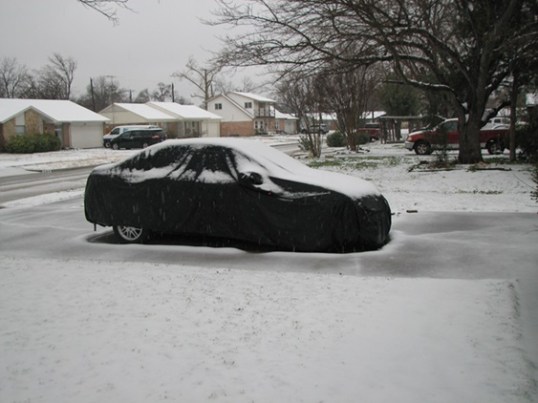
Photograph by Erin Nicole
I am currently sitting in my bedroom, wrapped in several blankets and watching the snow fall on the other side of my window. I love snow, mostly because I live in Texas and therefore, I don’t get to see it that often. The most snow we’ve gotten down here, at least in my lifetime, was in 2021. That was when we got hit by that blizzard and had to deal with rolling blackouts for a week straight. That’s not a good memory but still, I love to watch the snow fall. Even during that blizzard, I still loved the fact that I could use the snow as a nightlight as I read a Mickey Spillane book and waited for the power to come back on.
Down here in North Texas, snow is exotic. In other parts of the country, it’s just a part of everyday life.
Like in the Dakotas for instance….
First released in 1996 and directed by the Coen Brothers, Fargo is a film that is full of arresting images. As soon as you hear (or read) the title, those images and the sounds associated with them immediately pop into your head. You immediately visualize the desperate car salesman Jerry Lundegaard (William H. Macy) trying to trick a customer into paying extra for the trucoat and insisting that “I’m not getting snippy here!” You see the film’s two kidnappers, Carl Showalter (Steve Buscemi) and Gaear Grimsud (Peter Stomare), getting on each other’s nerves as they drive from one frozen location to another. You remember heavily pregnant Marge Gunderson (Frances McDormand) investigating a snowy crime scene and gently correcting another officer’s “police work.” You flash back to the moment when Mike Yanagita (Steve Park) suddenly breaks down in tears and tells Marge that she’s a super lady. “And it’s a beautiful day,” Marge says at one point, wondering how so many terrible things could have happened on such a lovely day. And she’s right. It was a beautiful day. It was far too beautiful a day to discover one man stuffing another into a woodchipper.
Myself, I always think of the scene where Carl attempts to find a place to hide a briefcase full of money. It’s night. Carl’s been shot in the face but he has the money that he’s gone through so much trouble to collect. He runs into a field, looking for a place to hide it. The field is covered in snow. Every inch of the ground glows a bright white. Everything looks the same. But Carl still runs around desperately before picking a place to bury the suitcase. It doesn’t seem to occur to Carl that there’s no visible landmarks or anything that would ever help him to find the money again. He’s blinded, by the snow, by the pain of the bullet, and, like most of the characters in this movie, by his own greed.
Of course, Fargo is not a film about people behaving in intelligent ways. Greed, loneliness, and desperation all lead to people doing some pretty stupid things. Jerry thinks that the best way to pay off his debts and raise the money for a real estate deal is to arrange for his wife to be kidnapped so his wealthy father-in-law (Harve Presnell) will pay the ransom. His father-in-law, who obviously despises Jerry and would be happy for him to just go away, is convinced that he’ll be able to both get back his daughter and recover his money. (If Jerry had just spent a moment really thinking about his plan before going through with it, he would have realized his father-in-law would never just part with his money.) Carl thinks that it’s a good idea to partner up with the obviously sociopathic Grimsud. When a cop pulls over Carl and Grimsud’s car, Grimsud ignores the fact that Carl was talking his way out of the ticket and instead kills the policeman and then kills several eyewitnesses. (“I told you not to stop.”) Marge figures out what is going on but even she puts her life in danger by investigating a cabin without proper backup. The characters in Fargo frequently behave in ludicrous ways and almost all of them speak with an exaggerated regional dialect (All together now: “Oh yeah,”) but they also feel incredibly real. The sad truth of the matter is that there are people as greedy, dumb, and hapless in the world as Jerry. There are people like Carl and Grimsud. Even Jerry’s fearsome father-in-law is a very familiar type of character. People do thing without thinking and inevitably, they make things worse the more overwhelmed they become. Common sense (not to mention decency) is frequently the last thing that anyone considers. Fortunately, Marge is believable too. Marge at times almost seems so gentle and polite (“No, why don’t you sit over there?” she sweetly tells Mike when he attempts to get too close to her.) that the viewer worries about what’s going to happen to her when she gets closer and closer to figuring out what’s going on. Fortunately, Marge turns out to be much stronger than anyone, even the viewer, expected. The world of Fargo can be a terrible place but there’s moments of kindness and hope as well.
Fargo is both a comedy and a drama. The opening title card says that the film is based on a true story, which is a typical Coen Brothers joke. (The film was loosely inspired by several similar crimes but the story itself is fictional.) Carter Burwell’s dramatic score is both appropriately grand and also gently satiric. Jerry does some terrible things but William H. Macy plays him as being so naive and desperate and ultimately overwhelmed that it’s hard not to have a little sympathy for him. Jerry truly thought it would be so simple to pull off a complicated crime. (The poor guy can’t even get the ice off of his windshield.) As played by Steve Buscemi, Carl Showalter talks nonstop and he makes you laugh despite yourself. His shock at how poorly everything goes is one of the film’s highlights. It’s a funny film but it’s also a sad one. I always worry about what’s going to happen to Jerry’s son. Ultimately, of course, the film belongs to Frances McDormand, who gives a wonderful performance as Marge. She’s the heart of the film, the one who reminds the viewer that there are good people in the world.
Considering the film’s cultural impact, it’s always somewhat shocking to remember that Fargo did not win the Oscar for Best Picture. It lost to The English Patient, a film about a homewrecker who helps the Nazis. Personally, I prefer Fargo.

Fargo (1996, dir by the Coen Brothers, DP: Roger Deakins)
 Through the Shattered Lens
Pingback: Lisa Marie’s Week In Review: 1/6/25 — 1/12/25 | Through the Shattered Lens
Pingback: Scenes That I Love: William H. Macy in Fargo | Through the Shattered Lens
Pingback: Scenes That I Love: Kurt Russell In Used Cars | Through the Shattered Lens
Pingback: The Best Picture Race: The 1990s | Through the Shattered Lens