Cleaning Out The DVR: Boulevard Nights (dir by Michael Pressman)


(I recorded the 1979 film, Boulevard Nights, off of TCM on December 14th, 2017).

Boulevard Nights tells the story of two brothers, living in East Los Angeles.

Raymond Avila (Richard Yniguez) used to be involved with the street gangs but he’s gone straight.  He still likes to cruise the boulevard.  He still likes to make his lowrider hop up and down.  He still knows better than to trust outsiders and he always makes sure that he’s not around whenever the cops show up.  But, unlike many of his old friends, Raymond is now determined to stay out of trouble.  He’s got a job working at a garage and he dreams of the day when he’ll have his own auto shop.  He takes care of his mother.  He keeps an eye on the neighborhood.

Chuco Avila (Danny De La Paz) is Raymond’s younger brother and also his opposite.  Chuco is a high school drop out who doesn’t want to cause trouble but who says that he can’t stop getting angry.  Chuco always carries a switchblade with him, even bringing it to a job interview.  Chuco only feels secure when he’s a member of a gang.  Chuco steals.  Chuco fights.  Chuco huffs paint and gets a snake tattooed on his arm.  Whenever Chuco has to hide out, he goes to a graffiti-covered shack that he shares with a stray cat.

There’s a war coming as random skirmishes between two separate neighborhoods lead to greater and greater violence.  Chuco is looking forward to it.  Raymond just wants to avoid it.  He’s got a good job and he’s planning on marrying Shady Londeros (Marta DuBois).  But, as Raymond explains it to Shady, if a war does break out, he’s going to have his brother’s back.

The plot of Boulevard Nights is a familiar one.  Stories about good and bad brothers have been told since ancient times and anyone who has ever seen a “gang” movie should be able to guess everything that’s going to happen in Boulevard Nights.  It’s not a spoiler to say that the war between the two gangs leads to tragedy.  You can see that tragedy coming from the first five minutes of the film.  It also doesn’t take a psychic to predict that one brother will survive while one brother definitely will not.  The only question is whether the film will end with either Raymond or Chuco wistfully staring out at the Los Angeles skyline.

What does set Boulevard Nights apart from other gang films is that it never glamorizes its violence and it was also shot on location in East Los Angeles.  When Raymond and Chuco drive through their neighborhood, the small and dilapidated houses that they see are the houses that were actually there in 1979 (and which might still be there today).  The use of real locations brought a grittiness to the film that the by-the-numbers script failed to provide.  Boulevard Nights also featured a cast largely made up of amateurs.  Members of the gang were played by actual gang members.  Needless to say, this led to some noticeably uneven performances but it also created an authenticity that would otherwise be lacking.

Boulevard Nights is an uneven film but, because it was shot on location, it functions as a bit of time capsule.  If you want to know what East L.A. looked (and sounded) like in the late 70s, you can either purchase a time machine or you can watch this movie.  For many viewers, watching the movie will be probably be the more practical choice.

Last year, Boulevard Nights was selected for preservation in the United States National Film Registry by the Library of Congress as being “culturally, historically, or aesthetically significant”.

The Too Old to Die Young Teaser


Here’s one for the cinemaphile’s glossary.totdy.jpg

In cinema circles, an Auteur is described as “a filmmaker whose personal influence and artistic control over a movie are so great that the filmmaker is regarded as the author of the movie” (Wikipedia). I’ve looked at films as a three-way set of responsibilities. You have the writer, because without the story, there’s nothing. You’ve the Director, who takes that Writer’s vision and presents it on film, and then there’s the cinematographer, who makes sure that the Director’s work is well-lit and shot. I feel all three roles can tip the ownership of a film in anyone’s favor. A great story can be damaged by a bad director, and a good director can try to the make the best out of a bad story. On top of that, you could also have bad movies that look really good.

There are a number of directors out there who fit this designation. Brian DePalma, Guillermo del Toro, David Fincher, Terrence Malick (who shows up every half a decade with a film) David Cronenberg, Richard Linklater,  Jean-Luc Godard (who I’m learning a lot about lately), the list is a large and heavily argued one. Each person has their own picks and favorites.

For me, Nicolas Winding Refn fits that role. With films like Valhalla Rising, Drive , Only God Forgives and The Neon Demon, it’s hard not to recognize the color contrasts and flow of his stories. In writing this, I also found out that Refn is colorblind, which makes what he’s done so far more amazing for me.

Refn’s latest project for Amazon Studios is a series called Too Old to Die Young. The most anyone really knows is that is supposedly “explores the criminal underbelly of Los Angeles by following characters’ existential journeys from being killers to becoming samurai in the City of Angels.”

Here’s a teaser starring Miles Teller, Callie Hernandez, Jena Malone, John Hawkes and William Baldwin. It appears to still carry that wild color scheme and may possibly be just as dark and brutal as his previous work. I’m curious as to whether they’ll stick with a standard approach or follow True Detective’s style of a single writer/director pair for all of the episodes. Either way, we’ll find out when it releases next year.

https://www.youtube.com/watch?time_continue=2&v=BwG0bd7O0Fs

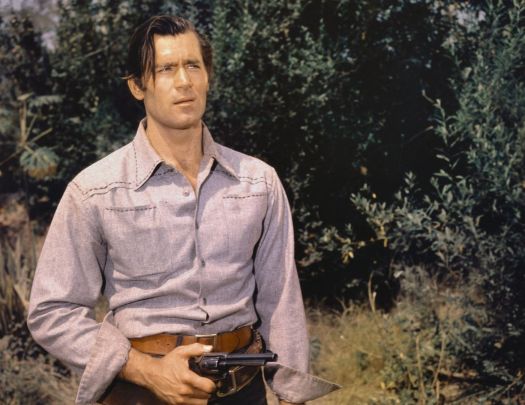
Remembering Cheyenne: RIP Clint Walker


gary loggins's avatarcracked rear viewer

At six-foot-six, Clint Walker certainly rode tall in the saddle. The actor, who died yesterday at age 90, was television’s first cowboy hero developed for the medium, and his popularity opened the floodgates for a slew of TV Westerns to follow. Walker also fared well on the big screen, and while not in the same stratosphere of John Wayne or Clint Eastwood, his movie career deserves a second look.

As Cheyenne Bodie (1955-63)

Born in Illinois in 1927, the seventeen year old Norman Walker joined the Merchant Marines for a spell, then worked a series of blue-collar jobs before being discovered by talent agent Henry Willson, who got him a small part in the 1954 Bowery Boys comedy JUNGLE GENTS, playing an ersatz Tarzan. Bit parts followed, until his burly presence and rugged good looks landed him the lead in a new TV series called CHEYENNE. Cheyenne Bodie was television’s…

View original post 760 more words

Music Video of the Day: Your Name by Kedr Livanskiy (2017, dir by Kedrina Yana and Konstantin Bushmanov)


Much like yesterday’s video, this is another video on which me and Evelyn disagree.  She thinks that it’s about being young and free in Russia.  I think it’s about vampires.

Enjoy!

Here’s The Trailer For Papillon!


Here’s the trailer for the upcoming film, Papillon!  As the trailer itself states, this is based on the amazing true story of Henri Charrière and his escape from the Devil’s Island penal colony.

Of course, this isn’t the first film to be made about Charrière, his escape, and his friendship with Louis Dega.  1973’s Papillon starred Steve McQueen as Charrière and Dustin Hoffman as Dega.  I haven’t seen this particular film but many consider it to be a classic.

In this remake, Charrière is played by Charlie Hunnam while Rami Malek takes over the role of Dega.  Will it be good or will it be forgettable?  The trailer, to be honest, is a bit generic.  We’ll find out for sure when the film is released on August 24th!


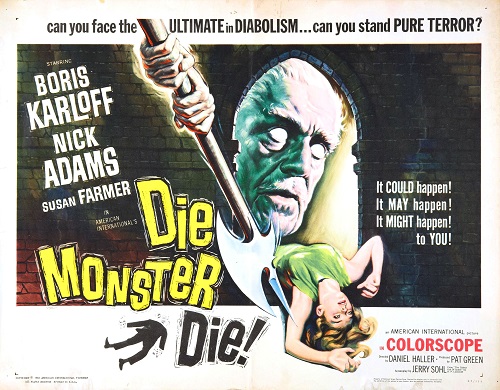
A Quickie with The King: Boris Karloff in DIE, MONSTER, DIE! (AIP 1965)


gary loggins's avatarcracked rear viewer

All you Cracked Rear Viewers know by now my affection for the King of Monsters, Boris Karloff . His Universal classics of the 30’s and RKO chillers of the 40’s hold an esteemed place in my personal Horror Valhalla. Karloff did his share of clunkers, too, especially later in his career. DIE, MONSTER, DIE! is one such film, it’s good intentions sunk by bad execution.

It’s the second screen adaptation of a story from the fertile mind of author  H.P. Lovecraft; the first, 1963’s THE HAUNTED PALACE, was a mash-up of Lovecraft and Edgar Allan Poe as part of the Roger Corman/Vincent Price series. Corman’s longtime Art Director Daniel Haller made his directorial debut, and the film certainly looks good. Veteran sci-fi writer Jerry Sohl contributed the screenplay, which was then tinkered with by Haller. Therein lies the problem; Haller’s changes drag down what could have been an exciting little…

View original post 383 more words

Music Video Of The Day: There Was A Time by Kedr Livanskiy (2018, dir by ?????)


My friend Evelyn and I have been debating whether or not this video is supposed to be about vampires or not.  Her argument is that it’s obviously meant to be about being young and celebrating life.  My argument is that the video reminds me a lot of Jean Rollin’s Two Orphan Vampires so obviously, the video must be about vampires as well.

Maybe we’re both right!

Who knows?

Anyway, enjoy!