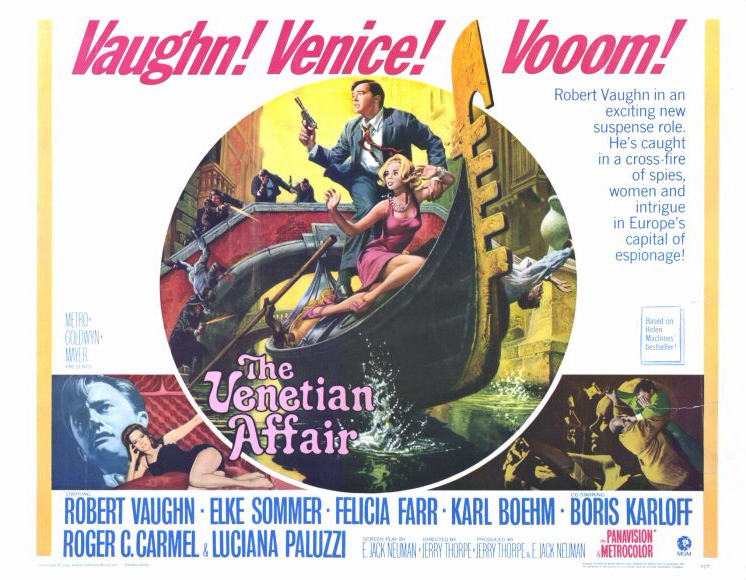
Robert Vaughn played superspy Napoleon Solo on TV’s THE MAN FROM U.N.C.L.E. from 1964 to 1968. The series was inspired by the James Bond craze, filled with outlandish gadgets and evil supervillains. Vaughn’s popularity led to a starring role in THE VENETIAN AFFAIR, a Cold War spy thriller with a much more adult theme. Here, he plays Bill Fenner, ex-CIA agent, now a hard-drinking reporter who gets caught up in international intrigue.
Fenner is sent to Venice after a U.S. diplomat supposedly sets off a bomb at an international nuclear disarmament conference. He soon learns the assignment was arranged by his former CIA boss, “Rosey” Rosenfeld (Edward Asner). Rosey wants to use Fenner to smoke out old flame Sandra Fane (Elke Sommer), a Communist agent with a mysterious link to the bombing. Fenner’s odyssey takes him through double-and-triple crosses in the world of international espionage he once left behind.
I had high hopes for Pride and Prejudice and Zombies, the just-released film which, like the novel upon which it is based, attempts to combine Jane Austen and The Walking Dead. The source material was good. The cast — with Lilly James as Elizabeth Bennet, Jack Huston as Wickham, and Matt Smith as Parson Collins — was impressive. The trailers looked great, promising a combination of zombies, ornate costumes, and a very British sense of humor. Sadly, however, the ultimate film is a bit of disappointment.
Actually, it’s more than just a bit of a disappointment. It is a HUGE disappointment. To have so much promise and then to turn out so bland — well, it’s enough to make you wonder if maybe zombies have become so common place in popular culture that they’re no longer as interesting as they once were. Don’t get me wrong, as a symbol of the impossibility of escaping death, zombies are great nightmare fuel. But, when you see them in a relatively bloodless PG-13 film like this, you realize that it takes more than just a few random zombies to make an effective horror film.
Plotwise, Pride and Prejudice and Zombies is exactly what it says it is. It tells the same basic story as Pride and Prejudice, with the exception being that England is now under siege from zombies, the Bennet sisters have now been trained in how to kill zombies, Mr. Darcy (played by Sam Riley) is now Col. Darcy and he’s an expert at tracking down zombies and killing them, and Wickham is now more than just a cad, he’s a cad who wants to help the undead overthrow the living. As I typed all that out, I realized I was probably making the film sound a lot more fun than it actually is. And really, the movie should be fun but it’s not.
Director Burr Steers never manages to capture the proper tone for telling this story. The satire is never as sharp as it needs to be. The scenes that are meant to pay homage to Austen try a bit too hard to capture Austen’s style without contributing any of her insight and the romance between Elizabeth and Darcy is sabotaged by the fact that Sam Riley and Lilly James had absolutely no chemistry together. The scenes with the zombies are bland, largely because this is a PG-13 rated film and bloodless zombies aren’t particularly scary. A typical episode of The Walking Dead is more graphic than anything you’ll see in Pride and Prejudice and Zombies.
Which is not to say that there aren’t a few moments when Pride and Prejudice and Zombies kind of works. It has moments but they’re isolated and they never really come together to build any sort of narrative momentum for the film as a whole. Sam Riley is a bit of a dud as Darcy but Lilly James, Jack Huston, and especially Matt Smith all give good performance. (Smith, in particular, is so good as Collins that I would like to see him play the role in an actual adaptation of Pride and Prejudice.) Early on in the film, there’s a fun scene where the Bennet sisters destroy a horde of zombies and it actually strikes the right balance between comedy and horror. Before that, we get the traditional scene that we get in all Austen adaptations, of the Bennet sisters preparing for a ball and, in between lacing up corsets and discussing whether they will all be able find husbands, they also carefully conceal the daggers and knives that they will be carrying just in case they happen to run into any of the undead. It’s one of the few scenes that suggests what Pride and Prejudice and Zombies could have been if it had only found a consistent tone.
For that matter, I also liked the animated opening credits, which wittily explained how the zombies first appeared in England and, not surprisingly, suggested that it was all the fault of the French. And the film also had a fairly effective scene that shows up in the middle of the end credits and suggested what would might happen if Pride and Prejudice and Zombies 2 is ever put into production.
But ultimately, even those moments that worked only left me frustrated that the rest of the film did not. For all of its potential, Pride and Prejudice and Zombies disappoints.
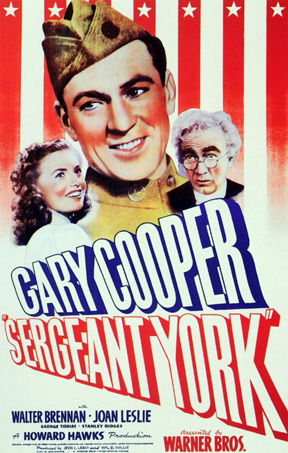
The 1941 film Sergeant York was the American Sniper of its day. A biopic of Alvin York, one of the most decorated American soldiers of World War I, Sergeant York was not only a huge box office hit but it was a film that celebrated American patriotism in the type of unabashed fashion that you would never see in a film made today. Though Sergeant York went into production at a time when the United States was officially pursuing a policy of international neutrality, it was released shortly before the Japanese attacked Pearl Harbor and, whether intentionally or not, Sergeant York served as a strong recruiting tool. According to Wikipedia (and we all know that Wikipedia is never wrong), there were reports of young men going straight from the movie to the nearest military recruitment office.
Clocking in at nearly two and a half hours (and running at least 40 minutes too long), Sergeant York is two films in one. The second half of the film deals with the military career of Alvin York (Gary Cooper), a plain-spoken and honest Tennessee farmer who, because of his strong religious beliefs, unsuccessfully attempts to register as a conscientious objector. Forced into the Army, York is, at first, dismissed as a simple-minded hillbilly. (His fellow soldiers are amused to discover that York doesn’t know what a subway is.) However, to the shock of his commanding officers, he proves himself to be an expert marksman. As he explains it, being from the country means that he’s been shooting a rifle his entire life.
On the basis of his skills as a marksman, York is given a promotion but he still says that he refuses to kill. It’s not until his superior officer reminds him of the sacrifices that past Americans have made that York starts to reconsider his position. Then, a gust of wind opens York’s bible to a verse about giving unto Caesar what is Caesar’s and York realizes that he can go to war and, if need be, he can kill.
And it’s a good thing that he can! Because World War I is heating up and York may be the only guy around with the strength and confidence to single-handedly defeat and capture over 170 German soldiers.
The army section of Sergeant York is predictable but well-done. As you’d expect from a film directed by Howard Hawks, a lot of emphasis is put on how the soldiers work together. York is portrayed not as being super human but instead as just an honest man who is exceptionally good at his job. There’s nothing surprising about the second half of Sergeant York but Hawks keeps the action moving and Cooper gives a good performance.
To be honest, I preferred the first half of the film, which examined York’s life before he joined the Army. When we first meet Alvin York, he drinks too much, he fights too much, and he’s totally irresponsible. It’s not until he falls in love with Gracie Williams (Joan Leslie) that York starts to change his ways. The scenes of York in the backwoods of Tennessee had a lively feel to them and it was enjoyable to see Cooper play a somewhat disreputable character. Cooper seemed to be having fun playing a ne’er-do-well and, in the scenes before York finds God, his bad behavior was a lot of fun to watch.
Considering its success at the box office, it’s not surprising that Sergeant York was nominated for best picture of the year. While Gary Cooper won the Oscar for best actor, the award for Best Picture went to How Green Was My Valley.
2014’s The Purge: Anarchy was a wonderfully subversive political satire disguised as an action film. Not only was Anarchy a huge improvement over the original Purge, it also introduced many filmgoers to Frank Grillo, one of the greatest tough guy actors since Robert Mitchum.
After the success of Anarchy, there was little doubt that there would be a third Purge film. There was also little doubt that Frank Grillo would return.
And that time has finally arrived. Earlier today, the first trailer for The Purge: Election Year was released. And here it is!
The Purge: Election Year will be released on the 4th of July.
Comic fans, you know the feeling — once in awhile you’re lucky enough go into your local shop on a Wednesday, spy a new title on the racks, and say to yourself “oh, hell yes.” Today I got to do that. And I got to say the same exact thing after I’d read the book. So I’m feeling pretty goddamn happy right about now.
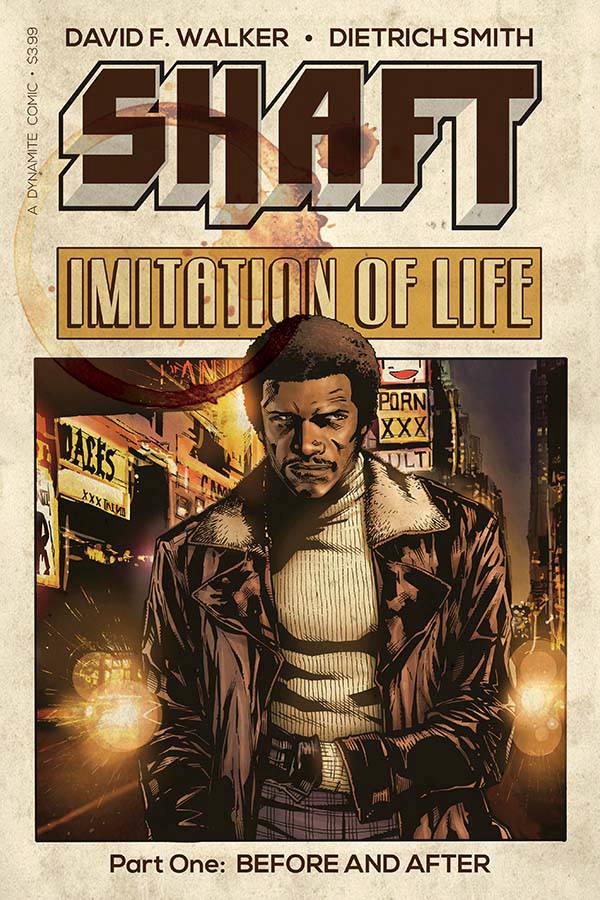
The four-color “floppy” in question is issue number one of Shaft : Imitation Of Life, the debut installment of Dynamite Comics’ long-awaited four-part sequel to last year’s superb mini-series starring the black private dick who’s a sex machine to all the chicks by writer David F. Walker and artist Bilquis Evely, and while Evely’s off doing DC Comics Bombshells and other projects these days, Walker is back for round two and that’s the key thing because this guy gets the character of John Shaft every bit…
Last night, I watched The Smiling Lieutenant, a musical comedy from 1931. I recorded it off of TCM as a part of the 31 Days of Oscar and I have to admit that I really was not expecting much. While I love old movies and I have a special place in my heart for pre-code movies and their obsession with lingerie and suggestive winks, I was concerned that The Smiling Lieutenant was a musical that was made at a time when the Hollywood studios were still figuring out how to use sound to tell a story. I worried that the film would be one of those extremely creaky and overly theatrical movies that you always run the risk of coming across whenever you explore the cinema of the early 30s.
But you know what? I was pleasantly surprised. The Smiling Lieutenant is an undeniably old-fashioned film and yes, there were a few scenes that felt a bit too stagey. Compared to what modern audiences are used to, some of the acting does seem stilted. This is a film that will demand a bit of adjustment on the part of the viewer. But, with all that in mind, The Smiling Lieutenant is still an enjoyable little movie.
The story is charmingly simple. In Vienna, Lt. Nikki von Preyn (Maurice Chevalier) is in love with Franzi (Claudette Colbert), the worldly and free-spirited orchestra leader. However, Nikki makes the mistake of winking at Franzi while in the presence of Princess Anna (Miriam Hopkins). When Anna takes offense, Nikki says that he was only winking because Anna is so beautiful. Anna immediately falls in love with Nikki and demands to marry him. She explains that if Nikki doesn’t marry her, she’ll marry an American suitor which would totally scandalize Vienna.
Doing his patriotic duty, Nikki marries Anna. However, Nikki still longs for the more experienced Franzi and spends his time pining for her. Realizing that her husband is in love with another woman, Anna confronts Franzi and this is exactly where, if this was a modern film, there would be either be a huge cat fight or Anna and Franzi would team up to destroy Nikki. However, since this is a 1931 pre-code film, Franzi realizes that Anna loves Nikki. As a result, Franzi decides to help her boyfriend’s wife win back his interest.
And how does Franzi do this? By giving Anna a makeover! As Franzi explains in song, it’s time for Anna to “jazz up (her) lingerie!”
The Smiling Lieutenant is an entertaining movie. I suppose that many would probably consider it to be the epitome of “fluff” but so what? I imagine that for audiences in 1931, a film like The Smiling Lieutenant provided a nice escape from the Great Depression and isn’t escape one of the best things that a good film can provide? Colbert, Hopkins, and Chevalier all give likable performances and, even 85 years after it was first released, it’s a fun little movie.
The Smiling Lieutenant was a huge box office hit and it was nominated for best picture of the year. However, it lost to Grand Hotel.
Believe it or not, I have a song of the day blog. It’s imaginatively entitled Lisa Marie’s Song of The Day and, ever since last summer, I have used to share, on a daily basis, my appreciation of EDM and Britney Spears. Yesterday, I shared something from The Chemical Brothers and, later today, I’ll be sharing a song from Fitz and The Tantrums.
But you know what? I’m in a musical mood today. Perhaps it’s because it’s Ash Wednesday and I’ve promised to give up excessive negativity for Lent. For that reason, I’ve decided to share two songs of the day, one on Lisa Marie’s Song of the Day and one here at the Shattered Lens.
And the song that I’m sharing here is the Sarabande from Handel’s Keyboard suite in D minor (HWV 437). Why am I sharing it? Well, I caught the end credits of Barry Lyndon last night on TCM and I was reminded of how much I love this piece of music. Thank you, TCM!
I did make it out of South Korea for three films in Japan, but then was thrown back there. I feel like this is turning into MASH on me.
High Kick Angels (2014, dir. Kazuhiro Yokoyama) – Hmmm…can’t say I have. I unfortunately can say an elementary school girl tried to grab my genitals when I was in the 4th grade, but I don’t think that counts. Well, with a poster like that you might be thinking Sailor Moon.
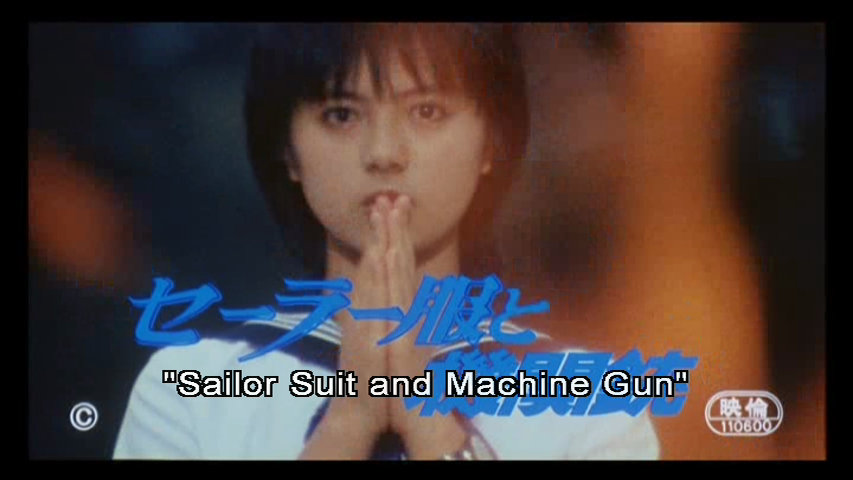
Maybe Sailor Suit and Machine Gun (1981)?
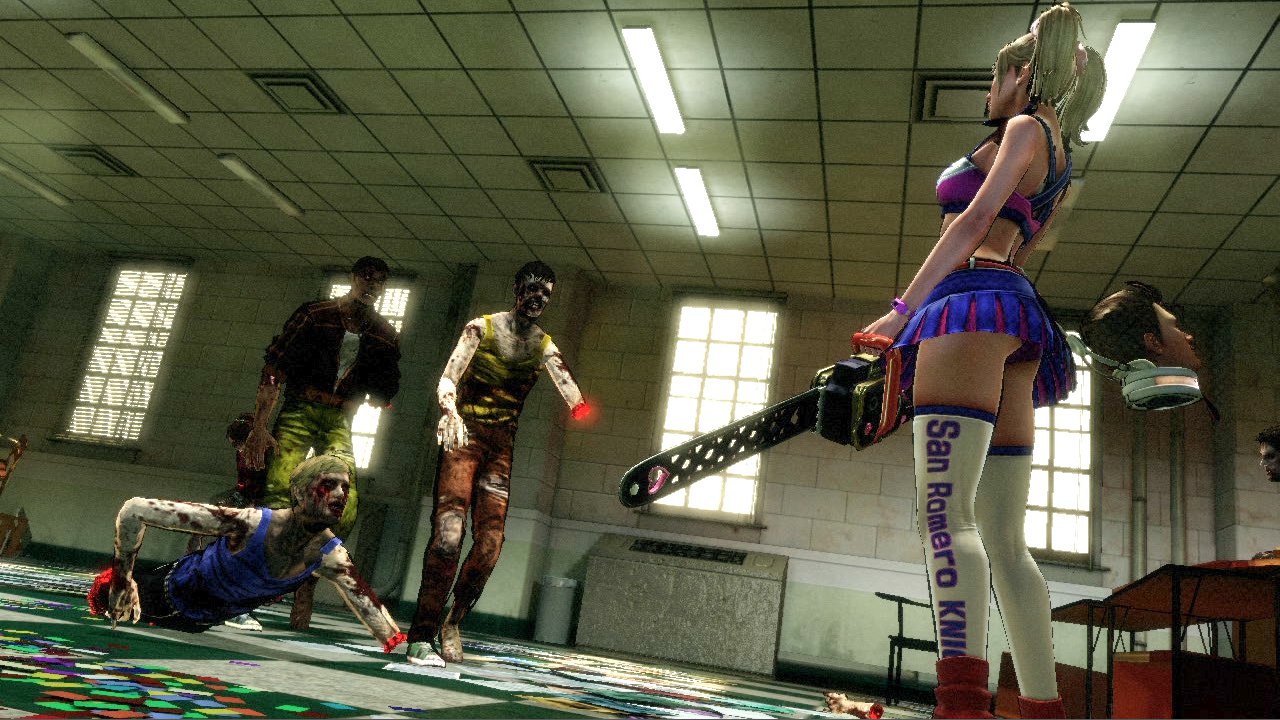
Perhaps even Lollipop Chainsaw?
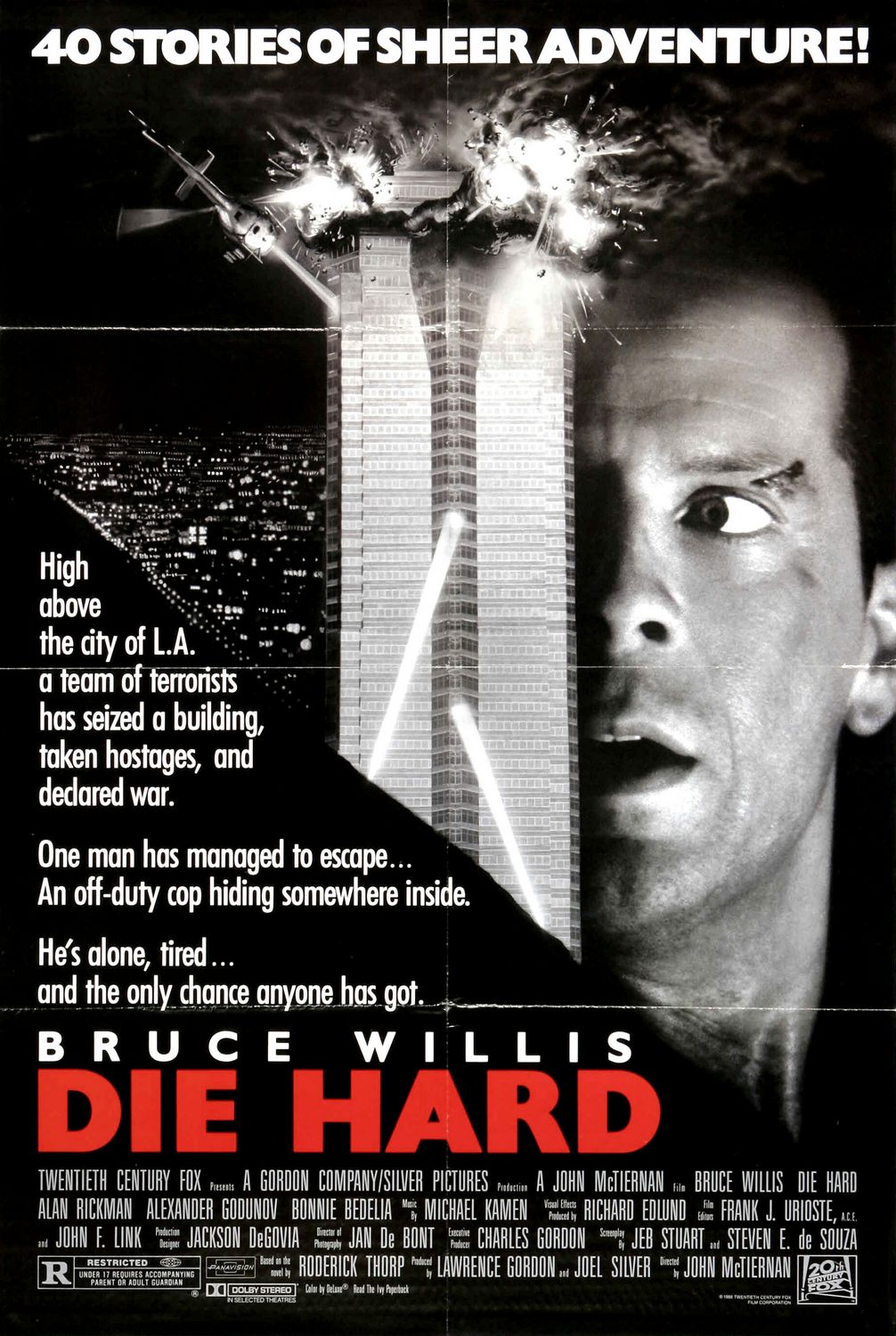
Nope, it’s Die Hard (1988).
Seriously, it’s Die Hard with schoolgirls in a school rather than a tower. It even recreates two scenes very obviously just to make sure you know this. And we have trailer this time!
If you are thinking you probably just saw all the fighting scenes in the movie, then you’re pretty much right. There are a few more, but not many.
The movie starts with some girls filming a zombie movie at a school when I guess no one is there. I really wasn’t sure if this school was abandoned or if everyone else was just on vacation. It doesn’t matter. All you need to know is that a girl they admire who knows martial arts shows up for some reason and bad guys show up looking for treasure or something.
The two scenes explicitly recreated are the safe lock bit and the body with writing on it dropped down to the bad guys. The body part is self-explanatory. The lock bit is done by having a little tower that requires several USB sticks which will allow the bad guys to see where this treasure is in the school. Of course the schoolgirls get one of the USB sticks and need to be tracked down. Basically it comes down to the big girl who knows martial arts working with these girls out of a safe room a la Die Hard. Really, what you see in the trailer is what you get besides conversations among the girls about not being very confident, but finding the strength to go kick some ass.
The only scene that really stuck with me is when the big martial arts girl convinces the girl who does ballet dancing that she can curl her toes and use them like a spear. I expect to read about Lisa doing this to someone who liked The Leisure Class any day now.
I really can’t recommend this one. It’s a bit of a letdown.
The Pinkie (2014, dir. Lisa Takeba) – Ever wanted to see a comedy by someone who wants to make a David Cronenberg movie from before his tragic accident when he lost the ability to make good movies while high on whatever Nobuhiko Ôbayashi was on when he made House (1977)? Too bad! Cause director Lisa Takeba essentially did just that with this weird slightly dark and bizarre romantic comedy with echoes of Cronenberg’s Dead Ringers (1988).
The movie is about guy who gets his pinkie cut off. It had something to do with the Yakuza. I learned back in the 90’s thanks to the TV Show The Pretender that they take your finger as punishment. What didn’t happen in The Pretender though is for that finger to wind up in the hands of a crazy stalker girl who then uses it to make a clone of a guy she is obsessed with. Having two of these guys going around made me think of Dead Ringers at the time, but in retrospect it also makes me think of Hirokazu Koreeda’s Air Doll (2009). That’s the one with Doona Bae from Cloud Atlas (2012) playing a blow up sex doll come to life.
Air Doll (2009, dir. Hirokazu Koreeda)
The movie is as wacky as that trailer makes you think, but it also definitely has it’s more Cronenberg-ey dark moments. In particular, the clone finding out it’s a clone and the issues that raises. The real guy is there too and actually uses the clone as sort of slave labor. He even has him prostitute himself as, I hate to use the expression since I’m trans but, a chick with a dick.
Oh, and did you notice the lightning near the end of the trailer around the guy? Yeah, that’s cause the clone shows up like The Terminator in a ball with lightning around him.
The problems with the clone basically start when she makes the clone aware it’s a clone and of course when the real guy shows up. From then on the movie just gets more wacky.
I kind of recommend it. It’s not that great, but I like really bizarre things and Japan is great at them. Plus, the movie is only about an hour long. It’s not going to take up much of your time. Unlike the next movie and the one after that!
The Ravine of Goodbye (2013, dir. Tatsushi Ohmori) – I’m sure I’ve mentioned it before, but I will again, and probably again and again. I used to watch a lot of the established film canon. Basically that’s all I watched from about 2005 to 2012. I mean it’s not normal for someone to just know right off the top their head that Italian director Michelangelo Antonioni was commissioned by 1970’s China to make a documentary about the country, they hated it with a vengeance, and so they basically got Dutch director Joris Ivens to make another one for them. That’s really not a good thing. However, I bring it up cause is this is that kind of movie.
Let me be straightforward cause the movie sure as hell isn’t. The film is about two cops looking into how exactly this couple got together. Turns out he raped her, and neither of them really got over it, so they got together as a couple. There’s also something about a dead kid as well. Honestly, despite what IMDb says, that’s not really important. In my opinion, what the film does is try to reflect the confusion created by trying to follow a story as the facts slowly trickle out in the way its story unravels. The jumping to conclusions before all the information has come in thing. It does this by basically backing it’s way into what I told you in a couple of sentences. However, for me, it felt like the narrative structure was reflecting the experience of being a small child forced to watch Godfrey Reggio’s Koyaanisqatsi (1982), and then explain it. In other words, watching this was for me like how the children look in Godfrey Reggio’s anti-TV BS propaganda film Evidence (1995).
Actually, in that the kids were supposed to be watching Dumbo (1941). Yeah, right!
If you enjoy films like those of Michelangelo Antonioni, then you might enjoy this. The same probably goes for the next film as well. Amazon Prime doesn’t make these recommendations based on nothing. Just expect a lot of still shots on things that made me think of why I don’t enjoy a majority of Hsiao-Hsien Hou’s films.
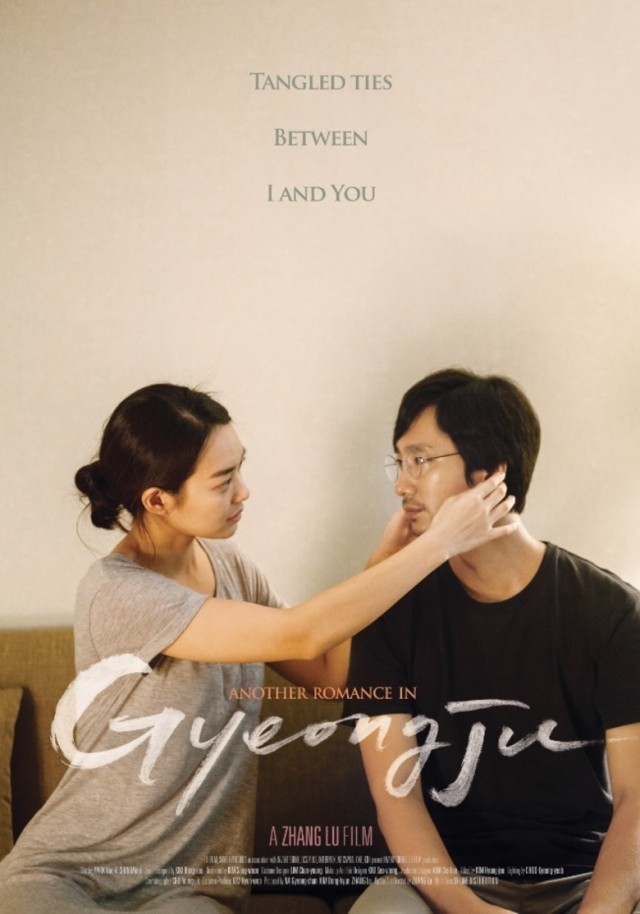
Gyeongju (2014, dir. Lu Zhang) –
Wow! That may be the most deceptive trailer I’ve ever seen! It appears to be real, but it’s like a fake trailer that takes Antonioni’s L’Avventura (1960) and makes it look like a romantic comedy. That movie had someone mysteriously disappear. Then a man and a woman wander around drifting towards each other as the architecture/environment around them changes to reflect the state of their characters. It’s the first in his trilogy of alienation. Sound like a romantic comedy?
This movie is about a Korean professor on Asian relations living in China who goes back home for a funeral and basically wanders around with a woman from a tea shop. Sound like a romantic comedy? It isn’t!
That really is the movie. I have a feeling that just like Tarkovsky’s The Mirror (1975) is only fully understood by Russians, this movie is only fully understood by Koreans. I believe the movie is a long mediation on what it’s like for a Korean born person to return home to a place divided in two and in other ways pushes itself away from other parts of Asia as well. The movie reminds you of the conflict with Japan via a Japanese woman who wants to forgive the professor and the tea shop owner for the crimes committed against their country by Japan. Another time a man will ask the professor how long he thinks North Korea will stay in business and flips out when the professor says a century. North Korea potentially attacking is brought up too, but I’m not sure if it’s serious or not. It almost comes across as a joke. Of course technically to the best of my knowledge, South Korea is the only country I’m aware of that is in a constant state of war because I believe they never signed the treaty ending the Korean War. Perhaps that’s why this film seems to evoke Antonioni’s trilogy of alienation with it’s cinematography.
It likes to use still shots of the environment and a lot of pans. There’s at least one 360 degree pan in it. It also breaks the 180 degree rule. It just stops and freezes on a pole in the tea shop for no discernible reason. I think there’s a scene that’s out of order. Also, near the end it appears to flash black for a less than a second. I’m really not sure what to make of that last one.
I would say this film is for cinematic explorers. I won’t say it’s bad, nor recommend it. You know who you are if this is your kind of thing. I’m just telling you as somebody who’s seen quite a few of these sort of movies that you probably won’t be disappointed.













 Through the Shattered Lens