Netflix Noir #3: Crime of Passion (dir by Gerd Oswald)


CrimepassionPosterThe third Netflix Noir that I watched was 1957’s Crime of Passion.

In Crime of Passion, Barbara Stanwyck plays Kathy Ferguson, a San Francisco-based advice columnist.  She is approached by two homicide detectives who request her help tracking down a fugitive who they think might read her column.  Charlie (Royal Dano) is aggressive and outspoken.  When he first meets Kathy, he tells her, “You’re work should be raising a family and having dinner ready when your husband comes home from work.”  His far more passive partner is Detective Bill Doyle (Sterling Hayden).

Kathy writes a column that convinces the fugitive to turn herself in.  (The power of Kathy’s column is shown in an amusing montage where woman after woman is seen reading the column aloud.  Significantly, no men are seen to ever read anything that Kathy has written.)  The resulting fame leads to Kathy getting a job offer in New York.

However, before Kathy can leave, she gets a phone call from Bill.  He asks her out on a date and, one scene later, they’re getting married in the shabby office of a justice of the peace.  Kathy sacrifices her career to be a suburban housewife.

From the minute that Kathy first looks at the small and anonymous house and the boring neighborhood that she’ll be sharing with Bill, it’s obvious that things are not going to work out well.  Even though Kathy even tells Bill, “I hope all your socks have holes in them and I can sit for hours darning them,” the life of domestic servitude is not for her.

Every day, she stays home while Bill goes to work.  At night, she reluctantly plays hostess to the constant gatherings of Bill’s colleagues and their wives.  The women stay in one room while the man gather in another.  Kathy is quickly bored with the inane chattering of the other wives but whenever she tries to go into the other room, she finds herself treated like an unwanted intruder.

And worst of all is the fact that Bill has absolutely no ambition of his own.  He’s got his house.  He’s got his wife.  He’s got his friends.  And he doesn’t feel that he needs anything else.

Kathy takes it into her own hands to advance Bill’s career, first by having an affair with Bill’s boss (Raymond Burr) and finally by trying to find a spectacular crime that Bill can solve.  And, as the suburbs continue to drive her mad, Kathy is not above creating a few crimes on her own…

In many ways, Crime of Passion reminds of another 50s film, Nicholas Ray’s Bigger Than Life.  Both films use the conventions of melodrama to present a surprisingly subversive look at the horrors of suburban conformity.  Unfortunately, Crime of Passion never quite reaches the heights of Bigger Than Life, largely because Sterling Hayden gives such a dull performance as Bill that you never believe that Kathy would have married him in the first place.  (The film would have been far more impressive if Bill had started out as an apparently dynamic character whose dullness was then revealed after Kathy married him.)  However, Barbara Stanwyck is well-cast as Kathy and Raymond Burr plays up his character’s ambiguous morality.  If nothing else, Crime of Passion is one of those film to show anyone who is convinced that nothing subversive was produced in the 1950s.
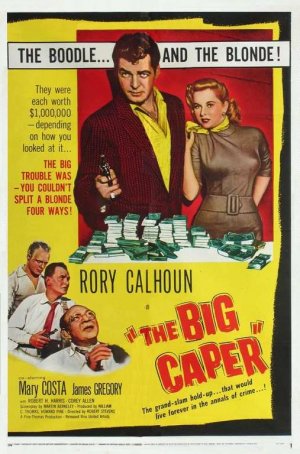
Netflix Noir #2: The Big Caper (dir by Robert Stevens)


The Big Caper Poster

For our next Netflix Noir, we take a look at a heist film from 1957, The Big Caper.

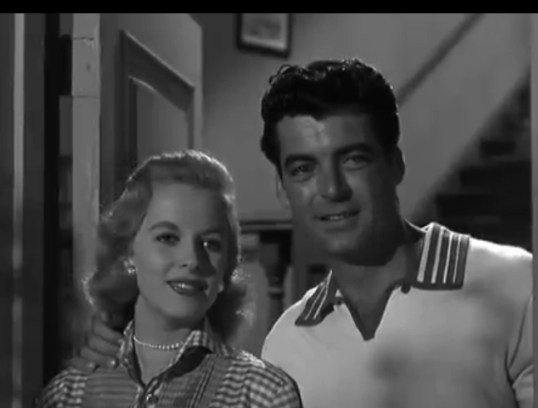
Frank (Rory Calhoun) is a small time criminal with a plan.  He knows that there’s a Marine base near the small town of San Felipe, California and he also knows that, during the weekend before payday, the San Felipe bank will be holding a million dollar payroll for those Marines.  He proposes  to Flood (James Gregory), a wealthy crime boss whom Frank idolizes, that they should find a way rob that bank over the weekend.  Flood agrees to the plan.

While Flood recruits some help for the robbery, Frank and Flood’s girlfriend, Kay (Mary Costa), move into the town and set themselves up as a part of the community.  Using Flood’s money, Frank buys a gas station and he and Kay move into a nice suburban house.  At first, Frank resents being forced to live like a “square.”  He bitterly complains that the local San Felipe newspaper doesn’t even tell him “how the horses did.”

But then something odd happens.  Frank starts to enjoy being a member of the community.  Soon, the gas station is making a profit and Frank is even thinking about buying a second one.  Oddly enough, his becomes best friends with the local cop.

As for Kay, she transitions to respectability even before Frank does.  As she eventually confesses to Frank, she’s tired of being treated like Flood’s property.  She wants to stay in San Felipe and make a life for herself.  Wearily, Frank tells her that she better hope that Flood doesn’t find out…

Meanwhile, Flood has recruited together his gang and they’re not exactly the most impressive bunch of criminal masterminds.  There’s Roy (Corey Allen), a physical fitness fanatic who is almost childlike in his devotion to Flood.  There’s Harry (Paul Picerni), who demands that his girlfriend Doll (Roxanne Arlen) be a part of the scheme.

And then there’s Zimmer (Robert H. Harris), a bald, sweating pyromaniac who spends most of his time begging for alcohol and lighting matches.  Zimmer arrives at Frank’s house unannounced and Frank is forced to pretend that Zimmer is his uncle.

Once Flood and the rest of the gang arrive, Frank starts to prepare for the robbery but he soon discovers that he’d rather be barbecuing with the neighbors.

The Big Caper is a clever little film, one that features excellent performances (especially from Gregory, Calhoun, Allen, and Harris) and tons of hard-boiled dialogue.  What makes this film especially memorable is the way that it contrasts the fake respectability of the wealthy Flood with the newfound, but genuine, respectability of Frank and Kay.

If The Big Caper was made today, it would probably be directed by the Coen Brothers and Ben Affleck and Ray Liotta would play Frank and Flood respectively.  However, the film works just as well with Rory Calhoun and James Gregory and is totally worth seeing.

The Big Caper

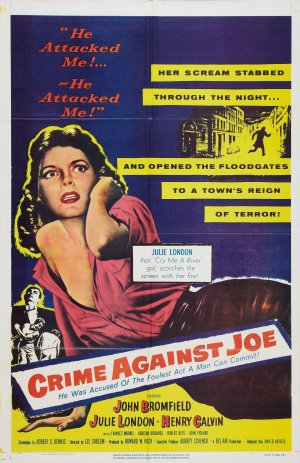
Netflix Noir #1: Crime Against Joe (dir by Lee Sholem)


Crime_Against_Joe_poster

After watching Inherent Vice last weekend, I decided to get on Netflix and do a search for film noirs.  This led to me watching four film noirs from the 50s, all of which were previously unknown to me.

For my first Netflix Noir, I watched a little something called Crime Against Joe.  It’s a 69 minute film from 1956.  It’s about a guy named Joe.  There’s been a crime.  Oddly enough, the crime really against Joe.  Instead, he’s been wrongly accused of committing a crime against a nightclub singer named Irene.  So, perhaps a better title for this film would have been It Sucks To Be Joe.

But anyway —

Crime Against Joe was directed by Lee Sholem.  According to Wikipedia, Lee Sholem had a 40 year career as a director.  During that time, he directed over 1,300 television episodes and feature films and he finished every single one of them either on time or early.  And you can certainly see evidence of that in Crime Against Joe, a film that starts out in a rush and pretty much never slows down until the final fade out.

Joe (John Bromfeld) was voted “most likely to succeed” in high school but — surprise!  surprise! — he’s failed to live up to the expectations set for him by the 1945 yearbook.  Instead, he enlisted in the army, served in the Korean War, and was diagnosed with “battle fatigue.”  (I assume that battle fatigue was the 1950s version of PTSD.)  He spent a while in a mental hospital and it was there that he first started painting.  When he was released, he moved in with his widowed mother (Frances Morris).  While she works to support him, Joe spends his time drinking and painting.

As the movie begins, a drunken Joe has just destroyed his latest painting.  (“I can see it in my head but it doesn’t come out on canvas!” Joe shouts, which is actually a pretty good way to describe the dark feeling that all artists occasionally get.)  He wanders around town, drunk.  He talks to a waitress named Slacks (Julie London), who is obviously in love with him.  He gets some sage advice from Red (Henry Calvin), a taxi driver.   He stumbles into a nightclub where he harasses a singer (Alika Louis) before finally getting thrown out of the club.  In the parking lot, as he stumbles away, a mysterious cowboy (Rhodes Reason) glares at him.

Joe stumbles about until, around two in the morning, he runs into a young woman wearing a nightgown.  He tries to talk to her but she only stares at him, her placid face frozen in a zombie-like state.  Joe leads her to a nearby house where the woman’s father thanks him for his help and then slams the door in his face.

Later that night, the nightclub singer is found dead on the side of the road.  Found near her body is a high school pin that belonged to someone from the class of 1945.  Knowing that Joe was drunk that night and had been seen in the nightclub, Detective Hollander (Robert Keys) goes to Joe’s house.  Hollander demands to see Joe’s high school pin.  Joe says he doesn’t know where it is.  Hollander stares at Joe’s paintings.  “You always paint half-naked women?” Hollander sneers before arresting Joe for murder.

At the station, Joe says that he was leading the woman back to her house at the same time that the singer was murdered.  The woman’s father shows up at the police station.  No, he says, Joe was nowhere near his house at two in the morning.  Joe is arrested for murder…

Fortunately, Slacks is willing to risk her life to prove that Joe is innocent.  And Joe knows that the murderer had to have been someone who he went to high school with…

Crime Against Joe is one of those low-budget, obscure B-movies that actually a lot more interesting than you might think.  John Bromfeld does a good job as Joe and the character’s PSTD gives the film a bit more depth than you might otherwise expect.  Julie London is great in the role of brave and selfless Slacks (though it’s interesting that this film felt the need to give a masculine nickname to a strong female character) and Rhodes Reason is genuinely menacing as the mysterious cowboy.  Crime Against Joe is also full of unexpected and occasionally surreal details.  The most obvious example would be the zombie-like woman who Joe runs into on the night of the murder.  However, my favorite little oddity is the fact that signs reading “Corey for Councilman” keep popping up in the strangest locations.

(It eventually turns out that Joe went to high school with Corey and the scene where Joe confronts his old classmate is a fun little piece of political satire.  That said, there was a part of me that hoped the significance of the sings would just remain an odd and unexplained little detail.)

There’s actually a surprisingly subversive streak running through Crime Against Joe.  We usually tend to think of the 50s as being a time when authority figures (like the police) were viewed with blind trust.  In Crime Against Joe, however, nobody in power is portrayed positively.  The police, for instance, come across like a bunch of close-minded bullies who are prepared to convict Joe based solely on his paintings and his less-than-sterling war record.  The scenes where Hollander interrogates Joe are full of menace.  In the end, this film is on the side of those living on the margins of respectable society.  When Joe and Slacks try to prove Joe’s innocence, they’re also attempting to prove their own right to exist in a society that has rejected both of them.

Crime Against Joe may not be a well-known film but there’s a lot more going on under its surface than you might originally think.  It’s on Netflix so check it out when you’ve got 70 minutes to spare.