(Lynda Day George’s primal screen courtesy of 1982’s Pieces, directed by J. Piquer Simon.)
Daily Archives: July 25, 2011
Review: NCAA Football 12
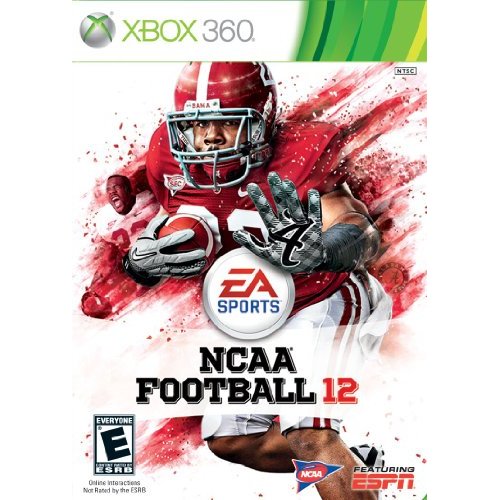
Yes, it’s that time of year everyone. Football season looms … at least, it does for the thousands of student athletes within the NCAA system. The NFL is still in limbo, even if it now appears inevitable (although either way, it won’t slow down the annual Madden release). Now, let me preface this review by saying that I don’t actually enjoy college football. I find the poor defensive play and imbalanced match-ups boring, and I hate the way that the BCS standings come together over the course of a season. The fact that the Big East has an automatic bid is a bad joke, etc. All of this is probably because I never attended a university where college football mattered. But absolutely none of that counts in the world of video games!
As a visceral experience, there’s a lot to be said for the college football style. Here, we still live in a world where running the football can be king, and a world in which the QB option (in a shocking variety of forms) can still be a primary offensive tool. Teams suffer every year from playing the service academies (who still run the triple option) because defending it is so different from the spread, or even the spread option, that most teams run. If you’re looking for a football experience where all of these systems are in play, then you should run — not walk — toward NCAA Football 12. Of course, most people are more NFL fans than NCAA fans, if the numbers are to be believed… but the one thing that the video game version will always have over Madden is that it isn’t quite so formulaic. We’re dealing with an eclectic mixture of offenses and defenses. If you care to start a dynasty (and the dynasty features are outstanding in the new version. In NCAA Football 12 we’re treated to the full coaching experience. More on that in a bit.) you have a ton of player turnover, which can make it difficult to have a consistent program. I suppose it’s probably easier if you’re a fan of Alabama or Florida. I’m not, so this title has a refreshing ‘battle uphill’ feel, especially in the Dynasty Mode.
The flagship promotion for this game has to do with the authentic recreations of the university celebrations, pre-game ceremonies, etc. It deserves to be the most outstanding feature. Granted, it has absolutely no effect on game-play, but one of the things that sets college football apart from the professional game is the sheer number of teams in play – each with their own unique celebrations, entries, and whatever else – who have their own tradition. If that kind of personalized experience doesn’t faze you, then you won’t find much of note has changed between iterations of this game. The graphics are still in the same generation, we have the same playbooks, the announcers have actually become less interesting (which may be a selling point, depending on your point of view – Lee Corso has made his departure), and there are no real innovations in game-play. The tackling feels slightly more authentic — that is, there’s less magnet tackling — and the AI that guides defensive players in zone defenses is dramatically improved over the 2011 version of this title. You can actually feel pretty confident when calling cover 3 defense… of course, this goes double for the AI player, who aggressively bats down passes (but mercifully doesn’t seem to randomly intercept any more). Still, the game emphasizes more than ever the value of lofting a pass high to avoid marauding defenders as opposed to just firing laser beam passes from point A to point B.
Outstanding features include the Dynasty mode. Returning are the online dynasty features, which were a huge improvement in last year’s title… but massively upgraded are the single player versions. You can now create your own coaching avatar who can hold the position of Offensive/Defensive Coordinator, or Head Coach, at a university of your choice – but who is held accountable for the team’s performance. The university has expectations, and you can experience first-hand being on the coaching hot seat and being fired from your job. Of course, if you’re good enough at the game, this is hardly a concern… but it does add a fascinating dynamic to the experience – a bad recruiting class could still doom you! If you are fired, you end up on the coaching carousel looking for a new job. It’s definitely a cool feature, even if you probably won’t run into it much.
The other game mode which received a significant overhaul is the Road to Glory mode. As always, you create a single player, and advance from a top-rated high school prospect through your collegiate career at whatever university. However, this time around, the experience is much more interactive. We’re treated with a game mode that allows us to fully develop a single player in a much more immersive way than in previous installments. Your created player will gain experience and skills — as always — but also adapt to (or be moved into) a specific role on the team. I imagine this is a much more authentic recreation of what going out for Div 1 sports is really like… but you tell me.
The game does take a significant step back in terms of calling audibles. I would say that the player is given more freedom than ever in terms of setting up audibles (with the addition of custom playbooks) but gone are the menus that actually tell you which button push calls what. Or, at least, they were absent for me. It seems like a senseless change, and one that left me feeling pretty bitter through my Dynasty play… when I had to frequently consult my audible chart in order to keep track of what I was calling, and when. If I could remember all of this playart, I’d probably be playing Div 1 football myself.
As always, this game will synergize with the Madden release in terms of draft classes, as the Madden schedule continues uninterrupted. Definitely worth a pick-up if you’re starved for some video game football, or if you consider yourself a college ball fan.
Review: Boris – Attention Please

I like to think of Attention Please as Boris’s main release for the year. If the other two are really good, this one’s something closer to brilliant. Typically when Boris release a “normal” album–something composed of distinct tracks, not a concept piece–there’s always a few tracks that fail to do much for me. Even Akuma No Uta and Smile had their down time. Attention Please does not. Every single track is wonderful. It’s also got the least in common of their 2011 works with anything they’ve released before, which, if you know Boris, is a sure sign that you’re in for something good.
Attention Please
The album is a melting pot of laid back songs like the opening track, dreamy shoegaze, and a sort of dirty pop sound that probably finds precedence in genres I’ve never explored. No matter which they’re tapping into at a given moment, they do it well. But it might be kind of pointless for me to just heap endless praise on this. If you’re already a fan of Boris then all you need to know is it’s really good. If you’re unfamiliar with them, then you’re hearing this all in a completely different state of mind than me. Let me give you a little background.
Boris – Track 3 off Vein, 2006
This is also Boris.
Party Boy
So you have to understand, half the fun of the album is hearing what they’re going to do next, and being astonished by how well they pull it off. Maybe this isn’t the best dance electro pop whateverthehell out there, I wouldn’t even know. It’s the fact that Boris is doing it that makes it so remarkable. At least to a point. I mean, a lot of these songs are still excellent by any standard.
Spoon
So enjoy it for its own sake, but also enjoy it because it is Boris. I think that’s all I have to say. Sorry if this isn’t really a “review” of the album. I’m too much of an infatuated fanboy to do much more than drool when I think about it. New Album has its ups and downs, and Heavy Rocks 2011 is somewhat inaccessible, but Attention Please is among their very best. Yeah, I said that about their 4-volume EP series and split with Torche in 2009. Yeah, I said that about Smile in 2008, and pretty much everything dating back to Flood, when I first heard them. But hell, why not. I hope I can keep saying it for years to come.
I’ll leave you with my favorite track off the album, which is kind of an unusual selection you might say, but calms me down in a way no band really has since Sigur Rós released ( ).
See You Next Week
Lisa Marie Considers A Better Life (dir. by Chris Weitz)
I recently had a chance to see A Better Life, the new film from director Chris Weitz that a lot of critics have already predicted will be a major contender for all sorts of awards at the end of the year.
A few critics have said that A Better Life is similar to the classic Italian neorealist film Bicycle Thieves. Look, let’s be honest. A Better Life is Bicycle Thieves except Rome has been replaced by Los Angeles and the Italian father-and-son are now an Illegal immigrant and his son (played by Demian Birchir and Jose Julian, both of whom give award-worthy performances). While Julian struggles to resist the temptation to get involved with gangs, Birchir struggles to pay the bills as a gardener. Eventually, Birchir manages to purchase a truck even though he knows that just by driving, he’s increasing the risk of being caught and deported back to Mexico. However, after only one day, the truck is stolen. Unable (because of their own status as illegal aliens) to turn to the police, Birchir and Julian embark on an increasingly dangerous quest through the shadows of Los Angeles, searching for their truck and everything that it represents (i.e., the better life of the title).
As a director, Chris Weitz takes a low-key, rather subdued approach to the material. While the cinematography emphasizes the idea of Los Angeles being both seductive and remote at the same time, Weitz focuses our attention on Birchir’s worn, world-weary face. Each line and wrinkle on that face tells us a different story of struggle and, ultimately, hope for a better life and a better future. Weitz slips up a little during the film’s final act. Some of the dialogue gets a bit too heavy-handed, despite the skill with which Bircher and Julian deliver it. It’s in these scenes that we suddenly start to see the hand of the filmmakers and suddenly, we’re no longer watching the story of a proud man sacrificing so his son can have a better life. Instead, we’re suddenly reminded that we’re watching a movie.
I have to admit that, as time has passed, I’ve become a bit less enthusiastic about A Better Life. It’s one of those films that carries a lot of power when you first see it but then, once you’ve had some time to think about it, it becomes obvious that you’re not so much reacting to what the film is as much as what you wish the film was. When I first saw A Better Life, much like a lot of critics, I thought I was seeing one of the best films of 2011. In retrospect, A Better Life is one of the better films (so far) of 2011 but hardly the best. What it is ultimately is a well-made film that struggles under the weight of its own good intentions.
Still, as I watched A Better Life, I couldn’t help but remember a crowd-pleasing scene from last year’s The Kids Are All Right. If you’ll remember, that’s the film where Julianne Moore is a professional landscaper who deals with the guilt of having an affair with Mark Ruffalo by yelling at, abusing, and eventually firing Luis, the Mexican who works for her. You may remember Moore snapping, “What are you looking at!?” and Luis replying with, “I am not looking at anything, that is just my face.” The line, of course, is delivered in a thick accent and the scene where Moore actually does fire him is largely played for laughs. We don’t see Luis again for the rest of the movie though Moore does get a throw-away line about how she wishes she hadn’t fired him (probably because she now has to do all dangerous physical labor herself).
Now. I have to admit that scene bothered me when I saw it and it has bothered me since. I doubt that the liberal audiences that flocked to see The Kids Are All Right would have found it as hilarious if Julianne Moore had unfairly fired an African-American character who spoke in exaggerated ebonics. It was as if the audience members were so exhausted from patting themselves on the back for watching a movie that pretended to be about lesbians that they were relieved to have an ethnic stereotype to laugh at.
To me, it’s because of scenes like that one that we will always need films like A Better Life.
 Through the Shattered Lens