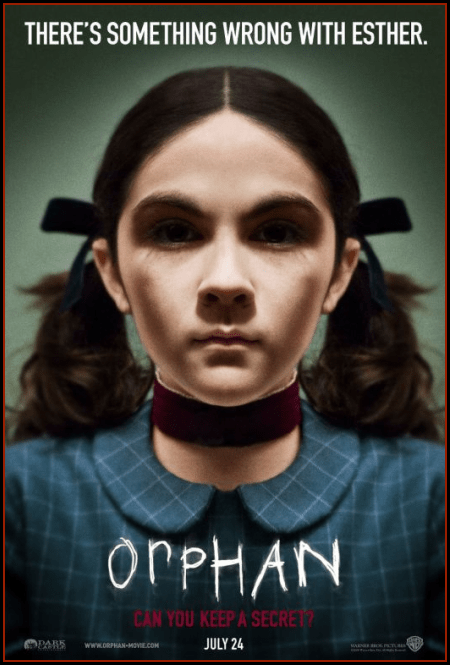
There has been a complaint which has been getting louder and louder for the past several years from both horror and mainstream film fans. The complaint is that horror films of late have either been remakes or another sequel. While this complaint is not exclusive to the horror genre (non-horror genres have had the same problem) it is more prevalent and happens more often. Once in awhile a film will come out that tries to be different and put out an original story. Spanish director Jaume Collet-Serra has done just that with his second foray into feature filmmaking with Orphan. While the film won’t win many awards and become the critical darling the way Let the Right One In did Collet-Serra’s Orphan does bring a fresh new take on the evil child subgenre. Despite some of the flaws and script problems the film does entertain throughout most of its running time until it loses steam in the final 15 minutes.
Jaume Collet-Serra first got his start directing the 2005 remake of House of Wax. A film more famous (infamous in some people’s eye) for being the first major film of socialite Paris Hilton. A film that deservedly got panned by critics, but still did well enough in the box-office to put horror fans on notice that Collet-Serra might be a filmmaker to keep an eye on. Orphan marks his second full-lenght feature and using the screenplay by David Leslie Johnson, Collet-Serra tries a hand in the evil child subgenre which has more than it’s share of classic titles like The Omen, The Bad Seed and The Good Son. While this subgenre of horror usually means some sort of demonic-possession or some sort of mental or genetic abnormality causing for their psychotic or sociopathic behavior, in Orphan an interesting reason was given to the nature of it’s titual character.
The film begins with a harrowing and quite disturbing scene of the Vera Farmiga’s character pregnant and in labor, but also starting to miscarriage her child. The graphic nature of the scene quickly lays down the hammer that Orphan will not hold things back just because childen will be involved throughout most of it’s running time. We then see Farmiga’s Kate and her husband John (played by Peter Sarsgaard) at the local orphanage as they attempt to fix their family and ease Kate’s emotional turmoil over the miscarriage by adopting a child. They meet Esther a 9-year-old Russian orphan girl who seem to be the perfect child at first glance. Esther’s well-spoken and well-mannered at such a young age. Esther soon becomes part of John and Kate’s young family which consists of a younger deaf daughter named Max and a son named Daniel. While Max accepts Esther as a new older sister Daniel senses something just off-putting about Esther and reacts much more coldly towards his new dopted sister.
The majority of Orphan‘s second and first half of the third and final reel shows Esther’s true nature peek through the facade of Old World genteel and proper behavior. 12-year-old Isabelle Fuhrmann does an excellent job portraying the sociopathic and manipulative Esther. It is difficult to believe that a child actor of her age able to tackle such a dark role and actually pull it off without making the character too over-the-top or campy. In fact, no matter how one thinks of the performances of the rest of the film’s cast (Farmiga does a good job in the Cassandra-role with Sarsgaard an average performance as the hapless and clueless husband) this film is totally Fuhrmann’s and she sticks the landing.
While the film tries to make something original (and most of it is to a point) out of a tried-and-true model of the evil child storyline the script doesn’t hold up through the length of the film. The story itself is quite interesting when one really steps back to look at it, but there’s several leaps in logic the Kate character makes which will illicit more than a few confused reactions (running away from incoming help and into the dark, unknown being a major one). The dialogue itself is serviceable with none of it wince-inducing. There’s just a sense that the film’s reveal in the end of the film as to Esther’s true nature was just handled in a very clumsy manner. The twist is very original but the execution of that reveal after the tense and very brutal 40-50 minutes before it comes off quite flat. Orphan definitely looked like a script which was in need of several more rewrites to reconcile the first 3/4’s of the film with the final part. Yet, despite the ridiculous manner in which the final 10-15 minutes unfolds Collet-Serra manages to keep the film from dragging along through two hours. It actually plays much faster for a film with such a long running time.
In the end, Orphan marks a decidedly better effort from Jaume Collet-Serra, but one which still shows that he has some polishing to do to join the ranks of better horror directors of his generation. The film is enjoyable enough if given a chance. Most horror fans will enjoy the film and some may even embrace it because of the silly ending. Mainstream audiences looking for a change of pace from the strum und drang of the summer blockbuster season could do no worse than Orphan. It is not a perfect film and not even an above-average one, but it is a good horror film that tried to add something new to the genre, but hampered by a storyline that cannot sustain the tension it built-up and the brutality it showcased. In the hands of a much more seasoned filmmaker with a better hashed out screenplay Orphan could’ve become an instant classic.

 Through the Shattered Lens
The film’s final “revelation” was actually my favorite part if just becuase it was so amazingly ludicrous as to be almost brilliant. It was definitely a great example of the pulp imagination at work. 🙂
They should have known there would be trouble as soon as they learned the “orphan” came from Russia. In the movies, at least, nothing good ever comes from Russia. I’m just happy the Russian Mafia didn’t pop up. They’ve become the new Deus Ex Machina of the movies.
LikeLike
It just took me out of it in that last 15 minutes. Everything before it was so tense and serious then the reveal happened and I was like….WTF?!
LikeLike
Pingback: Scenes I Love: Orphan – “Max’s Silent Bedtime Story” | Through the Shattered Lens