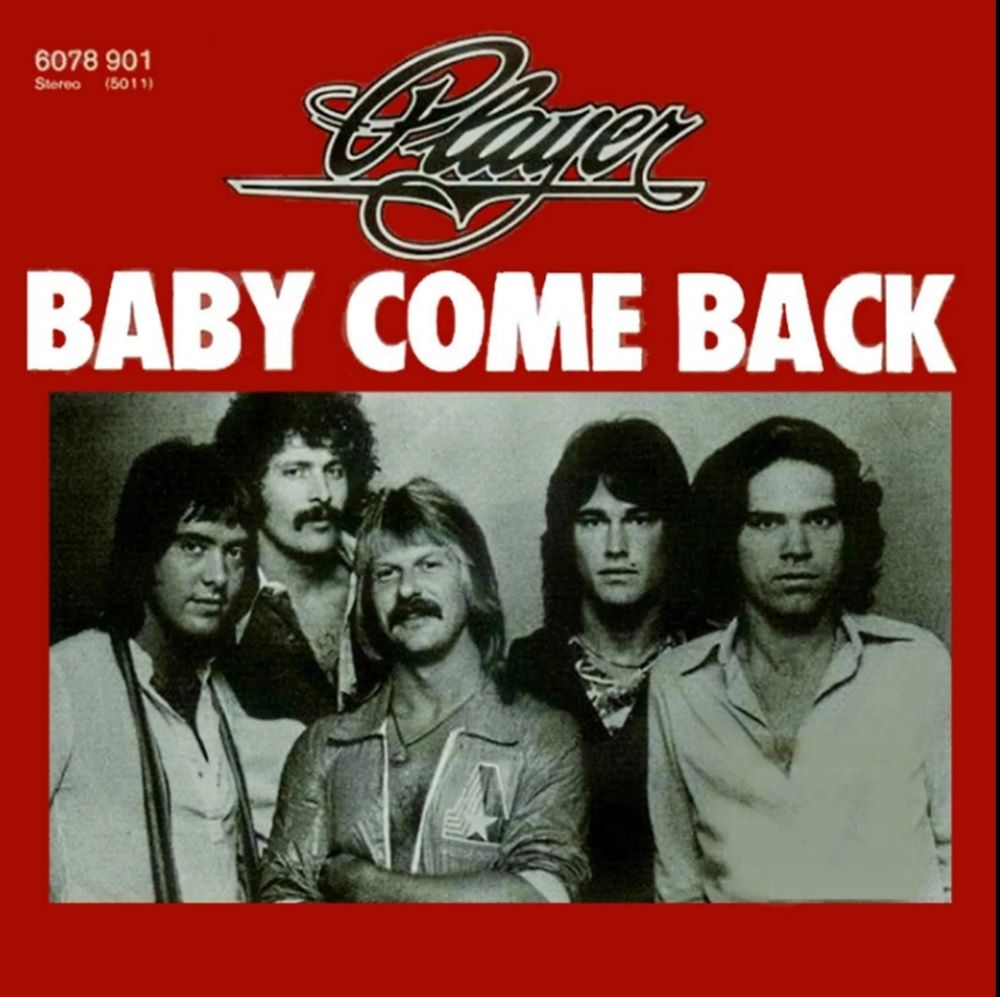
There’s something timeless about Player’s “Baby Come Back.” The moment that smooth, shimmering guitar riff kicks in, you’re instantly transported to an era of feathered hair, smoky bars, and love songs that meant exactly what they said. Released in 1977, it’s the sound of a guy trying to keep it together after heartbreak — and not quite succeeding. Honestly, any song that uses the phrase “mask of false bravado” earns its “timeless” badge automatically. That’s pure emotional poetry hiding inside a silky yacht‑rock groove.
What makes it work is how effortlessly cool it sounds while being totally sincere. The production is sun‑drenched, the harmonies glide, and the rhythm section keeps everything smooth without ever getting sleepy. You can hear the singer trying to play it off, pretending he’s fine — but those gentle falsettos betray him at every turn. It’s heartbreak with charm, regret you can actually dance to. The song doesn’t wallow; it sways.
Nearly five decades later, “Baby Come Back” still hits that sweet spot between sad and suave. It’s for those quiet, reflective nights when you’re too proud to text first — but not too proud to sing along. There’s a warm nostalgia baked into every note, and that lyrical honesty feels a little rarer each passing year. Turns out, love and vulnerability age beautifully when wrapped in a melody this smooth.
Baby Come Back
Spending all my nights, all my money going out on the town Doing anything just to get you off of my mind But when the morning comes, I’m right back where I started again And tryin’ to forget you is just a waste of time
Baby come back, any kind of fool could see There was something in everything about you Baby come back, you can blame it all on me I was wrong and I just can’t live without you
All day long, I’m wearing a mask of false bravado Trying to keep up a smile that hides a tear But as the sun goes down, I get that empty feeling again How I wish to God that you were here
Baby come back, oh baby, any kind of fool could see There was something in everything about you Baby come back, you can blame it all on me I was wrong and I just can’t live without you, oh
Now that I put it all together, oh, oh Give me the chance to make you see Have you used up all the love in your heart? Nothing left for me? Ain’t there nothing left for me?
Baby come back, oh darling, any kind of fool could see There was something in everything about you Baby come back, listen baby, you can blame it all on me I was wrong and I just can’t live without you I was wrong and I just can’t live
Seeing as Lisa requested I do Da Funk by Daft Punk, I thought it was appropriate to do a couple of other music videos leading up to it, including this infamous one.
Back in the 80s, there was a show on MTV called Basement Tapes. I can’t really find much information on it. As far as I can tell, they would air DIY music videos that were in a competition on the show. This music video was on it. Of course, decades later, YouTube got ahold of it, and now its truly the stuff of legends. This even spawned a failed pilot for a TV Show with Adam Sandler & Jeremy Piven called The Dog Police. Hopefully the video is still below.
It might seem crazy now, but remember that this was during the period when the cop-dog thing was at the height of its popularity courtesy of movies like Turner & Hooch (1989) and K-9 (1989). Other famous failed cop-dog TV Shows are the horrifying Poochinski and the short-lived Tequila and Bonetti.
Dog Police were a Devo-inspired band out of Memphis. To my knowledge, some, or all of the members now help teach music. At least that’s what one commenter on a 2008 article over on Stereogum said:
“Hahaha I just found out about this video, from the lead singer actually. I attend Southwest Tennessee Community College in Memphis, TN. As it turns out, the fellow who has been my mentor for a year on bass, guitar, and vocals is the bass player in pink, and the very knowledgeable drum/music theory professor is the lead singer. Trust me, this isn’t exactly something they’ve been bragging about, but Tom Lonardo (lead singer) showed it to a couple of students for some giggles this morning. The bassist is Sam Shoup. Both of these guys are very sought-after Memphis musicians in their respective talents. Sam arranges for the Memphis Symphony Orchestra, the Orpheum theatre, and plays for the Memphis Opera when he’s not sessioning at Ardent Studios. Also, he is currently the director of the Jazz Ensemble at Southwest. I’m not sure what all of Tom’s endeavors include, but he is always playing around Memphis somewhere or lecturing at Southwest. Both of these guys have very generously set aside time to teach the eager young musical minds of tomorrow when they’re not doing their thing out in the world.”
There’s also a quote from the director there:
“I directed this video in Memphis in, I think, 1984. It was produced by Wayne Crook, the dog masks were created by an amazing guy named Bill Kopfler, and the cinematographer (16mm) was Larry McConkey, who overcame this experience to become one of the most revered Steadicam ops in the world — 100+ features and still going strong. Proof of his skill: the chorus shot at 1:32 is NOT fast-forward, it’s real time. Larry ran backwards with the Steadicam, turned a corner, then down 4 steps at the end of the shot, all the while keeping perfect framing. As I recall, he nailed in either 2 or 3 takes! Maybe not as unbelievable as Larry’s legendary two and a half minute Copacabana shot in Goodfellas, but amazing nonetheless!”
He isn’t kidding about Larry McConkey. Some of his credits include World War Z (2013), Django Unchained (2012), Hugo (2011), Shutter Island (2010), Kill Bill: Vol. 1 & 2, Vanilla Sky (2001), Bringing Out The Dead (1999), Showgirls (1995), Free Willy (1993), Silence of the Lambs (1991), and a movie I still keep meaning to get around to seeing, Seven Minutes in Heaven (1985). At the time of writing this post, he has 129 credits in the Camera and Electrical Department section on IMDb.
Seeing as he was the steadicam operator on numerous Martin Scorsese films, that means Scorsese might have seen this music video. I love the image of Scorsese watching Dog Police. It’s not unrealistic. The third credit listed on IMDb in the Camera and Electrical Department is for After Hours (1985).
In addition, Larry McConkey worked on Three Kings (1999), which had Spike Jonze in it. Larry McConkey worked on The Good Shepherd (2006) that was produced by Francis Ford Coppola. This one is weaker, but since he worked on Kill Bill: Vol. 2 (2004), it means he also has ties to Sofia Coppola since she got a “special thanks” credit. He worked on The Freshman (1994) with Marlon Brando. He also worked with Sofia’s cousin Nicolas Cage on four movies, including one of his earliest credits for the movie Birdy (1984). Since he worked with Nicolas Cage, that means that Dog Police has a connection to both the group That Dog and the music video for Da Funk through That Dog drummer Tony Maxwell and the character of Charles (Dog Boy) from Da Funk that he played seeing as he was also Cage’s body double in Adaptation (2002). Spike Jonze directed a music video for That Dog. McConkey worked on Little Nicky (2000) with Adam Sandler, which in turn means he connects the failed The Dog Police show into all of this. It all connects. He also won a lifetime achievement award from the Society of Camera Operators. You can go on and on with more McConkey connections, but I stop at the realization that The Godfather (1972) is connected to Dog Police.
I have mixed feelings about Dog Police. The song is like a cross between Devo and a Queen-like chorus. I just realized where that chorus comes from. It’s from the Spider-Man Theme Song by The Electric Company. Here is a particular episode of the show that also ties in with Dog Police and Da Funk.
That means Dog Police is connected to Marvel and Daft Punk had one of their songs used in Iron Man 2 (2010). That is also Morgan Freeman narrating who was in two movies that were worked on by Larry McConkey.
Getting back to what I was saying, the first thing I noticed about this song was how unbelievably catchy it is. It’s no wonder that you can now just listen to the song on that new YouTube topic thing.
I also noticed that if you watch the video closely, then you are seeing a woman who is persecuted because of presumedly liking to have sex like a dog. The bartender tips this secret police force that then comes in and drags her away to who knows where. However, since they are dogs themselves, it means they are not just a secret police, but a hypocritical secret police. A perfect fit for the 80s. I love how the waiter gives a short, but heartfelt performance in this.
It would be great if that was all there was to this music video. Da Funk has similar themes where someone who has always been different from everyone else, moves to the big city, and finds themselves dealing with having to get around on a broken leg, being a dog person, and being so tied to his radio because of its connection to his youth that he can’t get rid of it even though it means he has an opportunity to connect with an old friend in a new place snatched away from him. Unfortunately, while Da Funk does it right, Dog Police muddles the water. It doesn’t just have a clever political message. It was also meant to be funny in a crude manner and introduce the band to people. As a result, it gets its semi-offensive comedy mixed in with the other part.
Its still a lot of fun. I half wish they had fixed that issue. But that would also mean this amazingly ridiculous thing wouldn’t exist. I don’t want that.
The music video was produced by Wayne Crook, directed by Joe Mulherin, and the dog makeup was done by William Kopfler.
 Through the Shattered Lens