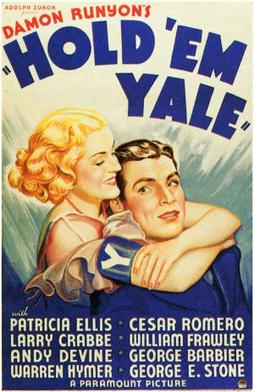
Hold ‘Em Yale (1935, directed by Sidney Lanfield)


Georgie, the Chaser (Cesar Romero) is a con artist who works for a low-level gangster named Sunshine Joe (William Frawley).  When Georgie reads about an heiress named Clarice van Cleve (Patricia Ellis) who impulsively falls in love with any man wearing a uniform, Georgie pretends to be a member of the Foreign Legion and tracks her down.  Georgie thinks that Clarice’s father will pay him off, just as he’s paid off all of her other suitors.  Instead, Clarice’s father disinherits her and Clarice ends up living at Georgie’s place, along with his other criminal associates (Andy Devine, Warren Hymer, and George E. Stone).

Georgie reacts by getting out of town, leaving Clarice behind with his good-natured gang.  However, even the gang gets tired of Clarice insisting that they dress up for dinner and that they all get a good night’s sleep.  After Sunshine Joe cheats them out of their money, the remaining criminals head to the Yale-Harvard football game, hoping to win some bets and to set Clarice up with the player that her father wants her to marry, studious benchwarmer Hector Wilmot (Buster Crabbe).

Just a little over an hour long, HoldEm Yale is actually a pretty amusing movie.  It was based on a short story by Damon Runyon and all of the characters are familiar Runyon types, streetwise but good-natured criminals who enjoy drinking and gambling and the film gets a lot of laughs out of their reactions to Clarice’s attempts to civilize them.  Patricia Ellis is great as the ditzy Clarice and this film provides a chance to see Buster Crabbe playing a character who isn’t a natural-born athlete for once.  It’s a minor film but worth watching for the cast and the snappy dialogue.  Who would have guessed a good movie could be built around Ivy League football?


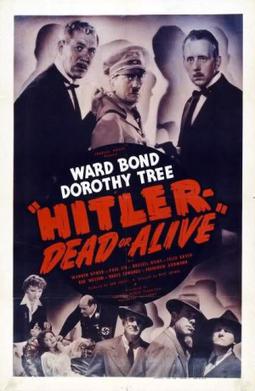
Film Review: Hitler — Dead or Alive (dir by Nick Grinde)


The 1942 film, Hitler — Dead or Alive, opens with two reporters visiting a prominent industrialist named Samuel Thornton (Russell Hicks).  They are curious about a statue of three men that stands outside of Thornton’s mansion.  Thornton proceeds to tell them the story of the three men.

In 1939, shortly after the Nazis invaded Poland and with the United States still pursuing a policy of neutrality, Thornton independently offered a million dollars to anyone who could bring Adolf Hitler to justice, dead or alive.  Accepting the offer were three ex-cons who had just been released from Alcatraz, Steve Maschick (Ward Bond), Hans “The Dutch” Havermann (Warren Hymer), and Joe “The Book” Conway (Paul Fix).  (As you may have guessed “The Book” is the intellectual of the group and yes, he wears glasses.)  After Thornton makes clear to them that they’re going to have to make sure that they either capture or kill the real Hitler and not one of his many doubles, the three men join the Royal Canadian Air Force and, along with ace pilot Johnny Stevens (Bruce Edwards), they head for Germany.

Made for an obviously low-budget, this B-movie is a bit of a curiosity.  It starts out as a comedy, with the three cooks cracking jokes about going straight and a lengthy sequence in which they try to work up the courage to parachute into Germany.  Even after they get caught by the Gestapo and sent to a prison camp, much of the film is played for laughs.  It’s not until they escape from the prison and Johnny sacrifices his life while shooting it out with the Nazis that the film starts to take a more serious turn.  Steve, who starts out the film only caring about the money, comes to realize that there are more important things than just finding a quick payday.

Steve, Hans, and Joe end up at the mansion of Else von Brandt (Dorothy Tree), a secret member of the German resistance who is so trusted by the Nazis that Hitler himself (played by Bobby Watson) will be stopping by for a visit.  By this point, Steve explains that he no longer cares about the money.  As far as he’s concerned, he’s now working for free.  After learning about all of the people who have been killed by Hitler, Steve is determined to stop him, even if it means sacrificing his own life.

There are still moments of humor to the found in the latter half of the film.  When Steve, Hans, and Joe confront Hitler, one of the first things that they do is shave off his mustache.  But the film’s conclusion is ultimately a very serious one and features one particular act of violence that I imagine stunned audiences in 1942.  Having told the story of the three men and their mission to get Hitler, Samuel Thornton ends the film by saying that it doesn’t matter whether Germany is being led by Hitler or Hitler’s double.  What matters is eradicating all of the Nazis from the Earth.  In the end, the message of the film is a simple one.  It’s okay to laugh.  It’s okay to joke.  But, in the end, everyone must do their part.

Hitler — Dead or Alive was made for an obviously low-budget and there are a few scenes, especially in the beginning, where the pace feels a bit off.  Just as with Beast of Berlin, the film’s version of a German prison camp feels like it could have been lifted from a dozen American crime films.  But Ward Bond is a strong hero and he delivers his lines with conviction, especially when he discusses why nothing is more important than stopping Hitler.  He gets good support from both Paul Fix and Warren Hymer.  The film may start out as a comedy but it’s anti-Hitler message comes through loud and clear.  Seriously, how can you not appreciate a film about defeating the Nazis?

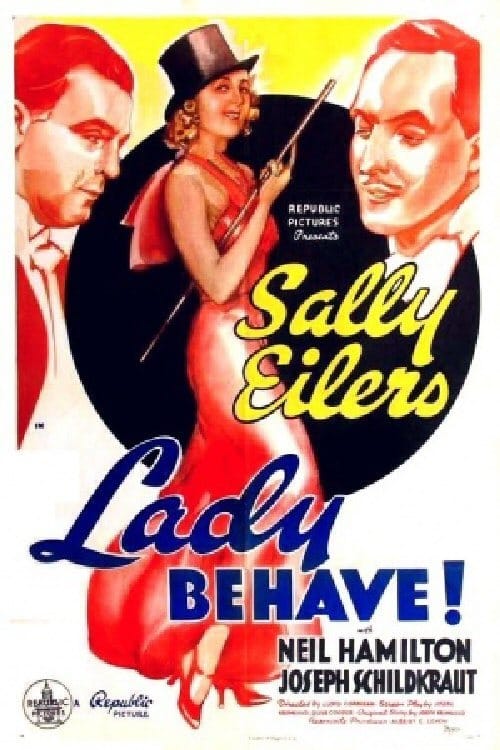
Mardi Gras Film Review: Lady Behave! (dir by Lloyd Corrigan)


The 1938 film, Lady Behave!, begins with a woman named Clarice (Patricia Farr) getting ready to go out and celebrate Mardi Gras.  Even though Clarice invites her older sister, Paula (Sally Eilers), to come with her, Paula refuses.  Paula has work to do at home.  It’s pretty obvious that this is the way that it’s always been between the two sisters.  Clarice has fun while Paula stays home and waits for her to return.

Fortunately, Clarice does return in the morning.  As she tells Paula, she had a great time during Mardi Gras.  In fact, she had such a great time that she ended up getting married!  She married a wealthy northerner named Stephen Cormack (Neil Hamilton).  The only problem is that Clarice is already married!  She’s totally forgotten that she only recently became the wife of a dissolute playboy named Michael Andrews (Joseph Schildkraut).  By getting married a second time, Clarice has committed bigamy!  She could go to prison for 10 years!

Whatever is Paula to do?

Well, what if she arranges for Clarice to leave the country?

What if she tries to bribe Michael into accepting an annulment?

What if Paula goes up to New York and pretends to be Clarice (because, after all, Stephen was pretty drunk when he married her)?

What is she does all three!?

Of course, when Paula goes up to New York, she discovers that Stephen is out of the country.  She moves into his mansion, where she discovers that his two children — Patricia (Marcia Mae Jones) and Hank (George Ernest) — are convinced that she’s just a gold digger who only wants to steal their father’s money (and, it should be noted, also their inheritance).  When Michael shows up at Stephen’s mansion, he explains to Paula that he needs $10,000 for a horse and he’ll only agree to an annulment if he gets the money.  However, when he meets Patricia and Hank, he tells them that if they pay him $30,000, he’ll help to break up the marriage between Stephen and Paula (who, of course, everyone but Michael thinks is actually Clarice).

Eventually, Stephen shows up and he assumes that Paula actually is Clarice.  Paula and Stephen quickly fall in love and it turns out that Stephen is very serious about his new marriage.  He even wants to take Paula on a honeymoon.  Of course, he thinks Paula is Clarice and Paula is freaking out because they’re not actually married but she wishes that they were.  But, if they did actually get married, Stephen would be guilty of bigamy and then he’d have to leave the country like Clarice and….

Yes, this is one of those somewhat busy screwball comedies where almost every action is motivated by a misunderstanding and where all of the dialogue is extremely snappy.  To be honest, it’s all a bit too hyper.  Though the film originally had a running time of 70 minutes, most of the existing prints are only 57 minutes long.  This film has a lot of plot for only 57 minutes and it’s often difficult to keep track of what’s happening from one scene to the next.  That wouldn’t be a problem if this film starred someone like William Powell and Carole Lombard (or, for that matter, Cary Grant and Myrna Loy) but instead, this film features Sally Eilers and Neil Hamilton, who are likable performers but not quite likable enough to carry the film over it’s rough edges.

On the plus side, Joseph Schildkraut has some very funny scenes as the flamboyant Michael.  And Marcia Mae Jones and George Ernest both do a great work as Stephen’s paranoid children.  They consistently made me laugh.  Otherwise, Lady Behave! is a bit too frantic for its own good.

Lisa Cleans Out Her DVR: 20,000 Years in Sing Sing (dir by Michael Curtiz)


(I am currently in the process of cleaning out my DVR.  I recorded the 1932 film, 20,000 Years In Sing Sing, off of TCM on January 31st.)

I was somewhat surprised to discover that I had this 1930s prison film on my DVR.  I’m not sure what led to me deciding to record it though, if I had to guess, I’d say that it was probably the title.  I probably assumed it was about a prisoner who served a 20,000 year sentence.  I mean, that sounds interesting, right?

It turns out I was wrong though.  The film starts with a shot of a line of prisoners walking into a prison, with their sentence superimposed over their heads.  One guy is in for 7 years.  Someone else has a 50 year sentence.  Another person has a 33 year sentence.  I’m guessing that if you added all of the sentence up, you would end up with 20,000 years.

That’s a lot of angry men, all trapped in one location.  Fortunately, Sing Sing Prison has a compassionate warden.  Paul Long (Arthur Byron) is a good man, a criminal justice reformer who believe that prison should be about more than punishment.  He is tough but fair and he runs his prison on the honor system.  Break the rules and you’ll be tossed into solitary.  Respect the rules and the Warden might even let you leave the prison for a day or two.  The press and the bureaucrats may think that Warden Long is naive but prison guards love him.  “We’re behind you,” the head guard says when it appears that Long might be about to lose his job.  And the prisoners respect him, even if few of them are willing to admit it.

Tommy Connors (Spencer Tracy) is the newest prisoner.  He’s been sentenced to 5 to 30 years for robbery and assault with a deadly weapon.  Tommy’s a tough guy, the type who speaks in the rat-a-tat manner that will be familiar to anyone who has ever watched a 30s gangster film.  He’s a tough guy so he ends every sentence with “see?,” as in, “No prison is going to break me, see?” Tommy’s the type of guy who brags that, even if they send him to solitary, he can do his time standing on his head.  When he gets called into the Warden’s office, he tosses a lit cigarette on the floor.  Can the Warden reform even as rough a customer as Tommy Connors!?

It doesn’t help, of course, that Tommy has a friend named Joe Finn (Louis Calhern) and, even though Joe is on the outside, he’s constantly encouraging Tommy to break the rules.  Joe has an ulterior motive for wanting to keep Tommy in prison for as long as possible.  That motive is his desire for Fay (Bette Davis), Tommy’s loyal girlfriend.  When Fay is injured in an accident, the Warden agrees to let Tommy visit her on the condition that Tommy return in 24 hours.  However, when Tommy’s visit leads to murder, the Warden is blamed.  It gets even worse when the Warden announces that he is sure that, despite the charges against him, Tommy will honor his word and return to the prison.

Will Tommy do the right thing?  Or will he flee and destroy the Warden’s career?

20,000 Years in Sing Sing was produced by Warner Bros and it features the studio’s typical pre-code combination of a B-movie action and progressive politics.  Seen today, it’s a watchable but minor film, one that often seems dated in its view of criminal behavior.  (Even I, a huge believer in the need for criminal justice reform, thought the warden was being incredibly naive when he put the convicts on the honor system.)  That said, it’s always interesting to see Bette Davis in the days before she became the Bette Davis and was just another ingenue trying to make an impression while surviving the studio system.  As well, since Spencer Tracy eventually became best known for portraying wise, plainspoken men, it’s interesting to see him playing the cocky and disrespectful Tommy.

Still, I think there is a place for a movie about someone spending 20,000 Years in Sing Sing.

(I imagine that, after the first 10,000 years, it gets easier.)


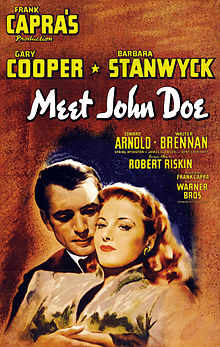
Shattered Politics #7: Meet John Doe (dir by Frank Capra)


Meet John Doe

I cannot stand the phrase “pay it forward.”

The idea is that somebody does something nice for you and then they say, “Pay it forward” and suddenly, you are magically required to go out and do something nice for someone else.  For one thing, I hate the obligation of it all.  I have this fear that as soon as I finally get finished paying it forward, some stranger is going to hand me a Coke and say, “Pay it forward,” and suddenly I’ll have to do it all over again!  And really, honestly, I shouldn’t have to pay it forward just because someone  gives me a Coke.  If you’re going to tell me to pay it forward, at least give me a car or a Victoria’s Secret gift card or something.

Ultimately, “pay it forward” is something that people say to make themselves feel good but it’s actually a pretty shallow concept.

The same thing can be said about John Doeism, the philosophy that rests at the center of the 1941 film Meet John Doe, our latest entry in Shattered Politics.  John Doeism is a grassroots political movement that is based around the slogan, “Be a Better Neighbor.”  Much like “Pay it forward,” “Be a better neighbor” sounds good and it’s easy to say but its main appeal is that it doesn’t require that much thought.  If anything, it sounds like the first step on the road to serfdom…

That said, I still like the film.

Meet John Doe opens with lay-offs at a major metropolitan newspaper.  (These lay-offs are signified by a handsome young man who points at people and then runs his finger across his throat.)  Among those laid off is columnist Ann Mitchell (Barbara Stanwyck).  However, before Ann is officially let go, she is told to write one final column.  Understandably angry over her treatment, Ann responds by making something up.  She writes and prints a fake letter from a man calling himself “John Doe.”  John Doe explains that he’s unemployed and that he will be committing suicide on Christmas Eve.

Well, quicker than you can say twitter death hoax, everyone in the entire country reads John Doe’s letter and demands to know who he is.  The newspaper’s editor, Henry Connell (James Gleason), rehires Ann and puts her in charge of finding the real John Doe.

When numerous unemployed and homeless men start to show up at the newspaper, claiming to be the real John Doe, little do they realize that they are, in fact, auditioning.  Ann finally decides that Joe Willoughby (Gary Cooper) has what it takes to be the public face of John Doe.  Not only does he have a compelling personal story (he’s a former baseball player whose career was ended by an arm injury) but he looks and sounds like Gary Cooper.

(And, as I typed that last sentence, it suddenly occurred to me that Meet John Doe managed to predict American Idol…)

Joe is soon a celebrity, reading speeches that have been written for him by Ann and encouraging people across the nation to be a better neighbor.  And Ann is falling in love with Joe.  However, Joe is not comfortable with his new role.  For one thing, he doesn’t like being a hero for telling a lie.  Secondly, he knows that rival newsmen are eager to expose him as being a fraud.  And finally, there’s a sinister publisher named D.B. Norton (played by Edward Arnold, who previously played corrupt Boss Taylor in Mr. Smith Goes To Washington) who is eager to be President of the United States.  He wants to turn John Doeism into a fascist political movement and, unless Joe endorses him, he’ll reveal that Joe’s a fraud…

Meet John Doe was Frank Capra’s follow-up to Mr. Smith Goes To Washington.  It features many of the same themes as Mr. Smith, with the main difference being that Meet John Doe is a lot more preachy.  Whereas Mr. Smith saved its big speech for the end, Meet John Doe has several big speeches spread throughout its running time.  (There’s also a scene where a guy named Bert tells the story of how he was inspired by John Doe and, I swear, it literally goes on forever.)

So, no, Meet John Doe is definitely no Mr. Smith Goes Go To Washington but I still liked it, mostly because of the chemistry between Gary Cooper and Barbara Stanwyck.  I wanted to be Barbara Stanwyck’s character.  Seriously, watching a film like Meet John Doe, leaves me convinced that I was born several decades too late.  If I had been born in 1918, I could have been a quick-witted, cynical, and secretly romantic intrepid girl reporter at a major metropolitan newspaper.
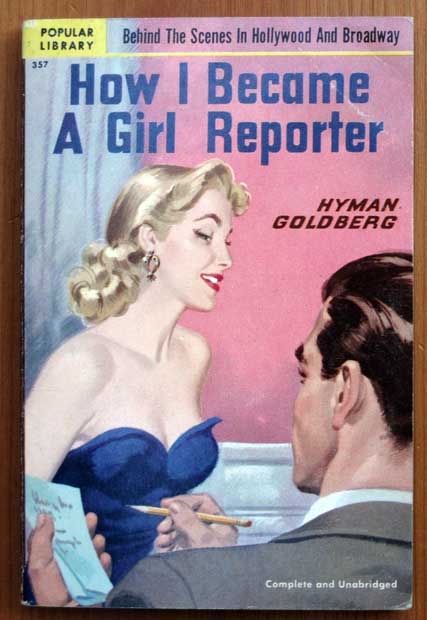
Girl Reporter

Even better, I would never have to worry about ever being told to “pay it forward.”