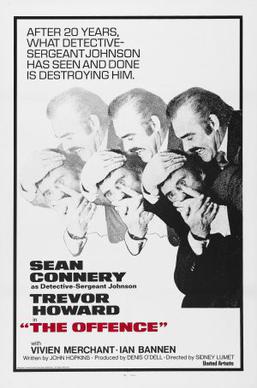
 After a suspected child molester named Baxter (Ian Bannen) dies while being interrogated in police custody, Detective Superintendent Cartwright (Trevor Howard) head up the internal affairs investigation. Baxter was beaten to death by Detective Sergeant Johnson (Sean Connery), a 20-year veteran of the force who has seen the worst that humanity has to offer. Did Johnson allow his anger over Baxter’s crimes to get to him or did something else happen during the interrogation?
When Sean Connery agreed to play James Bond for a final time in Diamonds are Forever, he did it under the condition that United Artists agree to back two of Connery’s non-Bond film projects. UA agreed, though they did insist that neither film cost more than $2,000,000. One of those projects was an adaptation of Macbeth, which was canceled in the wake of Roman Polansi’s version of the Scottish play. The other project was The Offense.
Based on a play by John Hopkins, The Offence is the type of movie that probably would have never been made if not for the interest of a big star, like Connery. The story is downbeat and grim and audiences are essentially asked to spend nearly two hours in the presence of two very unlikable men. Baxter is an accused child molester while Johnson is a bully who has been driven so mad by the things that he’s seen that he’s not only violent on the job but also on at home. Director Sidney Lumet directs with a cold and detached style, refusing to provide any sort of relief from the intensity of the film’s interrogations. The film is set up as an acting showcase for Connery and Bannen, giving both of them a chance to show what they could do with two unpredictable characters.
Unfortunately, not many people got a chance to see their performances. Even though Connery kept the budget under a million dollars and despite both the film and his performance being critically acclaimed, United Artists barely released The Offence and it took 9 years for the film to make back it’s meager budget. It didn’t even get released in France until 2007. Connery, however, often cited The Offence as being one of his best films and said that his performance in the film was his personal favorite.
The movies is too stagey and talky to be entirely successful but Connery was right about his performance. It’s one of his best and it retains its power to disturb to this day. Connery often chafed at being typecast as James Bond. With The Offence, Connery plays a character who is nothing like Bond. Everything about Johnson is brutal and seedy. While it’s impossible not to initially sympathize with his anger towards the state of the world, Connery reveals that Johnson’s self-righteous anger is actually a shield for his own dark thoughts and desires. He’s a bully, an angry man who grows more and more insecure as the film progresses and Baxter continues to see through him. Connery makes Johnson sympathetic, frightening, pathetic, and dangerous all at the same time. The Offence is a film that proves that Sean Connery was not only a good Bond but also a great actor.

 Through the Shattered Lens