Resident site writer and music-editor necromoonyeti knows more about the history of the Swedish metal band Bathory who helped pioneer not just black metal but an even more awesome subgenre we now know as Viking metal. I’m still educating myself in the sounds of Bathory, but one particular song from their epic discography which has caught my attention would be the 7th song from their 6th album, Twilight of the Gods. This song makes the latest “Song of the Day” and it’s simply called “Hammerheart”.
“Hammerheart” was the only song from Bathory’s sixth album which wasn’t written by it’s founder Quorthon but adapted from English composer Gustav Holst’s orchestral suite The Planets. To be more concise this Bathory adaptation uses an excerpt from The Planets’ fourth movement called “Jupiter”. The Holst song must’ve made quite an impression on Quorthon for it remains one of the more memorable Bathory songs once he switched the band from it’s 80’s black metal days to the slower, heavier style which would become Viking metal.
This song, every time I listen to it, makes me think of the cold, icy fjords being plied by dragonships full of Viking raiders as they move in and out of the rivers and tributaries of mainland Europe to bring their unique brand of culture to mainland Europe. It also makes me think of Viking funerals with this song being played as an accompaniment. I may not have Norse blood in my veins but this song lets me imagine that I do.
Hammerheart
Now that the wind called my name And my star had faded now hardly a glimpse up in the empty space And the wise one-eyed great father in the sky stilled my flame
For the ones who stood me near And you few who were me dear I ask of thee to have no doubts and no fears
For when the great clouds fills the air And the thunder roars from o, so far away up in the sky Then for sure you will know that I have reached the joyous hall up high
With my bloodbrothers at side All sons of father with one eye We were all born in the land of the blood on ice
And now you all who might hear my song Brought to you by the northern wind have no fear Though the night may seem so everlasting and forever dark
There will come a golden dawn At ends of nights for all yee on whom Upon the northstar always shines
The vast gates to hall up high Shall stand open wide and welcome you with all its within And Oden shall hail us bearers of a pounding Hammerheart
The years I most actively indulge my musical interests are the ones I find most difficult to wrap up in any sort of nice cohesive summary. December always begins with a feeling that I’ve really built up a solid basis on which to rate the best albums of the year, and it tends to end with the realization that I’ve really only heard a minute fraction of what’s out there. I’m going to limit this to my top 15. Anything beyond that is just too arbitrary–the long list of new albums I’ve still yet to hear will ultimately reconfigure it beyond recognition.
15. Thantifaxath – Thantifaxath EP
Thantifaxath’s debut EP might only be 15 minutes long, but that was more than enough to place it high on my charts. The whole emerging post/prog-bm sound has been largely a product of bands with the resources to refine it, and it’s quite refreshing to hear sounds reminiscent of recent Enslaved without any of the studio gloss. That, and I get a sort of B-side outer space horror vibe from it that’s not so easy to come by. (Recommended track: Violently Expanding Nothing)
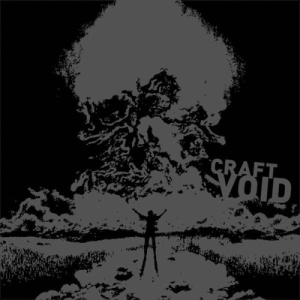
14. Craft – Void
This is the straight-up, no bullshit black metal album of the year. It doesn’t try anything fancy or original. It’s just good solid mid-tempo bm–brutal, evil, conjuring, and unforgiving. Hail Satan etc. (Recommended track: any of them)
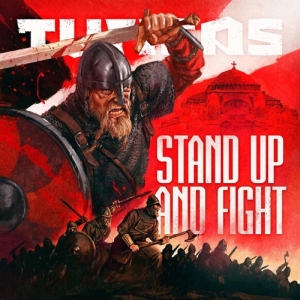
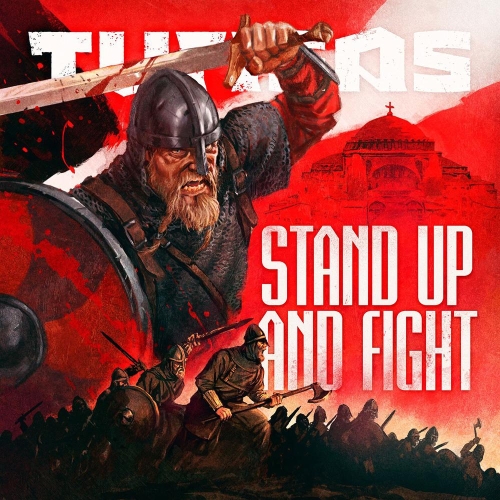
13. Turisas – Stand Up and Fight
Stand Up and Fight doesn’t hold a candle to The Varangian Way, but I never really expected it to. As a follow-up to one of my all-time favorite albums, it does a solid job of maintaining that immensely epic, triumphal sound they landed on in 2007. It lacks their previous work’s continuity, both in quality and in theme, but it’s still packed with astoundingly vivid imagery and exciting theatrics that render it almost more of a movie than an album. (Recommended tracks: Venetoi! Prasinoi!, Hunting Pirates)
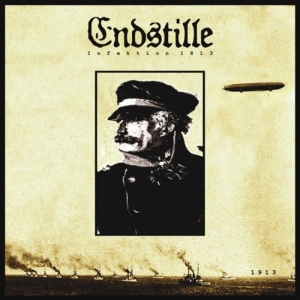
12. Endstille – Infektion 1813
Swedish-style black metal seldom does much for me, and it’s hard to describe just what appeals to me so much about Germany’s Endstille. But just as Verführer caught me by pleasant surprise two years ago, Infektion 1813 managed to captivate me in spite of all expectations to the contrary. Like Marduk (the only other band of the sort that occasionally impresses me), they stick to themes of modern warfare, but Endstille’s musical artillery bombardments carry a sense of something sinister that Marduk lacks. The dark side of human nature Endstille explores isn’t shrouded in enticing mystery–it’s something so thoroughly historically validated that we’d rather just pretend it doesn’t exist at all. The final track, Völkerschlächter, is one of the best songs of the year. Stylistically subdued, it pummels the listener instead with a long list of political and military leaders responsible for mass murder, named in a thick German accent over a seven second riff that’s repeated for 11 minutes. It’s a brutal realization that the sensations black metal tends to arouse are quite real and quite deplorable, and it will leave you feeling a little sick inside.
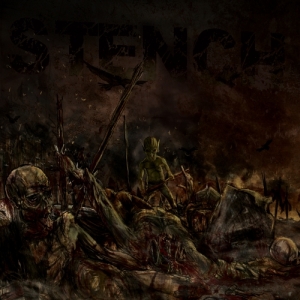
11. Nekrogoblikon – Stench
Nekrogoblikon released a folk metal parody album in 2006 that was good for laughs and really nothing else. The music was pretty awful, but that was intentional. It was a joke, with no presumption to be any good as anything but a joke. They’re the last band on earth I ever expected, a full six years after the fact, to pop back up with a really fucking solid sound. But Stench is good. I mean, Stench is really good. It’s still comical in theme, but the music has been refined beyond measure. Quirky, cheesy guitar and keyboard doodles have become vivid images of little flesh-eating gremlins dancing around your feet, whiny mock-vocals have taken the shape of pretty solid Elvenking-esque power metal, pretty much everything about them has grown into a legitimate melo-death and power infused folk metal sound. Don’t get me wrong, it’s still not meant to be taken seriously, but they’re now of Finntroll caliber. (Recommended tracks: Goblin Box, Gallows & Graves, A Feast)
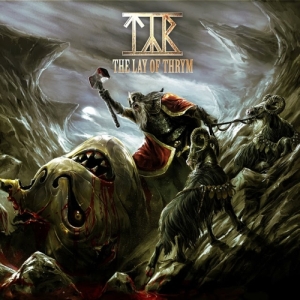
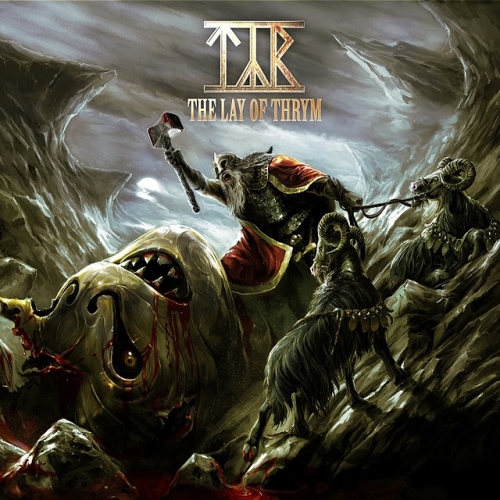
10. Týr – The Lay of Thrym
I thought By the Light of the Northern Star was a fairly weak album, and because The Lay of Thrym maintains some of the stylistic changes they underwent then, a part of me keeps wanting to say it can’t be as good as say, Land or Eric the Red. But of all the albums I acquired in 2011, I’ve probably listened to this one the most. Týr have one of the most unique sounds on the market, and it’s thoroughly incapable of ever boring me or growing old. Heri Joensen’s consistently excellent vocal performance alone is enough to make them perpetual year-end contenders. (Recommended track: Hall of Freedom)
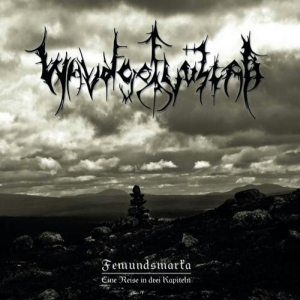
9. Waldgeflüster – Femundsmarka – Eine Reise in drei Kapiteln
This is some of the most endearing black metal I’ve heard in a while. Intended as a musical reminiscence of Winterherz’ journey through Femundsmarka National Park in Scandinavia, it’s a beautiful glorification of nature that takes some of the best accomplishments of Drudkh and Agalloch and adds to them a very uplifting vibe. Someone made an 8 minute compilation of the album on youtube which does a good job at previewing without revealing all of its finest moments. (Recommended track: Kapitel I: Seenland)
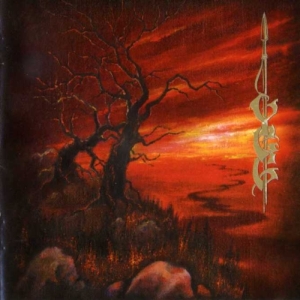
8. Ygg – Ygg
Ygg is an hour-long trance, evoking ancient gods in a way that only Slavic metal can. You could probably pick apart the music and discover plenty of flaws, but that would miss the point. I think that a lot of these Ukrainian and Russian bands are true believers, and that the purpose of music like this is more to create an experience in the listener than to be good for its own sake. This is a spiritual journey, and if it fails to move you as such it will probably come off as rather repetitive and generic, but I find it impressively effective. (Recommended track: Ygg)
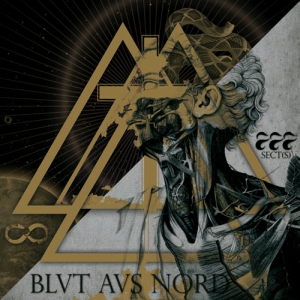
7. Blut aus Nord – 777: Sect(s)
I don’t know where to put this really. I could just as easily have labeled it second best album of the year. Dropping it down to 7th might seem a little unjustified, but eh, this is a list of my top albums, not of the “best” albums of the year. There’s no denying Sect(s) credit as a brilliant masterpiece, but it’s an ode to madness. I mean, this music scares the shit out of me, and if that means it’s accomplished something no other album has, that also means I don’t particularly “enjoy” listening to it. (Recommended track: Epitome I)
6. Altar of Plagues – Mammal
I never did listen to Mammal as actively as I would have liked. I never sat down and gave it my undivided attention from start to finish. But it’s served as a background piece for many late nights at work. It zones me in–stimulates my senses without ever distracting them from the task at hand. I don’t feel like I can really say much about what makes it great, because that’s not the sort of thing I’ve considered while listening to it, but I absolutely love it. It’s a big improvement from White Tomb, which was itself an excellent album, and more so than most other releases of 2011 I will probably continue to listen to it frequently in years to come. (Recommended track: Neptune is Dead)
5. Primordial – Redemption at the Puritan’s Hand (track: No Grave Deep Enough)
Redemption at the Puritan’s Hand is by no means perfect. It’s got a few sub-par tracks detracting from the full start to finish experience, but when it’s at its best all else can be easily forgiven. Call it folk metal or call it black metal, whichever you prefer, but first and foremost call it Irish, with every good thing that might entail. The vocals are outstanding, the music rocks out in folk fashion without ever relenting from its metal force, and while the lyrics don’t always make sense, they always hit like a fucking truck. Where they do all come together, delivered with Nemtheanga’s vast and desperate bellows, the result is overwhelming. O Death, where are your teeth that gnaw on the bones of fabled men? O Death, where are your claws that haul me from the grave? (Other recommended tracks: The Puritan’s Hand, Death of the Gods)
4. Falconer – Armod (track: Griftefrid)
Prior to 2011 I’d largely written Falconer off as one of those power metal acts that were just a little too cheesy to ever excite me. Maybe it was bad timing. Maybe I just happened to hear them for the first time while Kristoffer Göbel was filling in on vocals. Or maybe Armod is just their magnum opus–a spark of genius they’ve never neared before. Flawless if we ignore the “bonus tracks”, Armod takes that early folk metal sound Vintersorg pioneered with Otyg, merges it perfectly with power metal, and offers up 11 of the most well-written and excellently produced songs of the year. Mathias Blad’s vocals are absolutely phenomenal. (Other recommended tracks: Herr Peder Och Hans Syster)
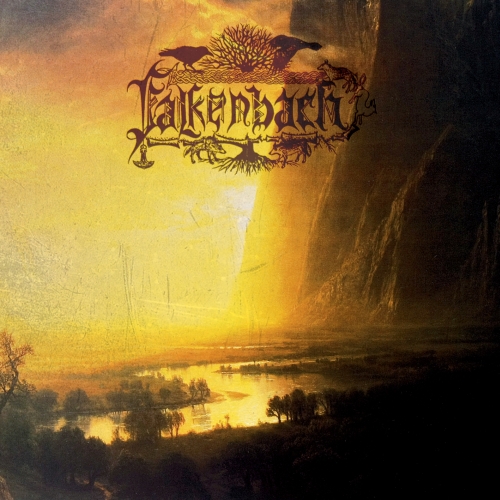
3. Falkenbach – Tiurida (track: Sunnavend)
A lot of people might voice the legitimate complaint that Tiurida, Vratyas Vakyas’s first studio album in six years, sounds absolutely indistinguishable from his prior four. For me, that’s exactly why it ranks so high. Vakyas landed on a completely unique, instantly recognizable sound which, alongside Bathory, defined viking metal as a genre, and he’s refused to change it one bit. I fell in love with this album ten years ago. (Other recommended tracks: Where His Ravens Fly…)
2. Liturgy – Aesthethica (track: Harmonia)
Yes, Liturgy. It’s immature, childish, and imperfect, but it’s uplifting in a completely new way. No matter how far Hunt-Hendrix might go to embarrass himself and his band mates, behind all of his pompous babble there just might be some truth to it. (Other recommended tracks: True Will)
1. Krallice – Diotima (track: Dust and Light)
More than the album of the year, Diotima is one of the greatest albums ever made. I can’t fathom the amount of skill it must take to perform with the speed and precision that these guys do, but if they battered down a physical barrier to metal in 2008, they finally grasped hold of what lies beyond it in 2011. They claim that the songs on their first three albums were all written at the same time by Mick Barr and Colin Marston, before their self-titled debut. If that’s the case, then it must be the experience of performing together and the creative contributions of Lev Weinstein and Nick McMaster that raised Diotima to a higher level. It’s not just that they’ve improved in every way imaginable; the songs themselves are overwhelming, breathtaking, and chaotic to a degree they’d never before accomplished. Krallice perform an unwieldy monster that took a few albums to thoroughly overcome. Now they’re in complete control, and their absolutely brilliant song-writing can shine through. With the exception of the dubious Litany of Regrets, this is possibly the greatest album I have ever heard. (Other recommended tracks: Inhume, Diotima, Telluric Rings)
Ensiferum’s self-titled debut in January 2001 was a prophetic landmark in metal, and I remember the feeling I got when I first heard it, probably about a year later. It wasn’t groundbreaking in its originality. No, I’d heard music like it before, here and there, scattered throughout my earliest mp3 collections. Blind Guardian and Rhapsody (of Fire), with their epic folk-infused triumphal marches and war cries, Thyrfing, with their stomp-along anthems to some Nordic specter, that peculiar absurdity Finntroll, so difficult to describe at the time… these bands had all been brought to my attention before Ensiferum.
I did not perceive at the time a common thread connecting them all. I was just frantically whipping my 28.8 kilobit per second modem headfirst into a musical fog, oblivious as it began to coalesce around me. Napster was dead, and with it passed my inclination to only pirate the most popular metal and grunge’s dying embers. Audiogalaxy was the new center of musical civilization, and with it came enlightenment. You didn’t just type in what you wanted and download it. You discussed it in chatrooms. You discussed it in forums. You carried the discussions over to more general-purpose forums. The internet became more united among music enthusiasts than it has ever been before or since.
Thus it was that 2001 served as a landmark year for me. I would look up Blind Guardian, and an hour later (well, this was 2001, so more like a day later) I would be enjoying Elvenking’s To Oak Woods Bestowed demo, Within Temptation’s Mother Earth, Therion’s Deggial… I didn’t know that these were all relatively new releases, I couldn’t categorize them into genres, and I had no real means of becoming informed about the bands save word of mouth (like anyone had heard of Wikipedia or Google back then). All I knew, or at least thought I knew, was that certain people had an incredible aptitude for finding and recommending music I would consistently love. I had not yet recognized the phenomenon at work here–the significance of the fact that all of this music was appearing at around the same time.
It must have been around the end of 2001 that I stumbled upon Ensiferum. By then I had heard dozens, maybe a hundred non-mainstream metal bands that I loved, and I was starting to pick up on their common themes, but I hadn’t fully put my finger on it. Then I saw this album cover, heard this song, and went “Ah ha! This is viking metal.” It might not be the precise term I would use today, and it might sound rather trivial, but at the time it was a sort of epiphany. This was the amalgamation of all of the metal Audiogalaxy had offered me under one roof. All of the amazing new things going on between about 1996 and 2001 suddenly took form as a conscious whole; Ensiferum was a glorious sign of things to come, heralding a new age of metal.
“From the three ascending moons,
moonshine was spilling onto the ground.
Gruesome trophies were all around,
in the halls of the Goblin King.
Now the victory is ours!
Let us dance the dance of immortals!”
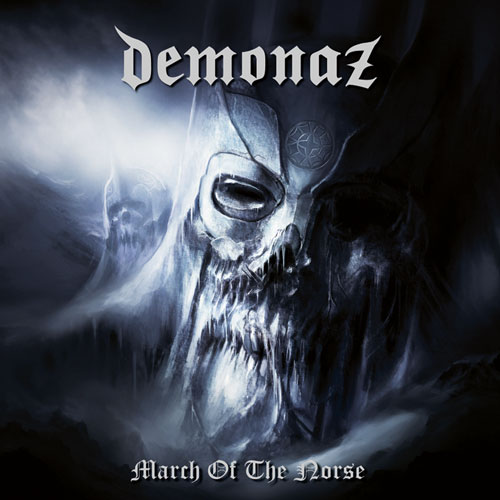
Unlike Abbath’s awkwardly titled sideproject I (which I haven’t actually heard yet), Demonaz Doom Occulta left little to the imagination in naming his new band. According to a lot of reviews I’ve read, he left little to his imagination in writing songs for it too. I don’t know that I can develop much of a case to the contrary, but March of the Norse is still more than capable of entertaining. I enjoy it.
Northern Hymn / All Blackened Sky
It’s definitely not a black metal album. If anything, you might say it’s an Immortal minus black metal album. In a lot of ways it has marks of the generic. The tempo and beat are pretty homogenous throughout, and what you hear is what you get; there’s not really anything buried beneath. There are a few slow moments that harken to Bathory, and a lot of plodding along in a way that characterizes stereotypical viking metal. But if you accept that Demonaz set out to create something pretty standard, I don’t think the results are bad at all. The songs never drag, and despite all sounding quite similar I did start to get pretty familiar with each individual song after a few listens, not just the sound as a whole. At the same time, the similarity with which each song starts gives it a lot of continuity. There aren’t many major transitions. In fact, I didn’t even notice when All Blackened Sky ended and the title track began my first listen through it. Don’t misconstrue that as a decidedly bad thing; it’s not that I missed it for lack of interest. The songs just flow together nicely.
Where Gods Once Rode
Now don’t get me wrong, aside from some pretty cool solos there is absolutely nothing “special” about March of the Norse. If you look for merit beyond face value you’re not going to find much, and I subsequently don’t have much to say about it. But it has value as a background piece. Because it’s neither very enticing nor unpleasant I can really put it on repeat all day long and never have to worry about being distracted from whatever I’m focused on, for good reasons or for bad. When I choose to tune in I always like what I hear, and I can tune right back out with no real effort.
I guess that’s all I have to say. I like this album, and I find it useful. It’s not the sort of thing I would go around recommending, but neither is it so base that only a die hard Immortal fan can enjoy it, as I’ve seen some people claim. Once something new crosses my path to replace March of the Norse as my sort of background album of the week I might never remember it again. But until then, well, I’ve got my $11 worth out of it. It’s certainly not the sort of thing I only listen to once and put back on the shelf. Sometimes generic done well is refreshing.
Geri and Freki does Heerfather feed, / the far-famed fighter of old, / but on wine alone does the one-eyed god / Wuotan forever live.
O’er Midgard Hugin and Munin both / each day set forth to fly. / For Hugin I fear lest he come not home. / but for Munin my care is more.
There Valgrind stands, the sacred gate, / and behind, the holy doors. / Old is the gate, but few there are / who can tell how it’s tightly locked.
Five hundred doors and forty there are, / I ween, in Walhall’s walls. / Eight hundred fighters through one door fare / when to war with the wolf they go.
Five hundred rooms and forty there are, / I ween, in Bilskirnir built. / Of all the homes whose roofs I beheld / my son’s the greatest meseemed.
There is Folkvang, where Freyja decrees / who shall have seats in the hall. / The half of the dead each day does she choose. / The other half does Othin have.
There is Gladsheim, and golden-bright / there stands Walhall stretching wide. / There does Othin each day choose / all those who fell in fight.
Now am I Othin, Ygg was I once. / Ere that did they call me Thund. / Wodan and Oden, and all, methinks / are the names for none but me.
Hail to thee, for hailed thou art / by the voice of Veratyr. / Where Valgrind stands, the sacred gate, / ye will find nine golden doors.
Hail to thee, for hailed thou art / by the voice of Veratyr. / Old is the gate, but few there are / who can tell how it’s tightly locked.
Where His Ravens Fly…
Far from a simple “see you in Valhalla,” Tiurida begins with a faring off worthy of kings, and even before understanding the lyrics you can feel their power in the music. Falkenbach’s 22 years of existence could be described as an effort to express the shared values, traditions, and beliefs of pre-Christian Europe. Written into the music just as much as the lyrics is a reverence for a greater age of man, in which fear and submission had not yet taken the place of mystery and honor. At least, that is what I have always taken out of his works, and perhaps it is why, in spite of the minimal variation in his sound over the years, I’ve always looked to new Falkenbach albums with a sort of reverence.
I never quite got the complaints that every Falkenbach album sounds the same–that he has eschewed developing as a musician and merely continued to produce the same thing over and over again. For while this is certainly true, especially of his last three albums, I would never want anything different. I would gladly take a hundred songs just like Where His Ravens Fly over any change that might cease to capture so fully the essence I’ve described.
Tanfana
I regard Tiurida as a phenomenal success, and possibly the best album of the year. Excluding the decidedly darker and heavier track Time Between Dog and Wolf, what you get on this album are five hymns. There is seldom any anxiety–no desperate or aggressive calls to return to past values, as so many other pagan bands manifest (with much success.) The lyrics are in the present tense, and so, in a sense, is the music. It’s hard to put my finger on what exactly I mean by this last comment, but it definitely lies in the folk side of his sound.
Tanfana is an instrumental song referring to a Germanic goddess of which very little is known. Tacitus’ mention of her in the 1st century is the only surviving source. Fitting, then, that the song should have no lyrics. This song is a very standard representation of how Vratyas Vakyas goes about employing folk music. A few things should stand out right away: The woodwinds are all synthesized; there are no actually traditional instruments at work here. Furthermore, they aren’t being played in any sort of traditional way, with any degree of diversity or improvisation. They are locked into the pace of the song and feel more like a sound sample loop than something performed live in studio.
The effects of this have to be significant, because it’s really what characterizes the folk element of almost all of Falkenbach’s songs. Well, two things stand out to me. Whether we’re talking monks or Burzum or really bad techno, there’s something inescapable about chanting effects. The repetition zones you in and forces you to experience the music in the here and now, whether you want to or not. It creates a heightened awareness of your present state of being. (And it might be why alcohol makes most awful music sound even worse but really bad techno sound awesome, but I’m getting way off focus now.) My point is that an element of this is present in Falkenbach’s sound, not only in the plodding progression of the drums and guitar, but in the folk. The other thing is that the folk instrumentation, being synthetic, bears a commonality with the more standard keyboard choruses he uses. Actual folk instrumentation generally calls to mind an image of something decidedly non-modern, but here there’s very little gap.
So when I say the music is in the present tense, what I mean is that his sound both evades my preconceived disconnection between folk and modernity and zones me into the moment–not of the music, but the on-going present state. Am I just babbling now? Perhaps, but it’s interesting to try and understand what about his sound appeals to me so distinctly from any other band describable as folk/viking/pagan metal. I think that, instead of taking me into the past, it has a sort of capacity to bring the past to me and blur any distinction.
Sunnavend
I suppose we all have particular bands and songs that move us in a personal way and might not have any such effect on anyone else. Falkenbach is just one of those bands for me. I don’t ever want his sound to change, and I’m so glad that on Tiurida it didn’t. This music gives me a unique sort of peace of mind–a feeling that lofty visions of the past aren’t mere idealizations or lost causes, but are entirely realizable in the present. This music is a hymn to the immortal, personified through gods whom modern society has yet to blaspheme.
2009’s By the Light of the Northern Star was a huge transition for Týr, the only band I know of from the Faroe Islands. No more slow, plodding, progressive folk metal. The band became a bit more aggressive, a bit faster… a bit more in keeping with the folk metal standard. It was still distinctly and undeniably Tyr; I can only fairly describe it as a change for the worse if I preface that it’s still better than most else out there. But for better or worse, it was something more like “heavy folk metal” than “progressive folk metal.” To sum up The Lay of Thrym in a nutshell, it takes the band’s new approach and improves on it.
In which case, you might say it’s pretty damn good. The opening track, Flames of the Free is just deliciously catchy, and, unlike Hold the Heathen Hammer High, it’s not so redundant that a dozen plays will demote it from enjoyable to obnoxious. Such a track does exist, unfortunately, in the form of Take Your Tyrant, but it is conveniently further in and thus easily skipped when it begins to wear on you. It is also followed by my favorite song on the album, Evening Star:
Which is a kind of unlikely contender. I mean, if you read these articles you have an idea of what I listen to by now. I’m not exactly into rock ballads. Tyr have always been their best at slower tempos though, in my opinion, and here they pulled off something completely captivating. I think it might be the most beautiful song they’ve written, and it is well placed to ease off of Take Your Tyrant.
The next track I want to highlight is the album’s second: Shadow of the Swastika. For a band as popular as Tyr (at least by folk metal standards), it’s a really ballsy inclusion. The song is a reaction to ignorant accusations that Tyr are racist for their Norse-centric lyrics and imagery. (The band’s logo includes an ancient runic symbol at one time employed by the Nazi party.) It simultaneously denounces anyone who thinks the modern generation should feel guilty about crimes committed 70 years ago and anyone who attempts to justify those crimes.
That might seem like common sense, but it’s something difficult to state. The critics who labeled Tyr racist in the first place are likely to interpret this song as saying “It’s time to get over the Holocaust” and have a field day, but obviously that’s not what Tyr are getting at, and I think they did an excellent job of making their case to anyone willing to hear it. The song is significant because they make no apologies. They aren’t saying “Please try to see that we aren’t racist,” they’re saying it should be obvious that they aren’t racist, and if you thought otherwise fuck off. Maybe some people will find it immature–will think that such accusations don’t deserve a response in the first place. But having made the choice to tackle a touchy subject, Tyr did it right.
You who think the hue of your hide means you are to blame, and your father’s misdeeds are his son’s to carry in shame: Not mine, I’ll take no part. You can shove the sins of the your father where no light may pass, and kiss my Scandinavian ass.
You who think the hue of your hide means you get to blame the black for your own faults and so bring humanity shame: Make sure you count me out of the ranks of you inbred morons with your sewer gas, and kiss my Scandinavian ass.
Pages of the past, how long will they last? A lie lost in the legacy of fools left us this parody unsurpassed. Pages of the past, how long will they last? The shadow of the Swastika by fools’ fears now for far too long has been cast.
I will leave you with the fifth track, Hall of Freedom. The album seems to stack its catchiest or otherwise most noticeable songs early on, with the final five requiring a bit more attention to hit home, thus I’ve only discussed and sampled the first half of The Lay of Thrym here. Regardless, it is a solid product nearly to the end (I could live without the bonus cover songs). My final verdict on The Lay of Thrym: It’s a big step up from By the Light of the Northern Star, which was a pretty decent album itself. Don’t expect the vibe of say, Eric the Red or Land on here, but it’s still no disappointment. To fans and newcomers alike I highly recommend it.
Turisas’s last release, The Varangian Way, got my vote for album of the year in 2007. It was a concept album, as so many monumental releases have been, telling the story of a band of viking soldiers of fortune traveling through Kievan Rus, intent on joining Byzantium’s Varangian Guard. Through sweeping symphonics, gritty folk, and a small but significant dose of progressive rock, the travelers encounter new lands, pass through Veliky Novgorod, party hard in king Yaroslav’s court, long for home while daring Dnieper rapids, and eventually arrive at the most majestic city in the world. (The back cover of the album is a map of Russia with each track title placed in its relevant location.) The lyrics might be shallow at times, and the English of questionable quality, but Turisas harness the power of names in a way I’ve never encountered before. When the central character raises “a toast to our generous host . . . ruler of Rus from coast to coast”, it’s the chanting of the Norse rendering of his name–Jarisleif! Jarisleif!–that really drills home the ruler’s greatness. The final, triumphal ending never mentions “Constantinople”. Nygård shouts “Tsargrad!” The chorus responds with “Konstantinopolis!” “The Golden Horn lives up to its name.” And the final resounding proclamation: “Great walls! Great halls! Greatest of all, Miklagard!”
I think it is the historic allusions, and the intensity with which they are employed, that really tip the scales from mere greatness to a masterpiece. If you have any fascination with history, you can’t help but be sucked in.
Stand Up and Fight is not nearly so consistant. At face value it certainly appears to be a continuation of the concept album. Hagia Sophia graces the cover. The opening track is called “The March of the Varangian Guard”, and the final track “The Bosphorus Freezes Over”. After a few listens, I caught on that, these three references aside, the album really has nothing to do with The Varangian Way. If you dig into the lyrics though, there are a few other Easter eggs.
The track most musically reminiscent of The Varangian Way is Venetoi! Prasinoi!
(Due to some bs copywrite issue you’ll have to click the link to hear this one.)
It’s a song about a chariot race, something I tend to associate with earlier Roman culture. If you plug “Venetoi” into wikipedia though, it redirects you specifically to the “Byzantine era” subsection of chariot racing. The use of lesser known names though isn’t at all emphasized like it is in The Varangian Way. The allusions are more subtle, meant I think to give a feeling of continuity without forcing the band to focus exclusively on one general topic. Track title aside, this song could take place in Rome proper.
Of course, The Varangian Way’s lyrics were dubious at times–(What the hell does the Nile river have to do with traveling through Rus to Constantinople?)–and their English was, if usually grammatically sound, not always quite on the mark. In the absence of allusions and grand proclamations, this is much more apparent on Stand Up and Fight. Consider Fear the Fear.
It opens with the lines “Bravery, as we’ve seen on TV: Explosions and swords, hot girls in reward.” How awkward is that? The song continues on with more words than most, and I’m pretty sure they’re attempting to convey some sort of message, but I don’t have a clue what it is. Yet the awkwardness isn’t always a bad thing. Skip to the last minute, and you’ll hear Nygård screaming “Die! Die you sucker! Let me go! Let me free motherfucker!” The way he does it, it’s just as cool as it is corny. It reminds me of Devin Townsend and Mikael Akerfeldt’s epic duet at the end of Ayreon’s “Loser”. … Well, that’s really a stretch, but that song is fucking awesome in ways I can barely comprehend, and I’ll take any excuse to link it:
.
Corny lyrics also play a hand in my favorite song on the album, Hunting Pirates.
(Due to some bs copywrite issue you’ll have to click the link to hear this one.)
Ok, first of all, it’s called Hunting Pirates. What the hell? The stuff Nygård babbles is ridiculous. “Kill them all! Let them die! Scum they are! Foe of mankind!” The music though, and his vocal style, are so fun that the cheese is almost a good thing. Besides, when he shouts “It is you who are the bad guys!” he’s not necessarily out to save the world. Plenty of folk metal bands are equally ridiculous, Turisas just take the less popular side. If if was a song about being a pirate, I’d laugh at the lines and not think twice about them.
My verdict on Stand Up and Fight: It’s catchy. It’s corny. It’s not The Varangian Way, but it’s miles beyond Battle Metal. Bare with the lyrics; they definitely overextend themselves in contemplation a few times, but for the most part it might only be their cultivation of a “good guy” persona that makes them appear any worse for wear than Alestorm’s demands for “more wenches and mead.” I mean, when I saw them live Nygård was chugging a bottle of vodka throughout the set.
Oh, while I was looking around youtube for functional links (without much success) I did find this:
What an awesome month. Forget Christmas, Halloween is where it’s at. Zombie movie marathons, kids walking around dressed as ghouls and barbarians, all the candy in the world, how can you beat it? And considering Christmas has its own devoted genre of music, why shouldn’t this (far superior) autumnal advent?
I thought I’d post up ten of my favorite “songs of the season” for your enjoyment.
Månegarm – Ur själslig död
I don’t know, maybe it’s just their unusual name, but I find myself often forgetting that Månegarm exist. I really shouldn’t. They’ve put out some impressive music.
Finntroll – Trollhammaren
I never saw the English translation of these lyrics until I came across this particular video, and now I love the song even more. “Amongst the shadows rides a beast like a black tree, gripping hard a mighty hammer, looking for weak Christian blood. He is not human, not fragile and weak like you. You will be helpless. No eyes see your end.”
Troll Bends Fir/Troll Gnet El – Strawberry Berserk
No one has ever quite settled on a proper means to transliterate Тролль Гнёт Ель, but whatever we call them they certainly fit the occation. The title of this song makes no sense to me, so I’m just going to assume it’s about getting really drunk.
Korpiklaani – Kohmelo
Korpiklaani manage to release a new album every year, with six since 2003 and another planned for February. As can be seen from their most recent one, this has been no deterrent to their quality. I know I linked this once before, but I can’t resist putting it up again – by far my favorite song by them.
Myrkgrav – Endeoner
Myrkgrav, like so many bands of the genre a solo project, composed this anthem to close his only full length album, Trollskau, Skrømt og Kølabrenning.
Thyrfing – Mjölner
I don’t listen to Thyrfing all that much over all, but Mjölner has one of the most ass-kicking melodies in metal.
Ensiferum – Victory Song
In this ten minute epic the chorus says it all. “Swords in their hands, they killed each and every man who dared to invade their sacred land. Victory songs are rising in the night, telling all of their undying strength and might.”
Pagan Reign – Печаль Сварога (Novgorodian Folk Dance)
Pagan Reign hail from Russia. Though they broke up after their 2006 release, the feel of the band remains largely intact under the offshoot project Tverd (Твердь). Also, this track gets my vote for the greatest intro ever.
Falkenbach – Heathenpride
Falkenbach’s contributions to viking/pagan metal cannot be overstated. Heathenpride tells the tale of a band of missionaries who ravage the northern lands in the name of Christ. With a sacrifice to Odin and Tyr, a pagan king calls for revenge and slaughters the Christian invaders. A happy ending if ever I’ve heard one. As it relates to actual history, Saint Boniface felled the sacred Donar Oak, near Fritzlar, Germany, in 723. Thirty-one years later he was put to the sword by pagans in Friesland, northern Holland. The Christians were, at best, just as barbaric as the pagans they sought to convert, and far less justified in their actions. Boniface’s death can be seen as one of the few pagan triumphs as Christians raped and pillaged their land. Whether Heathenpride is telling this story or some similar one that I am unaware of, the point is still a strong one.
Bathory – Hammerheart
The late Quorthon, father of viking metal, had once intended Twilight of the Gods to be his final album, and this was its closing track. We’ll see him in Valhalla.
Now that the winds call my name
And my star has faded, hardly a glimpse up in the empty space
And the wise one-eyed great father in the sky stilled my flame
For the ones who stood me near
And you few who were me dear
I ask of thee to have no doubts and no fears
For when the great clouds fills the air
And the thunder roars from oh, so far away up in the sky
Then for sure you will know that I’ve reached the joyous hall up high
With my blood brothers at side
All sons of father with one eye
We were all born in the land of the blood on ice
And now all you who might hear my song
Brought to you by the northern wind, have no fear
Though the night may seem so everlasting and forever dark
There will come a golden dawn
At ends of nights for all ye upon whom
The north star always shines
The vast gates to hall up high
Shall stand open wide and welcome you with all its within
And Odin shall hail us bearers of a pounding hammerheart
While I’m not as well-versed with all sorts of music genres like some friends of mine I do have a well-rounded taste when it comes to music. Growing up during the 80’s it was hard not to get into the hair-metal which dominated the scene. Yes, I fully admit to being a Motley Crue fan and even listened to the random Poison track here and there. In addition to hair-metal I also got into rap and hip-hop during the 80’s and early 90’s which I still consider the Golden Age of the genre.
Young people nowadays can have their Lil’ Wayne or Soulja Boy (but why would they want to) and the Dirty South crew and all that. I say I’ll take giants of the genre like Eric B. and Rakim, EPMD, Wu-Tang Clan, Afrika Bambaataa, Paris, N.W.A, Ice-T and Ice Cube over these new youngbloods any day of the week and Sundays included. While rap and hip-hop have become too much about commercialization I do like current acts like Mos Def and Talib Kweli of Black Star, Common, OutKast, Mobb Deep and Goodie Mobb.
As I’ve gotten older I’ve branched out from those two genres and embraced all types of music (though folk music still escapes me most of the time). It doesn’t matter now whether the artist/band plays some subgenre of metal like Norwegian Black, Viking, Pagan or combinations in-between. Or if they’re more classical genres like baroque, chamber and symphony. If they sounded good and I got into them I couldn’t care less what sort of genre they went under.
2009 was a good year for me in terms of discovering some new bands and artists. These were not new in the way that they’ve just been making music recently. All five I’m about to mention have been making music for at least a decade or decades for a couple.
1. Altan Urag
Altan Urag is a folk-rock band from Mongolia who have combined traditional Mongolian folk music, Western rock stylings and traditional Tuvan/Mongolian “karkhiraa” throat singing. It’s just very difficult to try and explain Altan Urag who has never heard of throat singers and folk music from the region. I’ve pretty much scoured every music store in my area, the net and other shadowy options to find their music. To say that I fell in love with this band would be one of the major understatement of the year.
2. Bathory
Bathory is one band I’ve heard of in the past but never really bothered to try. I was still very leery of the subgenres of metal that went by labels such as Norwegian Black, Pagan, Viking, etc. I was very much still a child of the NWOBHM movement of the lat 70’s and early 80’s and the rise of trash/speed metal of the 80’s. But the last two years I’ve branched out to try more types of metal and in 2009 I finally gave Bathory a chance and was instantly hooked. I’ve wondered since why I never gave them a chance. My favorite track of theirs has to be “Hammerheart” from their “Twilight of the Gods” album. It’s a much more subdued Bathory, but every time I listen to it I feel like I should be at a pub or some Viking hall downing a few pints of ale or horns of mead with my buddies before going off to battle. I definitely feel like Odin is watching over me when I listen to Bathory.
3. Blind Guardian
What is there to say about Blind Guardian that its most ardent fans haven’t already said ad infinitum about this greatest of all power metal bands. Power metal have been a genre I’ve dabbled in here and there in years past but never really paid them much attention as they truly deserve. Blind Guardian changed all that for me in 2009 and I now count Power Metal as one of my favorite type of music. Blind Guardian’s epic and quite operatic 2002 album, “A Night at the Opera”, was my first introduction to this power metal band of all power metal. While I’ve come to love all the other albums of their pre- and post-Opera I found this album of theirs the most accomplished and musically complete. Even people who are not typically fans of metal would find this album as something they would enjoy listening to. My favorite track is also the longest and most complex in the album, “…And Then There Was Silence.” It is an epic 14-minute track that tells the story of the Trojan War. If there’s a song more epic than this one I haven’t heard it.
4. Boris
Whenever I used to think of Japanese popular music and rock I always thought of J-Pop and it’s rock equivalent. I’m not wrong in that assumption as those type of music coming out of Japan have become quite popular due to the rise in the popularity of anime in the West. So, color me surprised when the same friend who introduced me to Blind Guardian and Altan Urag told me to check out Boris. The band is the power trio of Atsuo (vocals/drums), Wata (lead guitar) and Takeshi (bass guitar/vocals) out of Tokyo who simply cannot be hobbled by any particular genre of rock. One album may be stoner rock while the next all about doom and drudge metal. They’ve even released ambient rock and noise rock albums where one would think the music was just amps feedbacking back on themselves. I’ve come to call Boris the mad scientists of rock and their albums attest to that. My favorite track of theirs come from their 2003 album, “Akuma no Uta.” The song in question is called “Naki Kyoku” and one just has to listen to this song just what sort of musical geniuses the trio of Boris really are.
5. Tom Waits
Tom Waits. There’s just nothing much I can say about my love for Tom Waits other than people who have never heard him should just listen to “Pasties and a G-String” and be amazed. To try and describe Tom Waits would be an exercise in failure. One either loves The Waits or just don’t get him. There’s no middle-ground when it comes to The Waits.
So that makes the 5 bands and artists I fell in love with in 2009. Honorable mentions must go to these others: Mastodon, Turisas, Isis, Otis Taylor, Mantic Ritual, The Black Keys, Mirrorthrone and Nightwish just to name a few.

 Through the Shattered Lens