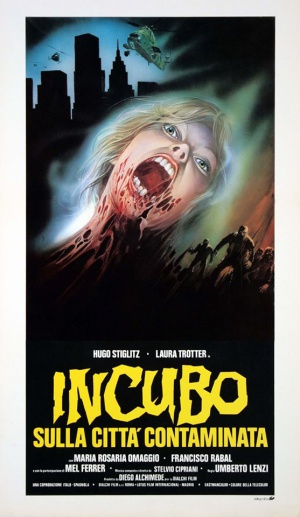
Since Case just reviewed 28 Days Later, this seems like the perfect time to say a few words about the 1980 Italian horror film, Nightmare City! Though Nightmare City has never been as critically acclaimed or as popular with audiences, it is regularly cited as probably being one of the main inspirations for 28 Days Later.
Now, don’t get me wrong. I can’t say for sure whether it was an influence or not. I listened to the entire Danny Boyle/Alex Garland commentary track on my DVD of 28 Days Later and neither of them ever mentioned Nightmare City. As well, there are some pretty big differences between Nightmare City and 28 Days Later. For one thing, 28 Days Later is a hyperkinetic Danny Boyle film whereas Nightmare City is obviously an Umberto Lenzi film, filled with over the top gore, gratuitous nudity, and nonstop violence. For that matter, the Infected in 28 Days Later still look human whereas all of the infected humans in Nightmare City are covered with what appears to be burned oatmeal. (I’m going to guess that it’s meant to be radiation scarring.)
And yet, despite all of that, it’s impossible to watch Nightmare City without thinking about 28 Days Later and vice versa. Both Nightmare City and 28 Days Later are commonly mislabeled as being zombie films, despite the fact that both of them are about people who have been driven mad by a military accident/experiment. Where you really see the influence that Nightmare City had on 28 Days Later is in the scenes in which various “infected” humans run through the streets, savagely attacking and killing anyone that they come across. For all the attention that was given to 28 Days Later‘s “fast zombies,” Nightmare City got there first. Call them human, call them infected, or call them zombies, the monsters in Nightmare City are relentless, unstoppable, and blood thirsty. Whatever flaws the movie may have, Nightmare City‘s zombies truly do belong in a nightmare.
(Except for that one scene in which a zombie extra is seen to be kicking a soccer ball while a dog chases after him but you have to look closely to notice…)
But before I say too much more about Nightmare City, I’m going to ask you to watch this tribute to the hero of Nightmare City, journalist Dean Miller:
Dean Miller was played by Spanish actor Hugo Stiglitz. (If that name sounds familiar, it may be because Quentin Tarantino named a character after him in Inglourious Basterds.) To be honest, the first time I ever saw Nightmare City, I thought that Stiglitz’s performance was one of the worst in the history of horror cinema. No matter how violent or bloody the film gets, Stiglitz rarely seems to react. He might occasionally arch an eyebrow. But, for the most part, he doesn’t seem to care. But, after subsequent viewings, I’ve come to respect the fact that, while everyone else in the film was overacting, Siglitz distinguished himself by refusing to act at all.
Nightmare City is a relentless and nonstop film. It starts out with Dean Miller being sent down to the local airport. His job is to cover the arrival of a scientist who has been assigned to investigate a recent nuclear accident. From the minute that the plane lands and a horde of hatchet-wielding zombies stream out onto the tarmac, Nightmare City is nonstop mayhem.
And, quite frankly, a lot of it doesn’t make much sense. At one point, the zombies enter a television studio and attack what appears to be the most boring dance show in the world and, as bloody and borderline disgusting as the action got, I still couldn’t get over how boring the dance show was before the zombies showed up. The other thing that struck me about that scene was that nobody at the television studio seemed to be that upset about a bunch of radiation-scarred zombies literally massacring hundreds of people on camera. Dean may have arched an eyebrow but even he didn’t seem that concerned.
(Fortunately, Dean manages to escape by grabbing a TV and throwing it at the zombies. Apparently, televisions explode if you throw them, even if they’re not plugged in at the time.)
Then the zombies attack a hospital and it’s the hospital attack that always disturbs me. There’s a scene where a nurse comes across a zombie raiding a blood bank and he shakes his head almost apologetically. Oddly, almost all of the doctors turn out to be self-defense experts. One elderly doctor even throws a scalpel at a zombie with all the skill of an Agent of SHIELD (or perhaps even …. HYDRA!)
Meanwhile, the military is supposed to be doing something but I’m not sure what. We get a lot of scenes of a general (played by Lenzi regular Mel Ferrer) staring down at a model of the city but he doesn’t ever actually seem to do anything. His assistant, meanwhile, is worried about his sculptor girlfriend being at home alone. He should be since there are two zombies in the basement, though we’re never quite sure how they got there without anyone else in the house noticing.
And the mayhem continues. There’s a zombie priest. There’s a zombie attack at an amusement park. There’s many scenes of Hugh Stiglitz staring off in the distance. At one point, his girlfriend falls off a roller coaster and we are briefly amazed at the sight of an obviously fake dummy crashing to the pavement below. But fear not because … it’s all a dream!
That’s right, Dean Miller wakes up in bed!
OH MY GOD, LISA, YOU JUST SPOILED THE MOVIE!
No, I didn’t. Believe it or not, the movie’s nowhere close to being over yet…..
Nightmare City is a hard film to review because, while it might not be good in any traditional sense, it’s also very much a one-of-a-kind movie. This is one of those relentless and shameless exploitation films that works despite itself. It’s preposterous, it’s silly, it’s often offensive, and yet it’s never less than watchable. If you’re into Italian horror, you have to see this film. If you’re into zombie cinema, you have to see this film. (If you’re not into either, you probably stopped reading this review a while ago.)
And, while you watch it, I dare you not think about 28 Days Later…
(This trailer is NSFW so watch at your own risk…)

 Through the Shattered Lens