Thousand Years of Dreams Day 14: Elegy Island


If there’s common thread to some of Kaim’s dream-memories it would be the theme and topic of war and how it affects everyone and everything. Some of the dreams has war right at the forefront while other it’s a background piece. For Day 14’s remembered dream-memory it’s how war affects written history and the consequence of war on descendants who only read about it in books and learned of it in classes.

“Elegy Island” is a prime example of how true the maxim that history is written by the victors. What that saying doesn’t point out is that the victors rewrite history and the truth of events to suit their needs or to hide away from the light the true nature of the event. As a student of history it’s sometimes frustrating to come to the realization that past cultures of long-lost tribes of people are gone forever because war has destroyed any trace of their legacy.

This dream-memory also makes it known how we as a people may have in our genetic history the ability and, sometimes, need to wage war, but it’s learning how to not repeat the same mistakes generations later which we’ve never been able to get a handle on. How holocausts and genocides will begin to fade in the memories of a people who were complicit in such acts with each passing generation until the stigma has faded to nothing but footnotes in long, hidden texts.

Maybe the cycle of war our species continues to find itself in will never be broken unless we make an effort to never forget the horrors of war. But as with each passing generation that remembrance will fall by the wayside and that “it wasn’t us who did this” become the excuse to stop remembering and hide the truth.

Elegy Island

This happened a long, long time ago.

On a small island – which has since perished – they had an odd custom.

They mourned their dead with song: with elegies.

The songs would play without ceasing from the last moments before death, through the funeral, to the burial.

Elegies would be sung for many purposes: to ease the grief of the family, to recall the legacy of the deceased, to appease the soul of the one who died under stressful cicumstances, to celebrate one person’s having lived to a ripe, old age, or to evoke anger at another’s pointless death.

There were no fixed melodies or lyrics. Apparently the songs were sung without lyrics at all.

“No documents have survived, so all we can do is assemble oral histories,” sighs the achaeologist as she views the island from the deck of the ship.

The people of that island country had no writing system, which means they had no way to leave behind signs or evidence of their lives.

“I wish we could at least interview a few survivors. but there weren’t any. Every single person was killed.”

The research team’s archaeologist is a young woman in her twenties. Her country is the one that destroyed the island. It happened while her ancestors, seven generations back, were still young people.

“I hate to bad mouth my own country,” she says with a shrug, “but they really didn’t have to go that far.”

“That far” is no exaggeration.

Her country prided itself on it’s overwhelming military force. For it to gain mastery over the tiny island would have been as simple as twisting an infant’s arm.

But her country believed in oppressing its neighbours with force. The leaders were thinking more of those neighbours then of the lands itself when it launched its all-out attack.

It was scorched from end to end.

Every human being on the island – from newborn babies to elders on the verge of death – was killed without mercy.

“It’s odd, though,” says the young woman with a grim smile, “there are hardly any records left from that time, even in our country.”

“I suppose what they did was so terrible, they didn’t want their descendants to know about it.”

Her remark prompts some older scholars on board to clear their throats, at the sound of which she snaps her mouth shut.

“Sorry,” she whispers, “you’re not much older than I am, you porbably don’t want to hear about all this old stuff anyway…”

“I do, though.”

“What interest can a sailor like you have in these boring academic matters?”

Kaim only shakes his head in silence.

Suddenly things become very busy on deck. The boat is approaching the island and has entered a stretch of intricate channels where the skills of the crew will be tested.

The boatswain calls Kaim.

“Oh, I’m sorry,” the woman says, “I shouldn’t be monopolising your time. You’ve got work to do…”

Even as she apologizes, the talkative young archaeologist asks Kaim.

“Do you mind if I ask you one last question?”

“Please, ask away,” he replies, stopping in his tracks.

She looks around to make sure no one is listening and whispers, “I’m sure this is your first time taking a research team over….”

“Uh-huh.”

“And your first time going to the island?”

“Well, yes…”

“So you probably don’t know about some of the bad stories they tell about this place – that some scholars who go there fall under a curse. Like, they get sick while doing their research on the island, or they become mentally unstable after they get home. I’ve heard some even killed themselves.”

“You mean a long time ago, right?”

“Right. This is the first research trip in fifty years. Up to them, every time they sent out a team, one or two of the members would suffer the curse. This is why they put a stop to them all these years. So I’m a little scared myself…”

She sends a mock shudder through her body. “I just thought I’d ask if you could teach me some magic spell for getting back safely…”

Kaim looks straight at her – not merely taking in her appearance but searching for the person deep inside.

“You’ll be fine,” he says.

“You think so?”

“I’m pretty sure you’ll be okay”

She looks at him questioningly.

“If you hear singing, though,” he adds “hum along with it”

“What do you mean?” she asks, her expression increasingly uneasy, but Kaim says nothing more.

“Get over here now, Mister!” the boatswain shouts at Kaim, who heads for his station.

He did tell the woman one white lie, though.

This is not his first time coming to the island.

He has been here many times before.

Hes first trip happened a long, long time ago.

As the archaeologist said, that islands elegies had no fixed melody or lyrics. They were all sung extemporaneously and never repeated.

A hundred deaths required a hundred elegies.

Nor did mourners agree in advance on the nature of their elegy before they started singing. At frist, each would sing his or her own song expressing his or her own feelings about the deceased. Eventually, the jumble of songs would come together into a single melody without any one singer taking the lead.

In the culture of this island that had no writing, there was, of course, no musical notation. There were no instruments for accompaniment either. Each mourner, in grieving for the loved one, would give voice to hopes for a peaceful journey, and a song would emerge.

Kaim’s travels first brought him here when the island was at peace, which is to say, centuries ago.

He happened to arrive just after the death of a village elder. For three days and nights, an elegy was sung around the clock. The island people’s song, which shook the darkness and reverberated all across the clear, blue daytime sky, left its mark with a certain ennobling comfort in the breast of Kaim, a man for whom fate had decreed that no one would ever sing an elegy.

To think that such an island had been burned to the ground!

The people fled in all directions at once, and were murdered one at a time.

It was an absolute bloodbath.

Kaim knows about the atrocities that accompanied the butchery – things that were not handed down to the generation of the young archaeologist.

Had it wished to, the woman’s country could have taken control of the island in a single night, but instead it used its military power to chase down each of the islands inhabitants over a period of several days as if carefully filling in the blank spaces in a coloring book.

The island became enveloped in elegies.

At first, while the living still outnumbered the dead, voices in elegiac song all but shook the island with their volume.

As the days went by, however, and the dead came to outnumber the living, the sobbing voices in song grew ever fainter.

When the battle reaches its final phase, the few remaining islanders, who had been cornered in the islands northern tip, fled into a large cave.

They resigned themselves to death.

All that was left for them to do was pray that they might be allowed to die with some degree of peace.

But even this small measure of hope they were unable to wring from their attackers.

The army of the archaeologist’s country wert for maximum brutality. The entered the cave with every weapon at their command, and they dragged out and killed one islander per day.

Today is was an old man.

The next day it was a young man.

The day after that they tortured to death a young mother with an infant at her breast, and the following day the infant they tore from her arms was put to death.

The elegies resounded without interruption.

The singing voices that escaped from the cave invaded the ears of the soldiers who were carrying on the masacre. Those soldiers with kind hearts collapsed one after another, or they went mad and left the front line.

Song was the final weapon of the islanders, who had no other means to fight.

They went on singing as they struggled against starvation, thirst, and their own fears.

The commanding officer of the anti-insurgency force ordered his men to fill in the mouth of the cave. If they buried the people alive, he thought, the singing would no longer be audible.

Nevertheless, thir singing continued.

It went on, day after day.

Rainy days, clear days, daytime, nighttime it continued, but no longer without breaks, which gradually increased in length.

The singing went beyond being an elegy for a single person and became a song suffused with the sorrow of all the living things on the island.

About the time the season ended, the last thing thread of singing died out.

The army left the island.

Not a single record of these military operations was left.

Never again did anyone come to live on the island.

The first research team in fifty years is plagued by difficulties.

One scholar after another collapses.

Almost every day, someone is sent out to the vessel anchored offshore, sick.

All of the scholars moan with pain, blocking their ears.

The situation is exactly what it was before the island was sealed from research.

Kaim knows exactly what is happening.

The ocean breeze sweeping across the island sounds like a song.

The brances swaying in the forrest sound like a song.

The birds in the trees sound like a song.

The babbling of a brook sounds like a song.

The treading of boots on piled-up fallen leaves sounds like a song.

The crashing and receding of waves on the shore sounds like a song.

The elegy for the island that people sang with every last bit of life they could dredge up from inside themselves, now is being sung by the island itself.

“Please stop, I beg you, please stop…”

The scholars cry out in their delirium, covering their ears.

“I dont know what we did. It was our ancestors, not us.”

The scholars who maon this hear anger and sorrow in the constanty recunding elegy.

What they say is true: it is not their fault.

But they have been given no knowledge of what happened on this island so long ago.

Sometimes, not knowing can be a profound sin.

They should prick up their ears and listen all the more.

That is what Kaim has always done.

The elegy being sung by the island is not merely hurling hatred and anger at them.

The island is not trying to torture members of the younger generation like them who are without sin.

Rather than blocking their ears, they should listen.

If they do so, the message will reach them.

For the island is telling them.

“You must know the truth. You must know what actually happened on this island so long ago.”

The investigation ends much earlier than originally planned.

Most of the research team have returned to the ship, their health broken, and some of the more seriosly ill members have been sent home. It is no longer possible to continue the work.

The young archaeologist who spoke to Kaim on the way in is one of the few who have persevered to the end.

“Thanks to you,” she says to Kaim.

As soon as she climbed from the launch into the ship she saw Kaim standing on deck and hurried over to him.

She looks haggard, but her fatigue is clearly less phyical than mental.

Still, her eyes harbor a strong-willed gleam.

“Did you hear the singing?” he asks.

“I did,” she says with a nod, looking back at the receding island.

“It was so sad!”

Just as he had thought: she was able to open herself to the sadness.

“Did you sing along with it?”

“Yes, I did that, too – partly because of what you said to me, but I also found myself humming the same tune quite naturally.”

Kaim nods and smiles at her.

This is the first time he has encountered anyone with the heart to hear the island’s elergy.

“This time when i get home,” she says, “I want to do some more serious research on the war. It’s something I have to do, I almost feel I don’t have any choice in the matter.”

“I’m glad to hear that,” he says.

“I might turn up some facts that my country finds inconvenient, but I feel its absolutely necessary to learn the truth – to know what actually happened.”

The ship emerges into the open sea.

A single white bird flies out from the island is if seeing the ship off on its journey.

Tracing a great arc against the blue sky, it releases one high, ringing cry.

No longer an elegy, this is a song of joy and forgiveness signaling the dawn of a new age.

END
Thousand Years of Dreams Day 13: Portraitist of the Dead


Day 13 brings us another dream-memory remembered by Kaim from Lost Odyssey. This time around it’s called “Portraitist of the Dead” and we get to know how the process of death could turn those surrounded by death to see it in a cold, emotionless manner.

Like the portraitist in the dream-memory I often wonder how doctors, coroners and morticians view death once they’ve experienced witnessing the event countless of times. For those who witness death of a loved one for the first time the effect could be devastating in more ways than one. There’s suppose to be stages to grief with denials and acceptance on either side of the spectrum, but emotionless and cold rarely happens to be one of them.

Soldiers who spend too long on the battlefield were said to cut their emotions from seeing enemies and comrades die if just to try and keep themselves from losing their sanity. Do civilians who must witness and deal with death on a daily basis do the same or do they actually feel some form of emotion behind their cold, professional exterior.

For those like myself who had to experience and witness the death of a loved one sometimes cutting one’s emotion helps in the short-term. In the end, even trying to stay calm and emotionless never works as grief, anger and sadness are just too strong to keep locked in. Sooner or later these emotions will burst through and, in the end, it’s these emotional outburst that helps us stay sane and our way of helping move the process of grief along.

It must be difficult for those who cannot do this because their profession requires them to remain calm and focused. Emotions just gets in the way of doing the job required. I don’t envy these individuals and at the same time respect their courage to go through it day in and day out in whatever way they can to stay sane.

Portraitist of the Dead

She always has mourning clothes with her. That way, she can begin a portrait as soon as a request comes in.

And so it is today.

Having slipped into her mourning dress in the shed on the pier, she boards the downstream ferry. Her hands are full: one holds the case with her painting tools and the other the garment bag for her mourning dress.

She has heard that a rich man lies dying in a town twenty kilometers downstream.

Her name is Rosa.

“It’s a race against time,” she says with a grim smile. “I have to start as soon as possible, before the face changes.”

“Changes how?” Kaim asks.

“It’s hard to say.”

There is a deepening strain to Rosa’s smile.

“But I know it when I see it – when the person has gone from ‘this side’ to the ‘other side’.”

“Once they’ve gone over, I can’t paint them – at least not in the way that will please the family. It just can’t be done.”

Rosa is a professional portraitist of the dead.

The custom of preserving death masks is now widely practiced in this area. Families too poor to hire an artist daub the face of the newly deceased with dye and preserve the loved one’s deathbed expression on a cloth pressed against the dyed face. Some families make a death mask with plaster. Only the wealthiest families can afford to hire a professional like Rosa, so that lurking in the background of an individual’s death there can be a variety of disputes.

“I have heard families quarreling over the inheritance behind my back even as I sit there sketching the dead person. One widow presented my portrait of her husband to the court to prove that he had been poisoned. Another time, some loan sharks waited until the moment the man died and charged right into the house. One husband tried to spit in his wife’s face as soon as she gave up the ghost. Apparently, she had been unfaithful to him for years.”

Rosa tells her stories with utter detachment. She reveals no emotion at all.

This, she says, is indispensible to be becoming an outstanding portraitist of the dead.

“You have to open your sketchbook and get your brushes going with the bereaved family members right there, overcome with grief. There’s no way you can produce a good portrait if you become emotional or allow yourself to be swept up in emotions of the other people in the house.”

Kaim responds with a silent nod.

His only connection with the woman is to have boarded the same boat and sat at the same table. Only a few minutes have passed since she started volunteering her stories, but that is all it has taken for Kaim to perceive the hint of nihilism lurking in her beautiful features.

“The more respectable artists despise painters like me.”

“Why is that?”

“Well, half of them accuse us of making our living from people’s deaths. The other half look down on us for not being moved by what we do. I see their point. I mean, the emotions are what give rise to all the arts, whether it’s painting, sculpture, music, or literature. We don’t have emotions like that: we’re nothing but craftsmen.”

Rosa speaks without a hint of either self-mockery or pride.

Her tone suggests that she is merely stating the obvious in an obvious way.

Kaim takes a sip of his rye whiskey, and Rosa drinks from her rose-petal tea.

The boat makes its leisurely way downstream.

The season is spring.

The river is high with snowmelt, and white water birds have settled on its surface.

“Strange,” Rosa says with a giggle, “when I first saw you, I thought you and I must be members of the same profession. Which is why I took the initiative to speak to you…”

Kaim gives her a strained smile. He knows nothing about painting and he is fairly certain there is nothing about his appearance that would cause him to be mistaken for an artist.

It well could be, however, that in the profile of this man drinking whiskey alone in the afternoon Rosa has recognized the hue of nihilism like her own.

Or then again, she might have perceived the shadow of ‘the other side’ clinging fast to Kaim’s back.

Until a few days ago, Kaim was on a battlefield.

There, he witnessed the killing of many enemies and many allies.

But he was unmoved by any of it.

Such youthfulness had long since vanished from him.

Though outwardly unchanged, Kaim has lived through several centuries.

Rosa says that she is in her mid-thirties and in her tenth year since becoming a portraitist of the dead, which apparently puts her near the beginning of her career.

“If you wouldn’t mind,” she adds, “I have a few more things I’d like to discuss with you.”

When Kaim nods silently in compliance, Rosa thanks him and gives him her first heartfelt smile of the day.

Portraitists of the dead are never present while the subject is dying. The very fact that such a professional has been called means that the person’s death is imminent. And so theirs is seen as a presence of ill omen and even defilement.

A family member or friend who has been at the bedside dares to broach the subject quietly in another room.

“Don’t you think it may be time to call the painter?”

The answer—whether “Too soon for that” or “I think you may be right”—is delivered in guarded tones.

Introduced to the family by the church, the portraitist never enters the house by the front door. Rather, he or she goes around to the back and is shown to the room where the sun cannot penetrate. There, the painter changes into mourning clothes and waits for the announcement of the death.

Eventually, a quiet knock on the door is followed by a summons to appear, and the painter dressed in mourning sets to work.

Not all deaths occur at the end of long lifetimes, of course. All too often the painter must depict the face of one who has died young of illness or accident.

The face that emerges in the artist’s sketchbook radiates the delicate vivacity of the one who has just crossed the border dividing life from death, one who has only moments before transitioning from ‘this world’ to the ‘other world’.

The work presented to the family is an oil painting done from the sketch, but Rosa believes the sketch itself is a far more authentic portrait of the dead.

“There is nothing quite like the atmosphere in a room where someone has just died. How to put it? It’s as though the flow of time has stopped, or time itself has melted into the very air… the sobbing and the wailing sound as if they might last forever, the only movement of time in all this being the way the face of the dead person emerges little by little onto the blank white page of the sketchbook.”

She hands him her thick sketch pad.

“See,” she says, showing him countless faces of the dead.

“This is two years’ worth.”

Many of the faces are peaceful, but others are full of agony, and all without exception possess a mysterious presence. They differ unmistakably from faces in sleep. Neither, however, do they look dead. They seem as if they might open their eyes at any moment or just as easily crumble to ash.

They hover, men and women alike, on the very brink of death.

“After the body has cooled, it’s too late. It’s also too late if the family has begun making its preparation for the funeral. The game is won or lost in those very few minutes follow the death itself. All we can do is start sketching – as efficiently and expeditiously as possible.”

With a painful smile, Rosa adds, “In the eyes of the family, though, that makes me a cold-hearted woman.”

Kaim turns the pages of her sketchbook, saying nothing.

He would like to tell her that it is the same on the battlefield. There, no one has time to mourn the death of a soldier. If you’re busy shedding tears instead of doing the next thing you have to do, you end up being one of those forced to travel to the other world.

The final sketch in the book is unfinished:

The face of a young girl.

The general outlines of the hair and face are sketched in, nothing more.

Kaim looks questioningly at Rosa.

“My daughter,” she says softly.

“But why…?”

“A portrait painter of the dead reaches full maturity in the position when she is able to paint a member of her own family. Which only makes sense, I mean, how self-serving is it if you can be coldly objective toward the death of a stranger but not toward a member of your own family?”

Her daughter died two years ago, the girl’s three short years of life brought to a sudden end by a bad flu that was making the rounds.

“I was holding her hands almost until the moment she died,” Rosa says, “I was in tears, calling her name and pleading with her to come back to me, not to die.”

After the doctor looked at her with a shake of his drooping head, though, Rosa relaxed her daughter’s hands and opened her sketch book. Wiping her tears she picked up her pencil and tried to sketch her daughter’s face.

“But I couldn’t do it. The tears came pouring out of me no matter how much I wiped them. I simply couldn’t work.”

Kaim turns his gaze on the unfinished sketch again.

Some areas of the white paper are wavy – perhaps where Rosa’s tears had fallen.

“I guess I’m not qualified to be a portraitist of the dead,” she says with a smile, glancing down at the river.

“But still… if I had to choose one work of art to leave behind, this would be it”

The boat gives a blast of its steam horn.

Frightened, the birds on the river leap into the air in a great mass.

Kaim closes the sketchbook and returns it to Rosa.

He considers complimenting her on the excellence of the drawing, but chooses silence instead. Such praise, he feels, could be a sign of disrespect for her work, for Rosa herself, and for her daughter.

“I didn’t mean to bend your ear like this,” she says, “I’m sorry.”

She stands and peers at Kaim once again.

“Really, though, you look like a member of my profession.”

Kaim gives her a strained smile and shakes his head.

“Sorry, I shouldn’t have said that,” she responds with a strained smile of her own.

“And you probably won’t like my saying this, either, but please call me if you ever need a portraitist of the dead.”

“I won’t need one,” Kaim says, “I have no family.”

“No family? Well, then, when your own time comes…”

With a little chuckle, Rosa leaves. Her right hand grasps the case with her painting supplies; her left, the garment bag with mourning clothes.

Unfortunately, Kaim will never need her services. He will not—cannot—go to the ‘other’ world just yet.

On the long, long road of his life, how many deaths must he encounter?

The steam horn blasts again.

The boat gradually lowers its speed and edges toward the river bank.

The landing draws closer.

When he leaves the boat, his journey will begin again.

It will be a long journey.

The next battlefield lies far beyond the mountains that tower in the distance.

End

Thousand Years of Dreams Day 12: Evening Bell


This latest dream-memory from Kaim is one of the shortest ones and starts the second leg of this 33-day journey through his memories.

“Evening Bell” sees Kaim once again remembering a past memory where his past self also struggles to remember his past. This is a common occurrence for the eternal warrior as he loses his memory time and time again. This time we see him remember a dream-memory which brings up the topic of death and how we as a race view it. With this particular memory death is viewed as the returning of ourselves back to the earth.

This idea is not unique in human history as we see many cultures of the past viewing death as a way to return our body to the earth to become one with it once more. Our very body enriches the soil which in turn helps the living grow the sustenance they need to continue on living. Kaim understands this and the fact that he cannot die means he can never partake in such rituals. A ritual the old woman asks of him when her time comes, but which he couldn’t promise to keep thus his decision in the end.

So, what do you think happens to us when we finally pass? Do you believe we just leave behind a husk to be returned to the earth? Or do you think we need to preserve our earthly form if we’re to have one in the afterlife? Do you even believe that there’s life beyond this one? What do you think the evening bells will toll when your time finally comes…

Evening Bell

Rolling farmland spread out before him, Kaim harvests vegetables, wielding his hoe with deep concentration.

The sky on this autumn evening is a deep crimson.

“Maybe we should call it a day,” says the heavyset woman who owns the farm. She drops an armload of vegetables into the basket.

Kaim nods and wipes the sweat from his brow.

“You’re a tremendous help,” says the woman. “Look how much we’ve done!”

Kaim responds to her praise with a slight nod.

“You still can’t remember where you came from?” she asks.

“Afraid not…”

“Well, the way you work,” she says with an easy laugh, “I don’t care if you’re from the moon!”

“Seriously, Kaim. What will you do when the harvest ends?”

“I don’t know yet, I haven’t made up my mind.”

“There’s plenty of work to do here even in the winter,” she says, “It’d be fine with me if you wanted to stay on a while longer…”

“Thank you,” says Kaim.

She herself is a hard worker and a warm human being.

This is not a life that allows for luxuries, but going out to the fields at dawn every day and ending work as the sun goes down softens the heart even as it toughens the body.

As they prepare to leave the field, a small bell begins to ring.

The hour is still somewhat early for the church’s evening bell.

Kaim glances down to the road at the base of the hill. A funeral procession advances slowly along the road, the mourners surrounding a horse cart bearing a coffin.

The woman sets her hoe on the ground, removes her headscarf and clasps her hands together. Kaim scans the hills to find that all the other workers on the surrounding farms are doing the same thing: clasping their hands, bowing their heads, and closing their eyes in the direction of the passing funeral.

Kaim follows their example.

The old man leading the funeral procession swings the little bell.

Its ringing echoes among the hills.

The mourners pass in silence.

The women in black veils,

The men in black coats, heads bowed.

The children in the rear elbow each other playfully, unaware of the meaning of death.

When the funeral has passed, the woman raises her head and blinks her moistoned eyes.

“The one who paddes away is going home,” she says.

“Home?” Kaim asks, somewhat startled.

“Home… to the soil… to the sky… to the sea. Like all living things.”

Kaim nods in silent recognition.

How many deaths has he seen in this endlessly long life of his?

All those people leave this world of ours and we never see them again. In that sense, death is an infinitely sad event.

If, however, we think that in dying they go back to their homes somewhere, a certain comfort and even joy comes to mingle with the sadness.

But Kaim – who can never grow old or die – can never go home.

The woman scoops up a handful of earth and says with deep feeling, “Many lives have become part of this soil – the lives of tiny living things we can’t see, the lives of withered grass … If you think about it that way, our vegetables are made for us by the lives of many others.”

“I see…”

“Can I ask you a favour, Kaim?”

“Of course…”

“If I should die while you’re working here, would you scatter some of my ashes on this field for me? A handful would do.”

Kaim is at a loss for words. He forces a smile.

Husband dead, children on their own, the woman lives by herself on the farm.

Kaim know that if he goes on working here, like it or not, he will eventually have to watch over the woman’s deathbed, even if she were to die one hundred, two hundred years from now.

The church bell rings, signalling the end of the workday.

The woman clasps her hands before her as she did when the funeral passed.

“I have been allowed to come safely through one more day. For this I give my heartfelt thanks. May tomorrow be another healthy day for me…”

Her voice in prayer resounds forcefully in Kaim’s breast. This happens every time he hears the church’s evening bell: the conviction overtakes him that he does not belong here.

“Ma’am,” he says to the woman after the last chime resounds.

“Yes?”

“Wouldn’t you say that people give thanks for each safe day, and pray for good fortune in the day to come, because they know their lives will ende?”

“Wha- what’s wrong, Kaim?”

“I’ll be leaving the village when the harvest is over.”

“Why, all of a sudden…? What’s happened?”

“I have no right to live here,” he says.

Ignoring her stupefaction, Kaim lifts the vegetable basket in both arms.

He takes another good, long look at the setting sun.

“Where will you go, Kaim, if you leave here?”

“I don’t know. Somewhere.”

“Are you just going to keep wandering like this?”

“I don’t have anyplace to go home to,” says Kaim.

Hoisting the basket onto his shoulder, he starts down the hill.

His back glows red in the setting sun.

End.

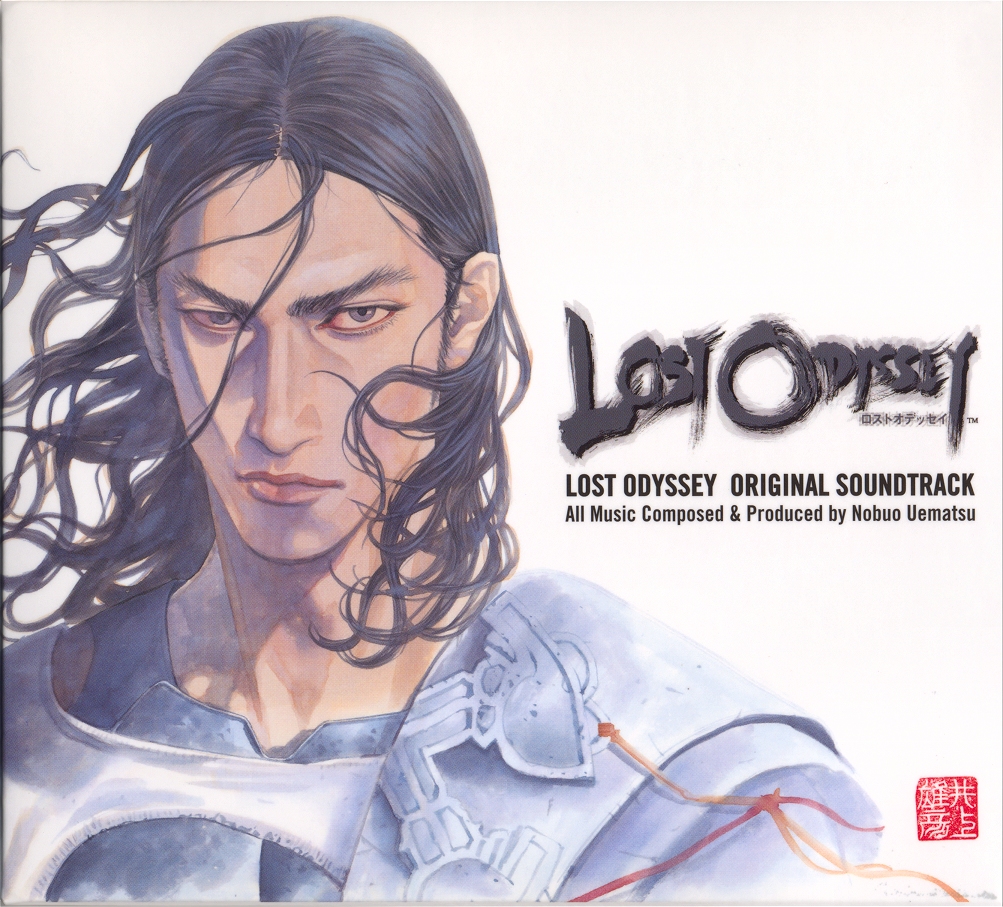
Song of the Day: Eclipse of Time (by Uematsu Nobuo from Lost Odyssey)


The latest “Song of the Day” is another favorite music track from the Lost Odyssey soundtrack by Uematsu Nobuo. The title of this particular track is “Eclipse of Time” and one of the most beautiful pieces in the game’s soundtrack.

“Eclipse of Time” becomes a sort of motif for one of the game’s characters, Queen Ming Numara who also happens to be another immortal like the game’s main protagonist, Kaim. We first hear this music playing when we enter her Ming’s room and it creates an ethereal musical backdrop which accentuates the Queen Numara’s eternal beauty. The track is quite simply played as a harp solo and it’s a rare thing to hear the harp as the main instrument in most game soundtracks. It’s Uematsu’s inclusion of such an instrument which raises the Lost Odyssey soundtrack to classic status.

This particular track reappears time and time again in different version and tempo throughout the game. It usually means that Queen Numara is either the focus of the scene or something she’s involved in a way. Unlike “A Return, Indeed…” this song doesn’t really appear in any of Kaim’s 33 dream-memories which is a shame, but understandable since the piece doesn’t really match the tone of Kaim’s dreams.

Of all the pieces of music in the Lost Odyssey soundtrack this is the one I can listen to over and over and not get tired of it.

Thousand Years of Dreams Day 11: Letters from a Weakling


“Letters from a Weakling” I consider one of my favorite of Kaim’s remembered dream-memories from Lost Odyssey and it marks the one-third mark of this 33-day marathon.

This particular dream always resonated with me because it dealt with the subject of human weakness and how it can lead people to turn on those who need protection most. While the subject matter is very tragic for the people involved the dream-memory does end on a hopeful and happier note. It’s the journey of Kaim, Alex and Myna which does take up the bulk of the dream and how their shared tragedy does lift the air of intolerance on later generations.

How often do we succumbed to the shout of traditions and exclusivity by those afraid to acknowledge and embrace change because it is a journey they fear to attempt and make. This happened often when it came to interracial relationships in the past and, while it’s much more accepted nowadays, there’s still some stigma for some people who don’t like such things. It’s a struggle that people who believe in same-sex marriage must go through now because those who cling on to “traditions” are afraid to let go of one of the last few social-changes still to be fully accepted.

I cannot blame those who remain silent and cowed by the vocal minority who deny acceptance of change, but their own form of cowardice doesn’t help those who need them to raise their own voice to protect those who need protection. There’s a favorite quote by Edmund Burke which goes hand in hand with the subject matter explored in this dream-memory of Kaim’s which Alex finally realizes — though too late — to take on”

“All that is necessary for the triumph of evil is that good men do nothing.”

In the end, the coward remembers that he is a good man and must do something even if it’s too late to save the very person they should’ve been protecting right from the start.

Letter from a Weakling

Once there was a woman who came from a foreign land to marry into an old family.

Her husband was from a tiny village in the mountains but he was working in a thriving harbor town abroad when he met and fell in love with her. At the time he asked her to marry him, his father in his home country collapsed and died. Being the eldest son in his family, the young man had no choice but to return to his homeland—taking her with him, of course.


Her name was Myna. This was not a name used by the women of his homeland.

Indeed, her name was not the only thing about her that was different.

The color of her skin, hair, and eyes, and the language she spoke were all different.

Had the young man’s hometown been a harbor city where people of many different lands cross paths, there would have been nothing unusual about this. In such places there were any number of homes that welcomed foreign men and women into the family, generation after generation.


“But this is about as deep in the country as you can get.” The young man told Kaim, sighing, on the night he made Myna his wife.

Kaim had rushed here all the way from the harbor town in the far country to attend the wedding.

At the banquet, the young man had given Kaim a look, and the two had slipped away from the festivities. They were standing in the garden, looking up at the night sky.


“When the eldest son marries, his wishes are of no importance. What matters is ‘family’.

The two families negotiate the engagement, and a bride is chosen who is acceptable to the groom’s parents. That’s how it was with my parents, and my grandparents did the same.”

“I know what you mean.” Kaim said with a nod.

Judging from the formal wedding ceremony, it was easy to imagine the highly conservative nature of the area, and just as easy to imagine that the relatives had not welcomed Myna into the family.


“Alex” Kaim said to the young man.

“Yes?” the young man answered, still looking up at the sky.

“You are the only one who can protect Myna, you know.”

“I know that much, Kaim.”

“Myna is a wonderful girl.”

“I know that, too, of course.”

The three were good friends. Kaim and Alex had worked together offloading ships at the same pier, and also together they had often gone to the neighborhood where Myna worked in an outdoor stall. Even now Kaim retains the bitter sweet memory of Alex and Myna struggling to communicate in each other’s languages.


“You know, Kaim” Alex said that night under the sky, “I think you sensed it, too, but Myna was drawn less to me than to—”

Kaim cut him short. “Never mind.” He said with a pained smile.

Of course Kaim knew how Myna felt. And if he had responded to her feeling, she and Alex would not have been married here today.

But Kaim had held back. Instead, he had urged Alex to pursue his love for Myna and helped the two come face to face. He felt no regrets about having played the part of an unlikely Cupid for them. Destined to continue his never-ending journey, Kaim was unable to love Myna in return.


One of Alex’s uncles stepped out of the house, drunk.

“Hey, Alex, what are you doing out here?” he growled.

“The groom can’t be absent from the reception!”

“Sure, I’ll be right there.” Alex said, turning toward his uncle.

Kaim tapped him on the shoulder.

“Make Myna happy, Alex.”

“Leave it to me.” He answered with a smile.


“Come on,” said the uncle. “Hurry up. The groom’s supposed to sit there the whole time! The entire family is here, and we’re going to drink the night away!” He grabbed Alex’s hand and dragged him back into the house.

The man was all smiles with Alex, but when he glanced at Kaim, his borderline polite smile could not disguise the gleam of distrust in his eye for an outsider. Kaim was sure he had noticed that same gleam, though perhaps not as openly displayed, in eyes that alighted on Myna.

So that was the kind of village to which Myna had come as a bride.

“You’d better make her happy, Alex.” Kaim called out again toward his friend’s receding form. “I’m counting on you!”

But now the uncle had his arm around Alex’s shoulders, and he was noisily monopolizing his nephew’s attention. Alex never heard those words from Kaim.


It was three months later when Alex came to visit Kaim at work on the pier.

“I’m in town on a buying trip. So I thought I’d stop by to say hello.” Alex announced.

But, judging from the fatigue evident on his friend’s face, Kaim had a pretty good idea of his real reason for coming here.

As casually as possible, Kaim asked, “How is Myna doing?”

With a feeble smile, Alex replied, “After the wedding…things happened.”


Myna had been accepted neither as a member of the family,
nor as a resident of a village.

There were too many differences: in daily customs, in culture.
But the one thing that made Myna too different for the tiny village was
the brown color of her skin.


“If only she could speak with people! Myna is trying her best to learn our language. But my mother and the other relatives make no attempt to learn hers. Not so much as a ‘Good morning’ or a ‘Thank you.’ They insist it’s up to the daughter-in-law to do all the adapting.”

Still, Myna was working hard to draw closer to Alex’s family and birthplace. She would be the first one out to the fields in the morning, work without a break until the sun went down, and do sewing until late at night. She would try to talk to people in the local dialect that Alex had taught her, using gestures and body language, and she would apologize profusely, with abject smiles, whenever she failed to understand what they were saying.

Kaim could easily imagine Myna going through these exertions, which made Alex’s report all the more painful to him.


“You should come to visit us now and then, Kaim. Myna would love to see you, too” Kaim responded vaguely with a silent nod. When Alex added “I want you to come and cheer her up,” he said nothing in reply.

“What’s wrong, Kaim? Are you angry?”

“I’m not going to visit.”

“Why not?”

“You promised me you’d make her happy, remember? We agreed that you’re the only one who can do that.”

“But still…”

“Sorry, I haven’t got time for this. I have to get this ship loaded before it sails at sunset.”


With this curt dismissal, Kaim turned away and continued working. Alex
stared at him from behind, looking frustrated and confused. Kaim could
feel his friend’s gaze on his back. Because he could feel it, he kept working
without another backward glance.

Eventually, Alex gave up and left.

Neither man spoke words of farewell.


A year after the wedding, Myna gave birth to a son.

The boy had brown skin like his mother.

He had just started crawling when Alex visited Kaim again.

There was talk of a divorce, Alex said.

“There’s nothing wrong with our relationship. Myna and I love each other, that’s for certain. But my mother and the relatives say there is no way they can accept a brown-skinned child as the family heir. His existence supposedly harms the marriage prospects of my younger brother and sister, too. So they want us to send the baby to Myna’s family. It’s gone that far…”


Alex had lost a great deal of weight. He was obviously living with much pain every day, trapped as he was between “family” and Myna.

None of this made sense to Kaim.

However “trapped” Alex might be, as long as he was firm on what was important to him, there could only be one answer to his family’s demands, and he should be able to arrive at it without anguish or confusion.


“I know how strong you are,” Alex sighed, speaking to Kaim’s back as Kaim went on hoisting huge, spine-snapping crates in silence.

The longshoremen here were well paid for handling crates on their own—loads that it would take three ordinary men to lift. The daily wage was calculated by the number of loads each man lifted, so asking for help would result in a pay cut. For this reason, Kaim and the others never complained or asked for help. They would lift even the heaviest loads by themselves.

Alex had been like that, too.

If someone nearby asked him, “Are you going to be okay with that?”
he would be all the more determined to do it on his own.

“Fine, fine.” He would smile and, gritting his teeth, he would lift the giant load.


But Alex was not like that anymore.

“I’m starting to think that, maybe, in the long run, tying Myna down to a life in my village, is just going to make her unhappy. My relatives say they’ll support Myna and the baby. So It’s not as if I’d be abandoning her or chasing her away. It’s just that, for both our sakes, starting a new life…”

Having finished piling crates on the deck, Kaim turned toward Alex for the first time.
He was looking down at Alex on the pier.
“And you’re all right with that?”

“Huh?”

“If you’re convinced it’s the right thing, then go ahead and do it.
It’s not for me to interfere.”


Alex’s features distorted under the impact of Kaim’s words.

Kaim said nothing more but went back to work.

His anger and frustration were reaching the boiling point.

Alex had no idea that Myna had been writing to Kaim on occasion since shortly after the wedding.

About the hardships she had been facing in the home of her husband’s family, she said not a word.

Instead, she would spell out how happy her current life was and declare repeatedly how much Alex loved her.

Always, the letters would end like this: “I’m sure you, too, must be living happily, Kaim.”


This was why Alex’s report of the situation at home had filled him with such intense anger and frustration.

He had never answered Myna’s letters.

He felt certain that if he were to write to her—whether with words of encouragement or comfort, or even playing along with her sad lies—something important that gave her spiritual support would snap in two.


“Come see the baby, Kaim.” Alex pleaded. “Myna would be thrilled if you’d do that.”

Instead of responding to Alex, Kaim called out to him from on deck,

“See that crate over there? Can you lift it?”

The crate near Alex was of the same size and weight as the one that Kaim had just loaded onto the ship.

In the old days, Alex would not have hesitated to carry it up to the ship, every muscle in his body shuddering.

Now, however, Alex gave Kaim one timid glance and, smiling to hide his embarrassment, said only, “Not me.”


Kaim said nothing more.

He felt strongly that their long friendship had come to an end,
though in fact, for Kaim, whose life would go on through all eternity,
it had been nothing more than a momentary acquaintance.


Kaim has been on his endless journey ever since.

Now and then he thinks back to those bygone days.

Both Alex and Myna long ago came to dwell among his distant memories—
the kind of memories that revive with a deep sense of bitterness.

And they are there to this day.


Alex made his third trip to see Kaim a year after the baby was born.

Having wasted away to a mere shadow of his former self,
Alex stared vacantly at Kaim, and his voice lacked all intonation
as he announced Myna’s death.

She had killed herself.

“Hanged herself in the barn…”

Kaim was amazed at his own detachment as he took in Alex’s words.


Myna’s letters had stopped coming several months earlier. Either she no longer needed to spin those sad, little lies about being accepted by Alex’s family and the townsfolk, or she had lost the strength to invent them anymore. In effect it was the latter, Kaim was learning now.

“To the very end, she could not make anyone accept her—my mother, my family, or the town.” Alex said tearfully. “She was all alone, finally, to the very end…”

Without a word, Kaim punched Alex in the face.

Alex seemed to know and accept the fact that the punch would be coming. He did nothing to resist or defend himself. The fist hit him full-on and sent him sprawling in the road.


“Why?” Kaim demanded to know. “Why did you say she was all alone?”
and when Alex righted himself, he smashed him in the face again.

Alex began coughing violently and uncontrollably, and when he spat up a gob of blod, a broken back tooth came out with it.

Kaim knew well enough that Alex had been suffering, too, that he had been engaged in a desperate struggle to do something about being trapped between “family” and “wife.” Otherwise, he would never have wasted away so dramatically from the brawny young man he used to be.

As well as he knew this, however, Kaim could not forgive him.

He had promised. He had given his word. He would make Myna happy.
He would protect her.

Kaim could never forgive Alex for failing to make good on his oath.


Wiping the blood from his mouth with the back of his hand, Alex dragged himself to his feet. “I know how strong you are,” he said to Kaim as he had once before, but this time his words took on a far sadder tone.

“But let me tell you this, Kaim. My mother and my relatives and the others… their way of looking at things is not completely crazy. To live in peace and quiet in the country, you have to follow the country’s special rules. It just so happens that one of those rules was not to accept a ‘bride’ like Myna. I was born and raised in that village, and I know the village code, know it all too well, which is why I have been in such pain all these months. I’m a weakling, I suppose. In your eyes, I’m probably so weak you want to spit on me. So laugh at me! Hit me! Despise me if you want to! Come on, hit me again!”


Alex thrust his face at Kaim for more punishment, and Kaim threw another punch.

This one landed squarely on his nose—and may have broken it.

Alex crumpled to his knees. The blood that gushed from his nose was blacker than the blood from his mouth. Alex looked up at Kaim with a smile of self-derision.

“Myna should have been with you. That’s what I think. If she had married you and not some weakling like me, she’d still be alive.”

With a wordless, strangled cry of rage, Kaim lunged at Alex, grabbing him by the collar and hoisting him to his feet.


Another punch.

And still another.

Kaim was not planning to stop punching Alex.

Now, though, with Kaim’s hand still fastened to the front of his shirt,
Alex looked straight at Kaim for the first time since coming to the dock.

“Why didn’t you ever answer Myna’s letters? That’s all she was hoping for—a letter from you.”

So he knew. Alex knew everything.


“It’s terrible out there in the country. Anybody who wants to can find out who wrote letters and who got them. Everybody out there is like family—everybody but Myna, that is.”

If Alex had wanted to, he could have quashed Myna’s letters easily. Then, not one of her sad, little lies would have reached Kaim.

But instead, Alex had read the letters, resealed the envelopes, and sent them to Kaim one after another. He had internalized Myna’s sad, little lies and started looking for Kaim’s answers even before she did.


Kaim stopped his fist in mid-air and asked, “How could I have possibly answered her?”

“Why not?” Alex retorted, “You knew how trapped she was feeling. You must have known how much encouragement one word from you could have given her.”

“But you were Myna’s husband.”

“Yes, that’s true, but you were always the one deepest in her heart. I knew that, and because I knew it, there was only one thing I could do.”

No, that couldn’t be!


Astounded, Kaim lowered his fist as Alex said to him, “I wrote to her, I pretended I was you, and I wrote her letter after letter. ‘Be strong,’ I told her. ‘Keep your spirits up.’ ‘I’ll come to see you soon.’ You’re too strong, Kaim, so you can’t understand the feelings of weak people. But I don’t have that problem: I’m weak, I understood how a weakling like Myna felt.”

Alex cried, the blood streaming from his nose and mouth.


“There is one thing I don’t know, though, Kaim. I don’t know whether Myna actually believed that the letters I wrote were from you, or whether she knew what I was doing and pretended to believe. I wonder. Was life in my village so painful to her that she couldn’t go on living there without pretending to believe?”

Kaim made no attempt to answer Alex’s question.

Slowly, he let the strength go out of his clenched fist and released his grip on Alex’s shirt.
Alex drew a step back from him, then took another step, putting distance between them before his final revelation.

“There was one letter, just one, that I didn’t send to you. That was three months ago. It was the first letter in which Myna begged you for help. She said she wanted to run away and asked you to come and save her. As soon as possible. To rescue her and the baby.”

That was the letter Alex threw away.

Posing as Kaim, he wrote a two-word answer:
“Be strong.”

The day after she read the letter from Alex, Myna hanged herself in the barn.


Kaim stood rooted to the spot, crestfallen.

This left him momentarily defenseless.

Alex shot his fist at Kaim’s solar plexus, though his feeble blow could hardly be called a “punch.” The pain it inflicted might have been greater for Alex’s own fist than for Kaim’s superbly conditioned muscles.

“What an idiot I was! ‘Be strong!’ Such words might have meant something to somebody like you, but to burden a weak person like Myna with them…no, they could only break and crush her.”
Alex gave another tearful, self-disparaging smile and thrust his face toward Kaim.

“So hit me! I don’t give a damn! Hit me all you want! Beat the hell out of me! But let me ask you this, Kaim, If I had sent her last letter to you, would you have finally answered that one? Would you have been able to accept Myna in all her weakness?”

Kaim did not know how to answer this question. Nor did he raise a clenched fist to Alex again.


So ended the story of Kaim and Alex.

Alex turned and walked away, but Kaim could not bring himself to call out to him. He simply stood there, drained of all emotion, and watched him go.

Alex did, however, turn to face Kaim again when he had put enough distance between them so that Kaim could barely make out his voice.

“I can tell you this much, Kaim.” He shouted. “I am going to raise that boy of mine! I’ll make him into a man of my village! I may have been too weak to be a husband, but as a father, I’ll do better. I’ll make him happy.”

Kaim returned his words with a silent nod. Alex allowed the hint of a smile to show on his badly swollen face. He then turned on his heels once more and strode away.

Kaim never saw Alex again.


Every now and then, Kaim remembers Alex and Myna as he proceeds on his endlessly long journey. When he thinks back on what he himself was like in those days, wanting only to be strong in all things, the memory is a bitter one.

If only he had been the person he is today!

The present-day Kaim would not have rejected such human weakness. Now he can accept the fact—sometimes with a pained smile, sometimes with genuine heartbreak—that everyone is weak.


If only he could begin his journey again!

Myna might not have had to die.

But this is no more than a hopeless dream.

He meets them only once, and they are gone forever—the mortals, the humans, the ones without eternal life. This is what makes them all the more dear to him. This is what makes his breast burn for them.


Aware now that he has failed to love human weakness throughout his battles and his wanderings, Kaim turns his steps toward Alex’s old village.

Alex himself, of course is long since dead.

But Alex’s descendants he can tell at a glance. They have brown skin.

Brown-skinned youths are the ones in charge of the village festivals.

Brown-skinned old women teach girls how to weave floral decorations.

Brown-skinned children and those who are not brown play together in all innocence, free of care.

Perhaps this can comprise a tiny epilogue to the story of Alex, Kaim, and Myna.


The graves of Alex and Myna lie side-by-side atop a low, wind-swept hill.

Kaim picks flowers from the field and offers them at the doomed couple’s graves before returning to the road.

What is human strength after all?

Kaim still does not know the answer to this question.

And this is why again today his journey must go on.

                                                                                                                                                                      End

Thousand Years of Dreams Day 10: Don’t Forget About Me Now, You Hear?


When Kaim remember’s this particular dream-memory it brought to mind one of the many fears I think we all have as we get older. For Day 10 we see through Kaim’s eyes a remembered dream on not just the fear of being left forgotten.

“Don’t Forget About Me Now, You Hear?” delves into how age makes us yearn to leave a legacy that would make us be remembered even once we pass away. It’s really the only we become immortal. Unlike Kaim who is immortal, regular people can only rely on the memories of their dreams and deeds to be remembered by those they leave behind.

But what if we don’t have such things to leave behind as a legacy? Are we still remembered by those we love? Or do we become forgotten and left by the wayside?

This is a fear I’ve always contemplated. Have I done enough and experienced life to the fullest to be remembered by those around me or am I consigned to oblivion.

The dream-memory does end on a hopeful note that no matter how we may feel about the worth of our legacy when it’s our time to go there’s a good chance there will always be someone to remember us and in the end all that’s needed is for one to remember to allow us to live forever.

Don’t Forget About Me Now, You Hear?

“Brother dear!”

The cry comes from someone behind as he wades through the post town’s crowds. At first Kaim does not realize that the person is addressing him, and he walks on in search of lodging for the night.

But the cry comes again, all but clinging to him, “Brother, dear! Big Brother!”

This is puzzling.

He last visited the town eighty years ago. There can’t be anyone here who knows him.
“Wait, Big Brother! Don’t go!”

His puzzlement begins to take on an eerie edge, for the voice addressing him as “Big Brother” can only belong to an old woman.

Without letting his guard down, he turns around slowly.
Just as he thought—it is an old woman.

Dressed in the clothes of a young girl, the tiny old woman is looking straight at Kaim with a bright smile on her face.

“I think you may have the wrong person,” he says, allowing his discomfort to show.

“No I don’t,” She says with a big shake of the head and an expanding smile. “You’re Big Brother Kaim!”

“What…?”
“What’s wrong, Kaim, did you forget me?”

“Uh… well… I mean…”

He can’t place her. Even if he were to succeed in doing so, he knows he has no acquaintances in this town. He wonders . . . could this be a chance re-encounter with someone he once met on the road? But no, he is sure he doesn’t recognize her, and strangest of all, why would this woman who looks old enough to be his grandmother address him as “Big Brother”?
“Don’t pretend you don’t know who I am Kaim! You’re so mean!”

She yells at him loudly enough that people in the crowd stop and stare at them.

It is not just the fact that she is shouting, of course, People always have to shout to be heard in these crowded streets. That alone would not attract attention. The old woman’s voice is different from a normal adult yell. It is like the innocent, unrestrained cry of a little girl who throws her whole body into her scream.

People turn shocked expressions on the old woman and quickly avert their eyes.

Their dismay is understandable. The old woman has her stark white hair up tied up with a colourful ribbon, and her dress has the same floral pattern and floppy sleeves as a little girl’s.

Many of the passerby look at the old woman with a mix of sympathy and pity on their faces.

Gradually, Kaim begins to comprehend the situation. This old woman has simply lived too long. This is why the past, locked away in her memory, has become realer to her then the reality before her eyes.
A middle-aged passerby tugs on Kaim’s elbow.

“If I were you I would just walk away. Don’t get involved with her. She’ll be nothing but trouble.”

“It’s true.” says the wife by his side, nodding. You’re a stranger here, so you don’t know, but this old woman is senile. You can ignore her. She’ll forget everything in five minutes.”

They may be right, but the fact remains is this old woman knows Kaim’s name.

In the little girl part of her mind, she thinks of Kaim as her “Big Brother.”
He tries probing his distant memories.

He spent no more than a few days here so long ago. He got to know very few people, and there can’t be any of those left who still remember him.

When Kaim goes on standing before the old woman, the nosy middle age couple becomes indignant. “You try to be helpful and what does it get you?” snorts the husband.

“Let them work it out themselves.” adds the wife. “Let’s just go.” Which they proceed to do.

Winding up the voice for maximum shrillness, the old woman calls out to them as they walk off in a huff. “Don’t forget me now, you hear?”

In that instant, Kaim’s memory makes the connection.

The old woman greets his look of recognition with an expression of joy.

“Do you remember me now?” she cries. “I’m Shushu. It’s me—Shushu!”

He does remember her. A little girl he met in this town eighty years ago.

Perhaps five or six years old at the time, she was a precocious little thing whose lack of shyness with strangers came from her being the daughter of the innkeeper.

Somewhere along the way, she had probably picked up a phrase she heard someone using and so whenever a guest would depart after a number of days at the inn, instead of the standard “Goodbye” or “Thank you” she would see the person off with a smile and a cheery “Don’t forget me now, you hear?”
Only now is he suddenly able to see the girl beneath the wrinkles, Kaim must avert his gaze from the old woman’s face.

“What’s wrong Big brother?”

He cannot bring himself to look directly at Shushu’s vacant stare.

Eighty year have gone by! What can they talk about when a man who never ages meets a little girl from the distant past who has aged too much?
“Let me through here, please. Sorry, let me through here, please.”

Forcing his way through the crowd, a young man rushes up to where Shushu and Kaim are standing. “Great-grandmother! How often do I have to ask you not to go out without telling me?”

After scolding the old woman, he turns to Kaim with an apologetic bow

“I’m terribly sorry if she’s been a bother to you. She’s old and getting senile. I hope you can forgive her.”
Shushu herself, however, angrily purses her lips and demands to know, “What are you talking about? I’m just playing with Big Brother Kaim, What’s wrong with that?

She peers at the young man and asks, “Who are you?”

The young man turns a sad gaze on Kaim and begins to apologize again.

With a pained smile, Kaim stops him.

Kaim knows that, at times, it can be sadder and more heartbreaking for a life to be prolonged than for it to be cut short. Sad and heartbreaking through a life may be, however, no one has the right to trample on it.
“She just can’t seem to get it through her head she’s old.” Even if I hold a mirror up to her she asks, “Who’s that old lady?” The young man, whose name is Khasche, further explains the situation to Kaim, “she might forget that she ate breakfast, but her memories from childhood can be clear as a bell.”

Kaim nods in silent understanding.

Khasche and Kaim sit on a bench in the town plaza, watching Shushu pick flowers.

She is apparently making a floral wreath for her long-lost “Big Brother.”
“But really sir, do you have time for this? Weren’t you in a hurry to get somewhere? ”

“No, I’m fine, don’t worry.”

“Thanks very much.”

He smiles for the first time and says, “I haven’t seen her this happy in ages.”

The young man seems convinced that his great-grandmother has encountered in Kaim a person who resembles someone she knew as a child. Kaim allows him this. He knows that Khasche cannot, and need not, imagine the existence of a person who never ages.

“Her health has really deteriorated lately. Whenever she runs a fever, we wonder if this is going to be the end for her and we prepare for the worst. But then she springs right back. Sometimes we joke that her mind is so far gone, she’s forgotten to die.”

Kaim sees the young man in profile, Khasche has a gentle smile on his face as he speaks of his great-grandmother. No doubt, when he was little, she used to hold him and play with him. Grown up now, Khasche watches over his Great-grandmother like a parent watching his own child.

He calls out to her, “That’s nice, Great-Grandmother. I haven’t seen you weave flowers together like that for a long time!”
Squatting in the grass with a fistful of flowers, Shushu answers, “That’s not true. I made a wreath for him yesterday!”

Then she says to Kaim, “isn’t that right, Big Brother? You wore it in your hair for me didn’t you?”

Kaim cups his hands around his mouth and calls back to her, “I certainly did, it smelt so nice!”

Shushu’s face became as mass of joyful wrinkles. Overcome with emotion, Khasche bows his head.

Kaim asks Khasche, “are you the one who takes care of her?”

“Uh-huh. Me and my wife Cynthia.”

“How about your parents? Or even your grandparents? Are they still living?”

Khasche shrugs and says, “I’m the only other member of my family left alive.”
His grandparents both died in an epidemic twenty years ago.

His father lost his life in the war that enveloped this area ten years ago.

His mother, Shushu’s granddaughter, aged more rapidly than her own mother, and the lamp of her life was snuffled out five years ago.

“So my great-grandmother has had to keep holding funeral over the years-for her Children and grandchildren, Before we even noticed, she had become the oldest person in town. It must be lonely living that way…”

“I’m sure.” answers Kaim.

“It might even be a kindness of the gods to let people fade out of mentally when they’ve lived too long. At least that’s how I’ve come to see it lately. You would think she would feel lonely to be left behind that way, but she’s not lonely at all. To live long means you have a lot of memories. Maybe it’s not such a bad thing to live in the world of you memories during the last days for your life.”
Shushu stands up, her arms filled with flowers.

“Big Brother Kaim! I’m going to make a floral wreath for you right now! And if I have any flowers left over, I’ll make one for this other person too.”

Kaim and Khasche look at each other with bewildered smiles.

Why are you smiling like that? Shushu asks. “Are you two friends now?”

She opens her wrinkle-ringed eyes wide in surprise and gives the two men a joyful smile, and collapses into the grass.
Khasche starts to run for a doctor but Kaim grabs his arm and holds him back, saying, “You’d better stay with her.”

Ironically, Kaim, who can never truly know what it feels like to age, has been present, for that very reason, at countless deaths over the years.

His experience tells him that Shushu will not recover this time.
Shushu is lying on her back where she has fallen, her armload of flowers now spread over her chest.

Her face wear’s a smile.

“Wait just a minute, Big Brother Kaim. I’ll make your wreath for you right away. . .”

Her mind is still lingering among her memories of the past.

Will she stay like this to the very end?


“Keep fighting Great-Grandmother! Don’t let go!”

Khasche clings to her hand, tearfully shouting encouragement, but she may not even realize that this is her own great-grandson.
“It’s me, Great-grandmother, it’s me, Khasche! You haven’t forgotten me, have you? I bathed you last night, you knew who I was then, didn’t you?”

Khasche appeals to her with all his might.

But Shushu, a girlish smile on her lips, is departing for that distance world.
I’m going to be a father soon, Great-grandmother! Remember? I told you last night. Cynthia has a baby inside. It’s going to make you a Great-great-grandmother! Our Family is going to grow—another person with your flesh and blood.”

Still smiling, Shushu grasps one of the flowers on her chest in her trembling fingers.

She thrusts it towards Khasche and in a voice no more than a whisper, she says, “Don’t forget me now, you hear?”
Khasche doesn’t understand.

Indeed how could her know the little phrase she always used to speak Long before he was born?

Kaim puts his arm around Khasche’s shoulder and says “Answer her.”

“I know what you mean Great-grandmother. I won’t forget you. I will absolutely never forget you. How could I forget my own Great grandmother?”

“Don’t forget me now, you hear?”

“I won’t forget you, Great-grandmother. Believe me. I’ll always remember you.”

“Don’t forget me now, you hear?”
Shushu closes her eyes and lays her hand on the flowers on her chest as if groping there for something. She seems to be trying to open the door where the memories are sealed.

A soft breeze moves over her.

The flowers adorning her chest dance in the wind along with the memories. Surely among those memories is the Kaim of eighty years ago.
Kaim snatches at one of the petals dancing in the wind, enclosing it in the palm of his hand.

Shushu will never open her eyes again.

She has left on a journey to a world where there is no past or present.

The only ones she has left behind are Kaim, who will go on living forever, and Khasche, who is about to welcome a new life into the world.
Clinging to her corpse, Khasche raises his tear stained face to look at Kaim.

“Thank you so much.” He says to Kaim the traveler. “Thanks to you, my Great-grandmother was so happy to be picking flowers at the very end.

“No. It wasn’t thanks to me,” Kaim says.

He closes his fist on the petal in his hand and says to Khasche. “I’m sure if she had made a wreath, she would have given it to your sweet new baby.”

Khasche shyly cocks his head and mutters, “I hope you’re right.” But then smiling through his tears, he declares. “I’m sure you are.”
“About that promise you made to her—be good and don’t forget her.”

“No, of course not.”

“People go on living as long as they remain in someones memory.” With these words, Kaim begins to walk slowly away. Behind him he hears Shushu’s voice.

Don’t forget me now, you hear?

It is the voice of the little girl from eighty years ago, ringing ever clear, sweet, and innocent, declaring farewell to the man who will travel life forever

Thousand Years of Dreams Day 09: The Talkative Mercenary


For Day 9’s dream-memory we get to see a glimpse of what Kaim’s life has led him to as he travels the world as the eternal warrior.

In “The Talkative Mercenary” we find Kaim in a role he has become quite accustomed to. He’s a mercenary fighting in one of the countless battles and wars he has signed up for to give his immortal wanderings some sort of meaning and focus. It is a battle about to reach it’s bloody conclusion and with him and his fellow company of mercenaries on the losing side and waiting for the final push everyone knows is coming.

This dream-memory also introduces a young, scared and quite talkative mercenary whose baptism of fire has shattered the illusion of glory and riches he thinks was the life of a mercenary-for-hire. Easy money and a quick path to success destroyed by the prospect of death in this battle or the next and the one after. While this talkative mercenary blubbers and whines about the unfairness of his situation those older soldiers around him have accepted their role and lived with the consequences of being a mercenary. Kaim is a longtime member of this band of brothers who have accepted that death is all that waits for them whether they live to see the end of this battle for another waits for them in another land.

We learn from Kaim’s remembrance of this memory how war takes a toll on those who fight them. Those who cannot accept that they’re dead men walking will perish and the sooner the better for such men are as much a danger to his fellow allies than to the enemy. Those who can accept that death waits for them and that they cannot deny death’s inevitability when it comes to war will survive to fight another day until it’s their time.

I’ve always been fascinated by the idea that there are men and women who willingly take on the role of soldier knowing that sooner or later they will have to perform the true duties of their chosen profession. For in the end, a soldier’s duty, first and foremost, is to take to the battlefield and kill those opposing them. It’s a warrior code that’s not for everyone as much as many try to convince themselves it’s their destiny.

It’s a form of fatalistic courage that deserve our respect whether we agree with the politics and ideology being fought over. These are people who knowingly will take another person’s life just so the many who can’t won’t have to and remain living in a semblance of peace. So, next time one finds themselves next to a soldier just back from war give this person the respect they deserve or, if one is unwilling to do so, remain silent and let them go in peace.

The Talkative Mercenary

The ramparts will fall to the enemy.
It is just a matter of time.
They will mount their attack at dawn.
The main body of the allied forces
has already drawn far back from the front.
Only the mercenaries are left behind the barricade.
Their orders: defend it to the death.
These men, who have gone from battlefield to battlefield,
know exactly what that means.

“They’ve just left us here to die,” chuckles the one called Toma in darkness too thick for a person to make out his own hand.

“They want us to buy time so the main force can pull farther back. We’re supposed to be their shields, performing our final service for our employers.”

His dry, papery laugh shakes the darkness.

Kaim says nothing in reply. Other mercenaries must be gathered there around them in the blackness, but all keep their thoughts to themselves.

Mercenaries have nothing to say to each other on the battlefield. They might be on opposite sides in the next battle. At a time like this especially, when they have to defend the barricade against the enemy’s withering attack, they can’t spare time even to look at each other’s faces.

Kaim knows nothing about this fighter called Toma. His voice sounds young. He probably has very little experience as a mercenary.

If a man grows talkative in the face of death, it means that, deep down somewhere, he has a weakness that prevents him from becoming a true soldier. A mercenary with even a hint of such weakness can never cheat death and live to see another day.

It is the law of the battlefield, and a man like Toma will only learn that law in the moment before he loses his life.

“We’re done for. We’ll all be dead in the morning. We’ll have that ‘silent homecoming’ they talk about. I can’t stand it. I just can’t stand it.”

In the darkness, no voices rise to second these sentiments. It’s too late for talk like this. The day they chose the mercenary’s path was when they should have resigned themselves to death.

They will sell their lives for a little money. They prolong their lives, a day at a time, by taking the lives of one enemy after another. That’s what a mercenary is: nothing more, nothing less.

“Hey… can anybody hear me? How many of us are here? We’re all going to die together. We’ll just be a line of corpses in the morning. Don’t shut up now. Answer me!”

No one says a thing. Instead of voices, the silent darkness begins to fill with a tangible sense of annoyance.

Wordlessly to gather on the battlefield; wordlessly to fight the enemy; and just as wordlessly to die.

That is the rule of the mercenary, the “aesthetic” of the mercenary, if such an expression may be permitted.

But Toma has taken it upon himself to abandon that aesthetic.

“I knew it was hopeless from the start. Headquarters didn’t know what they were doing. There was no way a strategy like that could work. You know what I’m talking about, don’t you guys? We had to lose. It’s a total mess. I wish to hell I had joined the other side. Then we could have gotten a mountain of cash for winning. We could have drunk ourselves blind. We could have had all the women we wanted. I could have gone either way on this one but I picked the wrong side to fight on…”

“Hey, you!” an older voice booms out of the darkness. An angry voice.

“Yeah, what?” answers Toma, his voice more vibrant now at having at last found someone willing to talk with him.

As if to crush his momentary enthusiasm, the other man goes on, “How about shutting up a while? If you really want to run off at the mouth that much, I can send you to the next world a step ahead of the rest of us.”

“I-I’m sorry…”

Instantly dejected, Toma falls silent and the darkness grows still again.

The stillness is charged, however, with a deep tension. Far deeper, even, than before Toma started talking.

The veteran warriors know: watch out for a talkative man.

Being talkative means trusting in words–trusting too much in words.

Words are useless on the battlefield. You take up your weapon in silence, you fight in silence, you kill the enemy—or he kills you—in silence. All the mercenaries here have lived this way. All but the talkative one.

A soldier who clings too desperately to words may cling just as desperately to something else–to the sweet trap of betrayal, for example, or the seduction of desertion under fire, or the lure of madness.

Kaim has often seen pitiful mercenaries who, unable to endure the terror of being surrounded by the enemy, go berserk and attack men from their own side.

Will Toma prove to be another such case? The possibility is great, and no doubt the other men are thinking the same thing, too. In the stillness, they turn the same gazes toward Toma that they reserve for confrontations with the enemy, looking for any signs of change in his demeanor. The moment they perceive the slightest threat in him, a blade will soundlessly pierce the left side of his chest.

The silence continues. Not even the usual all-night cries of insects can be heard tonight as they were last night. Perhaps the insects knew enough to clear out in advance of the enemy’s dawn attack. The thought reminds Kaim that he saw no birds in the area yesterday, either. Although animals came to snatch food when the men first built this fortification, there has been no sign of them for several days now.

Animals have mysterious powers of foreknowledge that humans have lost. This becomes painfully obvious from any visit to a battlefield.

There can be little doubt that the animals have turned their backs on this barricade.

Right about now, in some distant forest, a huge flock of black birds may be taking wing in search of human corpses to strip of their flesh:

“It’s feast time, boys!”

They already know, somehow. Once the sun is fully up, the battle will be over. If they don’t get here first, they’ll lose some of their feast to a flock from another forest. Their black bodies hidden against the night sky, those birds now are probably flying for all they’re worth.

A voice in the night. Toma’s voice.

Weeping.

“Listen, you guys… I don’t know how many of you are out there, but we’re all going to die in the morning… or most of us. Maybe one or two will live to escape, no more. Think about it: those are lousy odds. You’ve all been through this before. You’re veterans, war heroes, you’re probably not scared. But even so… even if you’re not scared, don’t you think this is stupid? Huh? Tell me! You’ve been through a lot more battles than I have, so tell me… what the hell are we here for? We don’t hate the enemy, we don’t owe the leaders on our side anything, but we’ve got to kill the enemy and follow our leaders’ orders… and we’re still going to end up dead. Tell me you guys… don’t you think it’s pointless? Don’t you think it’s stupid?”

The only response to Toma is the impatient click of a tongue in the darkness followed by someone else’s sigh of annoyance.

“I can’t take it any longer,” says Toma. “I hate this…”

And now he is sobbing.

“All I wanted was some money and maybe something better to eat and maybe nicer clothes. I would have been happy with that. What a mistake I made, taking work like this. I never should have done it…”

Kaim keeps all his senses open for movement in the night.

Aside from himself and Toma, five other soldiers are crouching down in the darkness. Not bad: all are experienced warriors. They would not have been able to put up with Toma’s whining otherwise. If they let themselves get angry and started shouting at him or grabbing him by the throat or whaling away at him, they would just end up consuming their strength and energy before their “work” started at dawn.

If this is an assemblage of men who know how to keep their silence, the chances for “life” are that much greater, assuming, that is, that the talkative, weeping man does not become too great a burden for the rest of them.

Still sobbing. Toma continues to curse his fate.

Suddenly, something is different: something stirs in the silence.

This could be bad, Kaim thinks, sharpening his attentiveness still more.

When dawn breaks, Toma will get in our way. Because of him, the possibility for “life” will wither. The mercenaries know that, and because they know it, they might do whatever it takes for them to secure for themselves even the slightest added chance to live.

“I don’t want to die here. I tell you. Not now, not here, like a worthless dog. You guys feel the same way, don’t you?”

Moonlight shines down from a rift in the clouds.

For a split second, Toma’s tear-stained face appears in the darkness. He is even younger than Kaim imagined from the sound of his voice. He is practically a boy.

The clouds hide the moon again, and thick black darkness enfolds everything once more.

A dull light stirs in the deph of the darkness.

Without a word, Kaim darts, wind-like, toward it. He was able to gauge the distance between himself and Toma during the flash of moonlight.

Kaim grabs Toma’s arm. Something hard falls to the ground. The dull light flashes again, this time at their feet, and melts again into the darkness.

A knife. Driven by the fear of death. Toma was trying to slit his own throat.

Toma twists away and tries to free his arm from Kaim’s grasp, but Kaim chops him in the solar plexus.

Without uttering a sound, Toma passes out.

With Toma slung across his back, Kaim strides through the darkness.

Eventually Toma wakes and thrashes his legs to get loose.

“Stop it! Let me go!”

Kaim lowers him to the ground.

“Every once in awhile, the moon comes out. Check your direction when that happens. Go straight toward the setting moon,” Kaim says gently.

“What the hell are you talking about?”

“It’s the only way you can get out of here.”

Kaim has chosen the thinnest part of the enemy’s encirclement. Of course, there is no guarantee that getting through here will save him. From now on, Toma will have to believe in his own luck and abilities.

“Are you coming back, too?” Toma asks.

“No, I’m going back. You escape alone.”

“Why? You come, too. Let’s both escape. Come with me!”

Toma clings to Kaim’s arm as he pleads with him, but Kaim gives him a hard slap on the cheek. The flesh of that cheek is too soft to belong to a veteran warrior. It is the flesh of a boy. A kid.

“You go alone.”

“But why?”

“To live, that’s why.”

“What about you? You want to live, too, don’t you? You should run away with me. You don’t want to die, do you?”

Want to live? No. Kaim has no great desire to live. He lives because there is nothing else he can do. He lives because he has to. Toma is far too young–his own burden of life far too fragile–for him to know the pain of such life.

“We live to fight. That’s what mercenaries do.”

“But…”

“Get the hell out of here. You’re ruining it for the rest of us.”

“You guys’ll never win this battle. So why not run away?”

“It’s our job to fight.”

With that, Kaim turns on his heels and starts back the way they came.

Toma stands there, watching Kaim move away, and a moment later he himself darts into the western forest.

To fight or to flee: Kaim cannot know which holds out the greater promise for life. He also believes it is better not to know.

Except—

“I hope you make it, boy,” he mutters, walking on.

The eastern sky is beginning to brighten little by little. Soon the enemy’s attack will begin.

From the western forest, a few birds take to the air.

Perhaps it means that a small-scale battle has started in the silence. Or that the poor young mercenary has been felled with his back to the enemy.

Kaim does not look back or break his stride.

He feels certain he has seen that talkative mercenary before. Before the war broke out, the boy was selling fruit in the market along the highway. He was a good boy, took good care of his mother, the women of the market were saying.

Live a long, full life, Kaim wishes for the boy as he himself walks on, glaring at the lightening eastern sky.


Thousand Years of Dreams Day 08: They Live in Shells


For Day 8 we have Kaim’s dream-memory of hope in the face of an ever encroaching hopelessness. In this dream he remembers his time in the total darkness of a prison cell where no light ever comes shining through. How such a fate means a slower death but only after one’s spirit and mind breaks completely.

“The Live in Shells” reminded me a lot of Frank Darabont’s The Shawshank Redemption. It spoke of the need for someone to hold onto hope to keep oneself sane in the dehumanizing and mindbreaking confines of a prison. While this dream didn’t explore the more intimate side of human emotions and behavior it does explore the concept of the dual-nature of ideas. For this dream the example would be darkness itself. We see how darkness can become a way to destroy another’s mind and spirit. On the other hand, darkness could also become the ultimate escape from the horrors of the world around us. Darkness becoming the symbol for that final sleep.

This wasn’t one of the better dream-memory of the 33 that will be explored, but it does bring forth some interesting ideas and concepts.

They Live in Shells

“Stop this! Please, I beg of you! Let me go!”

A young man’s screams echo through the emptiness.

No voice answers him.

Crouching in the darkness, Kaim counts the footsteps. Three men have come in. The disorderly footsteps probably belong to the young man. The other two are perfectly regular.

“Please, I’m begging you. If it’s money you want, I’ll get you all you could ask for on the outside. I promise. I won’t forget to show my thanks to you. Please!”

The only reply of the two men who have brought the young one here is the clunk of an iron lock opening.

“No! No! Please, I’m begging you. I’ll do anything you want. Anything!”

A dull thud is the sound of flesh tearing, bone wrenching. Someone collapses on the floor. A strangled scream. The clunk of an iron lock closing.

Kaim knows the young man has been thrown into the shell diagonally opposite his own. When you are locked into one of these windowless shells, your hearing becomes acutely sensitive.

“Don’t do this! Let me out of here! Please! Let me out of here!”

From the sound of the voice, Kaim can imagine a young man’s face with boyish traces: a small-time hoodlum hardly a step above a teenage gang member. When he was still on the streets, no doubt, he used to swagger down the sidewalk, his cunning but cowardly eyes darting every which way.

The two men who brought him here maintain their silence to the end, their footsteps moving off together. The heavy door opens and closes again.

Left alone in the darkness, the young man howls his entreaties for a time, but when her realizes they will do no good, he shouts himself hoarse, spitting out one curse after another until he begins to sob.

“Quiet down there,” an old man calls out from one of the inner shells, “It won’t do you any good to make a fuss, Time to give up, sonny.”

This is the voice of the oldest man living in the dozen or so shells lined up in the darkness.

He was already here when Kaim was sent to this place. It is always his role to quiet and comfort the obstreperous newcomers.

“If you’ve got time to bawl like that, keep your eyes closed!”

“Huh?”

“Just make sure you keep sucking on your memories of the outside-like a piece of candy!”

Sounds of suppressed laugher come from the surrounding shells.

Kaim joins in with a smile and a sigh

All the shells in the dark are supposedly full, but few of their inhabitants are laughing.

Most of them have lost the strength to laugh.

“Hey, sonny.” the old man continues in his role as adviser to the newcomer, “No point making a fuss. Just calm down and accept your fate. Otherwise…” and here a note of intensity enters the old man’s voice, “they’ll just drag you out of here feet first.”

This is exactly what happened yesterday to the former inhabitant of the young man’s shell.

He had been screaming on and off for a day. Then came a day of banging his head against the shell wall. Then nothing… until he was dragged out in silence.

“So get a hold of yourself, sonny. Don’t let the darkness swallow you up. Close your eyes and imagine nice scenery from the outside, the bigger the better: the ocean, or the sky, or some huge field of grass. Remember! Imagine! that’s the only way to survive this place.”

This was the advice he always gave to the newcomers.

But the young man screamed tearfully.

“Who the hell do you think you’re kidding? Survive this place? And then what? I know what this place is. ‘No exit’ prison! They throw the lifers in here, give them just enough food to keep them alive, and in the end they kick the bucket anyway—Am I right? There’s nothing left to hope for.”

His shouts turn to sobs again.

This is the reaction of most of the newcomers.

Nor are they mistaken. This is a prison. Each of the “shells” is a solitary cell with bars, and the sun shines on a prisoner only on the day of his funeral…

“Everybody dies, sonny, that’s for sure. You just cant let your mind go before your body does. Hope doesn’t have to fade unless you throw it out yourself,” the old man goes on softly.

Then he adds with feeling, “This system we live under can’t last much longer, either.”

The old man is a political prisoner. As leader of the anti-government faction, he long resisted the dictatorship until he finally lost the struggle and was imprisoned.

The young man has no ears for the old man’s words, however, he continues thrashing on the floor and crying.

This fellow won’t be in his shell much longer than his predecessor. In a few days, or in less than a month at best, he will go to pieces.

The darkness is that powerful. Depriving a prisoner of light is far crueler than taking his life in an instant.

“My my,” the old man reflects, “This fellow’s not going to do us much good in a prison break.”

The old revolutionary laughs, it might be a genuine laugh of a bold front, but in any case almost no one laughs in response.

Tomorrow morning- or rather, since there is no clear-cut “morning” in the darkness- after they go to sleep, wake up and have their next meal, another cold corpse will be dragged out wordlessly from another shell.

“Hey, listen. How many of us are here now?” the old revolutionary asks. “Answer if you can hear me!”

“I can hear you,” Kaim says.

His is the only voice.

“Man, this is bad, we were full up a little while ago.”

The old man gives a dry chuckle.

Kaim asks, I wonder if something’s happened out there.”

“Maybe so,” answers the old revolutionary.

“If you ask me, this would be about the right time for a coup d’etat or a revolution.”

“My ‘boys’ aren’t going to keep quiet much longer…”

“Uh, what was your name again? Kaim? Have you noticed what’s happening? How there used to be a lot more guys getting thrown in here until a little while ago, and most of them real nobodies, not worth sentencing to life?”

“Uh-huh, sure…”

The young man was one of them- nothing but a small-time crook. It just so happened that the storehouse he broke into belonged to a rich man with ties to a powerful politician. this was the only reason they put him in a shell.

“The shells always used to be full. They would throw a bunch of men in here and they would die, then the new men would come, and they would die…”

The young man was one of those, the terror of being enveloped in darkness was too much for him, and he went to pieces. He was apparently having hallucinations at the end: “I’m coming Mama, I’m coming. Wait for me, please, Mama…” he repeated over and over like a child. “Where are you, Mama? Here? Are you here?” and he gouged his own eyes out with his bare hands.

“I figured things were getting scary out there—the cops losing control—so the government was really starting to crack down- which is why these shells were always full.”

This is what brought the young man here. Blood streaming from his eye sockets, he died muttering in snatches, “What did I do? Everybody knows damn well… there are plenty of men way worse than me…”

“But now the place is empty. Do you know what that means, Kaim?”

“Sure. There’s so much crime out there now that the government can’t suppress it.”

“You got it; the whole royal family might be strung up by now for all we know. Its a revolution. It will happen any day now! That means you and I will get out of here. My boys will come and get us. Just hang in there a little while longer.”

Kaim nods in silence. The old revolutionary goes on, “Your strong, Kaim. Not many guys could stay as calm as you, thrown into a shell and enveloped in darkness like this.”

Not even Kaim can explain it. It is true that he was strangely calm when they put him in the shell. The darkness was something he seemed to recognize as a distant memory. In the distant past, he, too, may have tasted the anguish of the other shell inhabitants so tortured by the fear of being sealed in darkness.

“How are you so tough mentally, Kaim? Does it mean you, too, are a revolutionary?”

“No, not me…”

His crime is hardly worth talking about. He resisted somewhat under questioning when they brought him in as a suspect, and for that he was branded a rebel and thrown into a shell. The old man is probably right, though. The country’s dictatorship is almost certainly in its last days.

“It won’t be long now. We’ll be back in the real world before we know it. I have hope right in here, and it will stay here until I abandon it myself,” the old revolutionary mutters as if trying to convince himself.

The prison falls soon afterward. Armed young men come charging into the darkness and open the shells’ barred doors.

Embraced by his “boys”, the old revolutionary goes out.

“Wait,” Kaim cries, trying to hold him back.

But he is too late. Anxious to see the new world following the destruction of the old system, the old revolutionary steps outside and opens his eyes.

It is evening.

Though the sun is nearly down, its light is still strong enough to burn eyes accustomed to total darkness.

The old revolutionary presses his hands to his eyes. And with a groan, crumples to his knees.

Kaim has saved himself by shielding his eyes with his arm.

Not even he knows what caused him to do this. Could distant memories have taught him that the truly frightening thing about punishment by darkness is what happens after the release from prison?

When could I have been imprisoned, and where? More important, how long have I been on this endless journey?

With bleeding eyes, surrounded on the ground by his boys, the old revolutionary searches for Kaim.

“I came all this way, Kaim, only to make one terrible mistake at the bitter end. My eyes are probably useless now.”

This is precisely why he asks Kaim for one last favor.

“Tell me Kaim, what is the outside world like? Has the revolution succeeded? Are the people happy? Are they smiling joyfully?”

Kaim opens his eyes slowly, and just barely, beneath the shade of his hand.

As far as he can see, the ground is covered in bodies. The corpses of royal troops and revolutionary troops are heaped on one another, and countless civilians are dead. A mother lies dead with her small child in her arms, the bloody corpse of the child’s father next to them, arms outstretched in a vain attempt to shield them.

“Tell me what you see, Kaim.”

Kaim fights back a sigh and says, “You must work from now on to build a happy society.”

The old revolutionary senses the truth.

“I won’t abandon hope, Kaim, no matter what.”

As if to say, “I know that,” Kaim nods and begins to walk away.

“Where are you going?”

“I don’t know…someplace.”

“Why don’t you stay here and build a new world with us? You of all people can do that, I know.”

“Thank you, sir, but I’ll be moving on just the same.”

The old revolutionary does not try anymore to hold Kaim back. Instead, as a parting gift, he repeats for Kaim the words he spoke so often in his shell.

“There will always be hope, wherever you are, until you yourself abandon it. Never forget that!”

Kaim walks on.

His eyes chance to light on the body of a young boy lying at his feet. The boy breathed his last with eyes wide open in fear.

Kaim kneels and gently closes the boy’s eyelids.

He knows deep down, in a memory too far away for even him to reach, that while darkness can be a great source of terror, it can also bring deep and lasting peace.

End

Source: Lost Odyssey Wiki

Thousand Years of Dreams Day 07: The Upstreamers


For Day 7 of our 33-Day marathon of Kaim’s dream-memories we have “The Upstreamers”.

This time we see how Kaim’s remembered memory of a unique group of people gives us an insight on the nature of faith and belief. Not religion in the feed the masses kind, but faith and belief in a way of life that enriches one’s life and experiences even if it may look foolish and confounding to those who don’t believe. These so-called “upstreamers” choose to follow a faith which simplifies their life and gives them a goal to reach. Whether they reach this goal in their journey is beside the point. The journey itself becomes the important thing for these individuals.

I say that for many they’ve lost sight of what they truly believe in and replaced it with ready-made and tailor-made ideas and beliefs but none of the wisdom required. They’ve looked at the sacrifices needed to truly follow what they originally believe in because such beliefs require too high a price they’re not willing to make.

This particular dream-memory doesn’t tug at the heart-strings but does bring up interesting questions and themes on the nature of faith and belief. It shines a light on why people who give their life over to such ideas, make the required sacrifices and follow it through to the end because the short lifespan of humans becomes an impetus to try and reach that goal. A goal that in the end may be unreachable, but which enriches those who partake on the journey with experiences that’s purely the traveler’s and not thrust upon them by those who think they know best.

The Upstreamers

Strong winds have always blown across this vast grassy plain.

Perhaps the area’s topography has something to do with it, but the direction of the wind remains constant, irrespective of the time or season:

From east to west, from the horizon where the sun rises to the horizon where the sun sets. Swept by the unceasing winds, the misshapen trunks and branches of shrubs all incline to the west. Tall grasses do not grow here, and the grasses that do grow all lie flat on the ground, bending westward.

Caravans and herding folk traverse the single road that crosses the plain. They do not “come and go,” they only go, moving from east to west, using the wind at their backs to gain distance. Travelers heading west to east always use the circuitous route that snakes around the southern mountains. It is much farther that way, but much faster than crossing the plain head-on into the wind. The road across the plain is called the Wind Stream. Just as the flow of a great river never changes direction, the footsteps of those who use the road have not changed direction since the distant past, nor are they likely to change far into the future: from east to west.

Human shapes that appear from the horizon where the sun rises disappear over the horizon where the sun sets.

They never pass oncoming travelers—with only the rarest exceptions. The first time she passed Kaim on the Wind Stream, the girls was just an infant.

“So, my grandmother was alive then?”

In response to the girl’s untroubled question, Kaim smiles and answers,

“She was. And I remember what a nice old lady she was, too.”

Looking back down the road, the girl points toward the line of hills fading off into the distance.

“My grandmother crossed seven hills on her journey.” “Is seven a lot?”

“Uh-huh. Grandma lived a long time. Most people end their journeys after five hills. The people they leave behind build a little grave where they ended their journey, and then they keep traveling…”

The girl points down at the ground where she is standing.

“This is as far as I’ve come,” she says with a proud, happy smile.

The religion of the girl and her family professes a pious believe that if they devote their lives to walking eastward, against the flow of the Wind Stream, they will arrive at the easternmost source of the Stream itself. People call believers in that religion, “The Upstreamers.”

The word carries a hint of fear and sadness, but also a trace of contempt and scorn.

The Upstreamers are devoid of worldly desires. They live their lives for no greater purpose than traveling eastward on foot. They are free of doubt. They give birth to children en route, and they continue their journey while raising their children. When they age and their strength gives out, their journey ends. But their family’s journey continues.

From child to grandchild to great-grandchild, their belief is carried on. The journey of this girl’s family was begun by her late grandmother, who began walking from the Wind Stream’s western verge with her son, who was then the age the girl is now.

The Upstreamers do not walk for the entire year, of course. During the season when the winds are especially strong—from the late autumn to early spring—they take up residence in various post towns scattered along the road and earn day wages by performing tasks that the townsfolk themselves refuse to do. Some Upstreamers choose to stay in the towns, while others, conversely, take townspeople with them when they return to the road in the spring.

These are people who have fallen in love during the long winter,

Or boys who dream of travel,

or grown-ups who have tired of town life. Such are the reasons the townsfolk look upon the Upstreamers with complicated gazes.

The little girl’s mother was one of those who joined the journey mid-way, and he girl herself, some years from now, might fall in love with someone in a post town somewhere. She might choose to live in the town, or she could just as well invite her lover to join her on the road.

She has no idea at this point what lies in store for her. The girl’s father calls out to her: “Time to go!”

Their brief rest is over.

She seems sorry to leave and stands up reluctantly. “Too bad,” she says. “I wish I could have talked to you more. But we have to get to the next town by the time the snows start.”

Constantly exposed to upwinds, her cheeks are red and cracked, her lips chapped, but her smile is wonderful a she wishes Kaim a safe journey.

It is the serene smile of one who believes completely in the purpose of her life, without the slightest doubt. “Will I see you again somewhere?” she asks.

“Probably.”

Kaim answers, smiling back at her, but he can never match that smile of hers. He is now in the midst of a journey that will take him beyond the western end of the Wind Stream. He heads to the battlefield as a mercenary, and by the time the western battle is over, a new battle will have begun in the east.

It will be a long, cruel journey, with nothing to believe in. When he meets he girl again along he way, Kaim’s smile will have taken on even more shadows than it has now. Perhaps as a parting gift for him, the girl sings a few short lines for him:

This wind, where does it blow from?

Where does it start its journey here?

Does it come from where life begins?

Or does it begin where life ends?

“Goodbye, then,” the girl says, trudging on, one labored step at a time, hair streaming in the headwind.

 
Ten long years have flowed by when Kaim next meets the girl.

 
It is spring, when the grassland is dotted with lovely white flowers.

She has become the wife of a young man who does tailoring and shoe repair in one of the post towns.

“This is my third spring here,” she says, patting her swollen belly fondly.

In a few days, she will give birth to a child. She will become a mother.

“And your parents…?” Kaim asks.

She shrugs and glances eastward.

“They are continuing their journey. I’m the only one who stayed on here.” Kaim does not ask why she has done this.

Continuing he journey is one way to live, and staying in a town is another.

Neither can be judged to be more correct than the other. The only answer for the girl can be seen in her smiling face. “But never mind about me,” she says looking at him suspiciously.

“You haven’t changed one little bit from the time we met so long ago.”

For the thousand-year-old Kaim, ten years is nothing but a change in season.

“Some lives are like that,” he says, straining to smile.

“Some people in this world can never grow old, no matter how long they live.”

He looks at the girl, now grown into a woman, and wonders again, ‘Living through endless ages of time: is it a blessing, or a curse?’ Kaim’s remark hardly counts as an explanation, but the girl nods with a look of apparent understanding.

“If that’s the case,” she says, “You should be the one who goes to the place where the wind begins. You’d be the perfect Upstreamer.”

She could be right: after all, the lifespan given to humans is far too short for anyone to travel against the Wind Stream as far as the starting point of the wind. Still, Kaim responds with a few slow shakes of his head.

“I’m not qualified to make the journey.”

“No? Anybody can be an Upstreamer. Anybody, that is, who wants to see where the wind starts with his or her own eyes.”

Having said this, however, the girl adds with a touch of sadness, “No one has actually seen it, though, I guess.” The place where the wind begins: that place is nowhere at all. Even if, after a long journey, one were to arrive at the eastern end of the Wind Stream, the wind would be blowing there, too. And not just an east wind. West wind, north wind, south wind: winds without limit, without end.

Human beings, who cannot live forever, daring to take a journey without end. This might be the ultimate tragedy, but it could just as well be the ultimate comedy. Kaim knows one thing, however: one cannot simply dismiss it as an exercise in futility. “How about you?” he asks the girl. “Aren’t you going to continue your journey soon?”

She thinks about this for the space of a breath, and caressing her swollen belly, she cocks her head and says, “I wonder… I might want to go on living the way I am now forever. Or then again, I might feel that desire to reach the starting point of the wind.” All the Upstreamers without exception say that you can never know what might trigger a return to the journey. One day, without warning, you slough off the entire town life and start walking.

It is not always a matter of running into an Upstreamer and being lured back to the road: plenty of people set out on their own all of a sudden.

The teachings of the Upstreamers say that all human beings harbor a desire for endless travel. They probably are not aware of the desire because it is stashed away so far down in the breast that it is deeper than memory.

The instant something brings it to the surface, a person becomes and Upstreamer. “Even if you have the desire,” the girl says to Kaim.

“I wonder…”

“It’s true,” she says. “No question.”

The look in her eyes is as straight-on and free of doubt as it was the last time he met her.

Fixing him with that look, she points to her own chest.

“I haven’t completely lost it myself.”

“But I’m sure you’re happy with your present life?”

“Of course I am.”

“Do you really think the day will come when you will want to set out on the journey even if it means giving up that happiness?”

Instead of answering, she gives him a gentle smile. Many years flow by, but every now and then, something reminds Kaim of the girl’s words—that everyone harbors a desire for endless travel.

For Kaim, living itself is a journey without end.

In the course of his journey, he has witnessed countless deaths, and he has also witnessed countless births. Human life is all too short, too weak, and fleeting.

Yet, the more he dwells upon its evanescence, the more he feels, inexplicably, that words such as “eternal,” and “perpetual” apply more properly to life, finite as it is, than to anything else. Traveling down the Wind Stream for the first time in many years, Kaim spies the funeral of an Upstreamer.

A boy in mourning dress stands by the road holding out wildflowers to passing travelers, and urging them to “offer up a flower to a noble soul who has made the long journey this far.”

Kaim takes a flower and asks the boy, “Is it a member of your family?”

“Uh-huh. My grandma.”

The boy nods, his face the image of one Kaim knew so long ago.
The old woman lying in the coffin must be the girl. Kaim is sure of it.
“Grandma traveled a long, long time. She brought my daddy with her when he was just a little boy. See that hill over there? She started walking from way, way beyond it, and she got all the way here.”

So, the girl must’ve set out on her journey after all.

Turning her back on the town life, leading her child by the hand, she trod her way along the endless journey.

Her wish to aim for the place where the wind begins would be passed on to her child, her grandchild, and on through the succeeding generations.

To head for a land one could never hope to reach, and to do so generation after generation: this is another endless journey. Is it a tragedy?

A comedy?

Perhaps the serene smile on the face of the old woman in the coffin is the answer.

Kaim lays he flower at her feet as an offering.

The family members who have traveled with her join together in a song for the departed:

This wind, where does it blow from?

Where does it start its journey here?

Does it come from where life begins?

Or does it begin where life ends?

The wind blows.

It sweeps the vast grassland.

Kaim takes one long, slow step toward his destination.

“Have a good trip!” calls the boy.

Red and cracked as the girl’s were so long ago, his cheeks soften in a smile as he waves to the departing traveler.

End

Source: Lost Odyssey Wiki

Thousand Years of Dreams Day 06: Little Liar


Another day and another dream-memory recovered by our eternal warrior Kaim. This time around he begins to remember the long-lost memory of a little girl he once met during his travels through one of the uncounted towns in his journey. It’s this encounter with this little girl which gives this Day 6 dream-memory of Kaim’s quite an appropriate title of “Little Liar”.

She definitely was a little liar as Kaim begins to remember. But while that moniker sound like a condemnation, the way Kaim remembers it was quite different. Going over this dream-memory reminded me of how even when I was a young one I would sometimes lie to get attention just for the sake of getting said attention. Children seem to retreat to using their imagination as a form of defense mechanism when they want to put a rosy outlook on the miseries of their current, young life.

While the “little liar” in this dream-memory seems to have taken things to the extreme it’s not too hard to feel some sympathies for her and what she has resorted to doing to keep herself from spiraling into total despair. The end of the dream has tinges of both sadness and hope. How one decides to look at the final fate of the “little liar” will depend on whether one was the sort who sympathized with her or who grew weary of the little girl.

Little Liar

Everyone in the marketplace hates the little girl.

Not yet ten years old, and far from having outgrown the sweet innocence of childhood, she earns only open contempt from the grownups who have shops in the market.

The reason is simple.

She lies about everything.

“Hey, mister, I just saw a burglar go into your house!”

“Look, lady, everything just fell off your shelves!”

“Hey, everybody, did you hear what the traveler said? Bandits are planning to attack this market!”

Even the most harmless white lies can be annoying if repeated often enough, and the shopkeepers have found themselves growing angry.

“You better watch out for her, too,” the lady greengrocer warns Kaim.

“Nobody here falls for her lies anymore, so she’s always on the lookout for newcomers or strangers. Somebody like you would be a perfect target for her.”

She could be right.

Kaim is new to the town. He arrived a few days ago and has just started working in the marketplace today.

“What do her parents do?” Kaim asks while unloading a cartful of vegetables.

The woman frowns and shakes her head with a sigh.

“She doesn’t have any.”

“They died?”

“The mother did, at least. Maybe four or five years ago. She was a healthy young woman who never so much as caught a cold in her life, then one day she collapsed, and that was it for her.”

“How about the father?”

She sighs more deeply than before and says, “He left to find a job in the city.”

The parents used to operate a variety store in the market, though the mother almost single-handedly took care of the actual buying and selling of the many goods they carried.

As soon as she died, the shop’s fortunes took a plunge, until it was eventually taken over by someone else. The father went off to the distant capital city in search of a good- paying job that would enable him to cover their debts.

He promised to come back in six months, but he has been gone a whole year now. Letters used to arrive from him on occasion care of his friend the tailor, but those, too, gave out about six months ago.

“I guess you could say it’s sad for such a little girl to be waiting around for her father to come home, but still…”

The girl now sleeps in a corner of the communal storehouse run by the people of the marketplace.

“We all used to talk about taking care of her- to be stand-in parents for her until her father comes back.”

This is no surprise to Kaim. He knows from his own experience that all the people who work in the marketplace—and not just this plump, kindly woman—are good hearted and generous despite their limited means. Otherwise, they never would have hired a stranger like himself.

“But long before that first six months went by, we were all heartily sick of her. She was a sweet, simple girl while her mother was alive, but this experience has left her kind of twisted.

All her sweetness is gone.

Of course we all feel sorry for her, and we take our turns feeding her and dressing her in hand-me-downs, but the way she keeps telling lies to all the grownups, nobody really cares about her anymore.

Why can’t she see that…?”

“She must be lonely, don’t you think?”

With a pained smile, the woman shrugs and says,

“That’s enough gabbing for one day. Work, work!” and she goes back inside the shop.

Kaim is sorting the vegetables he has unloaded in front of the shop when he hears a little voice behind him.

“Hi, mister, you new here?”

It’s the girl.

“Uh-huh…”

“You’re not from the town, are you?”

“No, I’m not…”

“Are you living upstairs while you work here?”

“For a while, at least. That’s what I’m hoping to do.”

“I’ll tell you a secret, okay?”

It’s starting already, “Okay,” Kaim says without pausing in his work.

“There’s a ghost in this marketplace. The people here don’t tell anybody about it because it’s bad for business, but it’s really here. I see it all the time.”

“Really?!” Kaim responds with a feigned surprise.

He decides to play along with her rather than scold her for lying.

In this endlessly long life of his, he has encountered any number of children who have lost their parents or been abandoned by them.

The sadness and loneliness of children who have been cast into the wide world alone exactly what Kaim feels himself as he continues to wander throughout the infinite flow of time.

“What kind of ghost?”

“A woman. And I know who she is.”

“It’s the ghost of a mother who lost her child,” she says.

Her little girl—her only child—died in an epidemic.

Overcome with grief, the mother chose to die, and now her ghost appears in the market every night, searching for her daughter.

“The poor mother! She killed herself so she could be with her daughter, but she can’t find her in the other world, either. So she keeps looking for her and calling out, Where are you? Hurry and come with Mommy to the other world.”

The girl tells her story with deadly seriousness.

“Don’t you think it’s sad?” she asks Kaim. She actually has tears in her eyes—which is precisely why Kaim knows she is lying.

Even if he had not been warned by the woman, he would know this was a lie based on what she told him about the girl’s background.

Kaim carefully arranges bunches of well-ripened grapes in a display crate and asks the girl,

“Why do you think the mother can’t find her daughter?”

“What?”

The girl asks him with a dazed stare.

“Well,” he explains, “the girl is not in the other world, and she’s not wandering around in this world, so where is she?”

Kaim does not mean this to be a cross-examination.

He simply feels that someone who lies out of sorrow can have a far easier time of it by recognizing the lie for what it is. The loneliness of a girl who has lost her mother and been abandoned by her father consists not in telling on little lie but in having to keep on lying.

“Hmm, now that you mention it, that’s a good point,” the girl says, smiling calmly.

“Really—where did the girl go?”

Kaim momentarily considers pointing at the girl as if to say “Right here,” but before he can do so, she continues:

“This is the first time anybody ever asked me that. You’re kind of… Different.”

“I wonder…”

“No, you are. You’re different,” the girl insists

“I think we can be friends.” Her smile deepens.

Kaim smiles back at her, saying nothing.

Just then, they hear the lady greengrocer coming from the back of the shop, and the girl dashes away.

Just before she disappears around the corner into the alleyway, the girl gives Kaim a little wave as if to say “See you soon!” For the first time, the face of the girl with the all-too-grownup speaking style shows a hint of childishness befitting her years.

The girl begins coming to see Kaim at the shop several times a day when the lady grocer is not around.

She tells him one lie after another.

“I baked cookies with my mother last night. I wanted to give you some, but they were so good i ate them all.”

“Bandits kidnapped me when I was a little baby, but my father came to save me and beat up all the bandits, so I didn’t get killed.”

“My house? It’s a big, white one at the foot of the mountain. You’re new here so you probably don’t know it. It’s the biggest house in town.”

“You don’t have a family? You’re all alone? Poor Kaim! I wish I could share some of my happiness with you!”

All her lies are borne of sorrow: sad, lonely lies she could never tell to marketplace people who know her background.

At the end of every chat with Kaim, as she is leaving, the girl holds her finger to her lips and says,

“This is just our little secret. Don’t tell the lady grocer.”

Of course, Kaim says nothing to anyone.

If he happens to find himself in a situation where the market people are speaking ill of the girl, he quietly slips away.

Lies and disparagements are funny things. They don’t take shape because someone tells them but rather because someone listens to and voices agreement with them.

A truly isolated individual can never speak ill of anyone.

The same can be said regarding lies.

Because she has someone to tell her lies to, the girl need not fall into the abyss of true isolation.

To protect her small, sad share of happiness, Kaim plays the role of her listener, raising no objections.

One day when the girl comes to see Kaim, she takes special care not to be noticed by the lady grocer or by the owners of the neighboring shops.

“Tell me, Mister, are you planning to stay here a long, long time?”

“No, I’m not,” Kaim says, continuing to unload vegetables and fruit.

“You’ll be leaving when you save up enough money?”

“Probably.”

“But you don’t have enough yet?”

“I’m getting there,” he says, turning a strained smile on the girl.

This is a white lie of his own. He already has enough money to support himself on the road. Nor has he taken his current live-in job because he needs money so badly.

He is here because he has not found a destination he wants to travel to. A journey without a destination is an endless journey.

Wise men say that you need dreams and goals in life. But dreams to accomplish and goals to realize shine as guideposts in life precisely because life is finite.

So, then, what should be the dreams and goals of one who has been burdened with a life that has no end?

Kaim’s is not a journey to be hurried.

Nor is it one that can be hurried. Perhaps drifting day after day with no destination cannot even be called a journey.

“If I were you,” says the girl, “I would get out of this marketplace as soon as I had saved up enough for two or three days of traveling.”

Kaim responds to her with a silent, pained smile.

What would be the look on the girl’s face if Kaim were to tell her, “I’m staying here for you”?

I am finding the meaning of my life for now in providing you with a listener for your lies. The moment these words come to mind—words he can never actually speak to her—the girl looks around furtively and says in a near-whisper, “If you want to get out of here soon, I know a good way you can do it.”

“A good way…?”

“Sneak into the tailor’s and steal his money. There’s a little pot in the cabinet at the back of the shop. It’s full of money.”

“Are you telling me to steal it?”

“Yes.”

She looks straight at Kaim without the slightest show of doubt in her eyes.

In all seriousness, she goes on to explain, “That tailor deserves to have his place robbed.”

The money in the pot, she says, is tainted.

“I know this girl, a good friend of mine,” she says, “and it’s so sad about her.

Her mother died, and her father went off to work in the capital, and she’s all alone.

Her father was supposed to come and get her after six months, but she hasn’t heard a thing from him.”

Yet another lie borne of sorrow.

Kaim calmly asks, “Is there some connection between your friend and the tailor?”

“Of course,” she says. “A close connection. What’s really happening is the father was sending her money every month the way he was supposed to, to help make her life in the town a little easier. And he kept writing to her. He wanted to tell her he found a good job in the city and she should come to live with him right away. He’s too busy to come for her, so she should come to him. And he sent her money for the trip. But none of the letters or the money ever reached the girl.

And why do you think that is?”

Before Kaim can answer, the girl says, “The mistake he made was to send the letters and money care of the tailor. He’s been keeping all the money for himself.”

Kaim looks away from the girl.

In order to prop up one sad lie, the girl has piled on a still sadder one—a lie that can hurt another person.

This is the saddest thing of all.

“The lock on the tailor’s back door would be really easy to break,” the girl adds, and she gallops away without waiting for Kaim’s reply.

The girl comes running into the grocery store the next morning, shouting for the owner.

She says directly to the woman, not to Kaim,

“Burglars broke into the tailor’s shop last night!”

She says she saw a number of burglars sneaking in late at night after the marketplace emptied out.

“My oh my,” says the woman with a forced smile, “that must have been just terrible.”

She is obviously not taking the girl seriously.

“But it’s true, though! I really saw them!”

“Look, little girl, I’ve had just about all I can take from you. You’re such a little liar, it scares me to death to think about you growing up to be a burglar or a con artist or something. I’m busy trying to open my shop now, do you mind? Try in on somebody else.”

She is hardly through speaking when someone outside shouts,

“Help! Somebody come!” The tailor is standing in the street looking horrified and screaming at the top of his lungs.

“Bur—burglars! They took all my mo-mo-money!”

The little girl slips away as the tailor comes in.

The marketplace is in an uproar.

The girl was not lying: that much is certain.

But, all too accustomed to her lies, people now suggest the possibility of another kid of lie.

“Maybe she did it. What do you think?”

And so it begins…

“I think you may be right.”

“Talk about play-acting!”

“I wouldn’t put it past her.”

“Let’s go find her. We’ll make her tell—even if we have to get a little rough with her.”

No one objects to this suggestion.

Some run off to the storehouse, and the others start searching the marketplace.

“Can’t find her anywhere!”

“The storehouse is empty.”

“She ran away with the money!”

As the searchers return with their reports and speculation,

Kaim finally understands everything.

After all her sad lies, the girl has left behind one final truth.

“She couldn’t have gotten very far!”

“Yeah, we can still catch her!”

“The little thief! Wait till I get my hands on her!”

The men rage, and the women fan the flames:

“Good! Give her what she deserves!”

“We were so nice to her, and now look how she treats us! We can’t let her get away with it!”

A dozen men start to run after her,

but Kaim stands tall in the road, blocking their way.

“Hey, move it!”

The men are out for blood, but Kaim knows if he felt like it, he could knock them all down and they wouldn’t be able to lay a finger on him.

Instead, he relaxes his powerful stance and throws a leather coin pouch on the ground in front of the men.

“The stolen money is in there,” he says.

“What?”

“Sorry, I stole it.”

A confused stir quickly turns into angry shouts.

Kaim raises his hands to show he will not resist.

“Do what you like with me, I’m ready.”

The lady grocer breaks through the wall of men, shouting at him, “How could you do this, Kaim?”

“I wanted the money, that’s all.”

“And you’re not just saying this to protect the girl?”

The woman’s intuition is too sharp.

Forcing a smile, Kaim turns to the tailor and says, “It was in the pot in the cabinet, right?”

The man nods energetically.

“It’s true! He must have done it! I had the money in a pot! He’s the thief!”

“The money wasn’t the only thing in the pot, though, was it?”

“What are you saying?”

“You had some letters in there, too. Letters from the girl’s father.”

“That’s a lie! Don’t be crazy!”

“It’s true, though.”

“No, there couldn’t have been any letters! I threw them all—”

The tailor claps his hands over his mouth.

But it is too late.

The lady grocer glares at him.

“What’s this all about?” she demands.

“Uh… no… I mean…”

“You’d better tell us everything.”

The people’s angry glances turn from Kaim to the tailor.
Some days later, two letters arrive from the girl addressed to “The lady at the grocery store and the nice man upstairs.”

Kaim’s letter says the girl managed to find her father in the capital.

He has no way of knowing if this is true or not.

It is hard to imagine a little girl finding her father in the big city so easily without knowing his address or workplace.

Still, he decides to believe it when the girl’s letter says,
“I am happy now.”
Human beings are the only animals that lie.

Lies to deceive people, lies to benefit oneself, and lies to protect one’s own heart from the threat of crushing loneliness and sorrow.

If there were no lies in this world, much strife and misunderstanding would surely disappear.

On the other hand, perhaps it is because this world is a mixture of truth and lies that people have learned how to “believe.”

When he is through reading his letter, Kaim turns to the woman.

Concentrating on her own letter, she shyly raises her head when she senses Kaim looking at her.

“I give up!” she declares. “Listen to this:

‘I am so grateful to you and the others in the marketplace for all you have done for me. I will never forget you as long as I live.’

A liar to the bitter end, that girl,” she says, smiling through her tears.
End