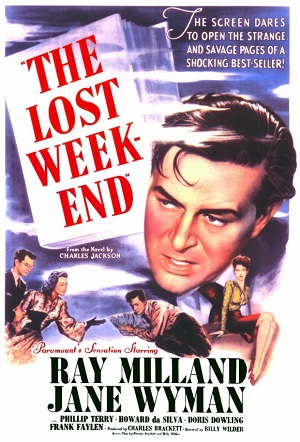
Lisa Reviews An Oscar Winner: The Lost Weekend (dir by Billy Wilder)


The_Lost_Weekend_poster

I’m currently stuck at home on this beautiful day, dealing with a really bad cold.  (Even as I sit here typing this up, I am currently in a feverish haze.)  It’s frustrating but, fortunately, I’ve got a lot of movies to watch.  After all, TCM is wrapping up their 31 Days of Oscars and my DVR is currently full of nominated films waiting to be reviewed.

For instance, I just watched the 1945 best picture winner, The Lost Weekend.  The Lost Weekend was directed by Billy Wilder, a director who is most often associated with sad-eyed comedies like Some Like It Hot, The Apartment, and The Seven Year Itch.  However, The Lost Weekend is most definitely not a comedy.  Instead, it’s an incredibly harrowing and rather depressing portrait of addiction and lost promise.

Don Birnan (Ray Milland) is a struggling writer.  When we first meet him, he’s packing for a weekend trip with his brother, Wick (Philip Terry).  The conversation between Don and Wick at first sounds friendly but soon, we start to hear hints of suspicion in Wick’s voice.  Wick seems incredibly concerned about what exactly Don is packing and Don starts to get defensive.  Don says that it’s been ten days since he had a drink and that there is no more liquor in the apartment.  However, whenever Wick turns his back, Don starts to search for the bottles that he’s hidden around his bedroom.  (He’s even got a bottle of whiskey hanging on a rope outside the window.)  It gets to the point that, whenever Wick isn’t looking, Don is holding a bottle.

And while that may sound potentially humorous, there’s nothing funny about the scene.  Don’s desperation is too real.  As someone who grew up having to deal with an alcoholic father, I recognized Don and his addiction immediately.  Everything about him — from his fast smile to his continual assurances that he’s cleaned himself up — is a facade, designed to help him survive until he can get his next drink.

The main thing about alcoholics is that they’re extremely clever.  Don knows that Wick wants to get him away for the weekend so that he can’t drink.  When Don’s girlfriend, Helen (Jane Wyman), mentions that she has two tickets for a concert, Don convinces Wick to go to the show with her.  Once Wick is out of the apartment, Don can sneak down to the neighborhood bar.  When it comes time to leave for that dry weekend vacation, Don manages to accidentally on purpose miss the train.

Left alone for the weekend, Don can now do what he wants.  He tries to write about his life as an alcoholic but discovers that his brain is too muddled for him to think straight.  So, instead, he drinks.  Unfortunately, Wick hasn’t left him any money and has also ordered all the local bars and liquor stores to not allow his brother to run up a tab.  As a result, Don finds himself scrounging for money.

In perhaps the film’s most famous scene, Don carries his typewriter down to the local pawnshop so that he can get money to buy a drink.  However, the pawnshop is closed for Yom Kippur.  The camera follows Don as he staggers around New York City, looking for an open pawnshop.  Wilder shot this scene on the streets of New York City, using a hidden camera.  The people who we see reacting to Don are not Hollywood extras but instead are actual New Yorkers who had no idea that the pathetic drunk they were gawking at was actually film star Ray Milland.

As the weekend plays out, Don transforms.  He goes from being smooth and outwardly confident to being unshaven and desperate.  Eventually, Don ends up in a sanitarium, where he’s taunted by a sadistic nurse.  (The nurse is played by Frank Faylen, who played Ernie the cab driver in It’s A Wonderful Life.)  Even when Don manages to get back to his apartment, he finds himself screaming as he hallucinates a bat eating a mouse.  Blood runs down the walls.

Does the film, at least, have a happy ending?  It depends.  The local bartender, Nat (Howard Da Silva), returns Don’s typewriter to him.  Helen convinces Don to write about his lost weekend.  Don says that he’s never going to drink again but, at the same time, we can’t help but remember that the movie started with Don saying the same thing…

As directed by Billy Wilder, The Lost Weekend plays out like a noir thriller, full of menacing shadows.  The score, composed by Miklos Rozsa, uses a theremin to let us hear the addiction-fueled chaos within Don’s head.  Best of all, Ray Milland totally loses himself in the role of Don Birnan, with the vanity of film stardom soon replaced with the pathos of addiction.  Even watching the film today, it’s easy to understand how The Lost Weekend won the Oscar for Best Picture of 1945.

Lisa Marie Goes Down On Mildred Pierce (dir. by Michael Curtiz)


A quick note: By titling this post “Lisa Marie Goes Down On Mildred Pierce” I have now not only proven that there’s no dare I will not accept but I’ve also won a small but useful sum of cash.  Never let them tell you that blogging doesn’t pay off.

Like a lot of people, I was looking forward to HBO’s remake of Mildred Pierce, featuring Kate Winslet in the role made famous by Joan Crawford.  And I hate to say it but, as hard as I’ve tried, I simply can not get into this remake.  Maybe it’s because the remake’s director, Todd Haynes, has apparently decided to use five hours to tell the exact same story that the original film told in less than two.  All I know is that the HBO version has, so far, been slow, ponderous, and ultimately a rather dull affair.

As I attempted to stay awake through the remake, I found myself wondering how the original 1945 film compared to the remake.  Fortunately, I just happened to have the original on DVD.  As well, by watching the original Mildred Pierce, I could continue my current mission to see every single film ever nominated for best picture.  (Joan Crawford won the Oscar for Best Actress for her performance as Mildred but the film itself lost Best Picture to Billy Wilder’s The Lost Weekend.)

 Mildred Pierce opens with the murder of sleazy playboy Monty Beragon (Zachary Scott).  Monty’s wife, Mildred (Joan Crawford), responds to the murder by attempting to frame her ex-business partner, the equally sleazy Wally Fay (Jack Carson).  However, the police arrest Mildred’s 1st husband, the well-meaning but really, really dull Bert (Bruce Bennett).  This leads to Mildred going to the police in an attempt to clear Bert’s name.  As the police interrogate Mildred, she tells them (and the film uses flashbacks to show us)  how she went from being a dissatisfied housewife to a succesful businesswoman to finally becoming Monty’s wife.  Through it all, Mildred is motivated by the need to take care of and spoil her manipulative daughter Veda (Ann Blyth).

Seen now, Mildred Pierce is an artifact of different time but, as a secret history nerd, I happen to love studying artifacts.  Like many of the films of the late 40s, Mildred Pierce‘s melodramatic plot serves as a reflection of a culture that, in the wake of World War II, was no longer as smugly complacent about how the world worked.  As I watched Mildred Pierce, the thing I immediately noticed was just how much the film seemed to be suspended between pre-War and post-War culture.  It’s the type of film that goes out of it’s way to acknowledge Mildred’s role as a “new woman” but, at the same time, still finds time to include numerous “comedic” scenes of various men leering at Mildred’s ankles. 

(Actually, I guess they were supposed to be staring at her legs but, since this was the 40s, this could only be represented by an occasional flash of ankle.  Personally, my ankles are okay but I like my legs better.)

Mildred Pierce is often cited as being a forerunner to feminist cinema and I have to admit I have some issues with that.  Yes, the film does acknowledge that a woman can be tough and that a woman can be a succesful businesswoman.  However, the film’s message ultimately seems to be that mothers who work will ultimately raise daughters who will become burlesque dancers and potential killers.  Mildred Pierce doesn’t so much celebrate female independence as much as it fears it.  If only Mildred had remained married to boring and predictable Bert than Veda would never have ended up as a murder suspect.

The question of ideology aside, the original Mildred Pierce remains an entertaining example of old school melodrama.  Director Michael Curtiz was one of those “craftsmen” who, in the 30s and 40s, seemed to direct hundreds of films without ever really establishing any sort of unique style of their own.  Instead, they simply used whichever style that would be most efficient towards dramatizing the script.  For Mildred Pierce, Curtiz imitated the style of a B-movie film noir.  It’s a good approach for this story even if Curtiz doesn’t seem to understand  the shadows of noir quite as well as his contemporaries Billy Wilder or Robert Siodmak.

Of course, Mildred Pierce is best known as the film that won Joan Crawford an Oscar.  I haven’t seen many of Crawford’s films (though I have seen Faye Dunaway playing her in Mommie Dearest) and I’ve got an unapologetic girlcrush on Kate Winslet but I honestly have to say that I prefer Crawford’s version of Mildred to Winslet’s.  Because, as much as I idolize Kate Winslet, she doesn’t seem to so much be playing Mildred Pierce as much as she’s observing her.  Crawford, meanwhile, sank her perfectly manicured nails into the role and pretty much refused to let go until she got her Oscar.  Crawford plays Mildred as a woman so obsessed with survival that she seems to be perfectly willing to destroy the rest of the world if that’s what it takes.  To be honest, it’s really not a great acting job but it certainly is fun to watch. Technically, Winslet gives the better performance but Crawford is a lot more entertaining.

(That said, I still love Kate and I actually would probably fall at her feet and say, “Thank you,” if I ever met her in real life because she’s really one of my heroes.  Physically, I developed early and I had to deal, at way too early an age, with a combination of a physical maturity and emotional immaturity.  By the time I was 13, I was so totally overwhelmed by the insecurity and uncertainty but then I read an interview with Kate Winslet in which she said, “I like having tits and an ass.”  And that, to be honest, was the first time I had ever come across anyone saying that it was okay to like your body.  So, anyway, the point of all that is that I love Kate Winslet.)

Crawford pretty much dominates the entire film but a few of the other performers do manage to make an impression.  As Mildred’s ex-husband, Bruce Bennett is pretty boring but the other men in Mildred’s life are well-played by Jack Carson and Zachary Scott.  Scott especially was well-cast as the type of guy that we always says we’re done with just to end up hooking up with them whenever we’re at our weakest.  As Veda, Anne Blyth gives such a driven and intense performance that you actually believe that she could be the daughter of Mildred Pierce.

In the end, Mildred Pierce isn’t really a great film but it is a lot of fun and that’s a definite improvement on the current remake.