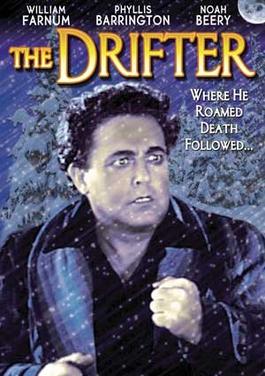
 “This town ain’t big enough for the both of us.”
This line, which has been recycled in so many western parodies, is actually used seriously in The Drifter, a forgotten western from the pre-code era. The line is delivered by Montana (Russell Hopton) and he’s speaking to a mysterious character known only as The Drifter (William Farnum).
The Drifter is a French-Canadian who has spent decades searching for his lost-lost brother but who is now ready to go into town, get work as a logger, and hopefully find a woman to marry. Along with a mysterious man who is named Whitey and who is played by Charles Sellon, The Drifter is hired to work for local lumber magnate, John McNary (Noah Beery). The Drifter impresses everyone with his good hearted ways and he falls in love with McNary’s daughter, Bonnie (Phyllis Barrington). Unfortunately, Phyllis is already dating Paul LaTour (Bruce Warren), who is her father’s main business rival. But before The Drifter can concentrate on winning Phyllis away from LaTour and also solving the mystery of his own missing family, he has to deal with the most dangerous man in town, Montana. As Montana puts it, the town’s not big enough for both him and The Drifter.
The Drifter‘s story is potentially interesting but the low-budget, the shoddy production values, and a slow pace all conspire to do the film in. This was one of the countless western programmers that was produced in the early 30s. Like many of the other poverty row productions of the era, it starred an actor who had been huge during the silent era but who struggled to find work during the early years of the sound era. William Farnum started as a stage actor and as a protegee to Edwin Booth, who was largely considered to be America’s finest stage actor even if he was forever tainted by being the brother of presidential assassin John Wilkes Booth. Farnum’s very theatrical style of acting made him perfect for both Broadway and for the silent film era, a time when actors had to use big movements and dramatic facial expressions in order to convey their emotions. When the sound era came along, Farnum’s style was suddenly no longer in vogue and, unfortunately, it took him a while to adjust to working with sound. Even in a sound film like The Drifter where he had dialogue, Farnum gives the type of overly theatrical performance that was more common during the silent era. What’s interesting is that Farnum’s performance actually works for the character of The Drifter, who is meant to be an outsider who struggles to communicate with other people. Despite some implausible twists at the end, the rest of The Drifter isn’t as interesting.
Farnum eventually did adjust to the sound era and he became a respected character actor, playing many captains and many judges. In 1953, when he died at the age of 76, Hollywood turned out to pay their respects. Cecil B. DeMille and Paramount Picture co-founder Jesse B. Lasky served as pallbearers.
 How much keeffe is in this movie?
 Through the Shattered Lens