The great Alec Guinness, one of the best actors of all time, was born 124 years ago on this date.
Today’s scene of the day comes from the film that won Guinness the Oscar for Best Actor, 1957’s The Bridge on the River Kwai. In that film (which was one of many that Guinness made with director David Lean), Guinness plays Col. Nicholson, a British POW who is tasked, by the Japanese, with building a bridge. Though many of his men claim that it will mean collaborating with the enemy, Col. Nicholson feels that the bridge should be a symbol of British ingenuity. As Nicholson explains it, the bridge will show what the British are capable of doing, even under the most trying of circumstances. Eventually, Nicholson’s obsession with showing up his captors by constructing the perfect bridge blinds him to everything else that is going on.
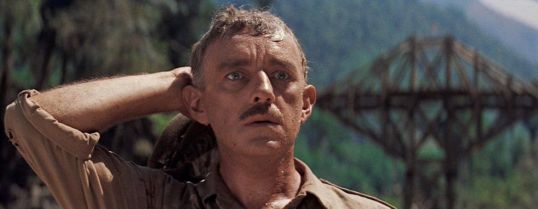
In this scene, Nicholson reveals just how obsessed he has become. It’s a phenomenal piece of acting from Guinness, an actor who — up until the film — was largely known for his comedic performances.
4 Or More Shots From 4 Or More Films is just what it says it is, 4 shots from 4 of our favorite films. As opposed to the reviews and recaps that we usually post, 4 Shots From 4 Films lets the visuals do the talking!
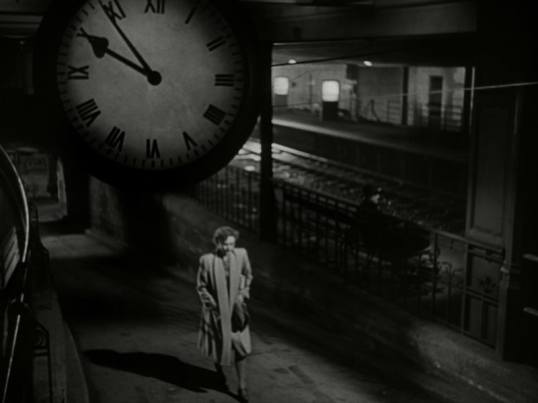
Today, we celebrate the birth and the legacy of the great British director, David Lean! He was born 114 years ago today and went on to become one of the most important and influential directors of all time. Lawrence of Arabia is still held up as one of the best adventure films ever made. My personal favorite Lean film remains Brief Encounter. Here are….
4 Shots from 4 David Lean Films
Brief Encounter (1945, dir by David Lean, DP: Robert Krasker)
The Bridge on the River Kwai (1957, dir by David Lean, DP: Jack Hildyard)
Lawrence of Arabia (1962, dir by David Lean, DP: Freddie A. Young)
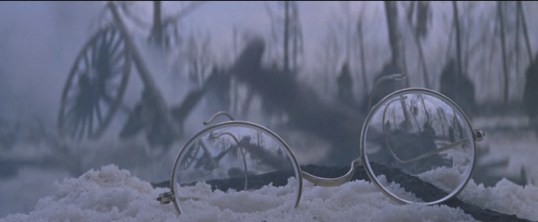
Doctor Zhivago (1965, dir by David Lean, DP: Freddie A. Young)
Last night, after I watched Captains Courageous, I continued to clean out the DVR by watching the 1957 film, The Bridge On The River Kwai.
The Bridge On The River Kwai is a great film but it’s not necessarily an easy one to review. It’s always easier to review a film when you can be snarky and dismissive but The Bridge On The River Kwai is one of the few films that can truly be called great. Everything about it — from the directing to the cinematography to the script to the acting (especially the acting!) — works. It’s a 3 hour film that never drags. It’s a rousing and exciting adventure story that also works as an anti-war film. As directed by David Lean, it’s probably about as perfect as a film can get.
The Bridge On The River Kwai takes place during World War II and really, it’s two films in one. One film tells the story of Shears (William Holden), a POW at a Japanese prison of war camp in what was then Burma and what is now Myanmar. Knowing that, under the rules of the Geneva Convention, officers are exempt from manual labor, Shears pretends to be a commander. However, when the camp’s commandant, the harsh Col. Saito (Sessue Hayakawa), announces the all prisoners — regardless of rank — will have to build a railway bridge over the River Kwai, Shears manages to escape. With the help of local villagers, Shears makes it to an Allied hospital.
It’s at the hospital that Shears has a two-scene romance with a nurse because the film’s producer, Sam Spiegel, was worried that the film was too male dominated. It’s also at the hospital that Shears is informed that he will be returning to the POW camp, with a group of British commandos, on a mission to destroy the bridge. When Shears explains that he’s not even an officer, British Maj. Warden (Jack Hawkins) explains that’s why the Americans have agreed to let the British use Shears for their mission.
The film’s 2nd storyline deals with Col. Nicholson (Alec Guinness), the senior British officer at the POW camp. When we first meet Nicholson, he’s in a battle of wills with Saito. When Nicholson insists that no officer will work on the bridge, Saito first forces all of the British officers to spend an entire day standing in the heat. When that doesn’t work, Saito has Nicholson locked in an iron box. However, Nicholson refuses to back down and becomes a hero to the other prisoners. Realizing that the bridge will never be finished on time and that he will be required to commit suicide because of his failure, Saito decides to take a different approach to dealing with Nicholson.
After releasing Nicholson from the iron box, Saito shows him the poor job that the British prisoners have been doing on the bridge. Saito appeals to Nicholson’s vanity.
And it turns out that Col. Nicholson is a very vain man indeed.
Soon, Nicholson is ordering his men to do a good job on the bridge, announcing that they are going to show the Japanese what the British can accomplish. Nicholson claims that the project will be a morale booster and that the bridge will be a permanent monument to British ingenuity.
This part of the film is an unexpectedly nuanced character study and Guinness gives a brilliant performance. For the film’s first hour, Nicholson is our hero but then, just as suddenly, he reveals himself to be a far more complicated character and our feelings towards him become much more mixed. We’re forced to reconsider everything that we previously felt towards him. Was Nicholson standing up for his men because it was the right thing to do or was he doing it because he desired the camp’s adulation? His motives are complicated and difficult to figure out and the implications are, at times, rather frightening. About the only thing that can definitely be said about Nicholson is that he becomes so obsessed with showing what the British can do that he loses sight of what the Japanese are going to do with that bridge once it is complted. Nicholson’s short-sightedness become a metaphor for blind nationalism and war in general.
When these two storylines finally intersect, it leads to one of the most justifiably climaxes in cinema history, one that leads one of the film’s few surviving characters to exclaim, “The madness, the madness!”
As I mentioned earlier, The Bridge On The River Kwai won the Oscar for best picture and for once, not even I can disagree with the Academy.


 Through the Shattered Lens