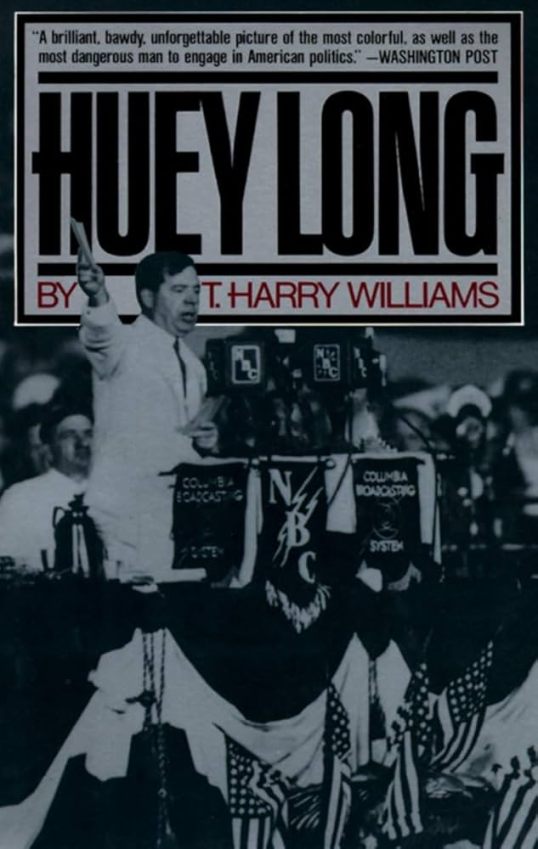
If you’ve got a lot of time to kill this weekend and if you’re interested in how a dictator could come to power in the United States of America, check out Huey Long by T. Harry Williams.
The winner of 1970’s Pulitzer Prize and the National Book Award, this 900-page book tells the story of Louisiana’s Huey Long. Long went from being an outsider to being governor of his state to being a member of the United States Senate and finally, to the verge of running for the presidency. The only that that stopped Huey from running for President in 1936 were multiple bullets, at least one of which was fired by the son of a political rival. (The majority of them were probably fired by Long’s own bodyguards, with Huey falling victim to “friendly fire.”) Huey was a controversial figure, a socialist who talked like a populist, a clever politician who pretended to be a buffoon, and a leader who was hates by many but who was also so beloved by many other that his family held control of Louisiana politics for decades after his death.
I first bought this book in high school. My history teacher had assigned the class to write book reports about a political figure. My teacher was impressed when I said that I would be writing about Huey Long. Of course, I put off writing the report until the day before it was due. I also put off reading (and, for that matter, even opening) the book. When I mentioned this to my mom, she took one look at the 900-page biography that I hadn’t even started to read, and said, “Why did you pick such a long book!?”
(I always pick the longest books I can find. I like to read and, when it comes to biographies, I like to get all the details.)
For the next few hours, I skimmed through the book as I wrote my report. I wrote about his early political campaigns, the role he played in the elections of both Woodrow Wilson and Franklin Roosevelt, and the steady stream of corrupt flunkies that he brought into Louisiana’s government. I included the details of Huey Long’s Share The Wealth plan and explained why Huey’s scheme was just a bunch of commie propaganda. My teacher gave my report a 100 (and he added an “A++,” which he circled in red!), said that it was good enough for college, and commended me on my hard work. My mom read my teacher’s comments and said I had more lives than a cat.
Even just skimming the book, I found Huey’s story to be fascinating. He stood up to the power brokers. He fought for the poor. He took kickbacks from the same corporations that he claimed to despise. He treated Louisiana like his own fiefdom. He might have ordered a few murders. And, years later, when I sat down and actually read the book, I discovered that Huey’s life was even more interesting than I initially realized. Huey Long may be 900 words long but he lived his life in such an over-the-top fashion and the times in which he lived were so interesting that the book becomes a surprisingly quick read. It helps that T. Harry Williams was a lively writer. This isn’t some slow-moving, self-consciously scholarly tome. This is a book that really captures the unique oddness of Louisiana and its politics.
If you’re looking for a long but rewarding read and if you’re a history nerd like me, check this book out. And then watch All The King’s Men (the original, not the remake!). Willie Stark, the governor at the heart of All The King’s Men, was based on Huey Long. Somehow, Long lived a life that was even more dramatic than his fictional counterpart.
(Check out last week’s Books For The Weekend here!)
 Through the Shattered Lens