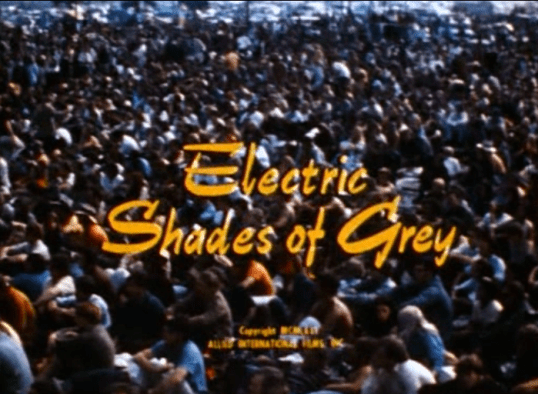
 First things first, the 1971 film Electric Shades of Grey is not a prequel to 50 Shades of Grey. There’s no Red Room to be found in Electric Shades of Grey. There’s no Anastasia Steele. There is no Christian Grey.
Instead, Electric Shades of Grey is about a man named Father John (John Darrell). When we first meet John, he’s just another kinda long-haired, stoned-looking man wandering around an outdoor, hippie-filled concert. He stops long enough to watch a fire-and-brimstone preacher giving a sermon about how all the hippies are going to go to Hell.
“Is that what I used to sound like?” John wonders.
John, it turns out, used to be a priest and taught at a Catholic school. One day, he saw a group of long-haired students sitting outside, smoking weed, and drinking. When John approached the students and reprimanded them for skipping class, one of them handed him a paper cup full of what John thought was harmless soda. Instead, the soda was spiked with LSD and soon, John was having a bad trip.
Now, I’ve seen a lot of cinematic acid trips and most of them try way too hard. The trip in Electric Shades of Grey is actually handled fairly well. John sees strange faces talking to him. Colors spin around him. And finally, John listens to a disembodied voice that might be the voice of God or might just be a part of his trip.
One scene later and John is walking out of the church. His hair is a little bit longer and he’s stopped shaving. He’s no longer wearing his collar. John has seen a new reality and now, he has to do the whole “finding himself” thing. As John explains later in the film, he’s no longer sure if he’s even a priest any more.
John drives across America. He picks up a hitchhiker named Sally. He smokes weed at a commune. He helps to deliver a hippie girl’s baby. He meets a black doctor who is also trying to find himself. He and his friends also meet several rednecks and other establishment types, the majority of whom have decided that they don’t like hippies. “Hippies look like a Jill and smell like a john! Hahahahahahahahaha!” screams one old man who then adds, “That’s pretty funny, ain’t it!? Looks like a Jill and smells like a john…”
(No wonder everyone wanted to drop out of society…)
And, of course, people die. Traveling John occasionally feels a bit like the Angel of Death because it seems like everyone that he hangs out with eventually ends up getting killed by people who probably voted for George Wallace in 1968.
Eventually, John has to decide — is he a dropout or is he a priest?
Electric Shades of Grey is an interesting film. It’s very low-budget and the acting is inconsistent but, at the same time, it’s an interesting time capsule. Like many independent, low-budget films from the late 60s and early 70s, it was shot guerilla style. Hence, when John is seen driving down the highway, he’s on a real highway and he’s passing cars being driven by real people, the majority of whom probably have no idea that their car was immortalized in a movie. When he stops off in a small town that’s not particularly friendly to counter-culture types, he’s stopping off in a real small town that, at the time, was probably not particularly friendly to counter-culture types. When people passing by stop to stare at John and his new counterculture friends, these are real people having real reactions. As a result, the film works as a time capsule.
There’s some debate about whether or not Electric Shades of Grey actually got a theatrical release. However, it has been released (under the title The Psychedelic Priest) on DVD by Something Weird Video.
 Through the Shattered Lens