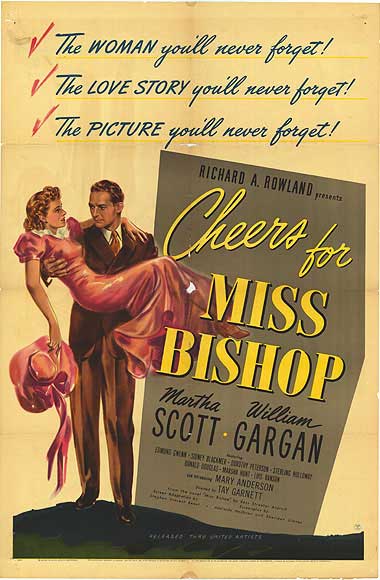
The 30th film in Mill Creek’s Fabulous Forties box set is the 1941 melodrama, Cheers For Miss Bishop. Cheers For Miss Bishop is a bit like an Americanized version of Goodbye, Mr. Chips. The story of Cheers For Miss Bishop, largely told via flashback, deals with a retired teacher who never quite got what she wanted out of life but still had a profound impact on all of her students.
The film opens with elderly Miss Bishop (played by Martha Scott) alone in her house. The time is the 1930s and Miss Bishop is nearing retirement and somewhat bitter over ending her years having never married. Prominent businessman Sam Peters (William Gargan) comes to the house and they start to recollect. We flashback to the 1880s, when Miss Bishop was preparing to go to college and Sam was just the local grocery boy. Sam was in love with Miss Bishop and, it’s suggested, that she loved him as well. But she was determined to go to college whereas Sam was determined to go straight into business.
With the support of the kindly Prof. Corcoran (Edmund Gwenn, giving a performance that pretty much epitomizes what we mean when we call someone a kindly professor), Miss Bishop got a job teaching English at Midwestern College. She was a popular teacher, one who not only inspired her students but who was also willing to stand up for them. Eventually she met and became engaged to a local lawyer, Delbert Thompson (Don Douglas). However, her heart was broken when Delbert ran off with another woman. Years later, she fell in love with another professor (Sidney Blackmer), with the only problem being that he happened to be married.
But that’s not all that Miss Bishop had to deal with. She also ended up adopting and raising Hope (Marsha Hunt) after Hope’s mother died in childbirth. As she got older, she became frustrated when the younger college administrators demanded that she adapt with the times. Miss Bishop also had to deal with her frequent romantic rival and cousin, the impulsive Amy (Mary Anderson).
Amy, I should mention, was my favorite character in Cheers For Miss Bishop, even though I don’t think that was the film’s intention. Some of that is because Mary Anderson totally embraced the melodramatic potential of her character, often going totally over-the-top in a way that still seemed perfectly natural. But there’s also the fact that Amy, as opposed to the often painfully inhibited Miss Bishop, had no boundaries. She knew what she wanted and she went for it, without apology. Amy may not have been a big role but she still dominated every scene that she appeared in. Amy demanded attention and good for her!
That said, the title of the film is Cheers For Miss Bishop and not Cheers For Amy. Ultimately, it’s a tribute to Miss Bishop and to teachers everywhere. It’s an extremely predictable and sentimental film but it does what it does fairly well. Occasionally, I got frustrated with Miss Bishop as a character (she was always so prim, proper, and respectable! Plus, there’s a scene where she gives a student from North Carolina some trouble about his accent, saying that he needs to take her English class and, if you know how I feel about actors from up north trying too hard to sound like they’re from the South, you can imagine how I felt about that scene) but Martha Scott gave a good performance. In the end, it’s a sweet little movie. And you can watch it below!

 Through the Shattered Lens