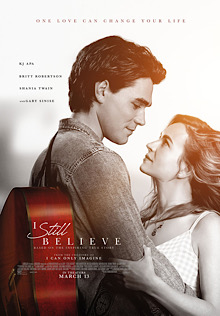
I Still Believe is based on the true story of musician Jeremy Camp (played by KJ Apa) and his first wife, Melissa Henning (Britt Robertson). Jeremy meets Melissa in college. They become friends. They try to date but the relationship is complicated by the fact that Jeremy’s mentor, Jean-Luc LaJoie (Nathan Parsons), is also in love with Melissa. Over the Christmas break, Melissa is taken ill and discovers that she has Stage 3C liver cancer. Jeremy and Melissa marry and try to find happiness and maintain their faith in the time that Melissa has left. Though Jeremy grows angry and has his moments of doubts, Melissa remains convinced that, though it may be hard to understand, there is a deeper reason for her suffering and it’s all apart of a bigger plan.
I Still Believe is the type of film that will bring out the cynic in most professional critics. That said, it’s also the type of film that’s pretty much critic-proof. It really doesn’t matter how much time or energy one might spend criticizing the film or its script or its belief system, the target audience of I Still Believe will love the film. I Still Believe is a film that’s either going to inspire snark or it’s going to inspire tears. It all depends on how you feel about the idea of a terminal illness all being a part of God’s plan.
(As far as that’s concerned, I’ll be keeping my own opinion to myself.)
Unlike a lot of the faith-based films that I’ve reviewed for this site, I Still Believe actually feels like a real movie. As opposed to the God’s Not Dead films, there are no cardboard atheists standing around and waiting to be shown up by the clever heroes asking how they can be angry at God if God doesn’t exist. The film, for the most part, avoids the trap of getting preachy and, to its credit, it treats Jeremy’s moments of doubt with respect. It doesn’t shame him for getting upset over something that, regardless of what you may or may not believe, seems terrible unfair. KJ Apa and Britt Robertson are both appealing performers and they have a believable chemistry as Jeremy and Melissa. Finally, the film look gorgeous. The farmlands of Indiana and the California campus where Jeremy and Melissa meet both feel vibrantly alive in this film.
At the same time, there’s nothing particularly surprising about I Still Believe. It’s a predictable film and the minute that Jeremy gets that phone call telling him that Melissa has been taken to the hospital, you’ll be able to guess everything that’s going to follow. If you’re not inclined to view Christian faith sympathetically, the film will not change your mind. When I was looking over some of the other reviews of this film, the most common complaint I saw was that the film “preaches to the choir.” It’s a valid complaint but, at the same time, I think it can also be argued that almost every film ever made has preached to one choir or another. You could say the same thing about the political films of Adam McKay and Jay Roach or, for the matter, the majority of outspokenly anti-religious films. Most message films tend to appeal to an audience who already agrees with what the film has to say. Typically. when someone complains that a film preached to the choir, what they’re really saying is, “It didn’t preach to my choir.”
I Still Believe is a well-made film that will probably be best appreciated by people who already share its view of life and religion. Though production on the film obviously started before the pandemic, it does feel like a film specifically made for these quarantined times. It’s a film that argues the faith and strength can be found in even the worst of circumstances. Whether that’s true or not is up to the viewer to decide.
 Through the Shattered Lens