Gary Farrell (Buster Crabbe) is a widowed truck driver who wants his son to have a better life than his old man. Good luck pulling that off on a salary of $45 a week. Gary enters a boxing tournament, just hoping to win enough money to pay for his son to go to military school. But, under the tutelage of veteran trainer Pop Turner (Milton Kibbee), Gary becomes a real contender. He also becomes a first class heel, turning his back on his old, honest lifestyle and getting involved with fast-living socialite, Rita London (Julie Gibson). Can Gary’s friends and newspaper reporter Linda Martin (Arline Judge) get Gary to see the error of his ways?
The Contender, which is in the public domain and can be viewed at the Internet archive, is a typical poverty row production, with all the expected boxing clichés. Gary’s initial rise is just as predictable as his downfall and eventual redemption. For fans of Buster Crabbe, though, it is a chance to see Crabbe playing someone other than Tarzan, Flash Gordon, or Buck Rogers. (Crabbe was the only actor to play all three of these roles over the course of his long career. He also appeared as Billy the Kid in several westerns.) Though he was a swimmer and not a boxer, Crabbe’s natural athleticism made him a good pick for the role of Gary. Julie Gibson is sexy and fun as the bad girl and be sure to keep an eye out for Glenn Strange, who plays Gary’s best friend. Just as Crabbe was forever typecast as Flash Gordon, Strange will always be remembered for replacing Boris Karloff in the role of Frankenstein’s Monster.
After I watched The Red House, I watched the 8th film in Mill Creek’s Fabulous Forties box set, a 1945 film noir called The Lady Confesses.
Mary Beth Hughes plays Vicki McGuire, who is engaged to marry Larry Craig (Hugh Beaumont). When we first meet Larry, he seems like a fairly normal guy. He drinks too much but then again, this film was made in 1945 and it’s totally possible that Larry had yet to see The Lost Weekend. Before getting engaged to Vicki, he was married to Norma Craig (Barbara Slater). Norma disappeared seven years ago and has since been declared legally dead. So, imagine everyone’s surprise when Norma suddenly turns up alive and knocking on Vicki’s front door! Norma announces that there’s no way that she’s going to give up Larry.
Larry reacts to all this by going out and getting drunk. He spends a while literally passed out at the bar and then, once he’s sobered up, he and Vicki go to visit Norma and try to talk some sense into her. However, upon arriving at her apartment, they discover that Norma has been strangled!
The police automatically suspect Larry of being the murderer but he has an alibi. He was drunk. He was passed out at the bar. And the only time he wasn’t at the bar, he was sleeping on a couch in the dressing room of singer Lucille Compton (Claudia Drake)…
Wait! Larry was sleeping on another woman’s couch? Well, Vicki isn’t necessarily happy to hear that but she still believes that her fiancée is innocent and she’s willing to do whatever it takes to clear his name, even if it means going undercover and working at a nightclub. Vicki and Larry suspect that nightclub owner Lucky Brandon (Edmund MacDonald) is the murderer. Can they prove it or, waiting around the next shadowy corner, is there another twist to the plot?
It’s not a spoiler to tell you that there’s another twist. In fact, for a film that only runs for 64 minutes, there’s a lot of twists in The Lady Confesses. The Lady Confesses is an entertaining film noir, one that gives B-movie mainstay Mary Beth Hughes a rare lead role. As well, if you’ve ever seen an old episode of Leave It To Beaver, it’s quite interesting to see Hugh Beaumont playing a somewhat less than wholesome character. Director Sam Newfield, who directed over 254 films during the course of his prolific career, keeps the action moving and provides a lot of menacing and shadowy images.
Though it may not be perfect (for one thing, we never learn why Norma disappeared in the first place), The Lady Confesses is a watchable and atmospheric film noir. And you watch it below!
Do you know what time of year it is!? Well, yes — it is August and soon it will be September. But even more importantly, it’s back to school time! Summer is over and, all across the country, children and teenagers alike are getting ready to return to school. Some schools in America have already opened. In my part of Texas, school is officially starting on August 25th. So, what better time than now for the Shattered Lens to go back to school? Over the next 8 days, we’ll be taking a chronological look at 76 films about teenagers and high school.
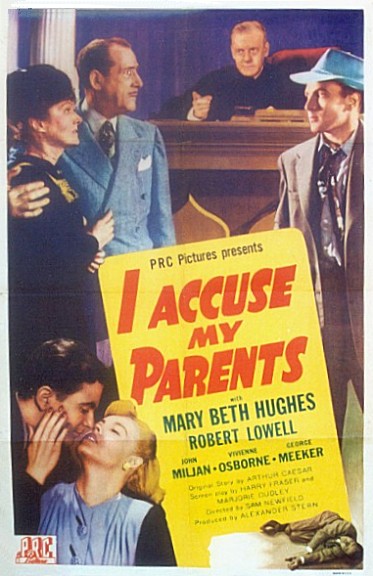
And what better film to start with than the low-budget 1944 look at juvenile delinquency, I Accuse My Parents? Well, technically, there’s probably a lot of better films that I could start with but, to be honest, I just love this film’s title. I Accuse My Parents. It’s just so melodramatic and over the top, much like this film itself. And yet, the title also carries a hint of the truth. After all, who hasn’t accused their parents at one point in their life?
I Accuse My Parents opens with Jimmy Wilson (Robert Lowell) standing in a courtroom and being addressed by a stern-sounding judge. Despite the fact that Jimmy appears to be in his early 30s, the film continually assures us that he’s a teenager. He’s been accused of manslaughter and, as the judge tells us, he has apparently failed to provide any help to his defense lawyers. Does Jimmy have anything to say in his defense? Jimmy looks down at the floor, obviously deep in thought. Finally, he looks up and says, “I accuse my parents.”
“OH MY GOD!” everyone in the courtroom says in unison. Or, at least, they would have if this film hadn’t been made in 1944. Instead, they simply gasp in shock.
It’s flashback time! We see that before Jimmy became a murderous criminal, he was just your normal 30 year-old high school student. He even won an award for writing an essay about how wonderful his parents were. Little did his fellow students suspect that Jimmy’s mom was actually a drunk and his father was more concerned with business than with raising his son. When Jimmy’s mom showed up at the school drunk, all of Jimmy’s friends saw her and laughed. Jimmy’s essay of lies had been exposed!
Even worse, when Jimmy got an after-school job as a shoe salesman, he met and fell in love singer Kitty Reed (Mary Beth Hughes). Little did Jimmy suspect that Kitty was also the mistress of gangster Charles Blake (George Meeker). Blake recruited Jimmy to start delivering stolen goods. Unfortunately, award-winning essay aside, Jimmy was a bit of an idiot and never realized, until it was too late, that he was being drawn into a life of crime. Even worse, his father was too busy working and his mother was too busy drinking to see what their son was getting involved with.
I have a soft spot in my heart for films like I Accuse My Parents. These films take place in a world where the worst thing that can happen will always happen. Being neglected by his parents doesn’t just leave Jimmy feeling angry or resentful. Instead, it leads to him meeting a gangster and becoming a criminal. And while most of the on-screen evidence would suggest that Jimmy’s main problem is that he’s a little bit stupid (and that would certainly explain why, despite clearly being in his 30s, Jimmy is still a senior in high school), the film wants to make it very clear that all of this could have been avoided if only he had better parents.
Add to that, it’s interesting to see that, even in the 1940s, it wasn’t easy being a teenager!
Finally, it should be noted that the film ends with a note letting us know that the producers had shipped copies of the film off to our fighting forces in Europe, which I think was sweet of them. (Though I have a feeling that the soldiers might have preferred something featuring Lana Turner…)
 Gary Farrell (Buster Crabbe) is a widowed truck driver who wants his son to have a better life than his old man. Good luck pulling that off on a salary of $45 a week. Gary enters a boxing tournament, just hoping to win enough money to pay for his son to go to military school. But, under the tutelage of veteran trainer Pop Turner (Milton Kibbee), Gary becomes a real contender. He also becomes a first class heel, turning his back on his old, honest lifestyle and getting involved with fast-living socialite, Rita London (Julie Gibson). Can Gary’s friends and newspaper reporter Linda Martin (Arline Judge) get Gary to see the error of his ways?
 Through the Shattered Lens