October Positivity: Whitcomb’s War (dir by Russell Doughten, Jr.)


This 1980 film takes place in the town of Hurrah, Iowa.  One of the opening scenes features Pastor David Whitcomb driving up to Hurrah and stepping out of his car to take a look at the city limits sign.  Hurrah has a population of a little over 3,000.  Apparently, almost all of them belong to the same church and everyone works for the same factory.

Unfortunately, the owner of the factor is not a member of the church.  In fact, onery old Phil Esteen (say the same quickly) is determined to shut the church down by scheduling everyone to work on Sundays.  As a result, hardly anyone is able to attend any of Pastor Whitcomb’s sermons.  The pastor finds himself preaching to a church that is full of children whose parents are working at Esteen’s factory.  When people complain about Esteen’s tactics, Esteen threatens to move his company to the nearby town of Riverton, which apparently has a river.  Phil Esteeen loves to talk about that river.

Whitcomb is upset to discover that people in his church hate Esteen and view him as being unredeemable.  Whitcomb says that’s not a good attitude.  A huge reason why people have that attitude is because there’s a group of demons living in the church basement.  (They may be demons but essentially, they just look like a bunch of community theater actors wearing red shirts.)  They’ve been tasked with making the pastor’s life difficult.  The demons have a bulky personal computer that they use to type up their evil plans and which they occasionally turn to for advice.  The computer itself is treated as being a sort of exotic oddity.  One gets the feeling that 1980 audiences were expected to look at the computer and think, “What type of twisted creature would actually travel with one of those things!?”

When the women of the church lead a protest against Esteen’s business practices, it just makes Esteen all the more determined to keep people working on Sundays.  Pastor Whitcomb realizes he’s going to have to try something different to reach Esteen and convince him to change his ways.  Can he do it?

(Personally, I think the whole problem could have been solved by the employees forming a union or all quitting at the same time or maybe the church holding more than one service during the day.  My point is that there seemed to be many potential solutions that no one in this film ever considered….)

This was one of director Russell Doughten’s do-it-yourself regional productions.  He directed and self-distributed several of these films in the 70s and 80s.  Seen today, this films are grainy time capsules of the distant past.  Doughten’s didn’t exactly make films that featured nuanced discussions of theological issues.  He was frequently a heavy-handed filmmaker, working in a genre that was specifically designed to be magnify those self-righteous impulses.  At the same time, there’s something undeniably charming about just how cheap most of his Iowa-shot films looked and just how enthusiastically they were acted by their largely amateur casts.  (And yes, the term to  remember is “enthusiastically” as opposed to “convincingly.”)  Much as with Ed Wood, Doughten’s appeal is less about his films and more about his refusal to let a lack of funds or a lack of talent stand in the way of bringing his vision to the screen.  A film like Whitcomb’s War has a ton of technical flaws but seen today, it’s definitely a time capsule of the era in which it was made.  Watching it means taking a trip to the past, to an era when computers were still exotic and even the Devil had to use a landline phone to communicate with people.

Incidentally, I did a google search and apparently, the town of Hurrah, Iowa no longer exists.  Maybe everyone moved closer to the river after all.

October Positivity: The Prodigal Planet (dir by Donald W. Thompson)


The last film in the Thief In the Night series, 1983’s The Prodigal Planet picks up where Image of the Beast left off.  Computer technician and post-Rapture Christian David Michaels (William Wellman, Jr.) is on the verge of being sent to the guillotine when he’s rescued by Connie (Terri Lynn Hall).  Connie may be wearing the uniform of UNITE and she may have the mark of the beast but she insists to David that she is actually on his side.  Not having much choice but to believe her, David joins Connie in a military grade RV.  They drive away from Des Moines just as a nuclear explosion takes out the whole city.

After seven years of being ruled over by Brother Christopher and the UN, the world is on the verge of ending.  (As the film’s narrators informs us, “Plane Earth is dying and the disease is sin.”)  Nuclear war has broken out, destroying cities and killing the majority of the citizens.  David is determined to get to Albuquerque, where he and a group of Christians plan to wait for the final judgment.  Government agent Jerry (Thom Rachford), who is one of only two characters to have appeared in every Thief In The Night film, is close behind but both he and his men are starting to show the signs of radiation sickness.

(Russell Daughten also returns as the Rev. Matthew Turner, with his apocalypse chart that explains each step of the end of the world.  Daughten’s role is small in this one, which is a shame as his grim Santa Claus screen presence was one of the best things about Image of the Beast.)

Along with the remnants of UNITE and a few survivors who have yet to take the mark, the world is also populated by “mutants,” humans whose faces are permanently scarred by the radiation.  They dress like monks and stalk empty and deserted city streets.  Their goal is to destroy anyone who they believe is responsible for the end of the world.  David and Connie rescue a scientist named Linda (Lynda Beatie) and her teenage daughter, Jodi (Cathy Wellman), from a group of mutants.  Linda is wracked with guilt because she previously put all her faith in science.  Jodi is bitter over how the world has turned out and, initially, she’s upset when David allows a mutant named Jimmy (Robert Chestnut) to join them in their journey.

With The Prodigal Planet, it’s obvious that director Donald W. Thompson had hopes of setting up an epic conclusion for the Thief in the Night films.  Not only does the film move the action out of Iowa and into other parts of the country but the film also runs for 127 minutes.  (By comparison, A Thief In The Night barely last over an hour.)  Unfortunately, most of that running time is taken up with David talking and trying to convert everyone that he meets.  On the one hand, considering what’s going on in the film’s world, it makes sense that David would do that.  On the other hand, it doesn’t exactly make for exciting viewing.  A film that features nuclear explosions and mutants should never be this slow or boring.  If the previous Thief In The Night films achieved a dream-like intensity, The Prodigal Planet dutifully plods along.  For every scene that works (like an extended sequence in which Linda and Jodi explore a city that isn’t as deserted as it first appears), there are other dramatically inert scenes that encourage the viewer to just about anything other than pay attention to what is happening on the screen.

(It doesn’t help that William Wellman, Jr. — despite appearing to be the only professional actor in this film — displays a bit of a blah screen presence in the role of David.  The scene where he tells Jodi that she’s spoiled because she’s pretty fails not because he’s necessarily wrong about Jodi as much as because Wellman can’t make David’s “tough love” approach compelling.  He just comes across as being a jerk.  The series was better off when the less polished but far more sincere Patty Dunning was the lead character.  As for Wellman, he was far more interesting as the morally conflicted national guardsman in The Trial of Billy Jack than he is here.)

Donald W. Thompson hoped to make a fifth Thief In the Night film, one that would feature The War in Heaven and bring the story to its prophesized conclusion.  Unfortunately (or not), he was never able to raise the money to do so.  And, as such, the saga of UNITE, Brother Christopher, and David Michaels came to a close with The Prodigal Planet.

October Positivity: Image of the Beast (dir by Donald W. Thompson)


1981’s Image of the Beast picks up from where A Distant Thunder ended.

The world is in economic and political chaos, largely as a result of millions of people vanishing a few years before.  (The government says the people were abducted by UFOs but everyone left behind knows it was actually the rapture.)  Brother Christopher and the United Nations are controlling the world.  Order is kept by UNITE.  Those who fail to get the Mark on either their palm or their forehead are not allowed to buy food or get healthcare.  In fact, Brother Christopher has declared that the mark is no longer optional and anyone who refuses to get it will be executed.

A Distant Thunder ended with Patty Myers (Patty Dunning) facing the guillotine and that’s where Image of the Beast picks up.  She is given one final chance to voluntarily take the mark before being put under the blade but, in obvious fear and shock, Patty says nothing.  Two UNITE soldiers tie her the ground, with her neck directly under the guillotine’s blade.

Finally, Patty yells, “I want the mark!”

However, at the same time that Patty makes the declaration, an earthquake hits and the skies turn black.  The cowardly soldiers run off, leaving Patty under the blade.  Realizing that she is witnessing the breaking of one of the apocalyptic seals, Patty attempts to free herself from her bounds.  Unfortunately, she moves around so much that the loosened blade comes crashing down and she promptly loses her head.

So much for Patty!

The action then shifts to a new character, a Christian rebel named David Michaels (William Wellman, Jr., who also played a different role in every single Billy Jack movie).  David, who has disguised himself as a member of UNITE, is looking for Leslie (Wenda Shereos), another Christian who escaped from execution during the earthquake.  David doesn’t find her but he does stumble upon Kathy (Susan Plumb), Kathy’s son (Ben Sampson), and the Rev. Matthew Turner (Russell S. Doughten, JR., who not only produced the Thief In The Night films but who also directed films like Nite Song).  Rev. Turner lives in a farmhouse and looks a lot like Santa Claus.  He has a helpful graph on his wall that can be used to understand just how far along the world is into the apocalypse.

As Rev. Turner explains it, computers are the new “golden calf.”  Why, people believe that computer can do anything better than humans!  They’re letting computer run their lives and Brother Christopher is using that to his advantage!  (Keep in mind, this film was made in 1981 so the computer that he’s talking about are those big, boxy computers that took hours to do the simplest tasks.)  Fortunately, David used to be a computer technician and he thinks that he’s come up with a way to 1) create a counterfeit mark and 2) corrupt Brother Christopher’s precious computer system!

(Calculators, interestingly enough, are referred to as being hand computers.  If nothing else, this film proves that paranoia about technology is hardly a new phenomena.)

Much like the previous films in the series, there’s a lot of scenes of the heroes trying to sneak around Des Moines without blowing their cover and revealing themselves to be believers.  And like A Distant Thunder, there’s a lot of talk about events that are happening that we never actually see.  This one of those films that deals with its low budget by having all of the big events happen off-screen.  The characters in this film spend a lot of time listening to breathless news reports on the radio and on television.  And while that can feel a bit anti-climatic, it’s also strangely effective in its way.  It captures the feeling of finding yourself in a situation where you’re never quite sure if you’re hearing the truth and it also captures the feeling of helplessness that comes from knowing that there are huge things happening that you can’t control.  While the film is a bit too talky for its own good, director Donald W. Thompson does a good job of creating an atmosphere of sustained paranoia.  Every time that David and Kathy walk around Des Moines, you’re expecting someone to grab them.  The fact that Des Moines, itself, is hardly a shadowy metropolis adds to paranoia.  “If this could happen in Iowa,” the film seems to be saying, “it could happen anywhere.”

Image of the Beast was a success on the church circuit and it was followed by one final Thief in the Night film, which I will discuss tomorrow.

October Positivity: A Distant Thunder (dir by Donald W. Thompson)


The 1978 film, A Distant Thunder, opens with a group of people confined in what appears to be a high school gym.  They have cots to sleep on and not much else.  They have been informed that they have a choice to make.  They can either agree to take “the mark” and declare their allegiance to the United Nations and Brother Christopher or they can be executed.  They have a day to decide.

Many of the people are willing to go to their death rather than get the mark.  But Patty Myers (Patty Dunning) isn’t so sure.  Her friends and fellow prisoners encourage her to refuse the mark but Patty says that she doesn’t know if she can stay loyal to a God who would allow so many bad things to happen.  One of her friends asks Patty to tell the story of how she came to be a prisoner of UNITE, the UN’s secret police force….

A Distant Thunder is a sequel to 1972’s A Thief In the Night and the first twenty minutes of A Distant Thunder is made up of flashbacks to the previous film.  Once again, we see how Patty had a dream about waking up to discover that her husband and all the other Christians in the world had mysteriously vanished and now, the UN was in charge of everything.  We even get the phenomenom of flashbacks within flashbacks as Patty remembers the times that she remembered her former life.  A Thief In the Night ended with Patty being tossed over a bridge by her friends, Jerry (Thom Rachford) and Diane (Maryann Rachford), just for Patty to then wake up and discover that her husband really was missing and her dream was coming true!

Once A Distant Thunder finishes up its recap of the first film, it follows Patty as she hides out on a farm with her friends, Wenda (Sally Johnson) and Wenda’s little sister, Sandy (Sandy Christian).  While they hide out, the world around grows more and more hostile.  There are wars.  There is a plague.  Brother Christopher announces that everyone will be required to have a special form of identification if they want to buy products, receive government food, or even get healthcare for their children.  Eventually, Brother Christopher announces that the identification is no longer optional.  People can either get the mark or they can face execution.  Wenda, who goes from being a nonbeliever to being a Christian, is determined to not get the mark.  Patty is more conflicted.

At a church-turned-death house in Des Moines, Patty, Wenda, and Sandy wait for their time with the guillotine and also their chance to make their final decision….

A Distant Thunder was made by the same people who did the first film and the majority of the first film’s cast returns for the sequel, which provides a nice sense of continuity between A Thief In the Night and A Distant Thunder.  Unfortunately, A Distant Thunder never quite reaches the fever dream intensity of A Thief In The Night.  A Thief In the Night worked because its imagery often captured the stark horror of an intense nightmare.  A Distant Thunder is a much more talky film and, as such, it exposes the defecencies of the largely amateur cast.

That said, there are a few moments where A Distant Thunder matches the first film’s atmosphere of paranoia.  As with the first film, A Distant Thunder benefits from having been filmed in Ames, Iowa.  Seeing the forces of UNITE invading the actual heartland was surreal in a way that the film never would have been if it had been set in a large and familiar city.  The scene where Patty and Wenda first see the guillotine is also effectively done.  It’s a frightening sight, all the more so because it’s standing in front of a fairly innocuous-looking church.  Seriously, people make fun of guillotines now but, as devices of punishment, they pretty much radiated the promise of a bloody death.

That said, the film is done in by its slow pace and its less than convincing performances.  Still, A Distant Thunder was enough of a success that it led to a sequel that I’ll look at tomorrow.

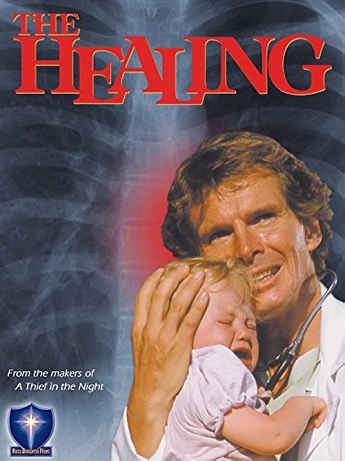
October Positivity: The Healing (dir by Russell S. Doughten, Jr.)


The 1983 film, The Healing, tells the story of Dr. John Lucas (played by Brian Jones).

Dr. Lucas has a bright future ahead of him.  He’s a successful and popular doctor in Des Moines.  He’s making a good deal of money.  He’s socially well-connected.  He enjoys playing golf every weekend.  Unfortunately, he also tends to neglect his wife and son.  His wife continually reminds Dr. Lucas that he was originally planning on becoming a doctor so that he could honor God.  But now Lucas has gotten materialistic and callous.  Lucas laughs off her concerns until, one day, Lucas is interrupted at the country club by a phone call informing him that his wife and son have both been killed in a car accident.

Sinking into despair, Dr. Lucas starts to drink.  Soon, he’s such an alcoholic that he has lost his job and his place in society.  With the exception of his fellow alcoholics, no one wants anything to do with Lucas.  Lucas is prepared to drink the rest of his life away but then, he sees an elderly homeless man having a medical emergency.  His natural instincts kick in and Dr. Lucas saves the man’s life and takes him down to the local shelter.  At the shelter, Lucas agrees to act as a doctor on the condition that no one push any religious stuff on him.  Following another tragedy, Lucas regains his faith.  However, his new-found idealism is put to the test when a junkie shows up at the clinic, carrying a switchblade and demanding a fix….

The Healing is another low-budget faith-based film from director Russell Doughten, Jr.  Doughten, who started out his film career working on 1958’s The Blob, directed several independent Christian films towards the end of his career.  This month, we’ve previously taken a look at Nite Song, Face in the Mirror, and Brother Enemy.  Like those films, The Healing was filmed on the streets of Des Moines, Iowa.  If nothing else, Doughten’s films served as a reminder that “urban” problems were not just limited to cities like New York, Los Angeles, and Chicago.  Instead, homelessness and crime were problems that afflicted every city, even the seemingly quite ones sitting in the middle of the country.  Unfortunately, The Healing often portrays the homeless as being plot devices as opposed to actual human beings.  In particular, one older gentleman’s only role in the film is to provide Lucas with some advice before promptly dying.

The Healing is achingly sincere in its desire to try to make the world a better, there’s no denying that.  Unfortunately, the film’s execution doesn’t always match its high ideals.  Brian Jones does a good of turning Dr. Lucas into a sympathetic character but the rest of the cast seems to the struggle with their underwritten characters.  The scenes featuring Dr. Lucas and the junkie also feel a bit rushed, as if the film itself was in a hurry to wrap things up.  As such, the conclusion of the junkie storyline never feels authentic and since the end of that storyline is also the end of the film, it casts a pall over the entire film.

Personally, as a history nerd, I’m glad that Doughten captured what Des Moines looked like in the early 80s.  If I ever find myself in Des Moines, I’ll compare the modern city to the 1983 version.  The film has its strengths but ultimately, it’s a bit too uneven to really work.

October Positivity: Brother Enemy (dir by Russell Doughten Jr.)


This 75-minute indie film from 1981 was directed by Russell Daughten, who also directed Nite Song and Face In The Mirror.

After losing his wife and his son in a car accident, Dave Weimer (William Wellman, Jr.) rebuilds his life by starting the most successful Christian puppet show in Iowa.  He has been invited back to his hometown so that he can put on a special charity performance at the high school gym.  Unfortunately, because Dave is going to need a lot of time to rehearse, this means that basketball practice has been canceled for a month!

The town’s teenagers are not happy about this.  For one thing, they’re really not sure who Dave Weimer is and they’re convinced that they are all way too old for puppets.  Why should they have to miss out on basketball for a kid’s show!?  So, a group of them get together and break into Dave’s workshop.  They destroy all of his puppets.  They also get arrested, even the little girl who was only there because her dumb older brother was supposed to be babysitting her!

The judge wants to throw the book at them but Dave has another idea.  He wants them to be put on two months probation and he wants to be their probation officer.  He wants the kids to build their own puppets and then put on their own biblically-inspired show.  Basically, their punishment is to do the show that Dave was originally planning on doing….

At first, no one is excited about doing a puppet show.  But it’s either that or go to juvenile hall.  The teens decide to do a show based on the story of the Prodigal Son.  One-by-one, they all let their guard down and open up to Dave.  Soon, the puppet show becomes less community service and more of a bible study.  However, Todd — the leader of the gang — is still angry and he plots to destroy the puppets once again….

Uhmmm, yeah.

Well, this was an interesting one.  On the one hand, the puppets were cute and I usually like movies in which a group of people suddenly have to put on a show.  On the other hand, Dave was kind of a creepy character.  Dave was played by William Wellman, Jr, a character actor who, before he became a regular in Daughten’s films, was best-known for appearing in biker films and the occasional war film.  (He appeared in several Billy Jack films.  He was a biker in Born Losers and a national guardsman in The Trial of Billy Jack.)  Wellman was well-cast as bikers and soldiers because he always came across as being very tightly wound and intense.  From the minute Wellman showed up on screen, he always seemed like he was just a few minutes from exploding.  Again, that’s a good trait for a biker but it’s not as good a trait for the creator of a Christian puppet show.  Wellman was a good actor but he just seems miscast here and, as a result, something always seems to be a little off about Dave.

As for the cast, I imagine they were largely amateurs or else actors drawn from the Des Moines theatrical community.  For the most part, the teenagers do better than the adults.  Like other Daughten films, Brother Enemy is almost painfully sincere.  Still, it’s hard not to watch the movie and feel that a lot of trouble could have been avoided if Dave had just had enough sense to lock the door of his workshop.

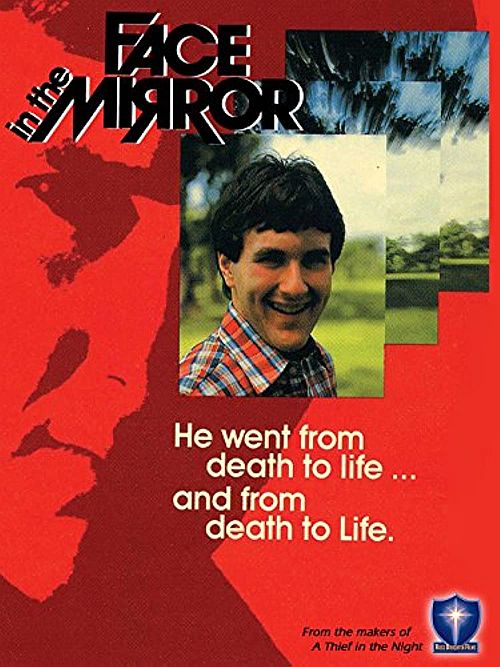
October Positivity: Face In The Mirror (dir by Russell S. Doughten Jr.)


The 1982 film, Face in the Mirror, opens with a community in crisis.

A teenager named Danny DeMarco (played by Michael Mitchell) has been shot and is being rushed to the hospital.  As we listen to the people who are following the ambulance to the hospital, it soon becomes clear that Danny shot himself and that the shooting occurred at a youth group meeting.  At the hospital, Danny is sent to the ICU.  He’s in a coma.  The doctors are not sure whether he’ll ever come out of that coma.

The first half of the 65-minute film is dominated by flashbacks as people try to figure out what could have led to Danny shooting himself.  Danny’s father remembers the time that he gave Danny a hard time for winning first place in a chess tournament.  Though I think most parents would be proud to have a son who was actually good at playing a game that required a certain amount of intelligence, Danny’s father is unimpressed.  Danny’s father was a jock in high school and he expects Danny to be the same.  Chess?  Why, that’s for wimpy youth group kids!

Speaking of wimpy youth group kids, the members of the youth group occasionally pause from the prayer to remember all of the times that they failed Danny.  They remember their own hypocritical behavior and how they would give Danny a hard time whenever he pointed it out.  They remember all of the times that Danny seemed to be confused about his faith and how they didn’t listen to his concerns.  They remember the youth group meeting in which Danny suddenly pulled out a gun and, after calling out everyone else on their hypocrisy and saying that he didn’t really believe in God, he pointed the gun at his head.  When another member of the group tried to grab the gun, it went off.  While their parents dismiss Danny as just being “a crazy kid,” the members of the youth group confront the role that they all played in Danny’s depression….

The first 30 minutes of this film is surprisingly well-acted and the theme of teen suicide is sensitively handled … up until the point that the film insinuates that Danny wouldn’t be depressed or suicidal if he was really a Christian.  I’ve known enough depressed but sincerely religious people to know that this is simply not the truth.  It’s actually a rather dangerous message to send out, as it suggests that depression is somehow a personal failing as opposed to something that everyone, to some degree, is going to have to deal with at some point in their life.

The second half of the film is all about the efforts of Danny’s friends to sneak into his hospital room so that they can pray for him and hopefully get through to him, even though he’s in a coma.  Again, the performances are sincere.  However, tonally, this half of the film is a mess.  There are some awkward moments of humor which really don’t seem like they belong in a movie about teen suicide.  The dialogue also get a bit cringey, as often happens when teenage characters are written by screenwriters who obviously were quite a bit older than the people they were writing for.

Face in the Mirror was directed by Russell Daughten, Jr.  Daughten also directed Nite Song and produced the Thief In The Night films.  Like those films, Face in the Mirror is a sincere but flawed time capsule.  The film’s tone is all over the place but I have to admit that I did kind of enjoy watching this grainy production with its amateur cast.  What can I say?  I have a weakness for low-budget indie films that feature a bunch of people who probably never made another film after this one.  Like Nite Song, watching this film is like stepping into a time machine and traveling to a simpler, if not quite innocent, past.  In the end, the film’s main message is that we should be aware that our words and our actions can hurt people without us even realizing it.  That’s not a bad one.

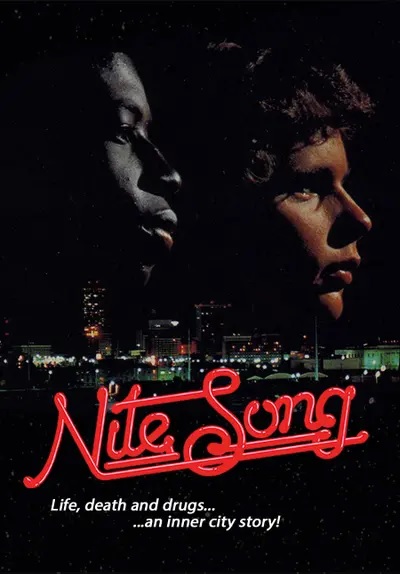
October Positivity: Nite Song (dir by Russell S. Daughten)


Wow, Iowa’s a dangerous place.

The 1978 film, Nite Song, takes place on the mean streets of Des Moines, Iowa.  Pete (Bobby Hoffman) and his best friend, Joe (Tom Hoffman), are neighbors in the local tenement.  They also both play on the high school basketball team.  In fact, the only reason that this movie is over an hour long is because there’s about five minutes of slow motion basketball footage.

Life’s not easy in Des Moines.  The local drug lord wants Pete to work for him.  Joe’s sister is addicted to heroin and his father is out of work.  Joe has recently become a Christian, which Pete finds to be kind of strange.  Even stranger is that Joe often sits outside on the balcony of the tenement and sings a song called I Will Serve Thee.  Later in the film, another character will spontaneously start singing I Will Serve Thee while staring up at the night sky.  I guess that’s the “nite” song of the title but what’s interesting is that the film itself isn’t a musical.

Anyway, the local drug lord wants Joe to help him rob the local pharmacy.  Joe refuses so the dealer refuses to give Joe’s sister any more heroin.  Joe and Pete decide to start following the drug dealer around town, in order to gather enough evidence to find a way to stop him.  Unfortunately, that plan doesn’t really work out that well.  Joe ends up with a knife in his back and Pete is left to struggle with whether he should go to the police or just sit out on the balcony and pray about it.  It turns out that all of the other kids at the high school are also Christians, specifically because of Joe.  They decide to clean up the streets themselves!  Fortunately, that won’t be hard because there’s only three criminals in Des Moines and they all hang out together….

It’s actually probably a little bit too easy to be snarky about a film like Nite Song, if just because it’s a low-budget, amateur film about life and death in Iowa.  But actually, the film deserves a bit more credit than I’m giving it.  Taken on its own terms, it’s actually an achingly sincere and earnest film and, as opposed to a lot of other faith-based films, it never makes the mistake of getting preachy or being overly judgmental.  (The film’s sympathetic portrayal of Joe’s drug-addicted sister actually deserve a good deal of praise.)  Even though the actors are all obviously amateurs and the singing gets a bit weird, everyone brings a certain authenticity to their roles.  This is a film about Iowa that was actually populated with people who were from Iowa and yes, that does make a difference.

Plus, there’s something charmingly naïve about the idea of the high school basketball team taking out the local drug dealers.  All those weapons and tough talk prove useless against a 15 year-old with a dream and jump shot.  Nite Song‘s a well-intentioned film.  Des Moines has nothing to be ashamed of.