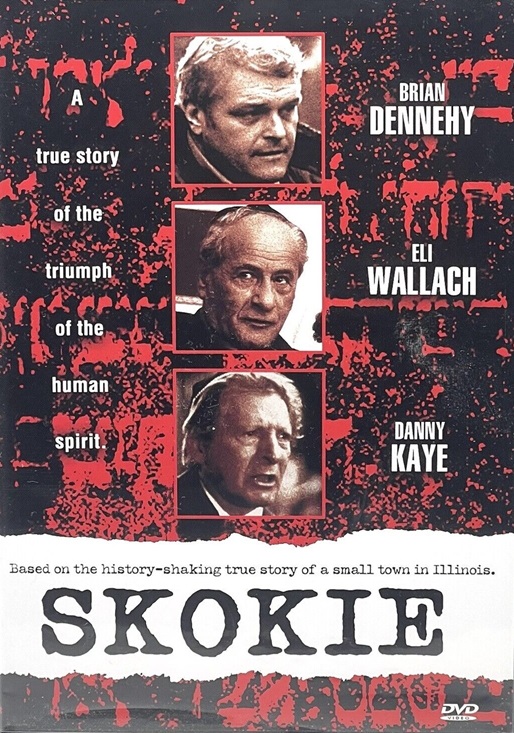
Made-For-Television Movie Review: Skokie (dir by Herbert Wise)


Skokie, a 1981 made-for-television movies, opens in a shabby Chicago office.

A group of men, all wearing brownshirts and swastika armbands, listen to their leader, Frank Collin (George Dzundza).  Collin says that they will be holding their next rally in the town of Skokie.  Collin explains that Skokie has a large Jewish population, many of whom came to the United States after World War II.  Collin wants to march through their town on Hitler’s birthday.

If not for the swastika and the brownshirt, the overweight Collin could easily pass for a middle-aged insurance salesman, someone with a nice house in the suburbs and an office job in the city.  However, Frank Collin is the head of the American National Socialist Party. a small but very loud group of Nazis who specialize in marching through towns with large Jewish populations and getting fee media attention as a result of people confronting them.  Making Frank Collin all the more disturbing is that he isn’t just a character in a made-for-television movie.  Frank Collin is a real person and Skokie is based on a true story.

The Mayor (Ed Flanders) and the police chief (Brian Dennehy) of Skokie are, needless to say, not happy about the idea of modern-day Nazis marching through their city.  Though they inform Collin that he will have to pay for insurance before he and his people will be allowed to hold their rally, they know that the courts have been striking down the insurance requirement as being a violation of the First Amendment.  While the mayor and the police chief worry about the political fallout of the rally, the Jewish citizens of Skokie debate amongst themselves how to deal with the Nazis.  Bert Silverman (Eli Wallach) and Abbot Rosen (Carl Reiner) argue that the best way to deal with Collin and his Nazis is to refuse to acknowledge them, to “quarantine” them.  As Rosen explains it, Collin is only marching to get the free publicity that comes with being confronted.  If he’s not confronted, he won’t make the evening news and his rally will have been for nothing.  However, many citizens of Skokie — including Holocaust survivor Max Feldman (Danny Kaye) — are tired to turning their back on and ignoring the Nazis.  They demand that the Nazis be kept out and that, if they do enter the city, they be confronted.

With the support of the ACLU, Collin sues for his right to march through Skokie.  The ACLU is represented by Herb Lewishon (John Rubinstein), a Jewish attorney who hates Collin and everything that he stands for but who also feels that the First Amendment must be respected no matter what.  When Lewishon is asked how he, as a Jew, can accept a Nazi as a client, Lewishon relies that his client is the U.S. Constitution.

Skokie is a thought-provoking film, all the more so today when there’s so much debate about who should and should not be allowed a platform online.  (Indeed, Collin and his Nazis would have loved social media.)  Lewishon argues that taking away any group’s First Amendment rights, regardless of how terrible that group may be, will lead to slippery slope and soon everyone’s First Amendment rights will be at risk.  Max Feldman, and others argue that the issue isn’t free speech.  Instead, the issue is standing up to and defeating evil.  The film gives both sides their say while, at the same time, making it clear that Frank Collin and his Nazis are a bunch of fascist losers.  It’s a well-acted and intelligently written movie, one that rejects easy answers.  Needless to say, at a time when so many people feel free to be openly anti-Semitic, it’s a film that’s still very relevant.

As for the real Frank Collin, he would eventually be charged with and convicted of child molestation.  After three years in prison, he changed his name to Frank Joseph and became a writer a New Age literature.  He’s looking for Atlantis but I doubt they’d want him either.
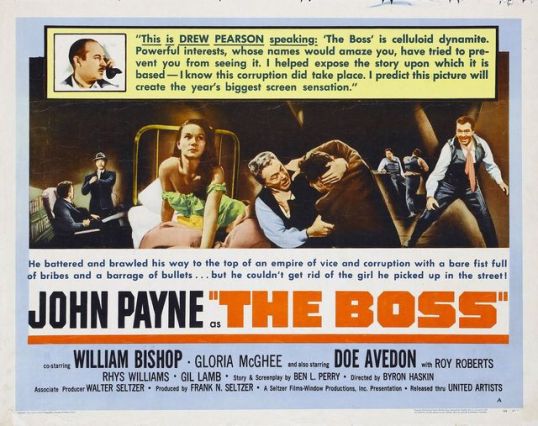
Shattered Politics #12: The Boss (dir by Byron Haskin)


The Boss

After you’ve watched The Phenix City Story, why not go over to Netflix and watch another obscure but hard-hitting B-movie, The Boss?

First released in 1956, The Boss came out a year after The Phenix City Story but they both serve as good companion pieces to each other.  Whereas The Phenix City Story shows what it’s like to live in a city dominated by corruption and crime, The Boss shows how a city could get that way in the first place.

The Boss opens in 1919, in an unanmed midwestern city.  (A title card informs us that the city is a “middle class city.”)  World War I has ended and the returning soldiers are marching in a parade throughout the city.  Leading the march is Capt. Matt Brady (John Payne), a humorless war hero.  Marching behind him are a group of soldiers who all seem to hate his guts, even after Bob Herrick (William Bishop) attempts to defend him.  It appears that Matt was a strict officer during the war and Bob was the only one of his men who didn’t hate him.  Of course, a lot of that is because Bob was a childhood friend of Matt’s.  They both grew up in the city together.  To be exact, their home was in the third ward.  As Bob explains, the Brady family rules the third ward.

Matt’s older brother, Tim (Roy Roberts), is the 3rd ward’s alderman.  After the parade ends, Tim explains that he expects Matt to follow in the family business.  However, Matt doesn’t want anything to do with politics.  Instead, he just wants to marry Elsie (Doe Avedon) and live a normal life.  In fact, Matt says, he’s got a date with Elsie that night.

However, before Matt can go on that date, he ends up getting attacked and beaten up by some of the soldiers from the parade.  He’s late for his date and when Elsie refuses to forgive him, Matt ends up going out and getting drunk.  After getting into a few more fights, he meets an insecure woman named Lorry (Gloria McGhee) and announces that they’re getting married whether she wants to or not.

The next morning, Matt wakes up to discover that he now has a wife, Elsie never wants to see him again, and that Tim has dropped dead of a heart attack.  Bruised and hungover, Matt suddenly finds himself forced to take over the family business.

The film jumps forward a few years.  Matt is now the most powerful man in the city.  He decides who get elected to which office and, with the help of the Mafia, he’s made a lot of money for himself.  Bob, meanwhile, has married Elsie and is now Matt’s attorney and unofficial second-in-command.  Meanwhile, Lorry lives in a huge mansion that she never leaves.

It took me a while to get into The Boss.  In fact, I nearly stopped watching after the first twenty minutes because it didn’t ever seem like there would be a moment when Matt would be anything other than surly, drunk, and bruised.  But then, once Tim drops dead, the movie becomes a bit more interesting.  If you remember John Payne for anything, it’s probably for being the nice but kind of boring lawyer from the original Miracle on 34th Street.  So, it’s interesting to see him here, playing a crude and perpetually angry man who always seems to be on the verge of punching someone out.  He gives a good performance and occasionally you even feel a little sorry for Matt.  For everything he does wrong, he’s still essentially the same guy who wanted to marry a school teacher and live out in the suburbs.

Of course, I’m a history nerd so my favorite scenes in The Boss were the ones that dealt with real moments from history, like the scene where Matt panics when he hears about the 1929 Stock Market crash.  Even better, though, is a brief sequence that takes place at a political convention.  Though no names are uttered and the party is never specifically identified, it’s obvious that Matt is meant to be at the 1932 Democratic Convention and the candidate that is asking for Matt’s support is obviously meant to Franklin Roosevelt.  When Roosevelt is nominated without Matt’s support, Matt can only bitterly observe that he wishes he was from Chicago because then he could own a President.

Would a movie made today have the guts to say such a thing about FDR?  I doubt it.

The Boss is currently available on Netflix.  If you’re into politics and history (and maybe even political history), be sure to watch it before it goes away.