Mardi Gras Film Review: Lady Behave! (dir by Lloyd Corrigan)


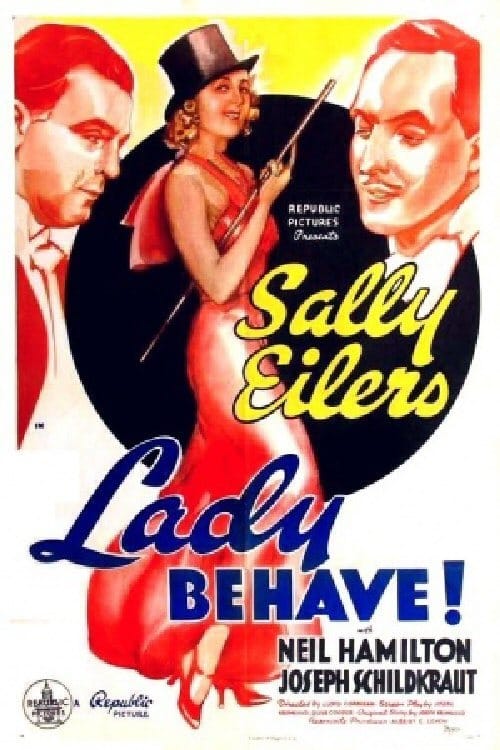
The 1938 film, Lady Behave!, begins with a woman named Clarice (Patricia Farr) getting ready to go out and celebrate Mardi Gras.  Even though Clarice invites her older sister, Paula (Sally Eilers), to come with her, Paula refuses.  Paula has work to do at home.  It’s pretty obvious that this is the way that it’s always been between the two sisters.  Clarice has fun while Paula stays home and waits for her to return.

Fortunately, Clarice does return in the morning.  As she tells Paula, she had a great time during Mardi Gras.  In fact, she had such a great time that she ended up getting married!  She married a wealthy northerner named Stephen Cormack (Neil Hamilton).  The only problem is that Clarice is already married!  She’s totally forgotten that she only recently became the wife of a dissolute playboy named Michael Andrews (Joseph Schildkraut).  By getting married a second time, Clarice has committed bigamy!  She could go to prison for 10 years!

Whatever is Paula to do?

Well, what if she arranges for Clarice to leave the country?

What if she tries to bribe Michael into accepting an annulment?

What if Paula goes up to New York and pretends to be Clarice (because, after all, Stephen was pretty drunk when he married her)?

What is she does all three!?

Of course, when Paula goes up to New York, she discovers that Stephen is out of the country.  She moves into his mansion, where she discovers that his two children — Patricia (Marcia Mae Jones) and Hank (George Ernest) — are convinced that she’s just a gold digger who only wants to steal their father’s money (and, it should be noted, also their inheritance).  When Michael shows up at Stephen’s mansion, he explains to Paula that he needs $10,000 for a horse and he’ll only agree to an annulment if he gets the money.  However, when he meets Patricia and Hank, he tells them that if they pay him $30,000, he’ll help to break up the marriage between Stephen and Paula (who, of course, everyone but Michael thinks is actually Clarice).

Eventually, Stephen shows up and he assumes that Paula actually is Clarice.  Paula and Stephen quickly fall in love and it turns out that Stephen is very serious about his new marriage.  He even wants to take Paula on a honeymoon.  Of course, he thinks Paula is Clarice and Paula is freaking out because they’re not actually married but she wishes that they were.  But, if they did actually get married, Stephen would be guilty of bigamy and then he’d have to leave the country like Clarice and….

Yes, this is one of those somewhat busy screwball comedies where almost every action is motivated by a misunderstanding and where all of the dialogue is extremely snappy.  To be honest, it’s all a bit too hyper.  Though the film originally had a running time of 70 minutes, most of the existing prints are only 57 minutes long.  This film has a lot of plot for only 57 minutes and it’s often difficult to keep track of what’s happening from one scene to the next.  That wouldn’t be a problem if this film starred someone like William Powell and Carole Lombard (or, for that matter, Cary Grant and Myrna Loy) but instead, this film features Sally Eilers and Neil Hamilton, who are likable performers but not quite likable enough to carry the film over it’s rough edges.

On the plus side, Joseph Schildkraut has some very funny scenes as the flamboyant Michael.  And Marcia Mae Jones and George Ernest both do a great work as Stephen’s paranoid children.  They consistently made me laugh.  Otherwise, Lady Behave! is a bit too frantic for its own good.

Double Your Fun With Wheeler & Woolsey: HALF SHOT AT SUNRISE (RKO 1930) & COCKEYED CAVALIERS (RKO 1934)


gary loggins's avatarcracked rear viewer

Welcome back to the wacky world of Wheeler & Woosley! Bert and Bob’s quick quips and silly sight gags kept filmgoers laughing through the pain of the Depression Era, and continue to delight audiences who discover their peculiar type of zaniness. So tonight, let’s take a trip back in time with a double shot of W&W comedies guaranteed to keep you in stitches!

1930’s HALF SHOT AT SUNRISE was their 4th film together, and the first exclusively tailored for their comic talents. In this WWI service comedy, Bert and Bob are a pair of AWOL soldiers on the loose in Paris, chasing girls while in turn being chased by a couple of mean-mugged MP’s (Eddie DeLange, John Rutherford). Bert winds up falling for Dorothy Lee (who appeared in most of their films, almost as a third member of the team), the youngest daughter of cranky Col. Marshall (cranky George MacFarlane)…

View original post 968 more words

Horror Film Review: The Picture of Dorian Gray (dir by Albert Lewin)


picture-of-dorian-gray-32

Hello and welcome to the start of TSL’s annual October horrorthon!  All through the month of October, our focus will be on horror.  We will be sharing reviews and thoughts on some of the best (and worst) horror films ever made!  I have to admit that this is my favorite time of the year.  I love horror … like all good people!

I want to start things off by taking a look at a film from 1945.  The Picture of Dorian Gray is based on the famous novel by Oscar Wilde (a novel that some people think was inspired by the Jack the Ripper murders).  Dorian Gray (played by Hurd Hatfield) is a young and handsome aristocrat who lives in 19th century London.  When we first meet him, Dorian is intelligent, kind and virtuous.  He’s also more than a little boring.  He is the bland face of the establishment, a man destined to be celebrated for his position in society and largely forgotten after his death.

Dorian is posing for a painting that’s being done by his friend, an artist named Basil Hallward (Lowell Gilmore).  One day, Lord Henry Wotton (George Sanders) stops by the studio while Basil is painting Dorian.  Lord Henry is everything that Dorian Gray is not.  He’s a worldly and cynical man and he is very proud to live a life devoted to complete and total hedonistic pleasure.  He immediately sets out to corrupt Dorian and it turns out to be a lot easier than he was expecting.  Henry convinces Dorian that he can have everything that he wants as long as he’s young and handsome.  Dorian announces that he wishes the painting could age instead of him…

Now, here’s where the film takes a huge departure from Wilde’s novel.  In the novel, the painting ages while Dorian stay young.  No specific reason is given.  Instead, it’s just something that happens.  In the film, it turns out that Basil owns an ancient Egyptian statue and that the statue has mystical powers.  Dorian makes his wish in front of the statue and that’s why the painting starts to age.  Personally, I think the bit with the Egyptian statue is unnecessary and a little bit silly.  To me, the story is a lot more effective if the painting starts to age without an explanation.  The filmmakers obviously disagreed.

But no matter!  In the end, the Egyptian statue isn’t that important.  What is important that, freed from getting old or physically suffering for his actions, Dorian transforms into a different person.  Soon, he’s even more hedonistic than Lord Henry.  When he breaks the heart of a tragic singer named Sybil Vane (Angela Lansbury, in a poignant and Oscar-nominated performance), Dorian sees that the painting is now cruelly smirking while his own face remains innocent and untouched.  When Dorian eventually commits a murder to keep his secret from getting out, the blood appears on the painting’s hands while his own remain clean.

And the years pass.  Dorian finds himself both being hunted by Sybil’s brother (Richard Fraser) and falling in love with the niece (Donna Reed) of a man that he earlier murdered.  Dorian never ages but his portrait becomes more and more twisted.  What’s particularly interesting is that we see little of Dorian’s evil actions.  Instead, we watch and listen as other characters whisper about the horrific things that he’s done.  Physically, Dorian remains an innocent and young aristocrat.  But all we have to do is look at the picture and we can see what a monster Dorian has become…

The Picture of Dorian Gray is an absolutely gorgeous film, one that is full of elaborate sets that are often cast in shadow.  (It’s interesting to note that the more corrupt Dorian becomes, the darker and more shadowy his estate becomes.)  The film is in black-and-white, with the exception of three scenes in which the portrait is revealed in all of its Technicolor glory.  If that sounds like a gimmick … well, it is.  But it’s an amazingly effective gimmick.

The Picture of Dorian Gray is a classic exercise in psychological horror.  See it the next chance you get!

portrait-de-dorian-gray-1945-01-g

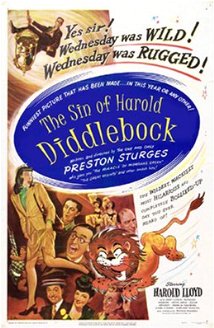
The Fabulous Forties #43: The Sin of Harold Diddlebock (dir by Preston Sturges)


Film1947-TheSinOfHaroldDiddlebock

The 42nd film in Mill Creek’s Fabulous Forties box set was a 1947 comedy called The Sin of Harold Diddlebock.

As a classic film lover, I really wish that The Sin of Harold Diddlebock was better than it actually is.  The film was a collaboration between two of the biggest names in cinematic comedy history: director/writer Preston Sturges and legendary actor Harold Lloyd.  In fact, this was the first film that Sturges directed after leaving the studio system so that he could make bring his unique brand of satire to life without having to deal with interference.  He managed to convince Harold Lloyd to come out of retirement to star in the movie and the film even works as a quasi-sequel to one of Lloyd’s most beloved silent comedies, The Freshman.  In a perfect world, The Sin of Harold Diddlebock would have been a comedy masterpiece that would have perfectly shown off the talents of both men.

Unfortunately, that’s really not the case.  The Sin of Harold Diddlebock is consistently amusing but it’s never quite as funny as you want it to be.  This is one of those films that sounds like it should be hilarious but, when you actually watch it, you see that the film is oddly paced and Lloyd never seems to be fully invested in his role.  I suppose the natural inclination would be to blame this on interference from the notoriously eccentric Howard Hughes, who co-produced the film with Sturges.  After Harold Diddlebock failed at the box office, Hughes withdrew it and spent three years personally reediting the film before re-releasing it under the title Mad Wednesday.  However, by most reports, Hughes wasn’t really the problem.  If Wikipedia is to be believed (and God do I hate starting any sentence with that phrase), Lloyd and Sturges did not have a good working relationship.  As sad as that is, it’s also understandable.  Geniuses rarely work well together.

The Sin of Harold Diddlebock does get off to a good start, seamlessly incorporating the last reel of The Freshmen with footage shot for Harold Diddlebock.  (Somewhat sweetly, the film starts with a title card informing us that the what we are about to see was taken from The Freshman.)  After college freshman Harold Diddlebock scores the winning touchdown in a football game, impressed advertising executive J.E. Waggleberry (Raymond Walburn) offers Harold a job.  However, Harold wants to finish college so Waggleberry tells Harold to look him up in four years.

Four years later, recently graduated Harold goes to Waggleberry for a job and discovers that J.E. Waggleberry has totally forgotten him.  Harold ends up working in the mailroom but is told that, as long as he is ambitious and smart, he will easily move up in the company.  22 years later, Harold is still working in the mailroom.  He is secretly in love with Miss Otis (Frances Ramsden).  Of course, he was also in love with each of Miss Otis’s six older sisters, all of whom worked at the company before the current Miss Otis.  Harold bought an engagement ring when the oldest Otis sister was with company.  Years later, he’s still carrying it with him and dreams of giving it to the current Miss Otis.

However, that might be difficult because Harold has just been fired.  J.E. Waggleberry feels that Harold’s unambitious attitude is setting a bad example.  As severance, Harold is given a watch and $2,946.12.

The normally quiet and reserved Harold reacts to losing his job by doing something very unusual for him.  He goes to a bar and, with the help of a con man (Jimmy Conlin) and a bartender (Edgar Kennedy), he gets drunk.  The bartender even creates a special drink called the Diddlebock.  Harold drinks it and wakes up two days later, wearing a huge cowboy hat and owning a bankrupt circus…

And it only gets stranger from there….

While The Sin of Harold Diddlebock doesn’t quite work, I appreciated the fact that it not only created its own surreal world but that it just kept getting stranger and stranger as the film progressed.  It was Harold Lloyd’s final film and there’s even a scene where he and a lion end up on the edge of a skyscraper that’s almost as good as the famous comedic set pieces from his silent classics.  It’s a pity that the film doesn’t really come together but I’d still recommend seeing it just for history’s sake.