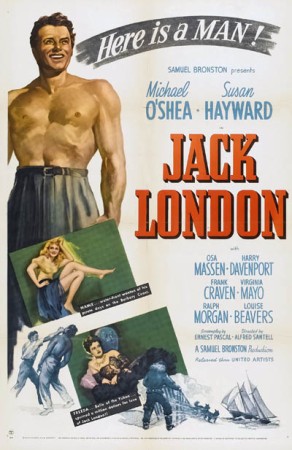
The Fabulous Forties #28: Jack London (dir by Alfred Santell)


Jack-London-1943

The 28th Film in Mill Creek’s Fabulous Forties box set was a 1943 biopic about the writer, Jack London.  Not surprisingly, the title of the film was Jack London.

Now, I should start this review off by mentioning that I know very little about Jack London.  I don’t think that I have ever read any of his short stories or his novels.  I know that he wrote a novel called White Fang but that’s largely because there’s been so many different film versions of the book.  (Long before directing Zombi 2, even Lucio Fulci made a version of White Fang.)  Here’s what I do know about Jack London:

  1. He was a prominent writer at the turn of the century.
  2. He was reportedly an alcoholic.
  3. He was a Socialist who even ran for mayor of Oakland, California on the party’s ticket.
  4. He was an atheist.
  5. In 1916, depending on the source, he either committed suicide, died of alcohol poisoning, or simply passed away as the result of 40 years of hard living.

Of those 5 facts, 4 are totally ignored in Jack London.  The film does acknowledge that Jack London eventually became a prominent writer, even going so far as to open with stock footage of a U.S. warship being named after him.

As for his alcoholism, we never see London drunk.  Indeed, the film’s version of Jack London is so earnest that it’s hard to believe he’s ever had a drink in his life.

As for his Socialism, we are shown that London grew up in a poor family.  When, after serving at sea, he takes a writing class, he argues with a professor over London’s desire to write about the poor.  However, we never hear London express any specific ideology.  We certainly don’t see him running for mayor of Oakland.

As for his atheism — yeah right.  This film was made in 1943!  There’s no way that Jack London was going to be portrayed as talking about why he didn’t believe in God.

As for his death — well, Jack London ends with the writer very much alive.  There’s not even a title card informing us that London eventually died.

Instead, Jack London is much more concerned with Jack (played by Michael O’Shea) dealing with the Japanese.  Oh sure, we get some scenes of Jack London watching a shootout and breaking up a bar fight in Alaska.  And Susan Hayward shows up as Jack London’s always supportive wife.  (For that matter, Louise Beavers also shows up as Jack London’s always supportive house keeper.)

But, in the end, the majority of the film features Jack London as a war correspondent covering the turn of the 20th century war between Russia and Japan.  When he’s captured by the Japanese, he observes the harsh way they treat prisoners and is shocked when he witnesses several prisoners being ruthlessly executed.  When he talks to a Japanese commandant, he’s outraged as the commandant explains how the Empire of Japan is planning to take over the world.  When Jack finally gets back to America, he’s less concerned with writing White Fang and more concerned with warning the American people to remain vigilant…

Jack London is basically wartime propaganda disguised as a biopic.  The entire point of the film seems to be that if Jack London was still alive, he would want the men in the audience to enlist and the women to buy war bonds.  None of it is subtle and, beyond its value as a time capsule of how Americans viewed the Japanese in 1943, none of it is particularly interesting as well.

In the end, Jack London plays out like one of those earnest but dull educational films that tend to show up on PBS when no one’s watching.
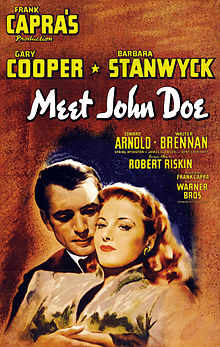
Shattered Politics #7: Meet John Doe (dir by Frank Capra)


Meet John Doe

I cannot stand the phrase “pay it forward.”

The idea is that somebody does something nice for you and then they say, “Pay it forward” and suddenly, you are magically required to go out and do something nice for someone else.  For one thing, I hate the obligation of it all.  I have this fear that as soon as I finally get finished paying it forward, some stranger is going to hand me a Coke and say, “Pay it forward,” and suddenly I’ll have to do it all over again!  And really, honestly, I shouldn’t have to pay it forward just because someone  gives me a Coke.  If you’re going to tell me to pay it forward, at least give me a car or a Victoria’s Secret gift card or something.

Ultimately, “pay it forward” is something that people say to make themselves feel good but it’s actually a pretty shallow concept.

The same thing can be said about John Doeism, the philosophy that rests at the center of the 1941 film Meet John Doe, our latest entry in Shattered Politics.  John Doeism is a grassroots political movement that is based around the slogan, “Be a Better Neighbor.”  Much like “Pay it forward,” “Be a better neighbor” sounds good and it’s easy to say but its main appeal is that it doesn’t require that much thought.  If anything, it sounds like the first step on the road to serfdom…

That said, I still like the film.

Meet John Doe opens with lay-offs at a major metropolitan newspaper.  (These lay-offs are signified by a handsome young man who points at people and then runs his finger across his throat.)  Among those laid off is columnist Ann Mitchell (Barbara Stanwyck).  However, before Ann is officially let go, she is told to write one final column.  Understandably angry over her treatment, Ann responds by making something up.  She writes and prints a fake letter from a man calling himself “John Doe.”  John Doe explains that he’s unemployed and that he will be committing suicide on Christmas Eve.

Well, quicker than you can say twitter death hoax, everyone in the entire country reads John Doe’s letter and demands to know who he is.  The newspaper’s editor, Henry Connell (James Gleason), rehires Ann and puts her in charge of finding the real John Doe.

When numerous unemployed and homeless men start to show up at the newspaper, claiming to be the real John Doe, little do they realize that they are, in fact, auditioning.  Ann finally decides that Joe Willoughby (Gary Cooper) has what it takes to be the public face of John Doe.  Not only does he have a compelling personal story (he’s a former baseball player whose career was ended by an arm injury) but he looks and sounds like Gary Cooper.

(And, as I typed that last sentence, it suddenly occurred to me that Meet John Doe managed to predict American Idol…)

Joe is soon a celebrity, reading speeches that have been written for him by Ann and encouraging people across the nation to be a better neighbor.  And Ann is falling in love with Joe.  However, Joe is not comfortable with his new role.  For one thing, he doesn’t like being a hero for telling a lie.  Secondly, he knows that rival newsmen are eager to expose him as being a fraud.  And finally, there’s a sinister publisher named D.B. Norton (played by Edward Arnold, who previously played corrupt Boss Taylor in Mr. Smith Goes To Washington) who is eager to be President of the United States.  He wants to turn John Doeism into a fascist political movement and, unless Joe endorses him, he’ll reveal that Joe’s a fraud…

Meet John Doe was Frank Capra’s follow-up to Mr. Smith Goes To Washington.  It features many of the same themes as Mr. Smith, with the main difference being that Meet John Doe is a lot more preachy.  Whereas Mr. Smith saved its big speech for the end, Meet John Doe has several big speeches spread throughout its running time.  (There’s also a scene where a guy named Bert tells the story of how he was inspired by John Doe and, I swear, it literally goes on forever.)

So, no, Meet John Doe is definitely no Mr. Smith Goes Go To Washington but I still liked it, mostly because of the chemistry between Gary Cooper and Barbara Stanwyck.  I wanted to be Barbara Stanwyck’s character.  Seriously, watching a film like Meet John Doe, leaves me convinced that I was born several decades too late.  If I had been born in 1918, I could have been a quick-witted, cynical, and secretly romantic intrepid girl reporter at a major metropolitan newspaper.

Girl Reporter

Even better, I would never have to worry about ever being told to “pay it forward.”