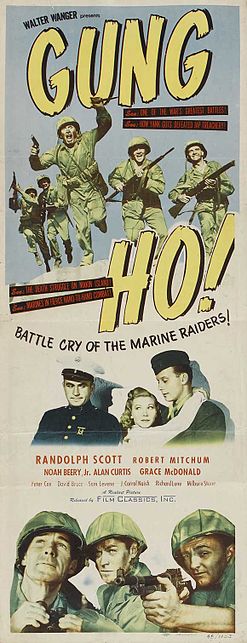
The 17th film in Mill Creek’s Fabulous Forties Box Set was the 1943 war film, Gung Ho!
Gung Ho!, which is filmed in a documentary style and features a narrator, opens with a series of job interviews. A tough lieutenant (J. Carrol Naish) is recruiting Marines to serves in a special unit, one which will only take on the most hazardous of assignments. The narrator reminds us that the interviews are taking place just a few weeks after the attack on Pearl Harbor and we listen as each interviewee is asked whether or not he is okay with killing members of the Japanese army.
Some of the interviewees hesitate and some don’t but ultimately, all of them are okay with killing. One (Rod Cameron) explains that he’s already a murderer, having killed someone back in Kentucky. Another says that he fought in the Spanish Civil War and that he sees his service as being a continuation of the fight against fascism. Another Marine (Alvan Curtis) says that he’s an ordained minister but he’s willing to do what has to be done. A Marine named Pig Iron shows up and, since he’s played by a young Robert Mitchum, we know that he’ll get things taken care of.
And then we get to the final interviewee. He doesn’t have a big role in the film but his one line makes a big impression. When asked why he doesn’t mind the idea of killing, he replies, “I just don’t like Japs.”
AGCK!
That’s a line that would definitely not make it into a modern version of Gung Ho! Or, if it did, it would be followed by the interviewee being admonished and then kicked out of the office. But Gung Ho! was made in 1943, at the height of World War II and in the shadow of Peal Harbor. As uncomfortable as it may make us today, “I just don’t like Japs,” was probably Gung Ho‘s big applause line when it was originally released.
And really, that’s the main value of a film like Gung Ho! It’s a well-made but predictable war film but ultimately, it’s most important as a time capsule. If you want to know the truth about an era’s culture, as opposed to what you may want the truth to be, look at the art. Read the books. Watch the movies. You may not always like what you find but you owe it to yourself to do so.
Anyway, as far the rest of Gung Ho!, it plays out exactly as you would expect. Under the eye of Lt. Commander Thornwald (Randolph Scott), the men train for combat. They visit Pearl Harbor and see the sunken remains of ships that are still smoking after being bombed. And finally, the men fight the Japanese on an island. Some survive. Many more of them die. And the fight continues.
Gung Ho! will probably be best appreciated by fans of war films, which admittedly I am not. That said, it is an interesting time capsule of 1943 America. Plus, it features Robert Mitchum! Admittedly, it’s a small role but he does get two great scenes and … well, he’s Robert Mitchum! How can you not enjoy watching Robert Mitchum?
And guess what? You can watch Gung Ho! below!
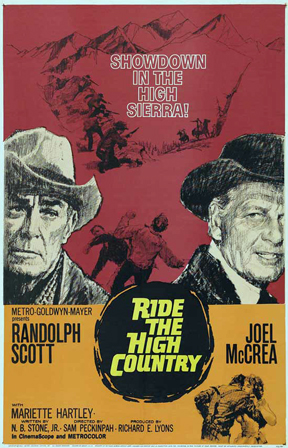 It’s the turn of the 20th century and the Old West is fading into legend. When they were younger, Steve Judd (Joel McCrea) and Gil Westrum (Randolph Scott) were tough and respect lawmen but now, time has passed them by. Judd now provides security for shady mining companies while Gil performs at county fairs under the name The Oregon Kid. When Judd is hired to guard a shipment of gold, he enlists his former partner, Gil, to help. Gil brings along his current protegé, Heck Longtree (Ron Starr).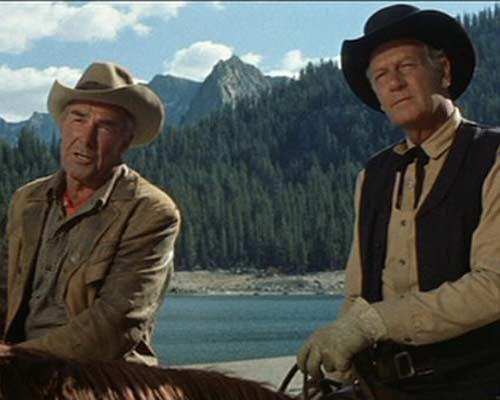
 Through the Shattered Lens