Cleaning Out The DVR #35: Stage Door (dir by Gregory La Cava)


(For those following at home, Lisa is attempting to clean out her DVR by watching and reviewing 38 films by the end of today!!!!!  Will she make it?  Keep following the site to find out!)
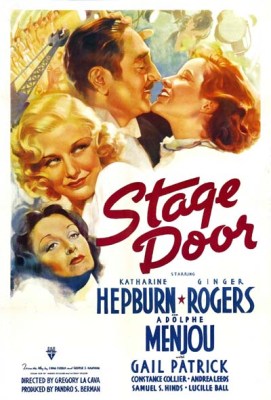
Stage_Door_(1937)

The 1937 film Stage Door is a great example of a unique genre of American film, the Katharine Hepburn Gets Humbled genre.

In the 1930s, Katharine Hepburn went through a period of time where she was considered to be “box office poison.”  She was undeniably talented but it was obvious that the studios weren’t sure how to showcase that talent.  They put her in high-brow films that often did not have much appeal to audiences.  As well, the press hated her.  Katharine Hepburn was outspoken, she was confident, she was a nonconformist, and, too many, her refusal to do interviews and sign autographs marked her as a snob.  Very few people wanted to see a movie starring Katharine Hepburn and therefore, very few people were willing to make a movie starring Katharine Hepburn.

(Interestingly enough, as I sit here typing this, another KH — Katharine Heigl — is pretty much in the exact same situation, with the main difference being that Hepburn was a far more interesting actress.)

Fortunately, Katharine Hepburn was smart enough to recognize the problem and she started to appear in films like Stage Door.  In Stage Door, she essentially played a character who mirrored the public’s perception of her.  Terry Randall is a snobbish and pretentious aspiring actress who comes to New York to pursue her career and moves into a theatrical rooming house.  At first, her attitude makes her unpopular with the other actresses living in the house.  But, as the film progresses, Terry slowly starts to let down her defenses and reveals that she’s just as insecure, neurotic, and vulnerable as everyone else.  She also proves herself to be willing to stand up to manipulative producers and condescending directors.  When she’s cast in her first Broadway show, it turns out that the show is being financed by her father and his hope is that she’ll do such a bad job and be so humiliated that she’ll give up acting.  And, at first, it appears that Terry will be terrible.  During rehearsals, she is stiff and mannered.  (Hepburn was actually quite brave to portray Terry as being such a believably bad actress.)

Of course, Terry isn’t the only actress at the rooming house who has issues to deal with.  For instance, Judy Canfield (Lucille Ball) has to choose between pursuing her career or getting married and starting a family.  Kay (Andrea Leeds) is a once successful actress who is now struggling to find roles, can’t pay her bills, and has become suicidal as a result.  And then there’s Jean (Ginger Rogers), Terry’s cynical roommate and frequent enemy and occasional friend.  Jean is falling in love with Anthony Powell (Adolphe Menjou), the lecherous producer of Terry’s play.

Stage Door is a wonderfully entertaining mix of melodrama and comedy.  You’ll laugh, you’ll cry, and you’ll really find yourself hoping that all of the actresses at the rooming house will have their dreams come true.  While the film is dominated by Hepburn and Rogers, it truly is an ensemble piece.  Not only does the cast include Eve Arden, Lucille Ball and Andrea Leeds (giving the film’s best and most poignant performance) but the great dancer Ann Miller appears as Jean’s equally cynical best friend.  Stage Door may be 79 years old but it’s aged wonderfully.

At the box office, Stage Door was a modest success and it directly led to Hepburn being cast in the classic screwball comedy, Bringing Up Baby.  Stage Door was nominated for best picture but it lost to The Life of Emile Zola.
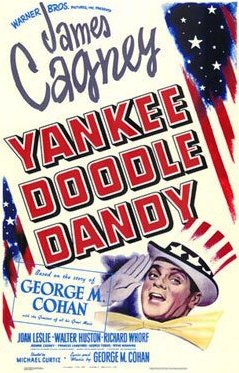
Cleaning Out The DVR: Yankee Doodle Dandy (dir by Michael Curtiz)


Yankee_Doodle_Dandy_poster

So, today, I got off work so that I could vote in Texas’s Super Tuesday primary.  After I cast my vote (and don’t ask me who I voted for because it’s a secret ballot for a reason!), I came home and I turned on the TV and I discovered that, as a result of spending February recording countless films off of Lifetime and TCM, I only had 9 hours of space left on my DVR.  As a result, the DVR was threatening to erase my recordings of Bend It Like Beckham, Jesus Christ Superstar, American Anthem, an episode of The Bachelor from 2011, and the entire series of Saved By The Bell: The College Years.

“Acgk!” I exclaimed in terror.

So, I immediately sat down and started the process of cleaning out the DVR.  I started things out by watching Yankee Doodle Dandy, a film from 1942.

Yankee Doodle Dandy is a biopic of a songwriter, signer, and dancer named George M. Cohan.  I have to admit, that when the film started, I had absolutely no idea who George M. Cohan was.  Imagine my surprise as I watched the film and I discovered that Cohan had written all of the old-fashioned patriotic songs that are played by the Richardson Symphony Orchestra whenever I go to see the 4th of July fireworks show at Breckenridge Park.  He wrote You’re A Grand Old Flag, The Yankee Doodle Boy, and Over There.  Though I may not have heard of him, Cohan was an American institution during the first half of the 20th Century.  Even if I hadn’t read that on Wikipedia, I would have been able to guess from watching Yankee Doodle Dandy, which, at times, seems to be making a case for sainthood.

And that’s not meant to be a complaint!  74 years after it was originally released, Yankee Doodle Dandy is still a terrifically entertaining film.  It opens with George (played by James Cagney) accepting a Congressional Gold Medal from President Franklin D. Roosevelt.  (We only see Roosevelt from behind and needless to say, the President did not play himself.  Instead, Captain Jack Young sat in a chair while FDR’s voice was provided by impressionist Art Gilmore.)  Cohan proceeds to tell Roosevelt his life story, starting with his birth on the 4th of July.  Cohan tells how he was born into a showbiz family and a major theme of the film is how Cohan took care of his family even after becoming famous.

The other major theme is patriotism.  As portrayed in this biopic, Cohan is perhaps the most patriotic man who ever lived.  That may sound corny but Cagney pulls it off.  When we see him sitting at the piano and coming up with the lyrics for another song extolling the greatness of America, we never doubt his sincerity.  In fact, he’s so sincere that he makes us believe as well.  Watching Yankee Doodle Dandy, I found myself regretting that I have to live in such an overwhelmingly cynical time.  If George M. Cohan was alive today, he’d punch out anyone who called this country “Murica.”

Yankee Doodle Dandy is an amazingly positive film.  There are a few scenes where Cohan has to deal with a few Broadway types who are jealous of his talent and his confidence but, otherwise, it’s pretty much one triumph after another for Cohan.  Normally, of course, there’s nothing more annoying than listening to someone talk about how great his life is but fortunately, Cohan is played by James Cagney and Cagney gives one of the best performance of all time in the role.

Cagney, of course, is best remembered for playing gangsters but he got his start as a dancer.  In Yankee Doodle Dandy, Cagney is so energetic and so happy and such a complete and totally showman that you can’t help but get caught up in his story.  When he says that, as a result of his success, things have never been better, you don’t resent him for it.  Instead, you’re happy for him because he’s amazingly talented and deserve the best!

Seriously, watch him below:

James Cagney won the Oscar for Best Actor for his performance here.  Yankee Doodle Dandy was also nominated for best picture but lost to Mrs. Miniver.

I’m really glad that I watched Yankee Doodle Dandy today.  In this time of overwhelming negativity, it was just what I needed!