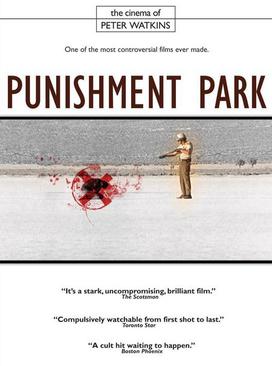
The 1971 “pseudo-documentary”, Punishment Park, imagines an alternative America that still feels very familiar.
With America paralyzed by continuing protests against racism, economic inequality, and the war in Viet Nam, President Richard Nixon declares a state of emergency and invokes the McCarran Internal Security Act of 1950. The law (which is a real law and still on the books, by the way) allows the federal government to detain anyone who is deemed a risk to national security. Anti-government activists are rounded up and put on trial before “community tribunals,” which are made up of a combination of military officers, politicians, businessmen, and housewives. Though the arrested are given a chance to defend themselves against the charges, there’s never any doubt that each trial will end with a conviction. Those convicted are given two options. They can either serve their entire sentence in federal prison. Or they can spend three days in Punishment Park.
Most of them make the mistake of picking Punishment Park.
What is Punishment Park? It’s 53 miles of California desert. Detainees have got three days to cross the desert, without food or water. If they make it to the American flag at the end of Punishment Park, they will be given their freedom. However, along with having to deal with the extreme heat, the detainees are also going to be pursued by a group of police officers and National Guardsmen. If the detainees are caught before reaching the flag, they’ll be sent to prison. The detainees are given a head start but it soon becomes apparent that the head start doesn’t count much for much when you’re in the desert without water. It also becomes apparent that Punishment Park is much more about revenge and reminding people of their place than it is about justice. The rules of Punishment Park only apply to the detainees.
As he did with the majority of his films (including the Oscar-winning The War Game), director Peter Watkins presents the film as being a documentary. Though they’re never seen onscreen, we hear the voices of the British and German film crews asking questions to both the detainees and the people pursuing them. (We also occasionally hear them protesting the brutality of what they’re witnessing, though the cops and soldiers are quick to point out that they really don’t care what a bunch of Europeans thinks about their actions.) The film cuts back and forth from one group being chased through Punishment Park and another group being put on trial and eventually convicted. Watkins cast the film with amateur actors, with the detainees being played by actual anti-war activists while many of the people pursuing them were played by actual guardsmen and police officers. Watkins has subsequently started that the attitudes and the hostilities of the people in the film were mirrored off-screen by those playing them as well. Much like the Stanford Prison Experiment, every one was more than willing to play their roles. It brings a much-needed authenticity to the film’s alternative history. (Interestingly enough, it also leads to several of the detainees coming across as being a bit annoying, as people who are convinced of their own righteousness tend to be. The important thing is that they’re authentically annoying. Even 50 years after the film was shot, both camps are full of people who still seem familiar.) Ironically, the film’s biggest weakness is that everyone seems to be so genuinely worried about whether or not they’ll survive the trek through the desert that it’s difficult to believe that they would actually stop moving so they could have a conversation with the documentary crew.
Still, whatever flaws the film may have, Punishment Park feels sickeningly plausible. In our current era of rising authoritarianism, militarization, reckless accusations of treason, and cries to set aside the Constitution so that “enemies” can be stripped of their rights, Punishment Park continues to feel frighteningly relevant today.
 “Do you know what Strontium-90 is and what it does?”
 Through the Shattered Lens