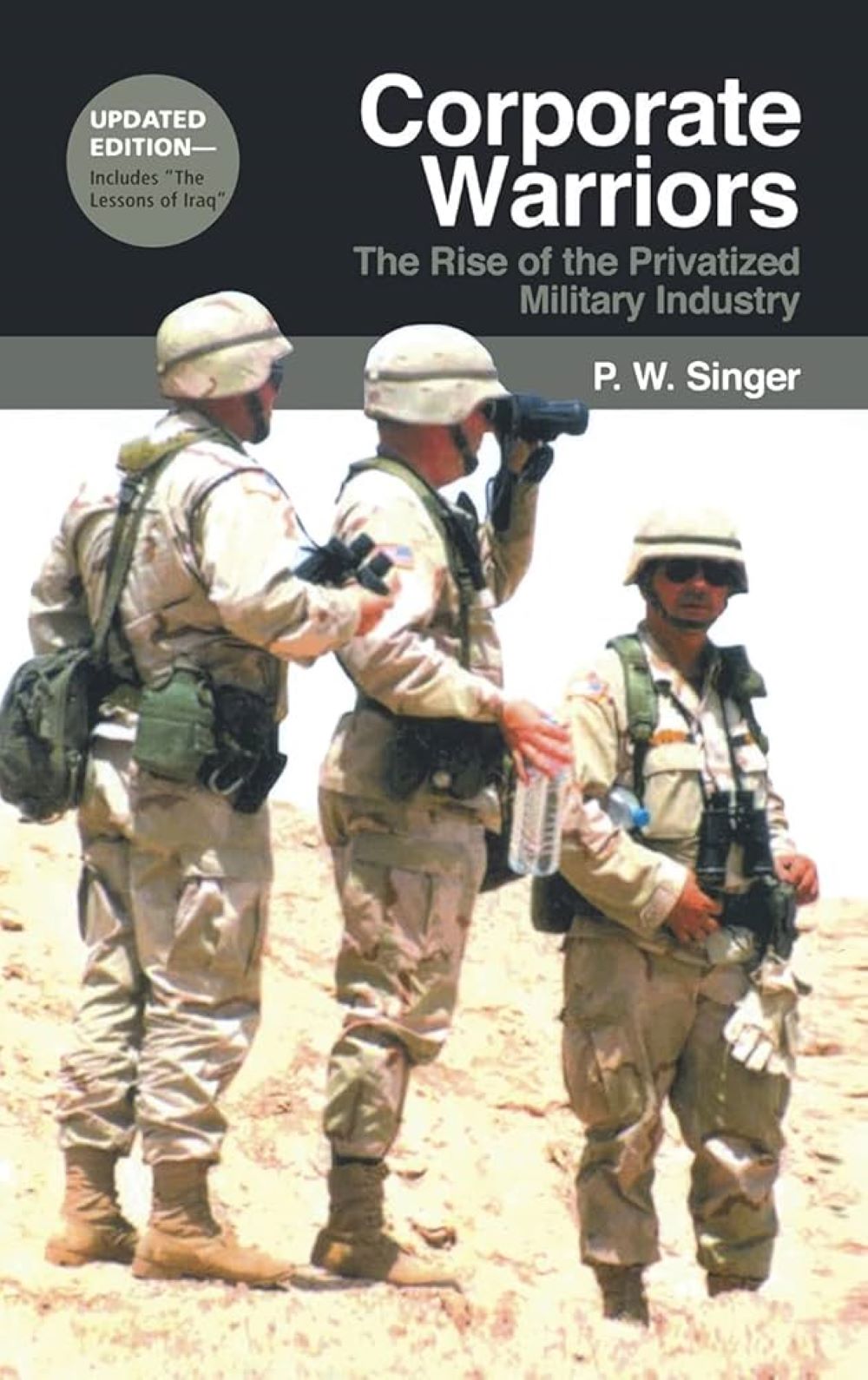
“The privatization of warfare allows startling new capabilities and efficiencies in the ways that war is carried out. At the same time, however, the entrance of the profit motive onto the battlefield raises a series of troubling questions—for democracy, for ethics, for law, for human rights, and for national security.” — P.W. Singer
P.W. Singer’s Corporate Warriors is one of the most important books about the rise of private military companies, or PMCs—businesses that sell military and security services for profit. Singer makes it clear that this is not a brand-new concept. As long as humans have fought wars, there have been soldiers willing to fight for whoever pays them. Ancient mercenaries fought for gold just as modern ones fight for governments, corporations, and even wealthy individuals. What makes today’s version different is how organized and professional these groups have become. They now look and operate like big international businesses, complete with CEOs, contracts, shareholders, and company logos.
Singer argues that these firms are now a permanent feature of modern warfare. Instead of ragtag mercenaries, many private contractors are highly trained professionals offering specialized skills that national militaries either can’t provide or don’t want to keep on the payroll full time. Governments and companies rely on them because they can move quickly, fill skill gaps, and handle dangerous or politically sensitive work. Still, that doesn’t mean they come without serious problems. Singer’s main concern is how much military power is now being handled by people who technically aren’t soldiers and don’t always fall under military law.
In the book, Singer sorts modern PMCs into three main categories. First are the “provider” companies like the South African firm Executive Outcomes, which became famous in the 1990s for fighting on the ground in places like Angola and Sierra Leone. These companies bring in their own troops, equipment, and training programs, often taking on direct combat roles. Next are “consulting” firms such as Military Professional Resources Inc. (MPRI), an American company that employs retired generals and officers to train and advise foreign militaries. The third kind includes “support” firms such as Halliburton’s subsidiary KBR, which focuses on logistics, food, construction, and base operations. These companies don’t fight but keep everything else running so that soldiers can focus on combat.
All three types share something in common: they are run like global corporations. They make money through contracts, report to shareholders, and market themselves as professional service providers. Singer notes that even major multinational companies now use PMCs for everything from executive protection to negotiations with risky foreign governments. Governments, especially the United States and its allies, also rely heavily on these firms to handle noncombat work—guarding bases, moving supplies, and securing reconstruction projects. This trend, according to Singer, represents a major shift in how warfare is organized.
The biggest concern is accountability. Private contractors don’t always fall under the same legal rules as soldiers. They operate in what Singer calls a “gray zone,” where war crimes or abuses can occur without clear consequences. One striking example came in 2004 when four American contractors working for Blackwater were ambushed and killed in Fallujah, Iraq. The brutal event shocked the public and revealed how central private contractors had become to America’s military presence there. Later incidents, like those involving private interrogators at Abu Ghraib and Guantanamo Bay, further blurred the lines between government responsibility and outsourced violence.
Singer’s warning is that handing so much military work to private companies risks separating war from national accountability. If a contractor commits a crime, who is responsible—the company, the client government, or the individual employee? When fighting becomes a business, the incentive to keep costs low and profits high can make ethics and oversight an afterthought.
Events since the book’s release have proven many of Singer’s points, especially the rise and collapse of Russia’s Wagner Group. Led by Yevgeny Prigozhin, Wagner became one of the most dangerous and talked-about private armies in the world. Unlike most Western firms, it operated under direct government influence while pretending to be independent. Wagner first gained attention during Russia’s 2014 invasion of Ukraine, then expanded into conflicts in Syria, Libya, and parts of Africa. The company didn’t just fight wars—it also ran businesses, gained control over mines, and seized energy resources. In short, it blended war and profit in a way that gave Russia global reach without official military involvement.
Wagner also showed how dangerous this model can be. Its fighters were accused of widespread brutality and war crimes, yet Russia could deny any official connection. And when Prigozhin turned against the Kremlin in mid-2023, leading a short-lived march toward Moscow, the illusion of control collapsed. His death later that year and the redistribution of Wagner’s forces into state-controlled units in 2024 revealed just how unstable such private armies can become. Wagner proved Singer’s central argument: once private forces gain real power, they can threaten not just world order but their own creators.
Other countries have followed this path with their own versions. In China, companies like Frontier Services Group protect overseas projects linked to the Belt and Road Initiative. In Turkey, SADAT provides training and advisory services aligned with the government’s foreign policy. The United Arab Emirates has hired foreign-led PMCs to conduct security operations in Yemen and parts of Africa. These cases show that many governments now use PMCs as unofficial extensions of their militaries and foreign policy tools—cheap, adaptable, and politically flexible.
However, while Singer’s analysis stands out for its clarity and early insight, it is not perfect. One issue is that he treats the rise of PMCs as almost inevitable, a natural result of globalization and free markets. In practice, their growth is far more dependent on political opportunity and state willpower than on market logic alone. Wagner’s collapse, for example, showed that governments can shut down or absorb these forces when they decide they’ve become too independent. Singer also tends to treat PMCs as private commercial actors, but many of today’s most influential groups operate as semi-official arms of the state rather than as free-market enterprises. That distinction matters because it changes how these organizations behave and how accountable they can realistically be.
Another problem is that Singer’s proposed solutions rely on greater regulation and international cooperation—goals that sound reasonable in theory but are difficult to achieve. International law struggles even to manage traditional militaries, so expecting it to control private ones that operate across borders is optimistic. Singer’s faith in future accountability mechanisms somewhat underestimates how fragmented and self-interested international politics can be.
Finally, Singer tends to focus mainly on Western examples, especially the U.S. and U.K., where the PMCs act as corporate service providers. In doing so, he underplays the different way non-Western states, especially Russia, China, and Middle Eastern powers, use them as political instruments rather than for profit. The world of PMCs today is not just about private enterprise—it’s about the blending of private business with government strategy.
Despite these weaknesses, Corporate Warriors remains a landmark work. Singer’s writing is clear, grounded, and unusually balanced for a topic that often invites conspiracy theories or alarmist rhetoric. He helps readers understand not just who these companies are, but how they fit into a global system where armies, corporations, and governments increasingly overlap.
More than twenty years on, the issues he described have only grown. PMCs still operate on nearly every major battlefield, from Eastern Europe to Africa. While governments continue to rely on them, meaningful oversight has not caught up. Even with its flaws, Corporate Warriors is still the best starting point for understanding how war became a global business, and why that shift will keep shaping world politics for decades to come.
 Through the Shattered Lens