Necrosomethingorother here, I’m going to be doing periodic album reviews for a while. My first one involves some rather controversial material, but hey, it’s what’s new in the metal world.
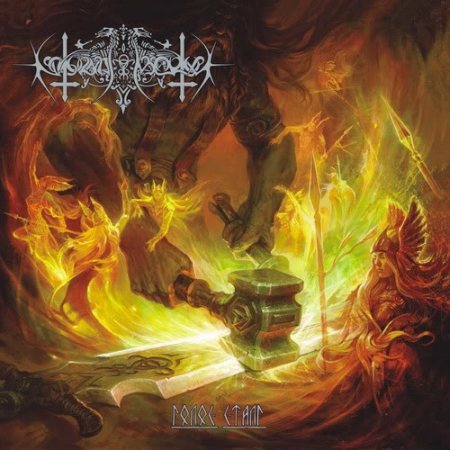
As I write I am acquainting myself with Nokturnal Mortum‘s sixth studio album, leaked Christmas day when I was too busy to notice. The Voice of Steel starts off where the Eastern Hammer EP ended, hurdy gurdies blazing in a mind-blowing intro, and then slowly transitions into some weird amalgamation of pagan nsbm and spacey Pink Floyd guitar solos. It’s still got some battlecry sopilka breakdowns of classic Nokturnal Mortum, the intense tribal drumming that first greeted us on To the Gates of Blasphemous Fire’s Cheremosh, the violin over epic synth that characterized Weltanschauung…
But it also has clean vocals and Pink Floyd guitar solos, and I’m just not sold on them yet. The Voice of Steel is in some ways amazing, in others irritating. It’s a decent album, no doubt about it, but it sure wasn’t what I was hoping for. Nothing would have made me happier than a whole album of the Eastern Hammer remake of Kolyada, and that The Voice of Steel is certainly not.
The album has some real gems, notably Shlyakhom Sontsya. It also has tracks like Moei Mrii Ostrovi that would fit in a lot better on an Amorphis album and just clash entirely with the group’s extremist views. They’re trying to mature musically, but they have to mature mentally first to really pull it off.
Extremism has produced some amazing music over the years. Wrath of the Tyrant, Det Som Engang Var, NeChrist, they all share in common a level of passionate convictions taken so far as murder, arson, or white supremacy. Obviously I don’t have to condone these acts to appreciate their origins, but the musicians have to come to terms with them eventually. Ihsahn seems to recognize his youthful escapades as a childish outlet for his anti-Christian views and now writes more mature music effectively. His album After, another new release, is pretty damn impressive. He can still frown on the Christian culture of servitude without letting it consume him and his innate musical talents. Meanwhile you’ve got Varg writing dissertations on the likelihood of Aryans being an advanced race from outerspace, and I have pretty low expectations of his forthcoming album.
I hear in Knjaz Varggoth’s new music a reflection of this Vargian state of depravity. Their old songs embodied folk, and they believed in it so thoroughly that they took on extremist views, but that was only the lyrical focus. NeChrist was packed with anthems to what the band barely understood, aggression married to mysticism, white supremacy only a catalyst. The aggressive desperation with which they summoned a bygone era made their music a mirror into the past. It was as though the songs they played were ancient melodies shouting, screaming to be heard once again over the clamor of modern rock by any means necessary. I can’t expect another masterpiece like NeChrist, maybe not even something as good as Weltanschauung, but a stylistic evolution means a mental one too, and I hear in songs that combine clean vocals and Gilmour guitars with cries for the motherland the path of Varg, not Ihsahn. It’s hard to appreciate music that’s neither passionate nor mature. The Voice of Steel is not culture triumphant, it’s more like a methodic racial manifesto. Come on Knjaz, either sustain your fire or light a new match, don’t slump into dogma.
For a far more heartfelt nsbm album, check out Temnozor’s 2010 offering, Haunted Dreamscapes.
 Through the Shattered Lens