If there is one artist I have consistently returned to every October for the 15 or so years that I’ve had a clue what I’m talking about, it’s Vratyas Vakyas. I first discovered Falkenbach via Audiogalaxy–a long forgotten site that stood out back in the Napster days for a design which allowed users to easily explore non-mainstream genres. I had never heard anything remotely similar to Falkenbach at the time, and I fell in love with the plodding hymns that seemed to turn black metal on its head and generate a spirit of reverence rather than darkness.
Of course, in hindsight Falkenbach fits into a broader historical progression, but his sound is still entirely unmistakable. Vratyas Vakyas was one of the earliest artists to really latch on to the ‘viking metal’ ideal that Bathory began in the late 80s, before too many stylistic norms were standardized, and the sound he landed on has never ceased to captivate me. “Heathen Foray” is the opening track to his fourth studio album, Heralding – The Fireblade (2005), and it also makes an appearance in somewhat grimmer form on his second album, …Magni blandinn ok megintiri… (1998). How far back the basic idea of the song dates is hard to say; there is a ton of earlier demo material available going as far back as 1989. I could have chosen any of dozens of stand-out songs to showcase here without any reservations, but this one has been speaking to me lately. Enjoy!
Part of the ‘appeal’ of the second wave of black metal as it manifested in Norway is the feeling that you are listening to a product of truly deranged minds. Granted most of the artists in the scene were fairly normal kids who matured and went on to enjoy long-term musical success, the genre’s focus on the occult, Satanism, and all things traditionally “evil” brought a few real wackos into the fold. Most of them wound up dead and behind bars. Gorgoroth pressed on.
This is a band that continues to project itself as dead-serious Satan-worshiping masochists long after their peers evolved away from the genre’s early image or else dropped sufficient hints to be recast as a sort of warm cuddly metal-spiked parody. Does their sound reflect this? I like to believe it does. “Procreating Satan” is the opening track to Twilight of the Idols, the band’s sixth studio album, released in 2003. It features the most notorious of the many vocalists the band has had over the years: Gaahl.
Lars Jensen has been working on his solo project, Myrkgrav, since 2003, but his discography is pretty brief. Trollskau, skrømt og kølabrenning (2006) is his only full-length album, and it’s a pretty solid entry into the annals of pagan metal. The album is a bit brooding overall, with a lot of slower tempo black metal-infused hymns, but the optimistic closing track has always stood out to me the most.
“Endetoner” feels like a victory anthem–a celebration of Norse history and tradition that honors those old gods who always seem to make a brief return to Midgard around this time of the year.
If I asked a random metal fan to name ten folk/viking metal bands, chances are they wouldn’t drop Sweden’s Månegarm among the contenders. It’s a bit odd, considering they’ve been around since 1995. But besides having a name that isn’t entirely easy to reproduce on a standard keyboard, there’s no reason to leave “Månegarm” off the list. Their ability to fly under the radar is something I don’t really understand; this band has definitely drawn less attention than they deserve over the years.
I am guilty to an extent, with nothing prior to Vargstenen–their 2007 release–in my collection, but I was still a little surprised to realize I had never featured this band before let alone this song. Following a brief intro track, “Ur själslig död” kicks off Vargstenen with epic bombast and a creative progression that avoids the easy temptation to repeat the track’s catchy main melody in excess. One thing that always stood out to me on this song was the vocals. Erik Grawsiö demonstrates a level of diversity I’m more accustomed to out of Slavic metal bands than their Germanic counterparts, and I absolutely love how he transitions back and forth between guttural singing and atonal growls. I couldn’t resist the urge to belt out a death metal roar of my own at the 40 second mark when I was listening to this in my car earlier today. So much for not scaring the new neighbors. <_<
Well, I started out this series featuring a couple of songs I’ve been enjoying for the better part of two decades. Here is one I discovered less than a week ago. It’s not too often that music successfully creeps me out these days, but I suppose I should have known I was in for a treat when Veilburner were described to me as a bad acid trip.
“Scorched Earth Exorcism” is a great example of this band’s unique, psychedelic mix of death and black metal. It’s some seriously twisted stuff, and nothing on the album better captures the deranged spirit of the season than the melody that takes over this song around the 4 minute mark. I’ve been watching AMC’s The Walking Dead marathon over the past few days, and I seriously had a dream about hunting zombies with this screwed up tune playing in the background. It was disturbing and awesome.
Throughout the 2000s, Agalloch unleashed a series of albums that have influenced countless bands across the metal spectrum. Not only did Ashes Against the Grain (2006) play an enormous role in ushering in the era of post-black metal, but Pale Folklore (1999) pioneered the folk metal aesthetic for a nation whose traditional genres stood leagues apart from the metal scene. (It would be another decade before Austin Lunn nailed a metal interpritation of bluegrass.) Most American folk metal bands carry Agalloch’s stamp of influence with them, and why not? Pale Folklore perfectly captures a sense of melancholy mystery that reflects a land whose native sons were slaughtered, leaving their secrets only a faint whisper in the air.
If there’s one thing that will draw me back out of obscurity no matter how much work I’m bogged down with, it’s Horror season here on Shattered Lens. As a de facto film blog’s one author who pretty much never watches movies, I like to do my part by digging out a mix of tunes appropriate for the season.
This is always the time of year when I stop focusing on new releases and revisit a lot of my metal and folk favorites of old. From b-side Satanic cheese to authentic pagan anthems to the truly deranged, all the music I love most seems to find a home when that oppressive summer sun gives way to pleasant temperatures and dimming lights. It’s my favorite time of year, and my music collection rises to the occasion.
Opeth is pretty common fair in the textbooks of heavy metal these days, but Mikael Akerfeldt’s finest works came before the fame, in my opinion. Their 1995 debut, Orchid, ranks highest for me. While Akerfeldt’s trademark progressive rock experimentation was present from the get-go, those early albums had a sort of hollow, natural tone to them that lent the band a distinctly folk vibe. Orchid (and Morningrise) seem to drift through the crisp, foggy air surrounding a lake on the edge of a forest, the sun just beginning to rise over the horizon. I don’t wake up early when I can help it, but if a morning commute is necessary, Opeth always sees a spike in my play count. The vision that songs like “The Twilight is My Robe” paint is stunningly vivid, and surprisingly peaceful in contrast to Akerfeldt’s harsh vocals.
A part of me feels totally out of my comfort zone reviewing Marduk, but I keep coming back to the band over the years in spite of it. The classic Swedish style of black metal, as popularized by bands like Dark Funeral, Naglfar, and of course Marduk, never managed to appeal to me much. It was all about this relentless brutality–an aesthetic not far removed from death metal–when I was turning to black metal for its occult appeal. It was Satan as a cold-hearted masochist, but I wanted to legitimize Catholic blood libel. Live dissection vs goat sodomy. That’s pretty clear, no?
But, aside from the fact that they were just better at it than everyone else, Marduk initially stood out to me for their song titles and lyrics. “Christraping Black Metal”, “Fistfucking God’s Planet”, “Jesus Christ… Sodomized”, this stuff was priceless. I think when I viewed it as a comedy I could get into the over-the-top, machine gun-paced blast beats as something delightfully ridiculous.
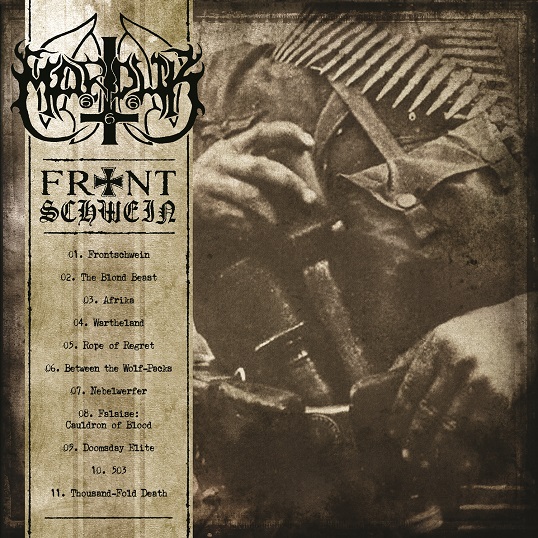
That sort of entertainment value can’t hold out forever, and it was ultimately Marduk’s shift towards martial themes that kept me attentive. They did it on Panzer Division Marduk in 1999, and they’ve turned to it again with the Iron Dawn EP in 2011 and now Frontschwein. If there is any one thing that this style of music captures effectively, it is 20th century warfare.
song: Frontschwein
Marduk capture the violent chaos of war on a level I have only heard rivaled by Germany’s Endstille, and while modern themes do not permeate all of their albums, they stand at the center on Frontschwein. The album recounts events in World War II from the perspective of Germany as a bloodthirsty machine reveling in cold destruction behind its thin veil of justifications. The connection is not merely lyrical, though Mortuus’ vocals are surprisingly discernible, allowing bits and pieces of war imagery to seep into your head unaided by a lyrics sheet; you can hear to conflict in the music: sliding guitars as falling bombs, blast beats as bullets. It’s methodical, rhythmic, and relentless, in contrast to the more eclectic approach the band has taken on Satanic-themed albums like Serpent Sermon. It is Marduk as I like them best.
That being said, it does feel repetitive at times. This style always does, to me at least, and I feel like Marduk relegated their less interesting songs to the middle, bookending the best of them. “Frontschwein” is followed by the incredibly catchy headbanging march of “The Blond Beast”, and Mortuus’ constant screaming of “Afrika” in the song of the same name forces your mind to picture a bloody desert battle between Rommel and Patton’s grunts. “Wartheland”‘s slow pummel with distinct lyrics like “succumb to domination” feels like an endless wave of Nazi forces marching in to conquest and occupation. The track titles in general go a long way towards steering the music towards its intended imagery. (I absolutely love the album title. I don’t know if it’s a common word or one of the band’s own crafting, but it certainly projects the overarching subject matter: humans as bloody fodder in an unstoppable military machine.)
But by “Rope of Regret”, my ears grow a bit numb to the pummeling. I enjoy the song when I listen to it in isolation, but I rarely can remain attentive long enough to reach it if I’m listening to the album as a whole. The next four tracks, all fairly typical in style, fade together for me whatever their individual worth. “503” is ultimately the song that draws me back in. A song of conquest, it drastically slows down the pace, listing in a dominant voice the conquests of the 503rd Heavy Panzer Battalion. It makes me snap back from my zoned-out state and again picture the album as a vision of German brutality in World War II rather than a jumble of noise. The song is well-placed, because it leads the way into “Thousand-Fold Death”.
song: Thousand-Fold Death
And “Thousand-Fold Death”… holy shit, this song alone is worth buying Frontschwein for. It’s got the best guitar licks on the album, but this song is all about Mortuus. He does things with his voice on this track that will give you motion sickness. It’s not just the sheer quantity of words per second he manages to belt out–his clarity while doing it is unbelievable. If I ever doubted that Mortuus was an incredible vocalist before this song, I certainly don’t now. The album ends with “Warschau III Necropolis”, an eerie, ambient mix of samples from militant speeches and battles, brass, and bizarrely distorted spoken words that manages to capture the grim nature of the album through a totally different means.
There is a reason why I have listened to Marduk more than any other band that plays that brutality-driven Swedish varient of black metal, and Frontschwein captures what I like about them best. I am a bit hesitant to say that I like it more than Endstille’s Infektion 1813, but those two albums definitely stand leagues above anything else I have heard in a genre of metal that, I’ll admit, I seldom find to be very creative or inspiring.
Korpiklaani have been pretty heavily criticized over the years for what has been perceived as a highly “gimmicky” sound. That view has a faint shred of legitimacy, but it gets blown way out of proportion. With bands like Alestorm and Nekrogoblikon managing to pump out really impressive albums without the slightest hint that they take any of their music seriously, it is easy to falsely impose on the genre a spectrum ranging from hoax to serious. You’re either writing brutal pagan metal homages to Odin or you’re dressing up as a mutant snork and dancing a jig, right?
It doesn’t really work like that. Bands like Kalevala (Калевала) and Troll Bends Fir (Тролль Гнёт Ель) can come off as fun-loving boozers, but you can’t escape the impression that they have a deep respect for their cultural heritage. Finntroll sing about dim-witted fantasy monsters eating people, and they’re heavy as hell. Being light-hearted and fun certainly does not make a folk metal band “gimmicky”, as if all folk traditions are inherently morbid. Doing it for nine albums without showing much inclination towards anything but fun and relegating your only English language songs to tantrums about not having enough beer–well, that can tarnish an image. I do understand why people might see Korpiklaani as a having a one-track mind.
But it really shouldn’t, and they really don’t. Not if sounding the same means maintaining the quality that turned people to them in the first place while honing their musical talents along the way. Not when for every track devoid of lyrical content the listener writes off eight others as the same because they don’t speak Finnish. Korpiklaani were very well received when they first appeared with Spirit of the Forest back in 2003. Folk metal was still fairly new then, and Jonne Järvelä was a frontrunner, not a bandwagoner. He had contributed to Finntroll’s Jaktens Tid in 2001, and prior to changing his band’s name to Korpiklaani he had released folk metal under the monicker “Shaman” beginning in 1999. He was recording non-metal Finnish folk music earlier than that. As folk metal picked up steam, Korpiklaani’s pop-centric, lighter brand–characterized by very simplistic metal riffs underscoring catchy yolk vocals, accordion, violin, and an occasional whistle–came under fire. Why?
That’s an open question. I really don’t get it. My best guess is that people experienced Spirit of the Forest and Voice of Wilderness when folk metal was still a novelty. They didn’t really love the band; they just loved the direction that metal was heading in, and Korpiklaani were a prominent example of that. As the scene broadened and more variety became available, some people were quick to throw Korpiklaani under the bus because the band’s pop tendencies made them feel a little insecure in their metal manliness. Korven Kuningas (2008), Karkelo (2009), and Ukon Wacka (2011) got a lot of negative reviews. But to me, the band just kept getting better. Spirit of the Forest gave us “Pellonpeikko”, and “Wooden Pints” is certainly nostalgic, but the album had a lot of half-formed filler tracks too. It has all the feel of an early, less developed work in a band’s discography. They really started to nail the folk on Voice of Wilderness in 2005, and Jonne Järvelä’s distinctive yolk-style vocals–the band’s most unique traditional feature–really didn’t fully mature until Tales Along This Road (2006) and Tervaskanto (2007). Their next three albums took all the heat, but they were only guilty of not offering further development. They didn’t really need to. The band was in their prime.
Manala (2012) was the first and only Korpiklaani album that I had misgivings about. It was distinctly heavier, with folk instrumentation feeling subservient to metal guitar riffs rather than the other way around. For that, it actually got some positive feedback. Korpiklaani were abandoning that “folk gimmick” and getting back to their “metal roots”, or some nonsense like that, as if the band even had metal roots. My speculation was, I think, a bit more realistic: Long-tenured violinist Jaakko “Hittavainen” Lemmetty retired after Ukon Wacka. Short of digging the jewel case out from my basement, I can’t even find a clear answer as to who played violin when Manala was recorded in 2011. Teemu Eerola replaced Hittavainen on tour that year, and Tuomas Rounakari stepped in as the band’s permanent violinist shortly after. I have to believe that there is a direct correlation between Manala‘s lack of a strong folk component and the transitional state of the band’s lineup at the time.
Korpiklaani did not record another album for three years. That’s a long stretch by their standards, and in the meantime Juho Kauppinen, their accordionist since Tales Along This Road, left as well. Was the band doomed to drift ever further from their unique poppy folk sound into the cesspool of generic derivative heavy metal?
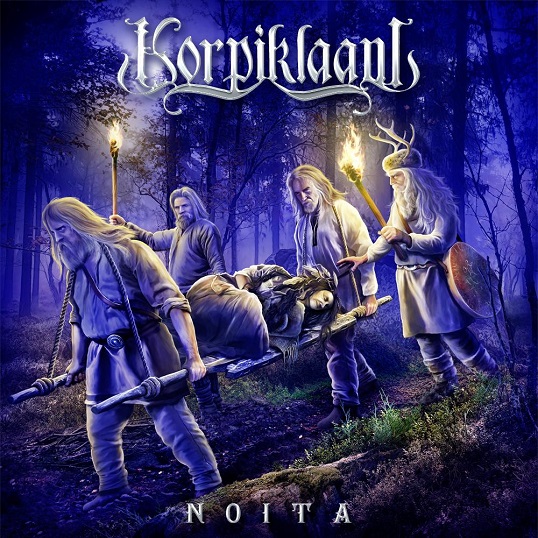
Not at all, as it turns out. Noita sounds strikingly successive, but in a way that works wonderfully. It takes Manala and drives it back into where the folk left off on Ukon Wacka. The first track, “Viinamäen Mies”, opens powerfully with a driving violin and a nice accordion accompaniment. Where the folk drifts out, the passages are brief enough to feel like a showcase of Jonne Järvelä’s vocals rather than a void in the content. The song is a total return to Korpiklaani’s poppy folk roots, and that feeling persists through the first two tracks.
Track: Lempo
The third song, “Lempo”, slows down the pace and stretches things out in a turn that is, for them at least, a bit on the heavy side. Unlike Manala though, the guitar is hardly alone in giving it an edge. The vocals are great, as always, and the folk instrumentation blends in and out of playing harmony to the plodding verses and busting out solos in really fluid form.
The rest of the album is a mix of these two approaches, and it is surprisingly the latter that comes out strongest. “Sahti” and “Luontoni” give us two more upbeat, fun songs that don’t feel remotely contrived, and then the album slows back down for the long haul. The violin on “Minä Näin Vedessä Neidon” is about as heavy metal as that instrument gets, and I was especially impressed on the closing track–“Sen Verran Minäkin Noita”–by how Tuomas Rounakari and Sami Perttula seem to have mastered improvisation over long, drawn out metal chords. Moreover, the rhythms on that song are way more diverse than we’re used to from Korpiklaani, tipping a hat to prog and viking metal. It’s one of the few songs in their catalog that don’t follow a standard verse-chorus-verse pattern. I can’t help but think “this is way too awesome to be Korpiklaani” when I listen to it. And I’m one of the people that never lost faith in the band.
It’s hard to imagine, listening to Noita, that Sami Perttula and Tuomas Rounakari were new to this band. Perttula totally gets their sound, and he brings a fiery spirit that wants to imbue anything and everything with rambling accordion harmonies. Rounakari offers much the same on violin, and also a great deal of thoughtfulness. In an English-language interview released by Nuclear Blast to promote the album, he explains each song quite articulately. He even points out cultural relevance in “Sahti”, a song that turns out to be about (surprise!) drinking. (It’s kind of funny, because Järvelä and Perttula’s bad English cater to every negative stereotype surrounding them. I write this song because I like get drunk!) If you didn’t know any better, you would think Korpiklaani had been Rounakari’s baby all along. Hittavainen was a hard man to replace, but I’m not complaining about who they found.
The album does have one very unfortunate, glaring flaw, and it’s called “Jouni Jouni”. “Jouni Jouni” is a cover of Billy Idol’s cover of Tommy James and the Shondells’ mind-numbingly stupid hit classic “Mony Mony”, and it appears right smack in the middle of the damn album. You know what makes even less sense? Noita has a “hidden” bonus track, “Antaja”, and that song sounds totally normal. Instead of putting “Antaja” in the main mix and relegating “Jouni Jouni” to the end of the line after a few minutes silence (or better yet, deleting all record of its existence), they cram it smack in the middle between “Minä Näin Vedessä Neidon” and “Kylästä Keväinen Kehto”. Bad Korpiklaani! Bad!
(Nuclear Blast is being a bit douchey about youtube samples, but if you want to check out some of the better tracks before you buy and can find them, I recommend “Kylästä Keväinen Kehto” and “Sen Verran Minäkin Noita”.)
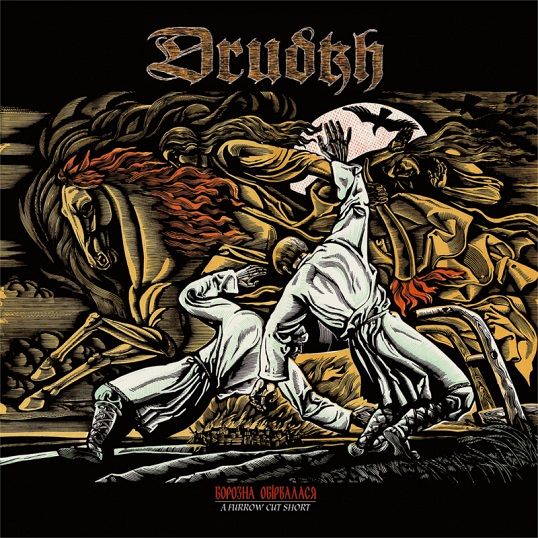
When I fired up Drudkh’s tenth studio album yesterday, A Furrow Cut Short, I was holding my breath in the dim hope that something awesome would slam into my brain from the get-go. After all, this is Drudkh. Not all of their releases have been met with equal acclaim, but they always seem to carry hype on their side.
The album began interestingly enough, with some bending tremolo guitar that kind of brought to mind Blut Aus Nord, and then I waited a bit and moved the play bar ahead. A pretty cool groove picked up around 1:50, and I rode it for a while. The song began to repeat an earlier passage with vocals tossed into the mix, and I moved the play bar ahead. There was that groove from 1:50 again. I rode it. I moved the bar ahead…
Greatness did not grace my ears in a neatly wrapped box, and that was fine. It was just a distant hope. At that point, my immediate instinct was to browse through the sixty minutes of content for all of the gripping moments that would surely rise out of the long black metal grind to knock my head around. A few came. Should I count them? Was that how best to measure this album’s worth? I started to feel a bit silly. This sort of fast-forward treasure hunt has been my subconscious approach to Drudkh for some time now. Here was a band that used to keep me wide-eyed through ten minute tracks as I waited for the peaks to overwhelm me, and over the course of ten albums the appeal had been reduced to skimming. What changed?
The production changed. That’s for certain. Since Microcosmos, Drudkh have been presenting a more deep and refined sound, and I don’t think it did them any favors. It was a technical improvement at the expense of the unique aesthetic appeal of their sound. They also largely left the world of folk music behind. On Songs of Grief and Solitude (2006), Drudkh reworked a variety of earlier melodies from their metal albums into a collection of instrumental folk tracks. It worked really well, and it’s something they would never be able to do with the tunes of Eternal Turn of the Wheel or A Furrow Cut Short.
Song: Cursed Sons I
<@Shad> One day
<@Shad> I will tell my children
<@Shad> That I started the Drudkh wikipedia page.
And there has been one other change. It’s something far beyond the band’s control, but it is significant: historical context. This first dawned on me when I was glancing over the reviews of A Furrow Cut Short already popping up on Encyclopaedia Metallum. One guy started off by writing “Ukraine is not a country where heavy metal thrives like in the UK or Scandinavia”. I stumbled over the words. I suppose fifteen years is a long time when you’re talking music. There are high school kids enjoying A Furrow Cut Short who weren’t born yet when Kharkiv was carving out its claim on the map of metal. That’s a little… weird for me, but it probably has a real impact on how I perceive this music too.
I will never really appreciate thrash metal, because I was never there. I encountered the genre as a prim and proper, cookie-cutter devolution of its original glory. I lacked the contextual sense that something new and monumental was overriding the standards of metal as I’d formerly known them. To me, thrash is just that sound Metallica pioneered, and I have no doubt that this perspective is woefully misguided. This same sort of historical misconception might be taking root on Ukrainian black metal. The reviewer I quoted… his statement would have been a reasonable introduction to Lunar Poetry or Goat Horns in the mid-90s, but by the time Drudkh started to gain attention, Kharkiv was no heavy metal backwater. It was a placename that you gobbled up. “Ukrainian” meant there was no need to sample an album first. You knew you wanted to hear it.
Nokturnal Mortum put Kharkiv on the map, and Knjaz Varggoth’s brainchild still stands leagues above anything else east of Prussia in my book. But Knjaz is also a racist piece of shit, and I can’t say I feel bad that the history books have been rewritten to regard Drudkh as the mother of all Ukrainian black metal. Still, we can’t forget the pre-existing spirit in which this band emerged. Standardized black metal was all about LaVeyan Satanism back then, its music a sort of declaration against society’s disposition to enforce religious values. “Satan” was a shallow facade, and once the point was made, the scene stagnated. Nokturnal Mortum ignited something novel by merging second-wave black metal’s counter-cultural rage with a sort of Bathory-esque true reverence for the old gods. Their music was as hateful as anything Mayhem or Emperor had produced, but it was also rabidly pagan. NeChrist slaughtered the tenets of modern society, smeared their blood across its chest, and danced naked on the pyre.
And that, to me at least, was the spirit of Ukrainian black metal entering the 21st century. It was not merely violent and destructive, but also highly contemplative. The means varied from band to band, but the idea was to bring a bygone spirituality to life. Musically, the tremolo and blast beats found themselves in the company of massive, sweeping auras of sound that might at any minute break into traditional melodies more savage and tribal than anything the co-emerging folk metal scene had to offer. Astrofaes and Hate Forest were two of the earliest bands to emerge from Kharkiv in this new tradition. Astrofaes, headed by Thurios, was the more melodic of the two, with forlorn chord progressions and folk allusions comparable to early Drudkh. Hate Forest, on the other hand, remains one of the most brutal bands I’ve ever heard. It was Thurios’ original collaboration with Roman Saenko, and it was so uncompromisingly violent and minimalistic that it made the most hellish Norwegian offerings feel tame. Yet it was entirely meditative. If Varg Vikernes popularized the notion of black metal as a trance-inducing journey, Hate Forest went leaps and bounds towards perfecting it.
When Thurios and Saenko went on to form Drudkh, the product was more tame than either of their parent projects. Thurios brought the folk and raw melody-crafting via Astrofaes, while Saenko added the trance state and fine touch for aesthetics. At least, that’s how I’ve interpreted it. I certainly can’t offer any informed view into their song-writing process. In any case, what they crafted, not so much on Forgotten Legends but definitely on Autumn Aurora, The Swan Road, and Blood in Our Wells, was totally unique and beautiful. But it did not feel unique to perhaps the extent that it really was. It felt like a brilliant addition to a scene that entailed so much more. (In more than one sense, and not all positive. I am sure the reviewer I mentioned must find it bizarre that almost every summary of Drudkh begins with a preface that they disavow all ties to racism/extremist ideologies.)
Song: To the Epoch of Unbowed Poets
I take two things from this. One is that Drudkh’s earlier sounds float on a cloud of nostalgia. An album that sounded a hell of a lot like Autumn Aurora would really excite me even if it was not half as good, because it would transport me back to a special place and time. The other is that a once unprecedented sound has become pretty common fair. Atmospheric black metal was not invented in Ukraine, but its modern roots run deep there. A lot of bands around the world have since come along and done more with it. They’ve taken it other places–incorporated it into other, equally novel sounds. Saor is a good recent example. In heaping praise on Andy Marshall’s solo project last year, I passively mentioned that it accomplishes its goal “without ever really breaching any new territory beyond the tried and true boundaries of pagan metal”. Well, Drudkh and the Ukrainian scene in general established a lot of those boundaries. And other bands took it further still, to the point where I could speak of an album like Aura without ever thinking “wow, this is original”.
A Furrow Cut Short has some really stand-out tracks. The two I sampled here especially struck me. But it is also lost in time. Changes to production and an abandonment of folk render the modern Drudkh incapable of reaching to the same plain of aesthetics that they once knew. I don’t think it incorporates anything new, either, that might allow me to hear it as a great example of where metal stands today. This album must stand or fall exclusively on its in-born aesthetic value, while competing with the vibe that it is a watered down version of what the band used to be.
That value is, well, average. You can get into the album if you try, but it will not sweep you off your feet. I am not one of these people who cling to the past and expect a band or style to sound exactly like it used to. I am always willing to humor “where are they headed now”, and I have a good deal of respect for what Drudkh did on Handful of Stars even if it didn’t much move me (or seemingly anybody else). At least they were trying to do something. Even Eternal Turn of the Wheel showed motion. A shying away from change, but motion at least, and I modestly enjoyed it for that. A Furrow Cut Short goes nowhere, and that fact drives home the feeling that this band’s sound has grown really stale.
I am a bit torn about A Furrow Cut Short. A part of me thinks “why did they bother?”, but a wiser side enjoys tracks like “Cursed Sons I” and “To the Epoch of Unbowed Poets” way too much to pretend I’d be better off without them. Still, I’m probably never going to listen to this album again. Maybe a quick revisit at the end of the year. There are just too many other bands doing something more original. And too many classics I’d rather rehash, for that matter. It’s strange, because Thurios, Saenko, and the rest of the crew haven’t lost their touch at all. They are doing great things with Blood of Kingu, and Dark Star on the Right Horn of the Crescent Moon would have definitely made my top albums list for 2014 if I had caught it in time. But considering every single member of Drudkh is in that band, I don’t get why Drudkh continue to sound so… redundant.
 Through the Shattered Lens