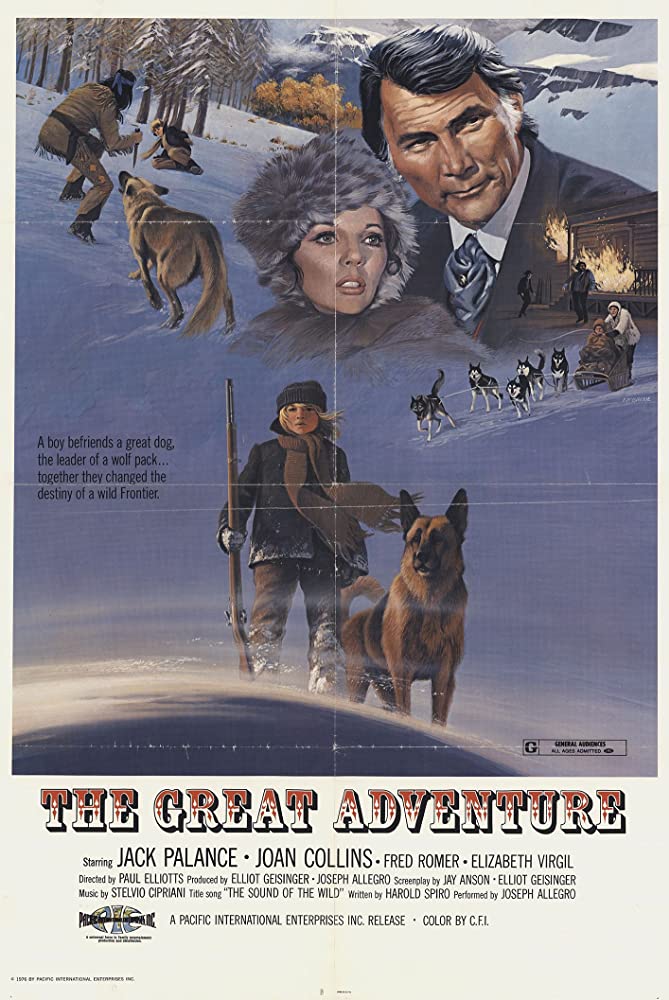
The Great Adventure (1975, directed by Gianfranco Baldanello)


During the Gold Rush, a young boy named Jim Chambers (Fernando E. Romero) rescues a German shepherd from a bear trap.  Jim’s father doesn’t want Jim to adopt the dog but then he gets killed by Indians so what is he going to do about it?  Traveling with two trappers who are also brothers (played by Manuel de Blas and Remo De Angelis), Jim, his sister, Mary (Elisabetta Virgili), and the dog move to the nearby town of Dawson City.

Jim and Mary want to take over the town’s newspaper, which was originally founded by their family.  However, both the newspaper and the town have been taken over by an evil gambler named William Bates (Jack Palance).  Bates may be willing to let the children run the paper but only if they allow him to take their dog.  Meanwhile, one of the trappers falls in love with the local saloon keeper, Sonia Kendall (Joan Collins).

Though The Great Adventure is set in Alaska and tells a typical Western story, it’s an Italian film through-and-through.  Jack Palance and Joan Collins may be top-billed but the movie itself is dominated by actors speaking in poorly dubbed English.  This was one of several films based on White Fang that was released in the 70s and, like many of them, it’s an uneasy hybrid of a treacly family film and a violent western.  On the one hand, it’s a film about two children and their dog trying to publish a newspaper and, on the other hand, Jack Palance kills people in cold blood.  The film is so badly edited to be almost impossible to follow but I’m an unapologetic Jack Palance fan and I almost always enjoy any film that lets Palance do his thing.  Unfortunately, The Great Adventure didn’t have as much Palance as I was expecting and Joan Collins is beautiful but hampered by the film’s G-rating.  (For an actress who was affectionately nicknamed The Great British Open, Collins is always a strange presence in a family film.)  At least the dog was a good actor.  He eventually abandons his newfound family so that he can rejoin a wild dog pack in the wilderness and he probably made the right decision.  He looks very happy at the end of the movie.

The TSL’s Daily Horror Grindhouse: The Ghost Galleon (dir by Amando de Ossorio)


gg

The Blind Dead are back and this time, they’re on a boat!

Yes, you read that correctly.  1974’s The Ghost Galleon is the third film in Spanish director Amando de Ossorio’s Blind Dead series.  The decaying and blind Knight Templar are back and they’re just as evil and blood thirsty as they were in both Tombs of the Blind Dead and Return of the Evil Dead.  However, this time, they’re on a boat.  What are they doing on a boat?  Apparently, they’re guarding some sort of Satanic treasure chest and they’re killing and eating anyone who makes the mistake of boarding their boat.

That means that this is the first Blind Dead film to not feature any scenes of the Blind Dead riding their horses in slow motion.  That may not sounds like much but the absence of those horses is definitely felt.  The Blind Dead on horses are a metaphor for everything from political tyranny to religious oppression.  The Blind Dead on a boat are still scary but now they’re also vaguely silly.

And yet, the Blind Dead on a boat is not the silliest part of the film!  The Ghost Galleon starts out with two models lost at sea.  Apparently, they were hired by a businessman and aspiring politician named (in the version released in America, anyway) Howard Tucker (Jack Taylor).  Howard is a boat manufacturer and he felt it would be great publicity if the models took one of his boats out into the ocean and pretended to get stranded.  Apparently, Howard felt that this would convince the public that they could live for weeks in one of his speedboats if they needed to…

No, I’m not making that up.  That’s the plot of the damn film.

ANYWAY — the models get stranded for real but suddenly, here comes a big, dark, old timey galleon.  It’s just floating out in the middle of the ocean and it appears to be surrounded by a very thick fog.  Naturally, the models decide to leave their boat for the galleon because why stay somewhere vaguely safe when you can get on a big, scary, evil looking galleon?

Now the models are missing and Howard needs to get his boat back.  So, he and his evil henchman get yet another model to sail out to the middle of the ocean with them.  Also accompanying them is a historian/scientist guy, who is mostly there because the film will later need him to fill in the backstory of the Blind Dead…

Now, I know that it probably sounds like I’m being supercritical of the third Blind Dead film but actually, it kind of works.  The key is not to worry about logic, consistency, or anything you learned about at that screenwriting workshop.  Instead, simply accept The Ghost Galleon as being the equivalent of a filmed nightmare.  For everything that the film lacks in logic, it makes up for in atmosphere.  (Let’s just say that the fog machine gets quite a workout.)  And while it may not make much sense for them to be on a boat, the Blind Dead are just as scary, evil, and merciless as ever.

Add to that, the film has a great ending.  I won’t spoil it here but I will say that the film’s final shot makes up for a lot of what you have to sit through in order to reach it.

The Ghost Galleon should not be the first Blind Dead film that you see.  (Unfortunately, it can be found in several ultra cheap box sets, complete with a bad transfer and spotty soundtrack.)  But if you’ve seen Tombs of the Blind Dead and Return of the Evil Dead, you should also see The Ghost Galleon.  If nothing else, it proves the de Ossorio could get results with even the most ludicrous of premises.