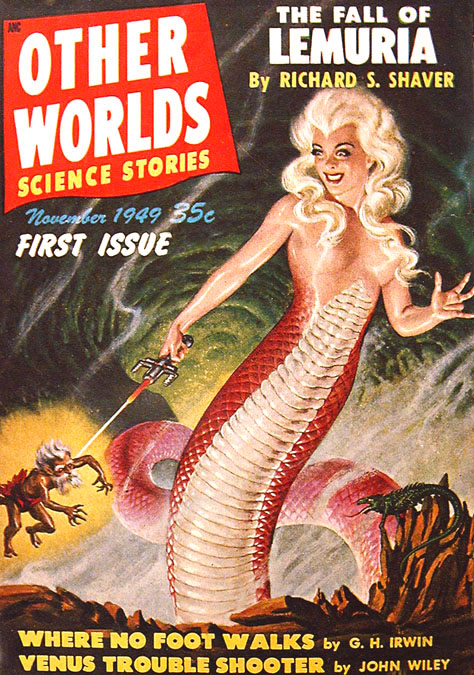
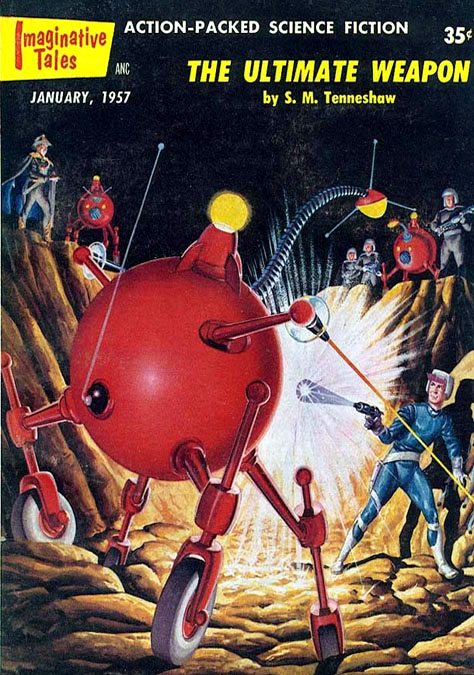
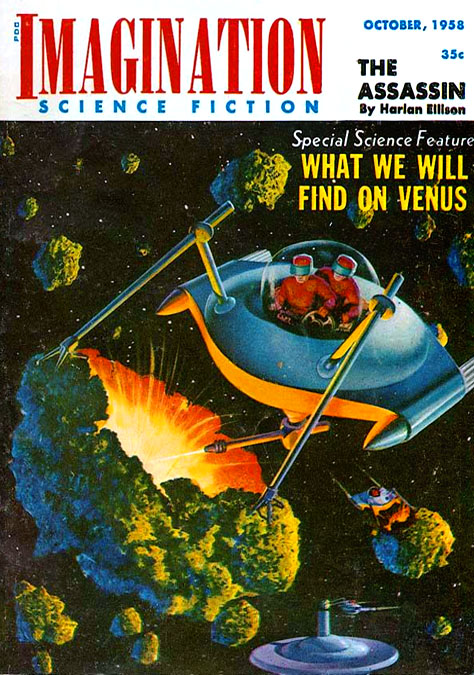
I think this cover speaks for itself. The artwork was done by Malcolm H. Smith, whose work appeared on the covers of several pulp magazines. Eventually, he left the pulps and was hired to work as an illustrator for NASA, where he helped engineers turn science fiction into reality.
The story highlighted on the cover, The Fall of Lemuria, was written by Richard Shaver, an author who claimed that all of his stories were based in fact. He wrote that there was a sinister civilization living underneath the Earth’s surface and that it had developed advanced technology. Shaver said that he had first discovered the civilization when, while working on an assembly line, he picked up a welding gun that allowed him to hear the thoughts of others and eventually to hear the conversations of people living underground. Shaver said that he had visited “the cavern world” many times. He wrote many stories about these people living underground, the majority of which were published in Amazing Stories.
There were many people who believed Shaver and who wrote letters to his publishers saying that they also heard voices coming from underground. Others thought that Shaver was suffering from schizophrenia and claimed that he was being exploited by the editors who published his stories and promoted them as being fact. When the pulp era ended, Shaver faded into obscurity, though he and his wife continued to publish a magazine about his theories, Shaver Mystery Magazine.





 Through the Shattered Lens